Showing 161–180 of 434
-
Carbon Dioxide (CO₂) as Feedstock for Chemicals, Advanced Fuels, Polymers, Proteins and Minerals – Short Version (PDF)
Markets & Economy, Technology
18 Pages
1036 Downloads
1036 Downloads
2023-04
FREE
1036
DownloadsNew report on the use of CO₂ for chemicals, advanced fuels, polymers, proteins and minerals by nova-Institute – A deep and comprehensive insight into the evolving technologies, trends and the dynamically growing market of CO₂ transformation and utilisation.
Several successfully implemented technologies are now in commercial use, and many more are at the laboratory and pilot stage. A current total production capacity of novel CO₂-based products of about 1.3 Mt/a in 2022 is observed. The production capacity in 2022 is dominated by the production of CO₂-based aromatic polycarbonates, ethanol from captured CO/CO₂, aliphatic polycarbonate and methanol. By 2030, the capacity outlook for CO₂-based products is expected to exceed 6 Mt/a of CO₂-based products. High dynamic growth is observed for methanol projects, methane plants, ethanol and hydrocarbons – the latter especially for the aviation sector. The potential of CCU has been recognised by several global brands which are already expanding their feedstock portfolio. However, in Europe, investments and prospects for CO₂ utilisation are largely undermined by a lack of political support. In contrast, we see supportive policies in China as well as in the US with the Inflation Reduction Act. Such smart policies are needed to bridge the gap between now and 2050 for companies to remain competitive in the sustainable transformation.nova-Institute’s new report examines this renewable carbon source in detail: Which products can be made from CO₂, and by which processes? To which extend have the technologies already been developed and implemented in pilot, demonstration and commercial plants? Which companies are working on technologies to uses CO₂ as a feedstock? What are the trends in CO₂ utilisation in the coming years?
This report addresses the fuel, chemical and materials industries, brands, technology scouts, investors, and policy makers. The report provides 240 pages of information on CO₂ utilisation. All the 116 companies mentioned are described in detailed profiles.
-
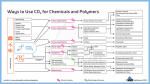
Ways to Use CO₂ for Chemicals and Polymers – Graphic (PNG)
Markets & Economy, Technology
1 Page
1124 Downloads
1124 Downloads
2023-04
FREE
Plus 19% MwSt.1124
Downloads -
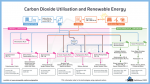
Carbon Dioxide Utilisation and Renewable Energy − Graphic (PNG)
Markets & Economy, Technology
1 Page
1544 Downloads
1544 Downloads
2023-04
FREE
1544
Downloads -
Cellulose Fibres Conference 2023 (Proceedings, PDF)
Markets & Economy, Policy, Sustainability & Health, Technology
87 Downloads
87 Downloads
2023-03
FREE
Plus 19% MwSt.87
DownloadsThe unique conference focused on cellulose fibres – in textiles, hygiene products and packaging!
The Cellulose Fibres 2023 Conference Proceedings (https://cellulose-fibres.eu, 8-9 March 2023, Cologne, hybrid) include all released conference presentations, the conference journal, sponsor documents, a Fiber2Fashion Knowledgepaper and the conference press release.
-
nova-Session: “Bio- and CO₂-based Polymers: Production, Trends 2022-2027 and the latest Policy Developments” (Proceedings, PDF)
Markets & Economy, Policy, Sustainability & Health, Technology
2023-03
50 € ex. tax
Plus 19% MwSt.Add to
cartThe download of the proceedings contains all six presentations of the nova-Session (March 2023).
Bio-based and CO2-based Solutions – Where are we heading?
The only way for chemicals and plastics to become sustainable, climate-friendly and part of the circular economy is the complete substitution of fossil carbon with renewable carbon from alternative sources: biomass, CO2 and recycling. We see strong investment in all three sectors, with growth rates far exceeding that of fossil polymers – i.e. fossil polymers are being substituted in the market.
The session will focus on developments in bio- and CO2-based polymers and building blocks: Bio-based polymers are estimated to grow at a CAGR of 14 % from 2022 to 2027. Some examples: Bio-based epoxy resin production is on the rise, PTT regained attractiveness after several years of constant capacities and PE and PP made from bio based naphtha are being further established with growing volumes. Increased capacities for PLA are ongoing, after being sold out in 2019. Current and future expansions for bio based polyamides as well as PHAs are on the horizon. And also, bio-based PET is getting back in the game.
Additionally, the use of CO2 as chemical feedstock for building blocks and polymers has been intensively diversified. Several successfully implemented technologies used at commercial level are in place and many more at the laboratory and pilot phase. Besides the long-established use of CO2 for the synthesis of polycarbonates, also polyurethanes are based on it. The most notable biotechnological conversion pathway of a syngas produces ethanol at commercial scale. Additionally, high interest is also observed in CO2-based methanol and in CO2-based hydrocarbons, which can be used for fuel, chemical and polymers applications. A current total production capacity of these CO2-based products of ca. 1.3 Mt/a in 2022 is observed and a strong increase in capacity is expected by 2027.
The EU policy landscape has seen significant updates in the final weeks of 2022 with the proposed Packaging and Packaging Waste Regulation and the publication of the Policy Framework on bio-based, biodegradable and compostable plastics. How these updates may affect CO2 and bio-based polymers will be addressed in the session.
-
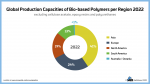
Global Production Capacities of Bio-based Polymers per region 2022 (PNG)
Markets & Economy
1 Page
276 Downloads
276 Downloads
2023-02
FREE
276
DownloadsReport on the global bio-based polymer market 2022 – A deep and comprehensive insight into this dynamically growing market
The year 2022 was a promising year for bio-based polymers: Bio-based epoxy resin production is on the rise, PTT regained attractiveness after several years of constant capacities and PE and PP made from bio-based naphtha are being further established with growing volumes. Increased capacities for PLA are ongoing, after being sold out in 2019. Current and future expansions for bio-based polyamides as well as PHAs are on the horizon. And also, bio-based PET is getting back in the game.
DOI No.: https://doi.org/10.52548/CMZD8323
-
562 Downloads
2023-02
FREE
562
DownloadsReport on the global bio-based polymer market 2022 – A deep and comprehensive insight into this dynamically growing market
The year 2022 was a promising year for bio-based polymers: Bio-based epoxy resin production is on the rise, PTT regained attractiveness after several years of constant capacities and PE and PP made from bio-based naphtha are being further established with growing volumes. Increased capacities for PLA are ongoing, after being sold out in 2019. Current and future expansions for bio-based polyamides as well as PHAs are on the horizon. And also, bio-based PET is getting back in the game.
DOI No.: https://doi.org/10.52548/CMZD8323
-
190 Downloads
2023-02
FREE
190
DownloadsReport on the global bio-based polymer market 2022 – A deep and comprehensive insight into this dynamically growing market
The year 2022 was a promising year for bio-based polymers: Bio-based epoxy resin production is on the rise, PTT regained attractiveness after several years of constant capacities and PE and PP made from bio-based naphtha are being further established with growing volumes. Increased capacities for PLA are ongoing, after being sold out in 2019. Current and future expansions for bio-based polyamides as well as PHAs are on the horizon. And also, bio-based PET is getting back in the game.
DOI No.: https://doi.org/10.52548/CMZD8323
-
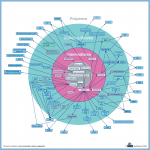
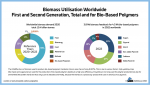
Shares of the produced bio-based polymers in different market sements in 2022 (PNG)
Markets & Economy
1 Page
317 Downloads
317 Downloads
2023-02
FREE
317
DownloadsReport on the global bio-based polymer market 2022 – A deep and comprehensive insight into this dynamically growing market
The year 2022 was a promising year for bio-based polymers: Bio-based epoxy resin production is on the rise, PTT regained attractiveness after several years of constant capacities and PE and PP made from bio-based naphtha are being further established with growing volumes. Increased capacities for PLA are ongoing, after being sold out in 2019. Current and future expansions for bio-based polyamides as well as PHAs are on the horizon. And also, bio-based PET is getting back in the game.
DOI No.: https://doi.org/10.52548/CMZD8323
-
512 Downloads
2023-02
FREE
512
DownloadsReport on the global bio-based polymer market 2022 – A deep and comprehensive insight into this dynamically growing market
The year 2022 was a promising year for bio-based polymers: Bio-based epoxy resin production is on the rise, PTT regained attractiveness after several years of constant capacities and PE and PP made from bio-based naphtha are being further established with growing volumes. Increased capacities for PLA are ongoing, after being sold out in 2019. Current and future expansions for bio-based polyamides as well as PHAs are on the horizon. And also, bio-based PET is getting back in the game.
DOI No.: https://doi.org/10.52548/CMZD8323
-
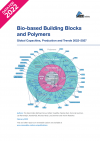
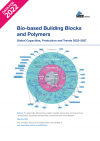
Bio-based Building Blocks and Polymers – Global Capacities, Production and Trends 2022-2027 (PDF)
Markets & Economy
387 Pages
2023-02
500 € – 1,000 €Price range: 500 € through 1,000 € ex. tax
Plus 19% MwSt.Press
release Select
licenceReport on the global bio-based polymer market 2022 – A deep and comprehensive insight into this dynamically growing market
The year 2022 was a promising year for bio-based polymers: Bio-based epoxy resin production is on the rise, PTT regained attractiveness after several years of constant capacities and PE and PP made from bio-based naphtha are being further established with growing volumes. Increased capacities for PLA are ongoing, after being sold out in 2019. Current and future expansions for bio-based polyamides as well as PHAs are on the horizon. And also, bio-based PET is getting back in the game.
DOI No.: https://doi.org/10.52548/CMZD8323
-
385 Downloads
2023-02
FREE
385
DownloadsReport on the global bio-based polymer market 2022 – A deep and comprehensive insight into this dynamically growing market
The year 2022 was a promising year for bio-based polymers: Bio-based epoxy resin production is on the rise, PTT regained attractiveness after several years of constant capacities and PE and PP made from bio-based naphtha are being further established with growing volumes. Increased capacities for PLA are ongoing, after being sold out in 2019. Current and future expansions for bio-based polyamides as well as PHAs are on the horizon. And also, bio-based PET is getting back in the game.
DOI No.: https://doi.org/10.52548/CMZD8323
-
Bio-based Building Blocks and Polymers – Global Capacities, Production and Trends 2022-2027 – Short Version (PDF)
Markets & Economy
28 Pages
1975 Downloads
1975 Downloads
2023-02
FREE
1975
DownloadsReport on the global bio-based polymer market 2022 – A deep and comprehensive insight into this dynamically growing market
The year 2022 was a promising year for bio-based polymers: Bio-based epoxy resin production is on the rise, PTT regained attractiveness after several years of constant capacities and PE and PP made from bio-based naphtha are being further established with growing volumes. Increased capacities for PLA are ongoing, after being sold out in 2019. Current and future expansions for bio-based polyamides as well as PHAs are on the horizon. And also, bio-based PET is getting back in the game.
DOI No.: https://doi.org/10.52548/CMZD8323
-
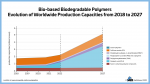
Bio-based biodegradable polymers – Evolution of worldwide production capacities 2018 to 2027 (PNG)
Markets & Economy
1 Page
521 Downloads
521 Downloads
2023-02
FREE
521
DownloadsReport on the global bio-based polymer market 2022 – A deep and comprehensive insight into this dynamically growing market
The year 2022 was a promising year for bio-based polymers: Bio-based epoxy resin production is on the rise, PTT regained attractiveness after several years of constant capacities and PE and PP made from bio-based naphtha are being further established with growing volumes. Increased capacities for PLA are ongoing, after being sold out in 2019. Current and future expansions for bio-based polyamides as well as PHAs are on the horizon. And also, bio-based PET is getting back in the game.
DOI No.: https://doi.org/10.52548/CMZD8323
-
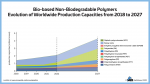
Bio-based non-biod. polymers – Evolution worldwide production capacities 2018-27 (PNG)
Markets & Economy
1 Page
212 Downloads
212 Downloads
2023-02
FREE
212
DownloadsReport on the global bio-based polymer market 2022 – A deep and comprehensive insight into this dynamically growing market
The year 2022 was a promising year for bio-based polymers: Bio-based epoxy resin production is on the rise, PTT regained attractiveness after several years of constant capacities and PE and PP made from bio-based naphtha are being further established with growing volumes. Increased capacities for PLA are ongoing, after being sold out in 2019. Current and future expansions for bio-based polyamides as well as PHAs are on the horizon. And also, bio-based PET is getting back in the game.
DOI No.: https://doi.org/10.52548/CMZD8323
-
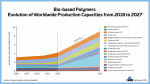
Bio-based polymers – Evolution of worldwide production capacities from 2018 to 2027 (PNG)
Markets & Economy
1 Page
526 Downloads
526 Downloads
2023-02
FREE
526
DownloadsReport on the global bio-based polymer market 2022 – A deep and comprehensive insight into this dynamically growing market
The year 2022 was a promising year for bio-based polymers: Bio-based epoxy resin production is on the rise, PTT regained attractiveness after several years of constant capacities and PE and PP made from bio-based naphtha are being further established with growing volumes. Increased capacities for PLA are ongoing, after being sold out in 2019. Current and future expansions for bio-based polyamides as well as PHAs are on the horizon. And also, bio-based PET is getting back in the game.
DOI No.: https://doi.org/10.52548/CMZD8323
-
395 Downloads
2023-02
FREE
395
DownloadsReport on the global bio-based polymer market 2022 – A deep and comprehensive insight into this dynamically growing market
The year 2022 was a promising year for bio-based polymers: Bio-based epoxy resin production is on the rise, PTT regained attractiveness after several years of constant capacities and PE and PP made from bio-based naphtha are being further established with growing volumes. Increased capacities for PLA are ongoing, after being sold out in 2019. Current and future expansions for bio-based polyamides as well as PHAs are on the horizon. And also, bio-based PET is getting back in the game.
DOI No.: https://doi.org/10.52548/CMZD8323
-
Importance of Mass Balance and Free Attribution (MBFA) for the Conversion of the Chemical Sector to Alternative Carbon Sources – RCI Position Paper (October 2022)
Markets & Economy, Policy, Sustainability & Health
4 Pages
772 Downloads
772 Downloads
2022-12
FREE
Free Shipping772
DownloadsA position paper of the Renewable Carbon Initiative
This position paper highlights the importance of mass balance and free attribution “MBFA” as one possible way to incentivise the transformation of the chemical sector away from fossil and on towards renewable carbon.
The term “mass balance” has become established to describe systems in which biomass, CO2 and secondary materials are used as a feedstock, but is not or not fully physically traced to the end product . It is common practice in many value chains in which large scale capacities are involved in one or more steps of the value chain that require mixing the sustainable with conventional material to fill the capacity. The approach makes it possible to substitute large quantities of fossil raw materials and attractive renewable content shares can be attributed to desired materials or products for which demand on the market exists. This incentivises a stepwise continuous transformation to increase the share of renewable carbon in particular for the large-scale chemical industry
However, the term “mass balance” is somewhat unfortunate because it is too general, and does not mention the essence of the method: the free attribution of the bio-based, CO2-based or chemically recycled share in the feedstock mix to certain selected end products.
The RCI recommends to only speak of “mass balance and free attribution (MBFA)” when talking about such cases, as this is how the complete method and its two central parts are referred to. This is transparent and honest, building trust from customers, end consumers and society in general. Both, mass balance and the free attribution are based on solid and established certifications.
Besides terminology, there is still a need for regulatory harmonisation between the schemes of the existing certification systems. MBFA cannot only be applied for bio-based feedstock, but also for CO/CO2 or feedstock from chemical recycling, both will gain strongly in importance in the coming years. Every MBFA scheme should cover these three renewable feedstocks: biomass, CO/CO2 and recycling.
-
Advanced Recycling Conference 2022 (Proceedings)
Markets & Economy, Policy, Sustainability & Health, Technology
139 Downloads
139 Downloads
2022-11
FREE
Plus 19% MwSt.139
DownloadsThe proceedings of the Advanced Recycling Conference 2022 (14-15 November 2022, hybrid, https://advanced-recycling.eu) contain conference presentations, the conference journal, sponsor documents and the press release.
-
600 Downloads
2022-10
FREE
Free Shipping600
DownloadsThe new nova-Institute’s market report commissioned by the Bio-based Industries Consortium (BIC) shows macroeconomic effects of the European Bioeconomy in the period from 2008 to 2019. Using data from Eurostat and, where required, nova-Institute’s estimated bio-based shares, turnover and employment numbers of the bioeconomic sectors have been calculated. Even though the latest numbers no longer include the UK, the EU’s bioeconomy turnover remained stable, which has resulted in an increase of around 25% since 2008.

nova-Session: “Bio- and CO₂-based Polymers: Production, Trends 2022-2027 and the latest Policy Developments” (Proceedings, PDF) [Digital]