Showing 61–80 of 386
-
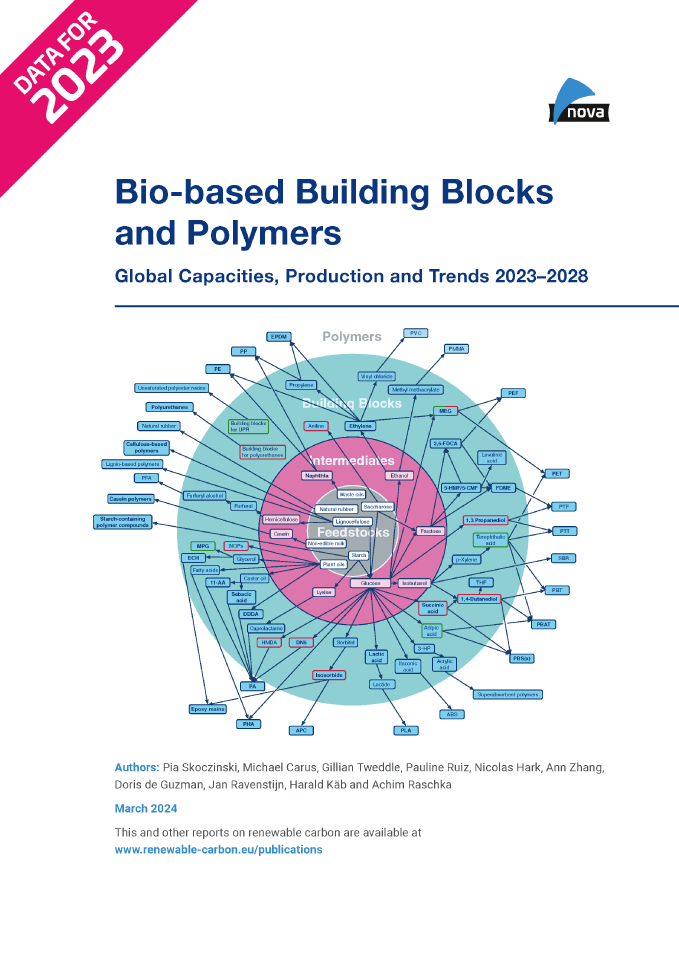
Bio-based Building Blocks and Polymers – Global Capacities, Production and Trends 2023–2028 – Short Version (PDF)
Markets & Economy
28 Pages
2464 Downloads
2464 Downloads
2024-03
FREE
2464
DownloadsNew report released on the global bio‑based polymer market 2023 – a deep and comprehensive insight into a dynamically growing market
The year 2023 was a promising year for bio‑based polymers: PLA capacities have been increased by almost 50 %, and at the same time polyamide capacities are steadily increasing, as well as epoxy resin production. Capacities for 100 % bio-based PE have been expanded and PE and PP made from bio‑based naphtha are being further established with growing volumes. Current and future expansions for PHAs are still on the horizon. After hinting at a comeback in 2022 bio-based PET production dropped in 2023 by 50 %.
DOI No.: https://doi.org/10.52548/VXTH2416
-
Bio-based Building Blocks and Polymers – Global Capacities, Production and Trends 2023–2028 (PDF)
Markets & Economy
438 Pages
2024-03
1,000 € – 3,000 €Price range: 1,000 € through 3,000 € ex. tax
Plus 19% MwSt.Select
licenceNew report released on the global bio‑based polymer market 2023 – a deep and comprehensive insight into a dynamically growing market
The year 2023 was a promising year for bio‑based polymers: PLA capacities have been increased by almost 50 %, and at the same time polyamide capacities are steadily increasing, as well as epoxy resin production. Capacities for 100 % bio-based PE have been expanded and PE and PP made from bio‑based naphtha are being further established with growing volumes. Current and future expansions for PHAs are still on the horizon. After hinting at a comeback in 2022 bio-based PET production dropped in 2023 by 50 %.
DOI No.: https://doi.org/10.52548/VXTH2416
-
Renewable Carbon Initiative (RCI) Webinar slides – February 2024 (PDF)
Policy, Sustainability & Health
61 Pages
1769 Downloads 1769 Downloads
2024-02
FREE
Free Shipping1769
DownloadsThis document contains a generic set of slides to introduce the concept of renewable carbon and the Renewable Carbon Initiative. The focus of this webinar was the latest scientific background report: “Non-level Playing Field for Renewable Materials vs. Fossil in Life Cycle Assessments – Critical aspects of the JRC Plastics LCA methodology and its policy implications”.
In addition, three RCI member companies shared their expertise on renewable carbon, defossilisation and sustainable carbon cycles.
AllocNow (speaker: Daniel Bochnitschek) talked about how the increasing demand for sustainable and low carbon products is driving the need for specific and comprehensive information on product carbon footprints. AllocNow discussed why standardisation of sustainability accounting methodologies is critical and how a data-driven approach can help create transparency at scale.
Econic Technologies Ltd. (speaker: Liz Manning) spoke about the opportunities and challenges of quantifying the sustainability impact of key products in complex manufacturing supply chains.
SCS Global Services (speakers: Miguel Ruiz and Jéssica Marcon Bressanin) highlighted its certification activities, focusing on biofuels and circular materials schemes, as well as greenhouse gas accounting methodologies.
More information at https://renewable-carbon-initiative.com/media/library
-
Mapping of Advanced Plastic Waste Recycling Technologies and their Global Capacities (PDF)
Markets & Economy, Technology
276 Pages
2024-02
3,000 € – 10,000 €Price range: 3,000 € through 10,000 € ex. tax
Plus 19% MwSt.Select
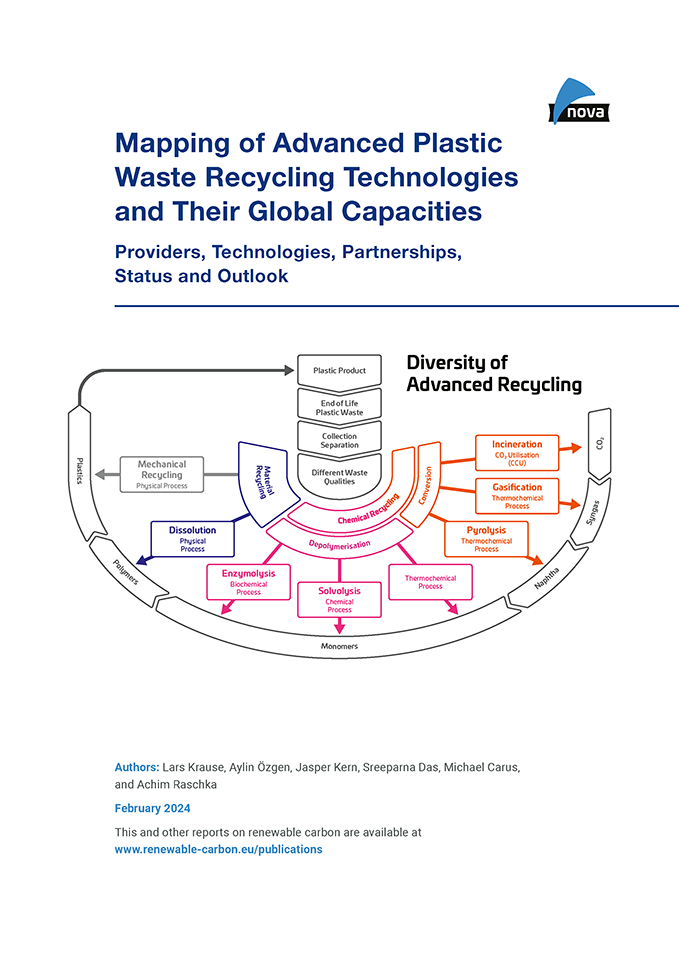
licenceAdvanced recycling technologies are developing at a fast pace, with new players constantly appearing on the market, from start-ups to giants and everything in between – new plants are being built, new capacities are being achieved, and new partnerships are established. Due to these developments, it is difficult to keep track of everything. The report “Mapping of advanced plastic waste recycling technologies and their global capacities” aims to clear up this jungle of information providing a structured, in-depth overview and insight. It has an exclusive focus on profiling available technologies and providers of advanced recycling including the addition of new technologies and updated/revised profiles. Furthermore, for the first time a comprehensive evaluation of the global input and output capacities was carried out for which more than 340 planned as well as installed and operating plants including their specific product yields were mapped.
Further information:
The new report “Mapping of advanced plastic waste recycling technologies and their global capacities” differs from the old report “Chemical Recycling – Status, Trends and Challenges” as follows:- All technology provider profiles from the old report included + updated to 2023.
- Overall >120 technologies and providers (vs. >70 technologies and providers in the old report)
- Global capacities
In summary, this report is suitable for interested readers who have already dealt with the advanced recycling topic and are looking for an up-to-date overview of all identified providers and a detailed description of the technologies.
DOI No.: https://doi.org/10.52548/WQHT8696
-
Mapping of Advanced Plastic Waste Recycling Technologies and their Global Capacities – Short Version (PDF)
Markets & Economy, Technology
12 Pages
2225 Downloads 2225 Downloads
2024-02
FREE
2225
DownloadsAdvanced recycling technologies are developing at a fast pace, with new players constantly appearing on the market, from start-ups to giants and everything in between – new plants are being built, new capacities are being achieved, and new partnerships are established. Due to these developments, it is difficult to keep track of everything. The report “Mapping of advanced plastic waste recycling technologies and their global capacities” aims to clear up this jungle of information providing a structured, in-depth overview and insight. It has an exclusive focus on profiling available technologies and providers of advanced recycling including the addition of new technologies and updated/revised profiles. Furthermore, for the first time a comprehensive evaluation of the global input and output capacities was carried out for which more than 340 planned as well as installed and operating plants including their specific product yields were mapped.
Further information:
The new report “Mapping of advanced plastic waste recycling technologies and their global capacities” differs from the old report “Chemical Recycling – Status, Trends and Challenges” as follows:- All technology provider profiles from the old report included + updated to 2023.
- Overall >120 technologies and providers (vs. >70 technologies and providers in the old report)
- Global capacities
In summary, this report is suitable for interested readers who have already dealt with the advanced recycling topic and are looking for an up-to-date overview of all identified providers and a detailed description of the technologies.
-
RCI’s Internal Survey: „How to enable the transition from fossil to renewable carbon in the chemical and material sector“ (January 2024)
Policy, Sustainability & Health
3 Pages
665 Downloads 665 Downloads
2024-01
FREE
665
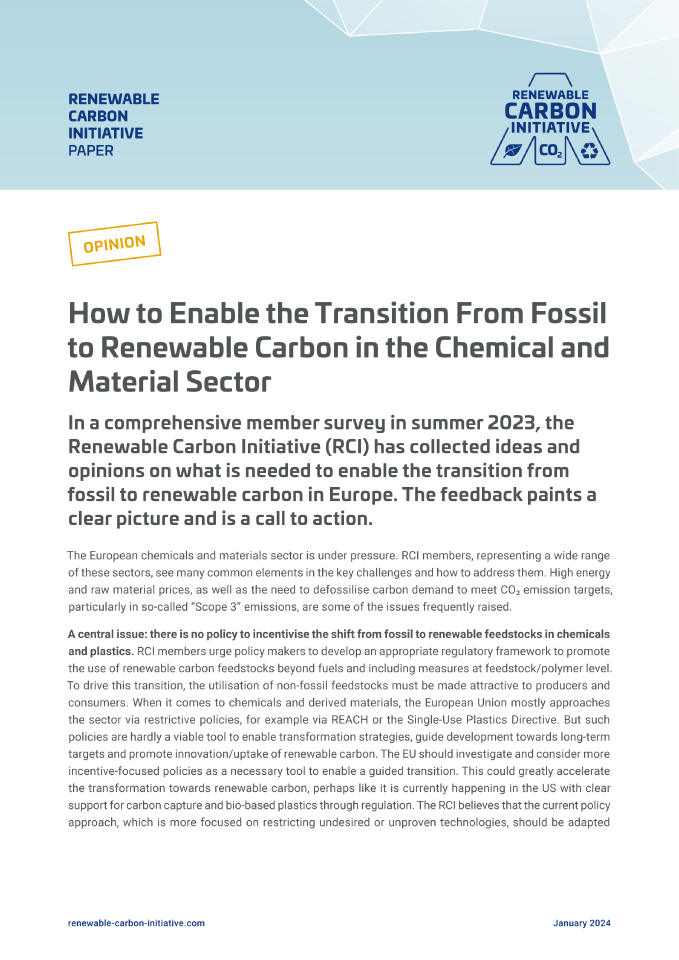
DownloadsIn a comprehensive member survey in summer 2023, the Renewable Carbon Initiative (RCI) has collected ideas and opinions on what is needed to enable the transition from fossil to renewable carbon in Europe. The feedback paints a clear picture and is a call to action.
The European chemicals and materials sector is under pressure. RCI members, representing a wide range of these sectors, see many common elements in the key challenges and how to address them. High energy and raw material prices, as well as the need to defossilise carbon demand to meet CO2 emission targets, particularly in so-called “Scope 3” emissions, are some of the issues frequently raised.
-
1305 Downloads
2024-01
FREE
1305
Downloads -
Nora and her flyphone on renewable carbon (Comic)
Policy, Sustainability & Health
2 Pages
856 Downloads 856 Downloads
2024-01
FREE
856
Downloads -
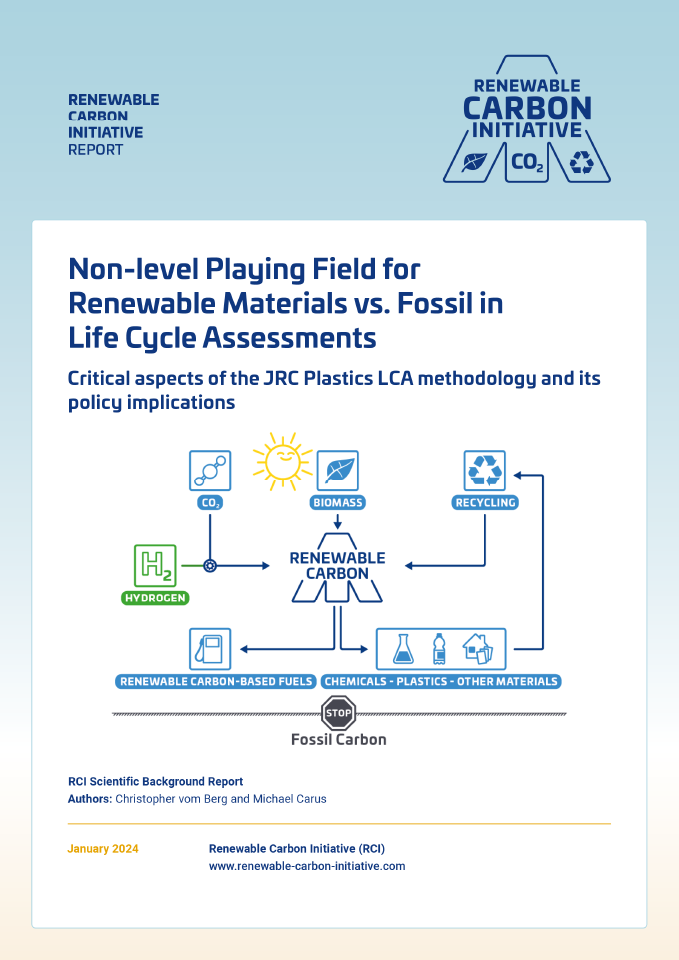
Non-Level Playing Field for Renewable Materials vs. Fossil in Life Cycle Assessments: Critical Aspects of the JRC Plastics LCA Methodology and its Policy Implications – RCI Report (January 2024)
Policy, Sustainability & Health
44 Pages
1555 Downloads 1555 Downloads
2024-01
FREE
1555
DownloadsCritical aspects of the JRC Plastics LCA methodology and its policy implications
This RCI Scientific Background Report was mainly motivated by a study published by JRC in 2021 with the title: “LCA of alternative feedstocks for plastic products”, commonly referred to as the JRC Plastics LCA Method (Nessi et al. 2021).
Alternative feedstocks refer to the same three feedstocks that RCI defines as renewable carbon: biomass, CO2 utilisation and recycling. The study describes a methodology developed by the JRC to compare the environmental performance of alternative feedstocks with fossil-based plastic products. However, the methodology has also been subject to criticism from various stakeholders, mainly from the bio-based sector, eliciting responses from the JRC.
This RCI report is mainly aiming to provide additional context to highlight issues that might arise with implementation of the JRC Plastics LCA methodology, and dives deeper into five aspects:
- The fossil footprint is likely underestimated, not transparent and lacks regional differentiation
- Renewable feedstocks are more cirtically evaluated than fossil feedstocks
- Methodological inconsistency and different regulatory support between energy and material use of renewable feedstocks
- Biogenic/Atmospheric carbon uptake cannot be transparently visualised at factory in PEF / JRC Plastics LCA methodologies
- The methodology should acknowledge the wider interface of sustainability assessment, policy design and landscape
The report contains several recommendations to remedy the above-mentioned aspects.
DOI No.: https://doi.org/10.52548/KOTY2900
-
The Use of Food and Feed Crops for Bio-Based Materials and the Related Effects on Food Security: Promoting Evidence-Based Debates and Recognising Potential Benefits – RCI Report (Short Version) (June 2023)
Markets & Economy, Policy, Sustainability & Health, Technology
2 Pages
1000 Downloads 1000 Downloads
2023-11
FREE
1000
DownloadsPromoting Evidence-based Debates and Recognising Potential Benefits
This short version of the scientific paper highlights on two pages new insights into a hotly debated topic and urges for careful and evidence-based debates.
The paper aims to show that the well-known biomass debate is flawed, subjective and not fully based on evidence. What is detrimental to food security are, according to the World Food Programme in 2023, climate change, conflict, extreme inequalities in wealth distribution, heavy dependence on food imports from industrial countries, overconsumption of meat, losses along the value chain and the impact of the COVID pandemic. Competition between biomass uses is not mentioned among the relevant causes.
The use of biomass for industrial applications, does have the potential to replace fossil feedstocks and thus contribute to the urgently needed reduction of fossil carbon emissions into our atmosphere to mitigate climate change.
While not denying the dire need to combat world hunger, the authors of the paper argue that using food and feed crops for chemicals and materials will not necessarily exacerbate food insecurity, and in fact has the potential to cause multiple benefits for local and global food security, climate mitigation and other factors:
- The climate wins – Bio-based materials are part of the solution to achieve climate change mitigation.
- Land productivity wins – The competition between applications is not for the type of crop grown, but for the land.
- The environment wins – due to increased resource efficiency and productivity of food and feed crops.
- Farmers win – because they have more options for selling stock to different markets.
- Market stability wins – due to increased global availability of food and feed crops.
- Feed security wins – due to the high value of the protein-rich co-products of food and feed crops.
- Food security wins – due to the increased overall availability of edible crops that can be stored and flexibly distributed.
-
Case Studies Based on Peer-Reviewed Life Cycle Assessments: Carbon Footprints of Different Carbon-Based Chemicals and Materials – RCI Report (November 2023)
Sustainability & Health
39 Pages
2291 Downloads 2291 Downloads
2023-11
FREE
2291
DownloadsIn this brochure, the RCI (https://renewable-carbon-initiative.com) presents five peer-reviewed LCA case studies – representing the highest possible scientific standard – that examine the carbon footprint of materials and products made from renewable carbon. These case studies are on products from RCI member companies Avantium (NL), BASF (DE), IFF (US), Lenzing (AT), Neste (FI) and all LCAs have been peer-reviewed by external experts. The LCAs have been summarised by experts of nova-Institutes sustainability team.
The case studies visualise that there are not only competitive materials and products made of renewable carbon already on the market, but that they also come with significantly lower carbon footprints ranging from 30–90%.
A key aspect of replacing fossil carbon with renewable carbon is the gained circularity of carbon. The less additional fossil carbon is added to our above-ground cycle of atmosphere, biosphere and technosphere, the smaller will be the amount of carbon emissions that have to be balanced out with expensive atmospheric removal and underground storage of carbon.
It is essential to recognise that the carbon footprint of renewable carbon-based materials is not automatically close to zero for two primary reasons:
- Fossil energy in the value chain
- Ongoing innovation and optimisation
All in all, the here presented materials and products show reduced carbon footprints already today, which lowers the remaining emissions gap so that less CO2 needs to be removed from the atmosphere in the future. At the same time, these materials and products still have significant potential to further reduce emissions in the future.
DOI No.: https://doi.org/10.52548/YYZY2819
-
358 Downloads
2023-10
FREE
358
DownloadsThis position paper describes that our understanding that new thinking and terminology are required to achieve climate targets and secure a sustainable carbon supply
Comprehensive carbon management goes beyond CO2 emissions, capture and long-term storage, to which it is often reduced to. It decouples the whole industry from fossil feedstock, eliminates the use of fossil carbon wherever possible and allocates renewable carbon (from biomass, CO2 and recycling) as efficiently and effectively as possible where carbon use is unavoidable. The aim is to achieve the lowest possible CO2 emissions, reducing the need for Carbon Dioxide Removal to achieve net zero, and to provide a secure supply of renewable carbon to all dependent industries such as chemicals and materials. Only when carbon is recognised as a raw material in carbon management strategies can truly sustainable carbon cycles be achieved. With a proper comprehensive carbon management, the carbon-reliant material and energy sectors will be defossilised and the remaining energy sector will be decarbonised. And only for the remaining share of truly unavoidable emissions, carbon dioxide removal and carbon capture and storage should come into play.
-
Joint Letter: Carbon Capture and Utilisation (CCU) should be recognised as a Strategic Net Zero Technology in the EU Net Zero Industry Act (PDF)
Policy
2 Pages
79 Downloads 79 Downloads
2023-10
FREE
79
DownloadsA co-signed letter with CO2 Value Europe, Cefic – European Chemical Industry Council, the European Cement Association (CEMBUREAU), The Confederation of European Waste-to-Energy Plants (CEWEP), UPEI – the Voice of Europe’s Independent Fuel Suppliers, eFuel Alliance, Eurogas, The European Steel Association (EUROFER), FuelsEurope, Methanol Institute and the European Confederation of Fuel Distributors (ECFD) that calls on Members of the EU Parliament and EU Member States to take position to include CCU technologies as part – along with CCS – of the list of strategic net-zero technologies in the Net Zero Industry Act (NZIA).
-
Ferdinand Kähler (nova-Institute),Olaf Porc (nova-Institute), Michael Carus (nova-Institute)
Policy, Sustainability & Health
92 Pages
3395 Downloads 3395 Downloads
2023-10
FREE
3395
DownloadsThe Carbon Flows report is a compilation of supply and demand of fossil and renewable carbon on a global and European level. It provides a comprehensive understanding of today’s carbon flows and what it means to replace fossil carbon with renewable carbon in the materials and chemicals sectors. It’s main intent is to provide a uniform and transparent data basis for a future carbon management that can be used and shared by industry, associations, policy-makers, science and alike.
In the last five years, the mindset around carbon has changed fundamentally. Of course, there is no way around the fact that the rising concentration of carbon dioxide in the atmosphere pose an existential threat to life on Earth. But at the same time, carbon is the main component of our food, the basis of all organic chemicals and plastics, and the backbone of life on Earth.
In the chemicals and plastics sectors in particular, almost 90% of the carbon used as feedstock is fossil carbon. This fossil carbon must be replaced by renewable carbon from recycling, biomass and CO2 by 2050 to avoid a further influx of fossil carbon into our technosphere and atmosphere.This report provides a comprehensive, detailed and updated carbon flow data basis that significantly surpasses previous publications, containing more than 35 figures and tables with corresponding descriptions of methodology, source material and data. All data have been corroborated as best as currently possible by scientific publications, feedback from experts and additional research. Remaining gaps and differences are transparently depicted and explained as well as possible.
The nova experts assessed data from a multitude of sources. A wide range of data on material flow are used to compile a comprehensive inventory of carbon stocks and flows. The sectors covered include all applications of organic carbon from fossil resources and biomass production, from raw materials through utilisation to final end-of-life. This includes use of carbon for feed and food, for materials, for energy and for fuels. A special focus is put on the carbon demand in the chemical and plastic industry today and tomorrow, with several figures specifically zooming into this sector and including scenarios for a full defossilisation by 2050.
The Carbon Flows report is designed to be a living document that we would like to update every one to two years if possible. This also means that we look forward to your feedback, additional input, new data and suggestions from any interested party. Please directly contact olaf.porc@nova-institut.de
DOI No.: https://doi.org/10.52548/KCTT1279
-
Renewable Carbon as a Guiding Principle for Sustainable Carbon Cycles (Update): Why It Is Right and Necessary to Choose Renewable Carbon as a Guiding Principle for Sustainable Development in the Chemicals and Materials Sectors – RCI Report (September 2023)
Policy, Sustainability & Health
51 Pages
1253 Downloads 1253 Downloads
2023-09
FREE
1253
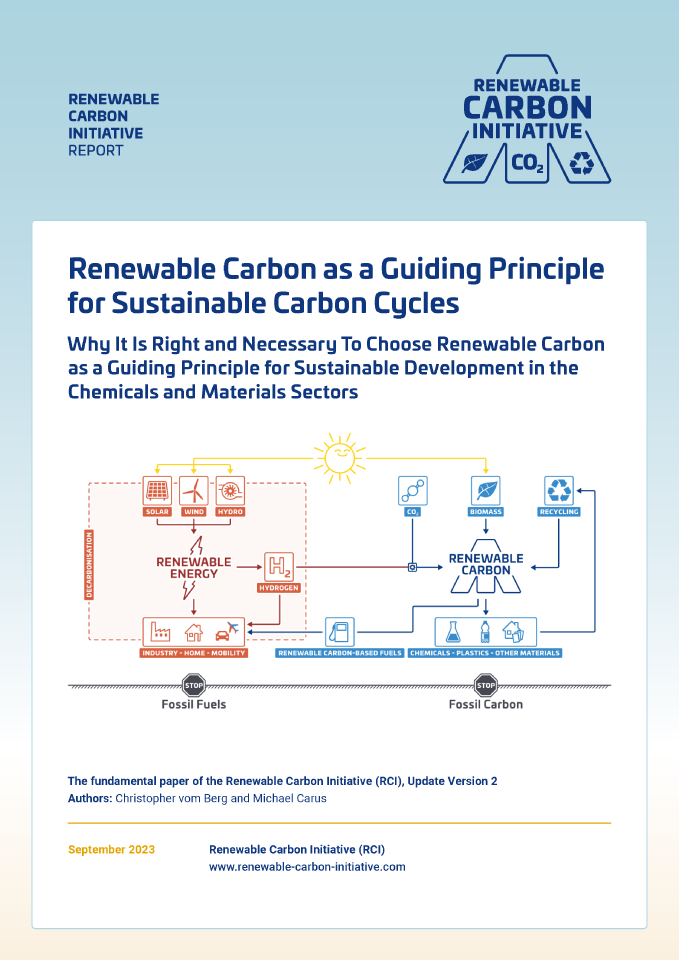
DownloadsWhy It Is Right and Necessary To Choose Renewable Carbon as a Guiding Principle for Sustainable Development in the Chemicals and Materials Sectors
The Scientific Background Report on “Renewable Carbon as a Guiding Principle for Sustainable Carbon Cycles – Why It Is Right and Necessary To Choose Renewable Carbon as a Guiding Principle for Sustainable Development in the Chemicals and Materials Sectors“ was RCI’s first major publication and forms the basis for the concept and strategy of the RCI. Together with input from all members, the RCI has worked on an updated version – In this second edition, the following main changes have been implemented:
- New IPCC data on greenhouse gas emissions from the 6th Assessment Report (published March 2022) have been integrated.
- To establish proper data baselines, entirely novel carbon flows data have been integrated.
- The initial eleven policy recommendations were further sharpened, fine-tuned and concretised through lots of feedback from talks with politicians, NGOs, industrial actors, the bio-based, CO2-based and recycling sector, energy experts and many other stakeholders. Further political demands resulted from these discussions as well as recently published RCI position papers and consultations, which are now also integrated into the paper.
To reduce greenhouse gas emissions and mitigate climate change, the inflow of fossil carbon must be reduced quickly and in high volumes. The EU has started pushing for decarbonisation in energy and transport sectors, but has largely ignored chemical and material industries. These sectors require carbon-based feedstocks and cannot be “decarbonised,” so tackling embedded carbon in these industries is crucial. This paper proposes an approach to minimize environmental impact and maximize the reduction of GHG emissions.
DOI No.: https://doi.org/10.52548/CXFS7519
-
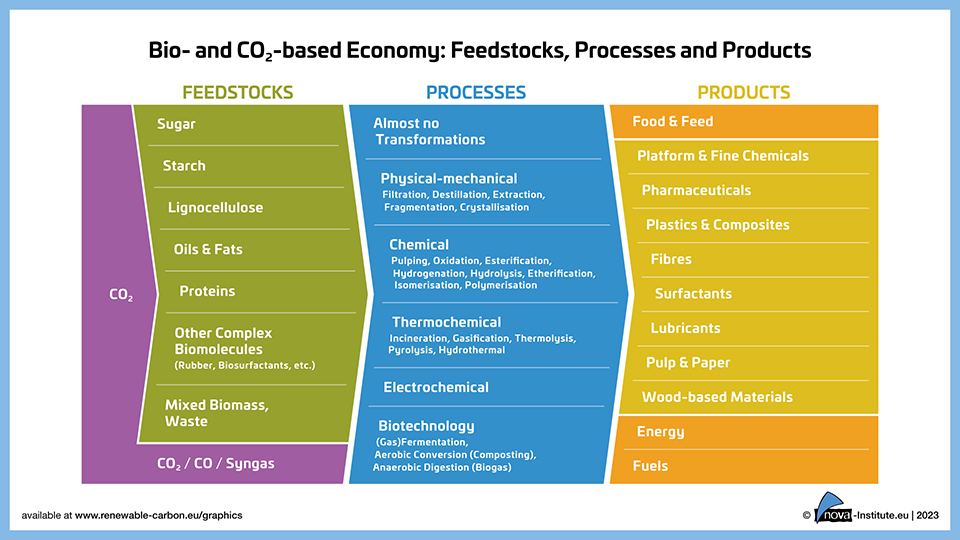
“Bio- and CO2-based Economy: feedstocks, processes and products” − Graphic – Update
Markets & Economy, Sustainability & Health, Technology
1 Page
3414 Downloads 3414 Downloads
2023-09
FREE
3414
Downloads -
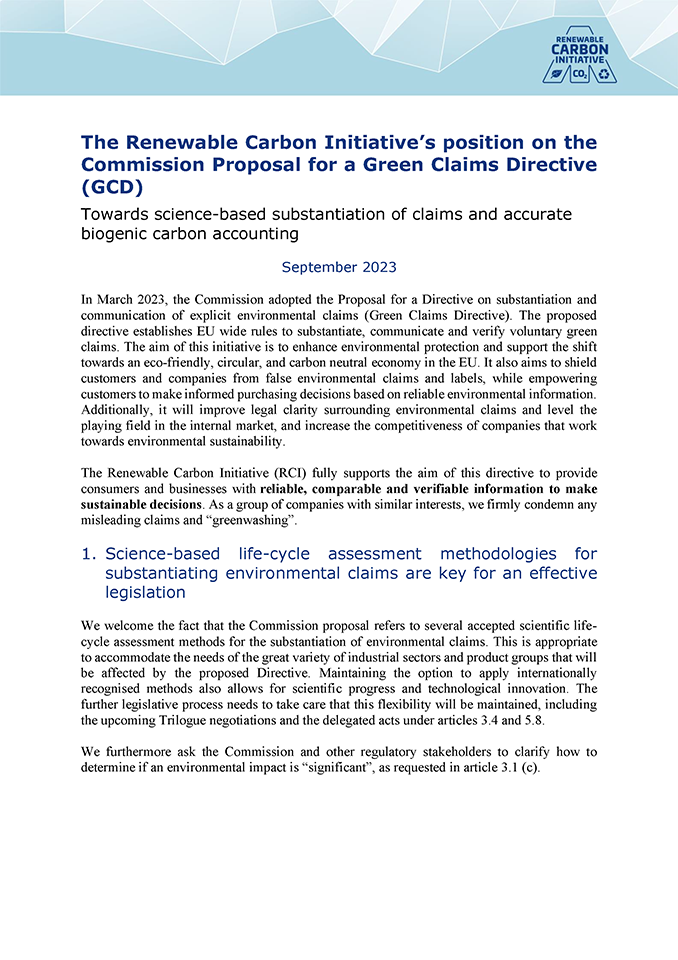
Commission Proposal for a Green Claims Directive (GCD): Towards Science-Based Substantiation of Claims and Accurate Biogenic Carbon Accounting – RCI Position Paper (September 2023)
Policy
3 Pages
165 Downloads 165 Downloads
2023-09
FREE
165
DownloadsTowards science-based substantiation of claims and accurate biogenic carbon accounting
The Renewable Carbon Initiative (RCI) wholeheartedly endorses the Green Claims Directive’s (GCD) mission to provide consumers and businesses with reliable, comparable, and verifiable information to facilitate sustainable choices.
In our position paper, we emphasise three aspects that, in our view, require additional attention to maximise the impact of the GCD and support products and solutions derived from non-fossil, renewable-carbon-based feedstock from biomass, CCU or recycling.
1. Science-Based Life-Cycle Assessment Methodologies: RCI welcomes the acceptance of several life-cycle assessment methods for substantiating environmental claims but emphasises the practical importance of maintaining flexibility in the upcoming trilogue negotiations. We also call for clarification on how to determine if an environmental impact is considered “significant.”
2. Differentiated Biogenic Carbon Accounting Methodology: The RCI advocates for enabling the possibility to better reflect uptake of atmospheric CO2 via biogenic carbon (and principally any process that captures CO2 from the atmosphere) in product assessments. In general, biogenic carbon in LCA is neither credited with carbon uptake through biomass at the beginning nor with the emissions (e.g. from incineration) at end of life. While this is from a proper LCA point-of-view valid and recommended, it leads to issues for stakeholders reporting their biogenic product’s carbon footprint at factory gate, because the uptake of atmospheric carbon cannot be shown and the conceptual advantage over fossil products gets lost. At the same time, we are aware of misleading “carbon negative” claims and argue that only full cradle-to-grave LCAs should qualify for such B2C claims.
3. Ensuring a Reliable Verification Mechanism: Recognising the need for mandated verification of environmental claims before B2C communication, RCI acknowledges the potential challenges posed by these resource-intensive processes. We want to stress the importance of an effective approach and an extended transition period to enable authorities, verifiers, and the industry to smoothly adapt to these processes and mitigate potential delays in communicating claims for innovative products.
tation. -
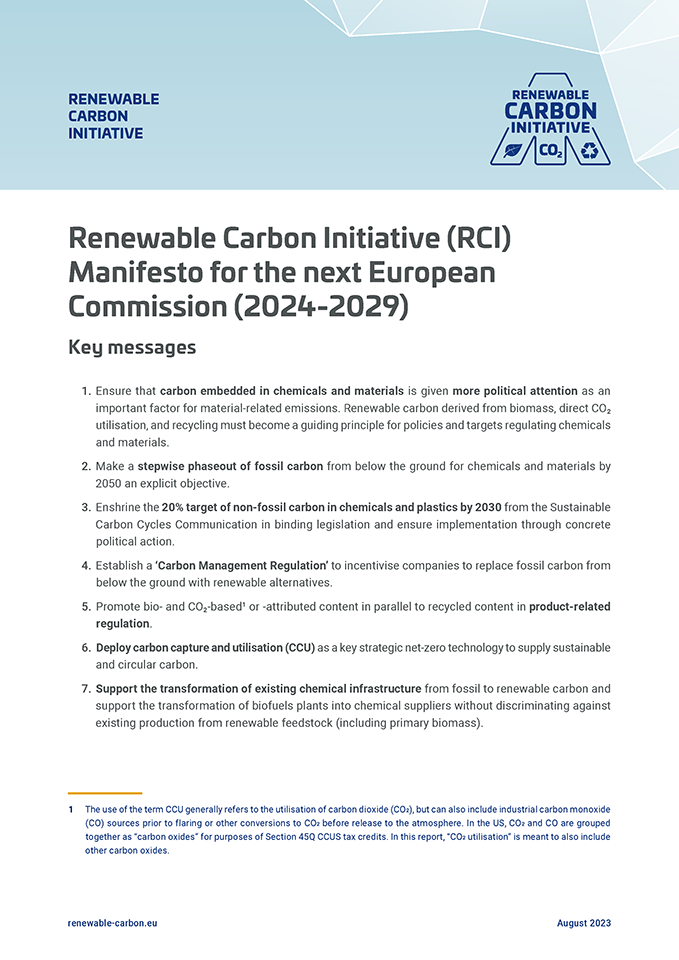
RCI’s Manifesto for the Next European Commission (2024-2029) – RCI Position Paper (August 2023)
Policy
3 Pages
243 Downloads 243 Downloads
2023-08
FREE
243
DownloadsThe RCI Manifesto highlights key issues for the new European Commission (2024 – 2029) to take up and focus on.
The key messages are:
- Ensure that carbon embedded in chemicals and materials is given more political attention as an important factor for material-related emissions. Renewable carbon derived from biomass, direct CO2 utilisation, and recycling must become a guiding principle for policies and targets regulating chemicals and materials.
- Make a stepwise phaseout of fossil carbon from below the ground for chemicals and materials by 2050 an explicit objective.
- Translate the 20% non-fossil carbon target for chemicals and plastics by 2030 from the Sustainable Carbon Cycles Communication into binding legislation and ensure implementation through concrete policy measures.
- Establish a ‘Carbon Management Regulation’ to incentivise companies to replace fossil carbon from below the ground with renewable alternatives.
- Promote bio- and CO2-based[1] or -attributed content in parallel to recycled content in product-related regulation.
- Deploy Carbon Capture and Utilisation (CCU) as a key strategic net-zero technology to provide sustainable and circular carbon.
- Support the transformation of existing chemical infrastructure from fossil to renewable carbon and support the transformation of biofuels plants into chemical suppliers without discriminating against existing production from renewable feedstock (including primary biomass).
[1] The use of the term CCU generally refers to the utilisation of carbon dioxide (CO2), but can also include industrial carbon monoxide (CO) sources prior to flaring or other conversions to CO2 before release to the atmosphere. In the US, CO2 and CO are grouped together as “carbon oxides” for purposes of Section 45Q CCUS tax credits. In this report, “CO2 utilisation” is meant to also include other carbon oxides.
Call for Signature
The RCI manifesto outlines 7 core recommendations directed towards the forthcoming European Commission, aimed at translating the vision of ending the use of fossil feedstock into reality.
Voice your support for the RCI manifesto for the next European Commission (2024–2029) now!
-
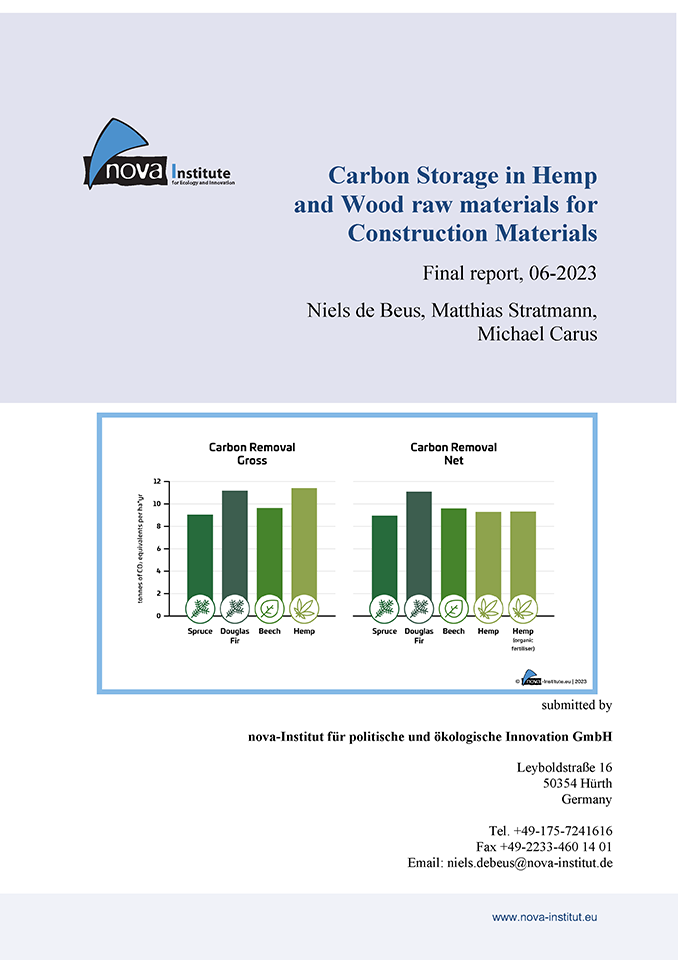
Carbon Storage in Hemp and Wood raw materials for Construction Materials
Sustainability & Health
20 Pages
484 Downloads 484 Downloads
2023-07
FREE
Free Shipping484
DownloadsAs such, it is interesting to investigate the potential of biomass to store carbon in raw materials used in industry, more specifically the construction industry. What is the potential of biomass to supply the construction industry with raw materials containing temporarily stored biogenic carbon per hectare and year? Are there differences between various biomass types? What is the associated reduction of atmospheric greenhouse gasses due to the carbon in the raw materials? What are the emissions of greenhouse gasses associated with this provision of raw materials? This study will look into these questions for wood and hemp based raw materials which can be used in the construction industry. The production of the construction materials, and the associated emissions with the conversion of the raw materials to final products, is outside the scope of this assessment due to the wide variety of construction materials which can be produced from the raw materials. The study has calculated the potential of a hectare of wood and hemp to transfer carbon from the biosphere to materials which can be used in the construction and insulation industry. The potential of a hectare of wood and hemp to provide carbon to the construction industry, including greenhouse gas emissions associated with the production, is similar.
-
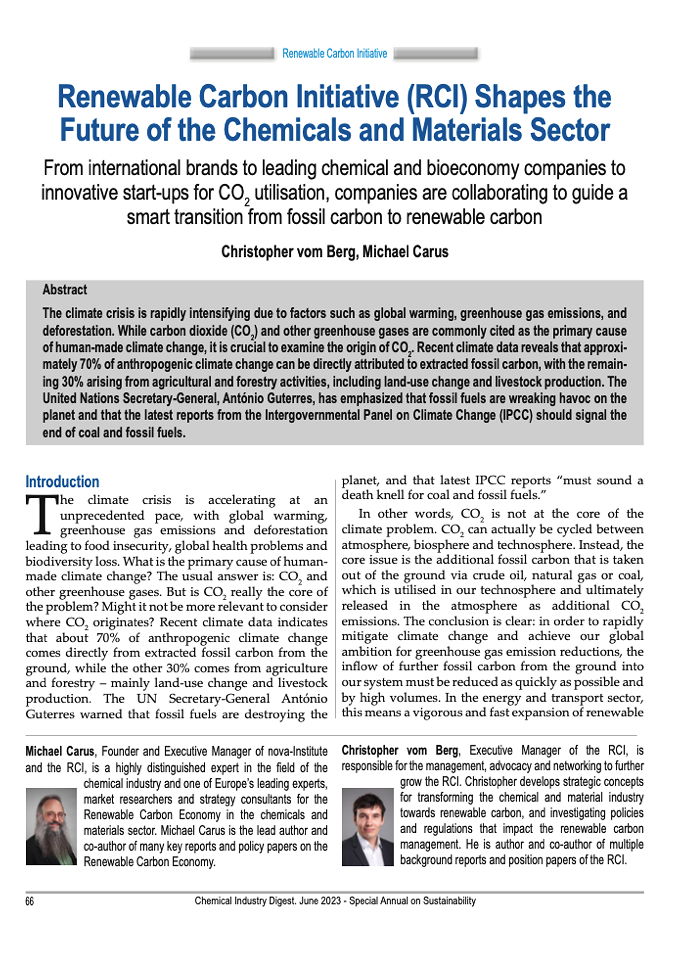
Renewable Carbon Initiative (RCI) Shapes the Future of the Chemicals and Materials Sector
Markets & Economy, Policy
3 Pages
142 Downloads 142 Downloads
2023-07
FREE
Free Shipping142
DownloadsFrom international brands to leading chemical and bioeconomy companies to innovative start-ups for CO2 utilisation, companies are collaborating to guide a smart transition from fossil carbon to renewable carbon. The Renewable Carbon Initiative (RCI) (www.renewable-carbon-initiative.com) was created after observing the struggles of the chemical and material industriesin facing the enormous challenges to meet the climate goals set by the European Union and the sustainability expectations held by societies around the globe. It was clear that the industry has to go beyond using renewable energy and also consider their raw materials. Because decarbonisation is not an option for the chemical and material sector, as it is entirely based on the use of carbon, an alternative strategy is required: defossilisation through renewable carbon – carbon from above the ground: biomass, CO2 and recycling.