Skip to content
Renewable Carbon Publications - LogoRenewable Carbon Publications - Logo
  • Publications
  • Contact
1
  • CO2-based Fuels and Chemicals Conference 2024 (Proceedings, PDF) [Digital]CO2-based Fuels and Chemicals Conference 2024 (Proceedings, PDF) [Digital] 1 × 50 €
    Plus 19% MwSt.

Subtotal: 50 €

CartCheckout

  • Renewable Carbon
    • Renewable Carbon
    • Events
    • Publications
    • Graphics
    • News
    • Business Directory
    • Newsletter
    • nova-Institute
  • Publications
  • Contact

Renewable Carbon Publications - LogoRenewable Carbon Publications - Logo
1
  • CO2-based Fuels and Chemicals Conference 2024 (Proceedings, PDF) [Digital]CO2-based Fuels and Chemicals Conference 2024 (Proceedings, PDF) [Digital] 1 × 50 €
    Plus 19% MwSt.

Subtotal: 50 €

CartCheckout

nova provides studies on
all renewable carbon relevant
topics such as

25 12 03 shop slider 4 cover bio-based & CO₂-based polymers
as well as chemical recycling
25 12 03 shop slider advanced recycling figure 2025 25 12 03 shop slider advanced recycling cover Report on
Global Advanced
Plastic Recycling
Capacities

More details
25 05 14 shop slider bio based hg Data for 2024:
25 05 14 slider publications bio based cover Report on Bio-based
Building Blocks and
Polymers
More details
nova Networking and Knowledge Download PDF here Networking Opportunities
Recent Reports
Expert Information
nova-Institute Logo Networking and Knowledge Flyer 2024 Everything at a glance
  • Renewable Carbon Publications
  • Page 4
Grid view List view
“CO2-based Fuels and Chemicals Conference 2024 (Proceedings, PDF)” has been added to your cart. View cart

Showing 61–80 of 431

  • Download Statistics
  • Direct Download
    (pdf)

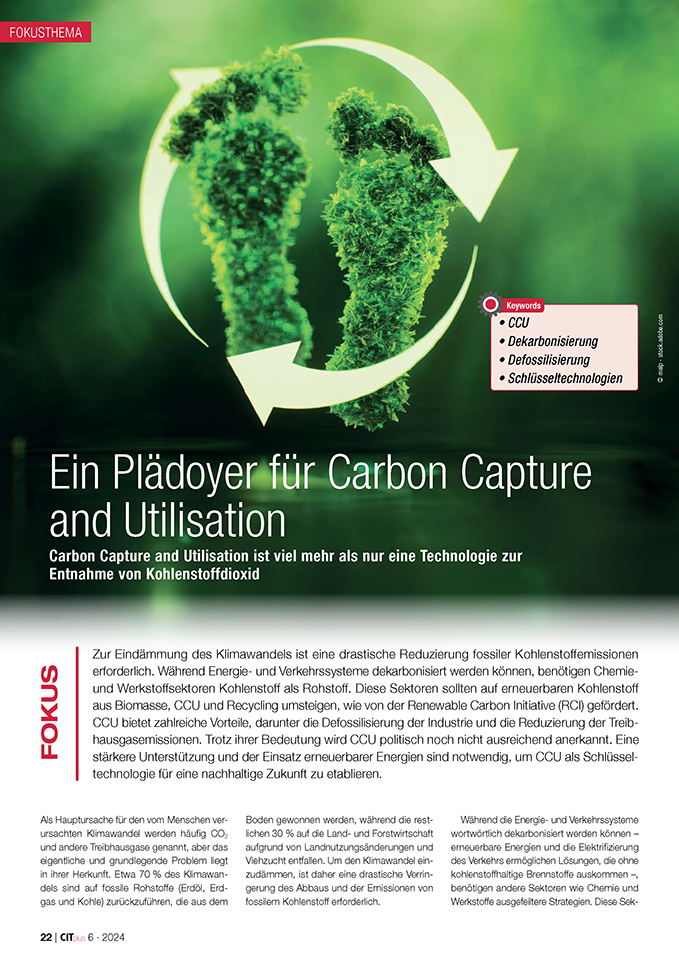
    Ein Plädoyer für Carbon Capture and Utilisation – Carbon Capture and Utilisation ist viel mehr als nur eine Technologie zur Entnahme von Kohlenstoffdioxid (PDF)

    Markets & Economy, Policy, Sustainability & Health

    4 Pages
    401 Downloads

    401 Downloads  

    2024-06

    FREE


    401
    Downloads

    Direct Download

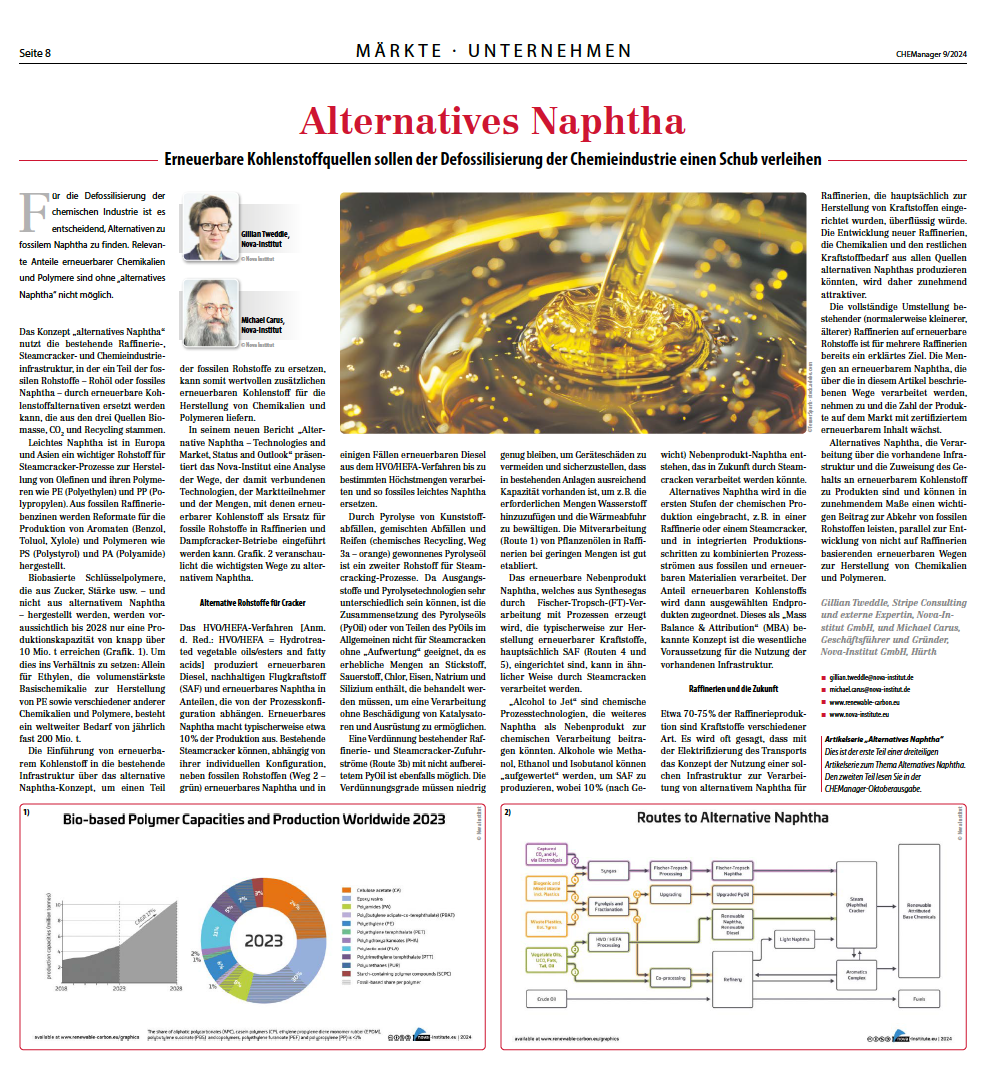
    Zur Eindämmung des Klimawandels ist eine drastische Reduzierung fossiler Kohlenstoffemissionen erforderlich. Während Energie- und Verkehrssysteme dekarbonisiert werden können, benötigen Chemie- und Werkstoffsektoren Kohlenstoff als Rohstoff. Diese Sektoren sollten auf erneuerbaren Kohlenstoff aus Biomasse, CCU und Recycling umsteigen, wie von der Renewable Carbon Initiative (RCI) gefördert.

    CCU bietet zahlreiche Vorteile, darunter die Defossilisierung der Industrie und die Reduzierung der Treibhausgasemissionen.

    Trotz ihrer Bedeutung wird CCU politisch noch nicht ausreichend anerkannt. Eine stärkere Unterstützung und der Einsatz erneuerbarer Energien sind notwendig, um CCU als Schlüssel- technologie für eine nachhaltige Zukunft zu etablieren.

    Weitere Informationen:

    https://www.chemanager-online.com/news/ein-plaedoyer-fuer-carbon-capture-and-utilisation


  • Direct Download
    call for member states to support an eu sustainable carbon policy package as a part of a future green eu industrial deal (pdf)

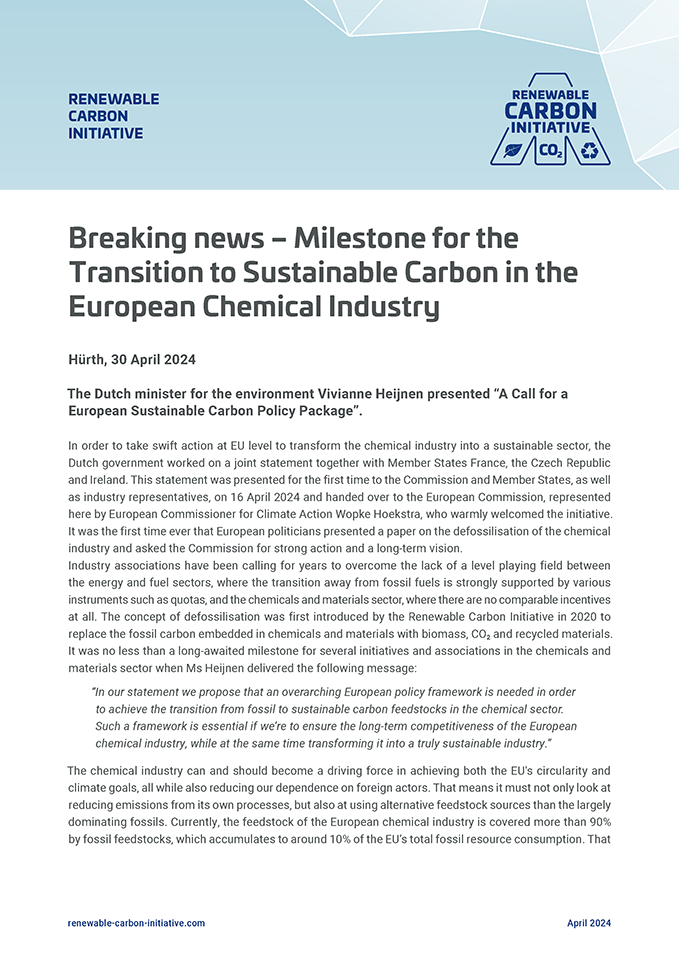
    Breaking news – Milestone for the Transition to Sustainable Carbon in the European Chemical Industry (PDF)

    Policy

    4 Pages
    110 Downloads

    110 Downloads  

    2024-05

    FREE

    Free Shipping
     

    110
    Downloads

    Direct Download

    On 16 April 2024, a major milestone was reached in the European chemical industry’s transition to sustainable carbon.

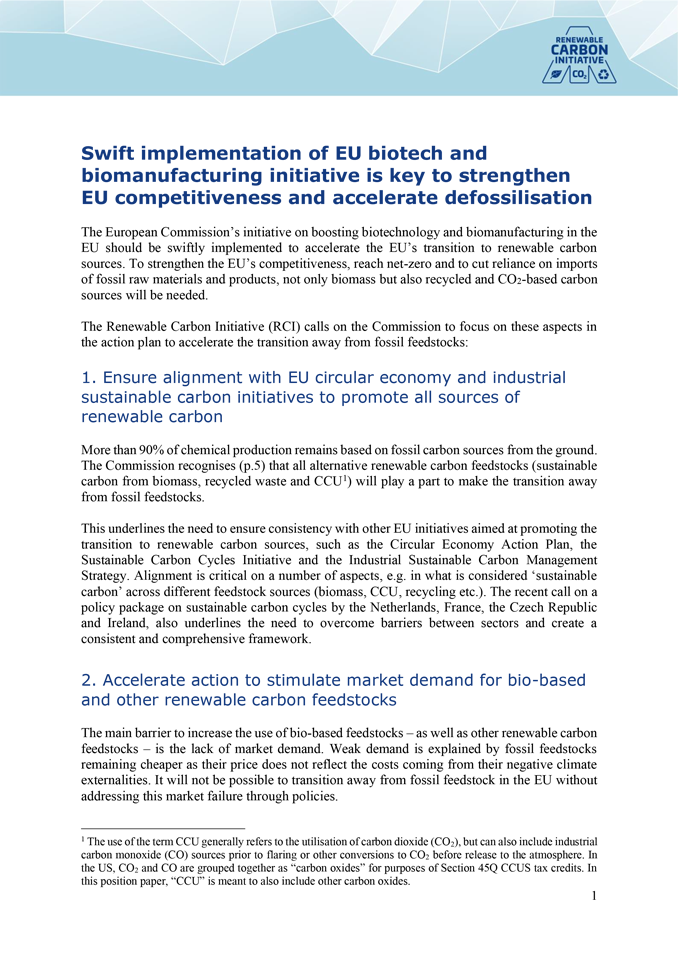
    A group of four EU member states – the Netherlands, France, Ireland and the Czech Republic – are proposing an overarching long-term European policy framework to the European Commissioner for Climate Action, Wopke Hoekstra, who has warmly welcomed the initiative. The joint statement aims to achieve a transition from fossil to sustainable carbon feedstocks in the chemical industry.

    More supportive Member States are expected to join this proposal soon, as it provides a clear pathway without alternative to ensure the transition towards a modern and globally competitive chemical industry in Europe – which at the same time can also achieve sustainability and net-zero targets. The Joint Statement is a milestone and a significant opportunity to limit Europe’s external dependencies while moving closer to our European climate and environmental goals.

  • Direct Download
    breaking news – milestone for the transition to sustainable carbon in the european chemical industry (pdf)

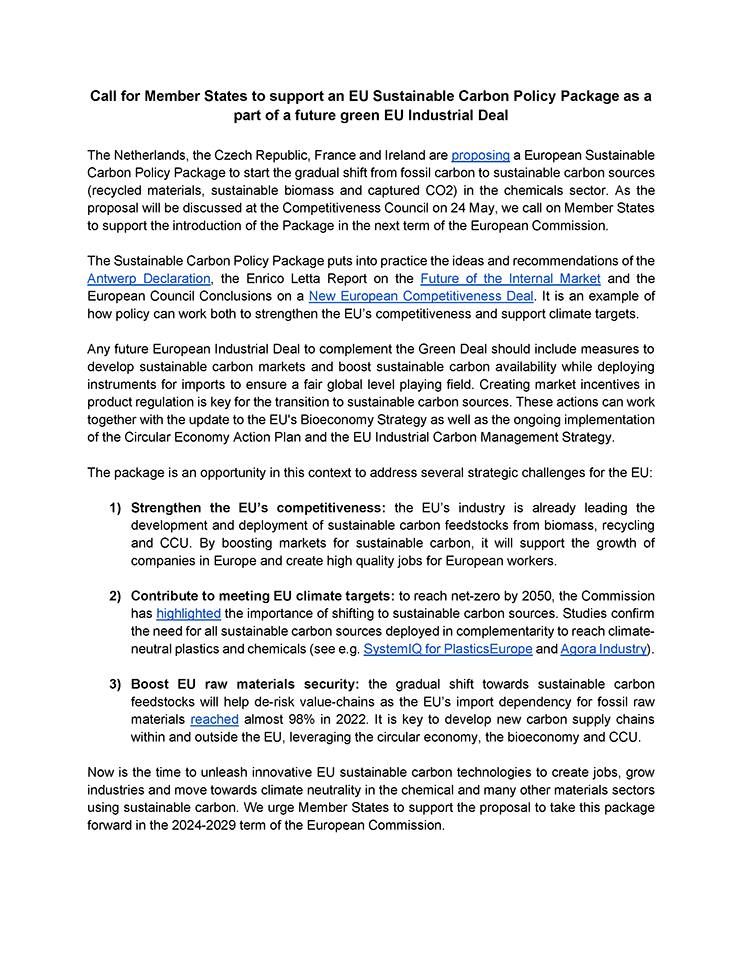
    Call for Member States to support an EU Sustainable Carbon Policy Package as a part of a future green EU Industrial Deal (PDF)

    Markets & Economy, Policy, Sustainability & Health

    2 Pages
    418 Downloads

    418 Downloads  

    2024-05

    FREE

    Free Shipping
     

    418
    Downloads

    Direct Download

    The signatories of this proposal urge Member States to support the EU Sustainable Carbon Policy Package for the 2024-2029 term of the European Commission.

    The Netherlands, the Czech Republic, France, and Ireland are advocating for an EU Sustainable Carbon Policy Package to transition the chemicals sector from fossil carbon to sustainable sources. This proposal, to be discussed at the Competitiveness Council on May 24, aims to enhance EU competitiveness, achieve climate targets, and secure raw material supplies by developing sustainable carbon markets and promoting innovative technologies. The initiative aligns with the Antwerp Declaration, the Enrico Letta Report, and the European Council Conclusions, and seeks to support job creation, industry growth, and climate neutrality.

  • Direct Download
     short version (pdf) (copy)

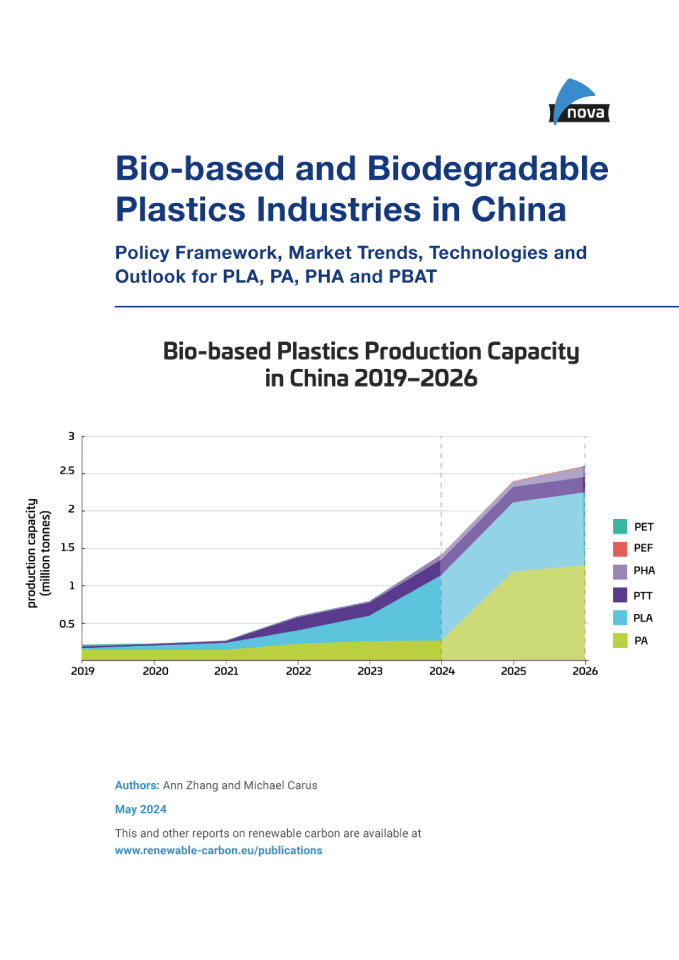
    Bio-based and Biodegradable Plastics Industries in China – Short Version (PDF)

    Markets & Economy, Policy, Sustainability & Health

    14 Pages
    1235 Downloads

    1235 Downloads  

    2024-05

    FREE


    1235
    Downloads

    Direct Download

    China has emerged as a global leader in strategic technologies such as 5G, renewable energy, and electric vehicles in the past two decades. This dominance may leave European companies impressed and concerned about competition while also sparking curiosity about China’s leapfrogging advancement in these areas.

    Paving the way to a net-zero chemical industry in 2060, using renewable biomass to produce bio-based chemicals has been one of the promising transitional solutions for the global chemical industry. As China and Europe strive to follow this path, a similar question may exist within the European chemical industry: What is the status of the bio-based industry in China? Can China and Europe find a cooperative and win-win way to develop this industry?

  • Select
    licence
     short version (pdf) (copy)

    Bio-based and Biodegradable Plastics Industries in China (PDF)

    Markets & Economy, Policy, Sustainability & Health

    71 Pages


    2024-05

    1,500 € – 8,000 €Price range: 1,500 € through 8,000 € ex. tax

    Plus 19% MwSt.
    Press
    release
    Select
    licence

    China has emerged as a global leader in strategic technologies such as 5G, renewable energy, and electric vehicles in the past two decades. This dominance may leave European companies impressed and concerned about competition while also sparking curiosity about China’s leapfrogging advancement in these areas.

    Paving the way to a net-zero chemical industry in 2060, using renewable biomass to produce bio-based chemicals has been one of the promising transitional solutions for the global chemical industry. As China and Europe strive to follow this path, a similar question may exist within the European chemical industry: What is the status of the bio-based industry in China? Can China and Europe find a cooperative and win-win way to develop this industry?

  • Direct Download
    rci position paper on chemical and physical recycling (pdf)

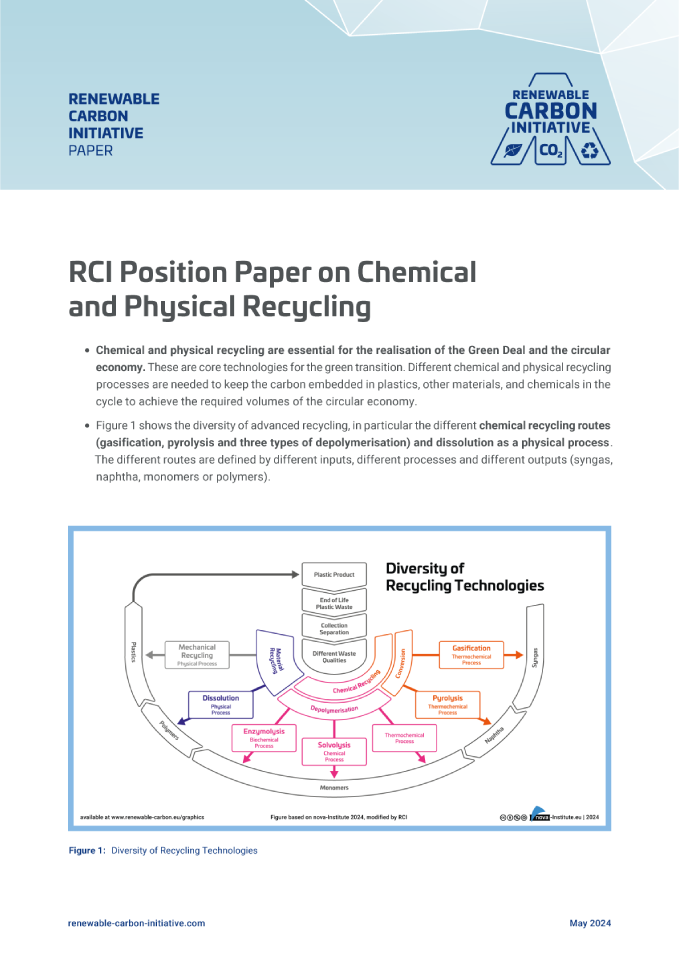
    RCI Position Paper on Chemical and Physical Recycling (PDF)

    Policy, Technology

    4 Pages
    992 Downloads

    992 Downloads  

    2024-05

    FREE

    Free Shipping
     

    992
    Downloads

    Direct Download

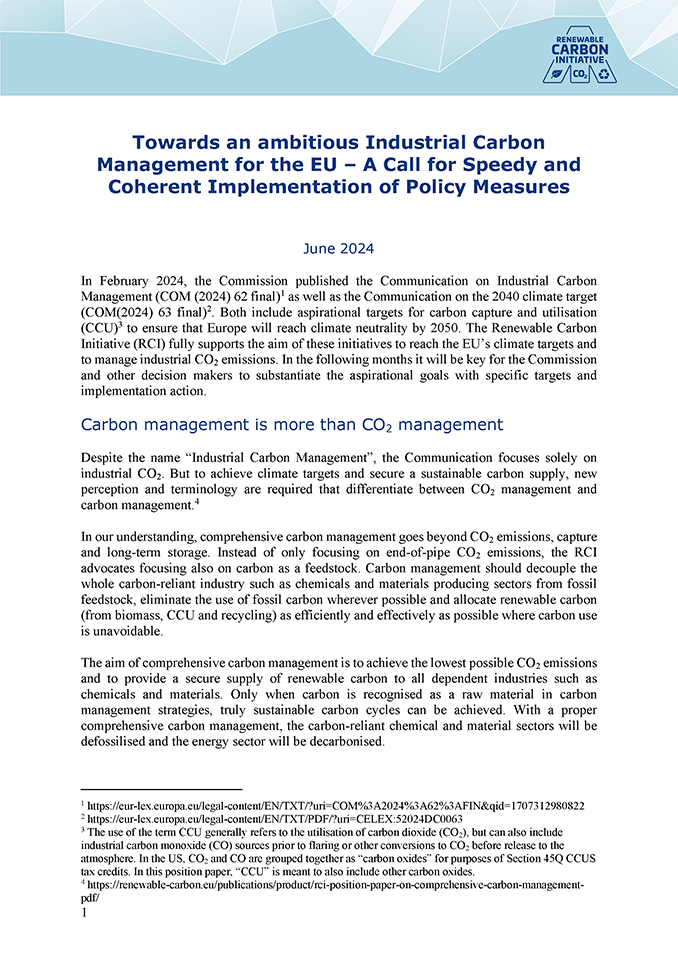
    In this position paper, the RCI describes that chemical and physical recycling play essential roles in realising the objectives of the Green Deal and advancing the circular economy. These technologies are indispensable for the green transition.

    This position paper identifies eleven requirements to create secure demand, drive investment and further improve the technology field. These include general acceptance of the technology; mandatory recycled content for all polymers/plastics in all applications; recognition and clarification of rules for the calculation of recycling rates; full acceptance of mass balance & attribution with fuel-use excluded; accelerated approval of new chemical and physical recycling facilities; expansion of recycling infrastructure for all sectors beyond packaging; and the extension of CO2 pricing for waste incineration in the ETS combined with a landfill ban.

    Additionally, RCI advocates for a pragmatic approach, emphasising that while closed-loop recycling is a noble goal for sectors such as packaging, textiles and automobiles, it should not be approached too dogmatically. Flexibility is essential to prevent environmental and economic inefficiencies. If the waste stream of one sector can be better used in another, this should be possible.

  • Direct Download
    renewable carbon initiative (rci) webinar slides – april 2024 (pdf)

    Renewable Carbon Initiative (RCI) Webinar slides – April 2024 (PDF)

    Markets & Economy, Policy, Technology

    43 Pages
    212 Downloads

    212 Downloads  

    2024-05

    FREE

    Free Shipping
     

    212
    Downloads

    Direct Download

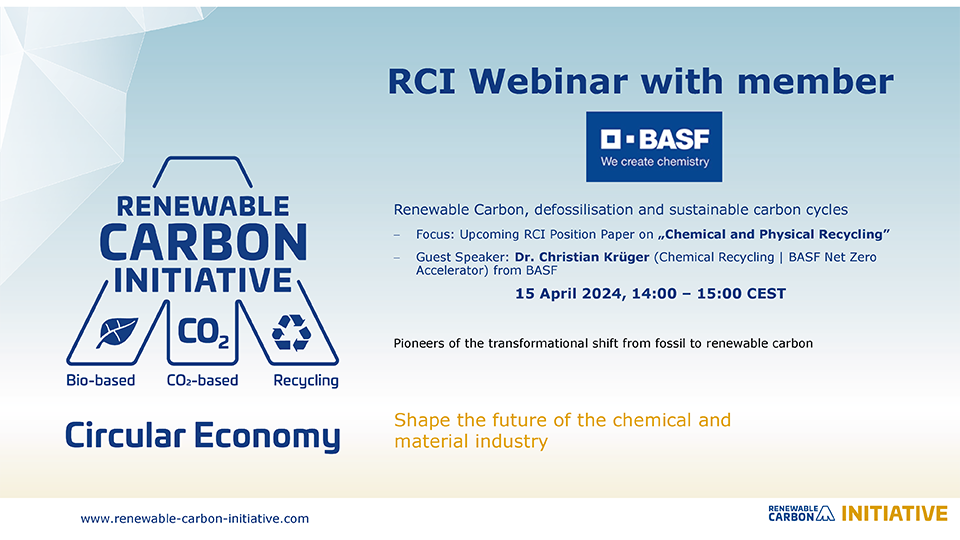
    This document contains a generic set of slides to introduce the concept of renewable carbon and the Renewable Carbon Initiative. The focus of this webinar was the upcoming position paper on Chemical and Physical Recycling.

  • Add to
    cart
    CO2-based Fuels and Chemicals Conference 2024 (Proceedings, PDF) [Digital]

    CO2-based Fuels and Chemicals Conference 2024 (Proceedings, PDF)

    Markets & Economy, Policy, Sustainability & Health, Technology


    2024-05

    50 € ex. tax

    Plus 19% MwSt.
    Press
    release
    Add to
    cart

    The proceedings of the CO2-based Fuels and Chemicals Conference 2024 (17-18 April 2024, https://co2-chemistry.eu) contain all released presentations, the conference journal, and the press release of the three winners of the Innovation Award “Best CO2 Utilisation 2024″.

  • Direct Download
    advanced recycling erwartet rasanten globalen und europäischen wachstumstrend (pdf)

    Advanced Recycling erwartet rasanten globalen und europäischen Wachstumstrend (PDF)

    Markets & Economy

    3 Pages
    183 Downloads

    183 Downloads  

    2024-04

    FREE


    183
    Downloads

    Direct Download

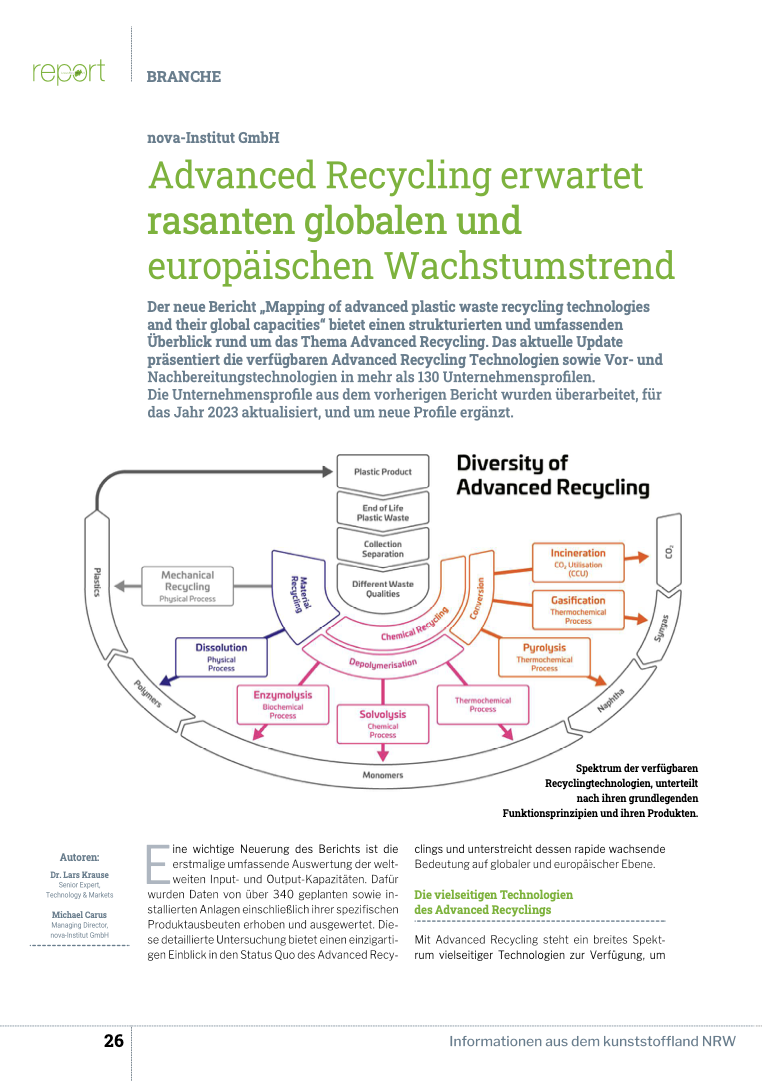
    Der neue Bericht „Mapping of advanced plastic waste recycling technologies and their global capacities“ bietet einen strukturierten und umfassenden Überblick rund um das Thema Advanced Recycling. Das aktuelle Update präsentiert die verfügbaren Advanced Recycling Technologien sowie Vor- und Nachbereitungstechnologien in mehr als 130 Unternehmensprofilen. Die Unternehmensprofile aus dem vorherigen Bericht wurden überarbeitet, für das Jahr 2023 aktualisiert, und um neue Profile ergänzt.

    Quelle: Advanced Recycling erwartet rasanten globalen und europäischen Wachstumstrend – aus kunststoffland NRW report 01/2024, 26-28

  • Add to
    cart
    Cellulose Fibres Conference 2024 (Proceedings, PDF) [Digital]

    Cellulose Fibres Conference 2024 (Proceedings, PDF)

    Markets & Economy, Policy, Sustainability & Health, Technology


    2024-04

    50 € ex. tax

    Plus 19% MwSt.
    Press
    release
    Add to
    cart

    The conference covered the entire value chain, from lignocellulose, chemical pulp, cellulose fibres such as rayon, viscose, modal or lyocell and new developments to a wide range of applications:
    Textiles from renewable fibres, non-wovens such as wet wipes as well as new areas such as composites, hygiene, packaging or nanocellulose in the food industry. The conference offered deep insights into the promising future of cellulose fibres, which perfectly fits the current trends of circular economy, recycling and sustainable carbon cycles.

    The Cellulose Fibres Conference Proceedings (https://cellulose-fibres.eu, 13-14 March 2024, Cologne, hybrid) include all released conference presentations, the conference journal, sponsor documents, a Fiber2Fashion Knowledgepaper and the conference press release.

  • Direct Download
    Bio-based-Building-Blocks-and-Polymers

    Bio-based Building Blocks and Polymers – Global Capacities, Production and Trends 2023–2028 – Short Version (PDF)

    Markets & Economy

    28 Pages
    2462 Downloads

    2462 Downloads  

    2024-03

    FREE


    2462
    Downloads

    Direct Download

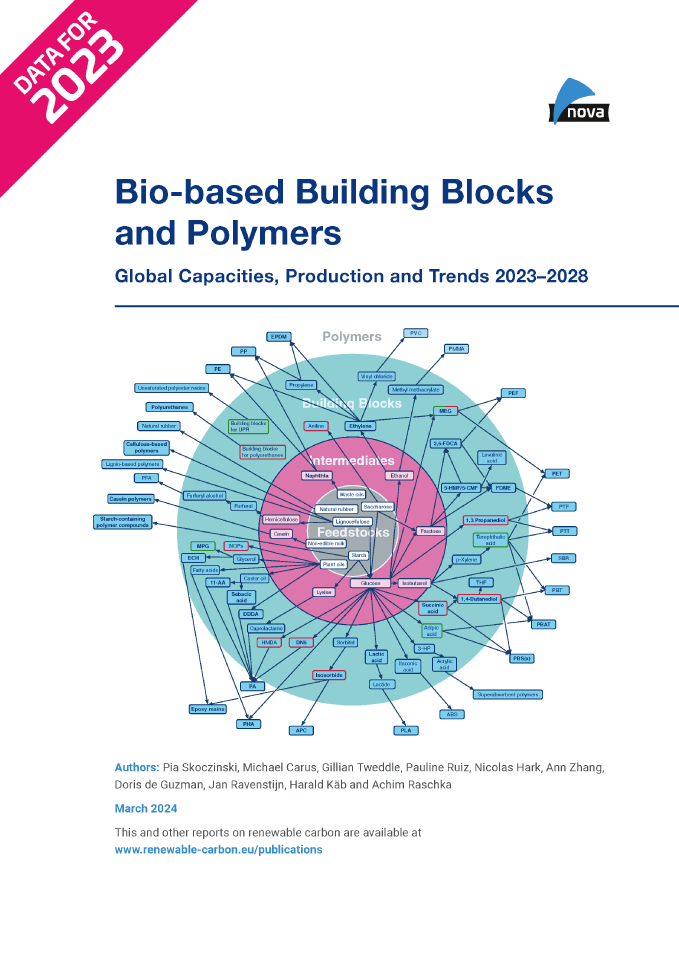
    New report released on the global bio‑based polymer market 2023 – a deep and comprehensive insight into a dynamically growing market

    The year 2023 was a promising year for bio‑based polymers: PLA capacities have been increased by almost 50 %, and at the same time polyamide capacities are steadily increasing, as well as epoxy resin production. Capacities for 100 % bio-based PE have been expanded and PE and PP made from bio‑based naphtha are being further established with growing volumes. Current and future expansions for PHAs are still on the horizon. After hinting at a comeback in 2022 bio-based PET production dropped in 2023 by 50 %.

    DOI No.: https://doi.org/10.52548/VXTH2416

  • Select
    licence
    Bio-based-Building-Blocks-and-Polymers

    Bio-based Building Blocks and Polymers – Global Capacities, Production and Trends 2023–2028 (PDF)

    Markets & Economy

    438 Pages


    2024-03

    1,000 € – 3,000 €Price range: 1,000 € through 3,000 € ex. tax

    Plus 19% MwSt.
     
    Select
    licence

    New report released on the global bio‑based polymer market 2023 – a deep and comprehensive insight into a dynamically growing market

    The year 2023 was a promising year for bio‑based polymers: PLA capacities have been increased by almost 50 %, and at the same time polyamide capacities are steadily increasing, as well as epoxy resin production. Capacities for 100 % bio-based PE have been expanded and PE and PP made from bio‑based naphtha are being further established with growing volumes. Current and future expansions for PHAs are still on the horizon. After hinting at a comeback in 2022 bio-based PET production dropped in 2023 by 50 %.


    DOI No.: https://doi.org/10.52548/VXTH2416

  • Direct Download
    renewable carbon initiative (rci) webinar slides – february 2024 (pdf)

    Renewable Carbon Initiative (RCI) Webinar slides – February 2024 (PDF)

    Policy, Sustainability & Health

    61 Pages
    1769 Downloads

    1769 Downloads  

    2024-02

    FREE

    Free Shipping
     

    1769
    Downloads

    Direct Download

    This document contains a generic set of slides to introduce the concept of renewable carbon and the Renewable Carbon Initiative. The focus of this webinar was the latest scientific background report: “Non-level Playing Field for Renewable Materials vs. Fossil in Life Cycle Assessments – Critical aspects of the JRC Plastics LCA methodology and its policy implications”.

    In addition, three RCI member companies shared their expertise on renewable carbon, defossilisation and sustainable carbon cycles.

    AllocNow (speaker: Daniel Bochnitschek) talked about how the increasing demand for sustainable and low carbon products is driving the need for specific and comprehensive information on product carbon footprints. AllocNow discussed why standardisation of sustainability accounting methodologies is critical and how a data-driven approach can help create transparency at scale.

    Econic Technologies Ltd. (speaker: Liz Manning) spoke about the opportunities and challenges of quantifying the sustainability impact of key products in complex manufacturing supply chains.

    SCS Global Services (speakers: Miguel Ruiz and Jéssica Marcon Bressanin) highlighted its certification activities, focusing on biofuels and circular materials schemes, as well as greenhouse gas accounting methodologies.

    More information at https://renewable-carbon-initiative.com/media/library

  • Select
    licence
    mapping of advanced plastic waste recycling technologies and their global capacities (pdf)

    Mapping of Advanced Plastic Waste Recycling Technologies and their Global Capacities (PDF)

    Markets & Economy, Technology

    276 Pages


    2024-02

    3,000 € – 10,000 €Price range: 3,000 € through 10,000 € ex. tax

    Plus 19% MwSt.
     
    Select
    licence

    Advanced recycling technologies are developing at a fast pace, with new players constantly appearing on the market, from start-ups to giants and everything in between – new plants are being built, new capacities are being achieved, and new partnerships are established. Due to these developments, it is difficult to keep track of everything. The report “Mapping of advanced plastic waste recycling technologies and their global capacities” aims to clear up this jungle of information providing a structured, in-depth overview and insight. It has an exclusive focus on profiling available technologies and providers of advanced recycling including the addition of new technologies and updated/revised profiles. Furthermore, for the first time a comprehensive evaluation of the global input and output capacities was carried out for which more than 340 planned as well as installed and operating plants including their specific product yields were mapped.

    Further information:
    The new report “Mapping of advanced plastic waste recycling technologies and their global capacities” differs from the old report “Chemical Recycling – Status, Trends and Challenges” as follows:

    • All technology provider profiles from the old report included + updated to 2023.
    • Overall >120 technologies and providers (vs. >70 technologies and providers in the old report)
    • Global capacities

    In summary, this report is suitable for interested readers who have already dealt with the advanced recycling topic and are looking for an up-to-date overview of all identified providers and a detailed description of the technologies.


    DOI No.: https://doi.org/10.52548/WQHT8696

  • Direct Download
    mapping of advanced plastic waste recycling technologies and their global capacities (pdf)

    Mapping of Advanced Plastic Waste Recycling Technologies and their Global Capacities – Short Version (PDF)

    Markets & Economy, Technology

    12 Pages
    2220 Downloads

    2220 Downloads  

    2024-02

    FREE


    2220
    Downloads

    Direct Download

    Advanced recycling technologies are developing at a fast pace, with new players constantly appearing on the market, from start-ups to giants and everything in between – new plants are being built, new capacities are being achieved, and new partnerships are established. Due to these developments, it is difficult to keep track of everything. The report “Mapping of advanced plastic waste recycling technologies and their global capacities” aims to clear up this jungle of information providing a structured, in-depth overview and insight. It has an exclusive focus on profiling available technologies and providers of advanced recycling including the addition of new technologies and updated/revised profiles. Furthermore, for the first time a comprehensive evaluation of the global input and output capacities was carried out for which more than 340 planned as well as installed and operating plants including their specific product yields were mapped.

    Further information:
    The new report “Mapping of advanced plastic waste recycling technologies and their global capacities” differs from the old report “Chemical Recycling – Status, Trends and Challenges” as follows:

    • All technology provider profiles from the old report included + updated to 2023.
    • Overall >120 technologies and providers (vs. >70 technologies and providers in the old report)
    • Global capacities

    In summary, this report is suitable for interested readers who have already dealt with the advanced recycling topic and are looking for an up-to-date overview of all identified providers and a detailed description of the technologies.

    Click here for the the full version of the study.

  • Direct Download
    rci’s internal survey: „how to enable the transition from fossil to renewable carbon in the chemical and material sector“ (january 2024)

    RCI’s Internal Survey: „How to enable the transition from fossil to renewable carbon in the chemical and material sector“ (January 2024)

    Policy, Sustainability & Health

    3 Pages
    665 Downloads

    665 Downloads  

    2024-01

    FREE


    665
    Downloads

    Direct Download

    In a comprehensive member survey in summer 2023, the Renewable Carbon Initiative (RCI) has collected ideas and opinions on what is needed to enable the transition from fossil to renewable carbon in Europe. The feedback paints a clear picture and is a call to action.

    The European chemicals and materials sector is under pressure. RCI members, representing a wide range of these sectors, see many common elements in the key challenges and how to address them. High energy and raw material prices, as well as the need to defossilise carbon demand to meet CO2 emission targets, particularly in so-called “Scope 3” emissions, are some of the issues frequently raised.

  • Direct Download
    rci: non level playing field for renewable materials vs. fossil in life cycle assessments

    RCI’s scientific background report: “Non-level playing field for renewable materials vs. fossil in Life Cycle Assessments” (January 2024)

    Policy, Sustainability & Health

    44 Pages
    1555 Downloads

    1555 Downloads  

    2024-01

    FREE


    1555
    Downloads

    Direct Download

    Critical aspects of the JRC Plastics LCA methodology and its policy implications

    This RCI Scientific Background Report was mainly motivated by a study published by JRC in 2021 with the title: “LCA of alternative feedstocks for plastic products”, commonly referred to as the JRC Plastics LCA Method (Nessi et al. 2021).

    Alternative feedstocks refer to the same three feedstocks that RCI defines as renewable carbon: biomass, CO2 utilisation and recycling. The study describes a methodology developed by the JRC to compare the environmental performance of alternative feedstocks with fossil-based plastic products. However, the methodology has also been subject to criticism from various stakeholders, mainly from the bio-based sector, eliciting responses from the JRC.

    This RCI report is mainly aiming to provide additional context to highlight issues that might arise with implementation of the JRC Plastics LCA methodology, and dives deeper into five aspects:

    1. The fossil footprint is likely underestimated, not transparent and lacks regional differentiation
    2. Renewable feedstocks are more cirtically evaluated than fossil feedstocks
    3. Methodological inconsistency and different regulatory support between energy and material use of renewable feedstocks
    4. Biogenic/Atmospheric carbon uptake cannot be transparently visualised at factory in PEF / JRC Plastics LCA methodologies
    5. The methodology should acknowledge the wider interface of sustainability assessment, policy design and landscape

    The report contains several recommendations to remedy the above-mentioned aspects.

    DOI No.: https://doi.org/10.52548/KOTY2900

  • Direct Download
    22 11 28 rc publications cover proceedings arc

    Advanced Recycling Conference 2023 (Proceedings)

    Markets & Economy, Policy, Sustainability & Health, Technology


    12 Downloads

    12 Downloads  

    2023-12

    FREE

    Plus 19% MwSt.
     

    12
    Downloads

    Direct Download

    The proceedings of the Advanced Recycling Conference 2023 (28-29 November, https://advanced-recycling.eu) contain conference presentations, the conference journal, sponsor documents and the press release. Download of the conference journal incl. the program.

  • Direct Download
    23 06 13 cover food paper short version thumbnail

    RCI’s scientific background report: “The use of food and feed crops for bio-based materials and the related effects on food security – Promoting evidence-based debates and recognising potential benefits” (June 2023) Short Version

    Markets & Economy, Policy, Sustainability & Health, Technology

    2 Pages
    999 Downloads

    999 Downloads  

    2023-11

    FREE


    999
    Downloads

    Direct Download

    Promoting Evidence-based Debates and Recognising Potential Benefits

    This short version of the scientific paper highlights on two pages new insights into a hotly debated topic and urges for careful and evidence-based debates.

    The paper aims to show that the well-known biomass debate is flawed, subjective and not fully based on evidence. What is detrimental to food security are, according to the World Food Programme in 2023, climate change, conflict, extreme inequalities in wealth distribution, heavy dependence on food imports from industrial countries, overconsumption of meat, losses along the value chain and the impact of the COVID pandemic. Competition between biomass uses is not mentioned among the relevant causes.

    The use of biomass for industrial applications, does have the potential to replace fossil feedstocks and thus contribute to the urgently needed reduction of fossil carbon emissions into our atmosphere to mitigate climate change.

    While not denying the dire need to combat world hunger, the authors of the paper argue that using food and feed crops for chemicals and materials will not necessarily exacerbate food insecurity, and in fact has the potential to cause multiple benefits for local and global food security, climate mitigation and other factors:

    1. The climate wins – Bio-based materials are part of the solution to achieve climate change mitigation.
    2. Land productivity wins – The competition between applications is not for the type of crop grown, but for the land.
    3. The environment wins – due to increased resource efficiency and productivity of food and feed crops.
    4. Farmers win – because they have more options for selling stock to different markets.
    5. Market stability wins – due to increased global availability of food and feed crops.
    6. Feed security wins – due to the high value of the protein-rich co-products of food and feed crops.
    7. Food security wins – due to the increased overall availability of edible crops that can be stored and flexibly distributed.
  • Direct Download
    rci scientific background report: case studies baed on peer reviewed life cycle assessments – carbon footprints of different carbon based chemicals and materials (pdf)

    RCI’s scientific background report: “Case studies based on peer-reviewed Life Cycle Assessments – Carbon footprints of different carbon-based chemicals and materials” (November 2023)

    Sustainability & Health

    39 Pages
    2283 Downloads

    2283 Downloads  

    2023-11

    FREE


    2283
    Downloads

    Direct Download

    In this brochure, the RCI (https://renewable-carbon-initiative.com) presents five peer-reviewed LCA case studies – representing the highest possible scientific standard – that examine the carbon footprint of materials and products made from renewable carbon. These case studies are on products from RCI member companies Avantium (NL), BASF (DE), IFF (US), Lenzing (AT), Neste (FI) and all LCAs have been peer-reviewed by external experts. The LCAs have been summarised by experts of nova-Institutes sustainability team.

    The case studies visualise that there are not only competitive materials and products made of renewable carbon already on the market, but that they also come with significantly lower carbon footprints ranging from 30–90%.

    A key aspect of replacing fossil carbon with renewable carbon is the gained circularity of carbon. The less additional fossil carbon is added to our above-ground cycle of atmosphere, biosphere and technosphere, the smaller will be the amount of carbon emissions that have to be balanced out with expensive atmospheric removal and underground storage of carbon.

    It is essential to recognise that the carbon footprint of renewable carbon-based materials is not automatically close to zero for two primary reasons:

    • Fossil energy in the value chain
    • Ongoing innovation and optimisation

    All in all, the here presented materials and products show reduced carbon footprints already today, which lowers the remaining emissions gap so that less CO2 needs to be removed from the atmosphere in the future. At the same time, these materials and products still have significant potential to further reduce emissions in the future.

    DOI No.: https://doi.org/10.52548/YYZY2819

Renewable Carbon Types

Publications

Topics

  • 1
  • 2
  • 3
  • 4
  • 5
  • 6
  • …
  • 22

nova-Logo
contact@nova-institut.de
www.nova-institute.eu

nova-Institut GmbH
Leyboldstr. 16
50354 Hürth / Germany

  • Renewable Carbon
  • Events
  • Publications
  • Graphics
  • News
  • Business Directory
  • Newsletter
  • nova-Institute
  • My account
  • Legal Information
  • Terms and Conditions
  • Data protection regulation
© 2026 nova-Institut GmbH
Renewable Carbon Publications - Logo

Login

Lost your password?