Showing 101–120 of 238
-
Consumption of Embedded Carbon for Global Polymers (PNG)
Markets & Economy, Policy
1 Page
134 Downloads
134 Downloads
2023-07
FREE
Free Shipping134
DownloadsFigure from the RCI Carbon Flows Report 2023
-
Carbon Demand for Embedded Carbon in the EU-27 Chemical Industry (PNG)
Markets & Economy, Policy
1 Page
154 Downloads
154 Downloads
2023-07
FREE
Free Shipping154
DownloadsFigure from the RCI Carbon Flows Report 2023
-
Explorative Scenario – Carbon Embedded in the Heavy Oil Fraction. (PNG)
Markets & Economy, Policy
1 Page
56 Downloads
56 Downloads
2023-07
FREE
Free Shipping56
DownloadsFigure from the RCI Carbon Flows Report 2023
-
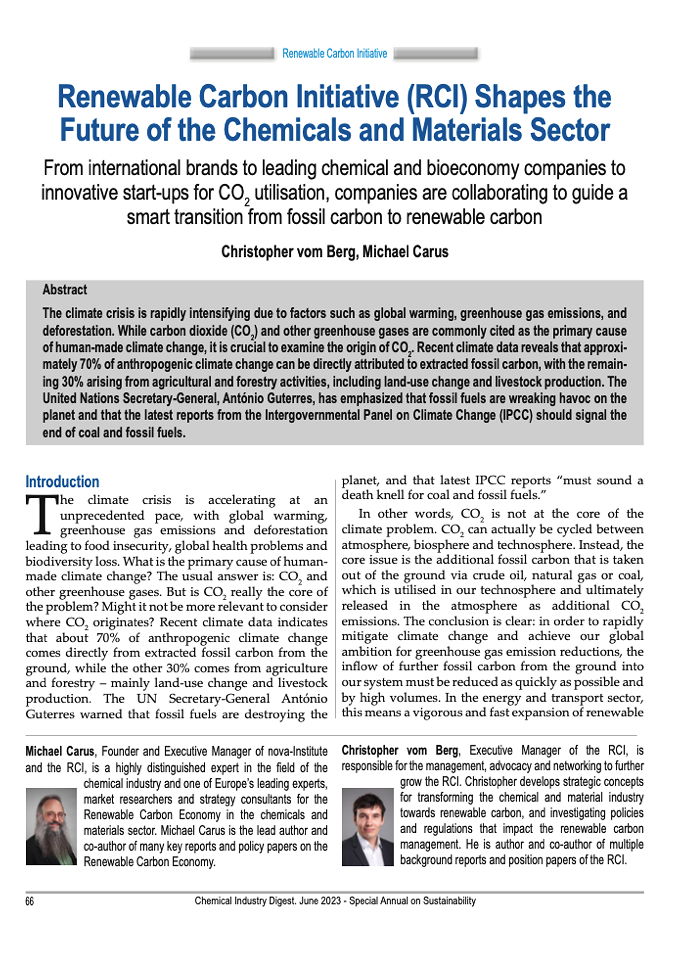
Renewable Carbon Initiative (RCI) Shapes the Future of the Chemicals and Materials Sector
Markets & Economy, Policy
3 Pages
139 Downloads
139 Downloads
2023-07
FREE
Free Shipping139
DownloadsFrom international brands to leading chemical and bioeconomy companies to innovative start-ups for CO2 utilisation, companies are collaborating to guide a smart transition from fossil carbon to renewable carbon. The Renewable Carbon Initiative (RCI) (www.renewable-carbon-initiative.com) was created after observing the struggles of the chemical and material industriesin facing the enormous challenges to meet the climate goals set by the European Union and the sustainability expectations held by societies around the globe. It was clear that the industry has to go beyond using renewable energy and also consider their raw materials. Because decarbonisation is not an option for the chemical and material sector, as it is entirely based on the use of carbon, an alternative strategy is required: defossilisation through renewable carbon – carbon from above the ground: biomass, CO2 and recycling.
-
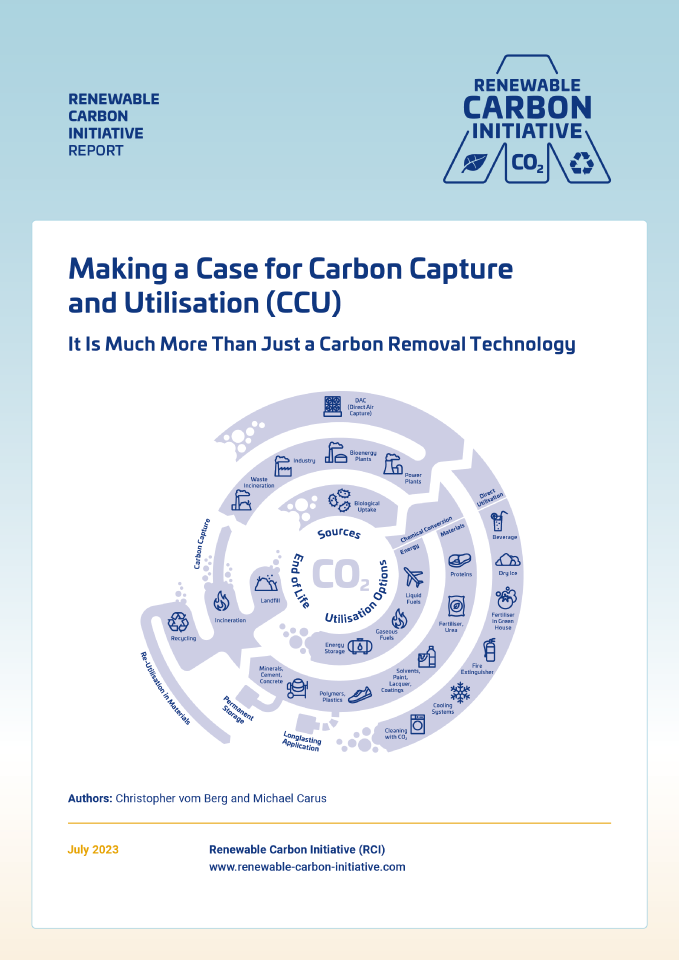
RCI’s scientific background paper: “Making a case for Carbon Capture and Utilisation (CCU) – It is much more than just a carbon removal technology” (July 2023)
Markets & Economy, Policy, Sustainability & Health, Technology
48 Pages
2105 Downloads
2105 Downloads
2023-07
FREE
Free Shipping2105
DownloadsThis scientific background paper highlights the importance of Carbon Capture and Utilisation (CCU) and the need for more political recoginition and support for CCU.
CCU enables the substitution of fossil carbon in sectors where carbon is necessary, supports the full defossilisation of the chemical and derived material industries, creates a circular economy, reduces the emission gap, promotes sustainable carbon cycles, fosters innovation, generates local value and stimulates job growth.
CCU is much more than a carbon removal technology: the technology offers multiple solutions to pressing problems of our modern world and can support several Sustainable Development Goals if implemented properly.
In total, 14 different benefits and advantages of CCU are described and discussed in the paper. A key advantage is that CCU supplies renewable carbon to – and thereby substitutes fossil carbon in – sectors that will require carbon in the long run. This includes the chemical sectors and products like polymers, plastics, solvents, paints, detergents, cosmetics or pharmaceuticals. But CCU is also essential to a long-term net-zero strategy, crucial for creating a sustainable circular economy, providing solutions for scaling up the renewable energy system, and bringing multiple benefits for innovation and business.
The relevance of the technology is not yet accepted in Europe, but the RCI wants to make a very clear statement: CCU is a central pillar for the biggest transformation of the chemical and material industry since the industrial revolution.
DOI No.: https://doi.org/10.52548/VYKR3129
-
182 Downloads
2023-07
FREE
182
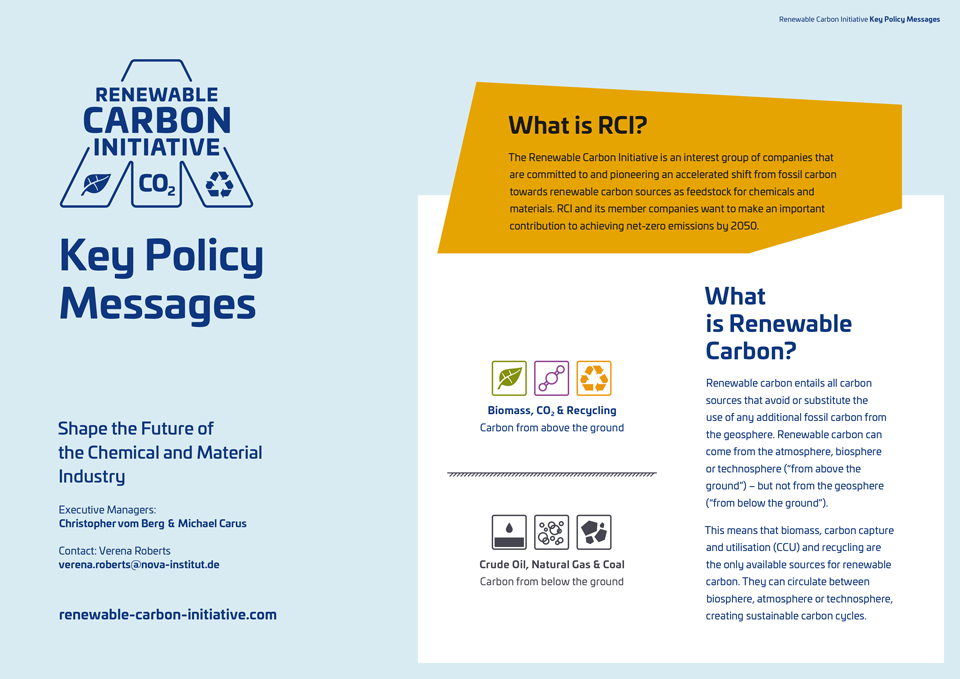
DownloadsThis short document contains seven key policy messages the RCI advocates for to shape the future of the chemical and material industry. These seven messages are:
- Renewable carbon and comprehensive carbon management need to become integral guiding principles of policies to achieve truly sustainable carbon cycles.
- Adopt a precise definition of “non-fossil, sustainable” carbon and then adopt a legally binding target for 20% sustainable, non-virgin-fossil carbon content
- Suitable measures to support the 20% goal would be
- material- and product focused policies that promote all three renewable carbon sources,
- CCU receiving at least the same support as CCS and
- recognition and promotion of chemical recycling technologies
- Support the transformation of existing chemical infrastructure from fossil to renewable carbon and support the transformation of biofuels plants into chemical suppliers
- Support the massive expansion of renewable energies
- Develop standards, certificates and labels for renewable carbon
- Phase out financial support, tax advantages and tax exemptions for fossil feedstocks
-
Proceedings: nova-Session on Policies for Chemicals and Plastics in a Net-Zero Economy (PDF)
Policy
8 Downloads
8 Downloads
2023-06
FREE
Plus 19% MwSt.8
DownloadsAre you ready to join the conversation on Europe’s clean future? The EU has recently introduced a series of key policies aimed at achieving net-zero emissions by 2050, which will have a significant impact on the way companies operate. To help you understand these policies and their implications specifically for chemicals and plastics, nova-Institute hosted an online workshop on “Policies for Chemicals and Plastics in a Net-Zero Economy” in June 2023.
The proceedings includs four presentations of:
- Luciano Proto Cassina, and Nico Hark, nova-Institute: Overview of EU initiatives impacting renewable carbon chemicals and plastics
- Larry Sullivan, KBR: What does the US’s Inflation Reduction Act mean for the EU?
- Carla Benauges, DG CLIMA, European Commission: The EU’s answer to the IRA, the Net-Zero Industry Act
-
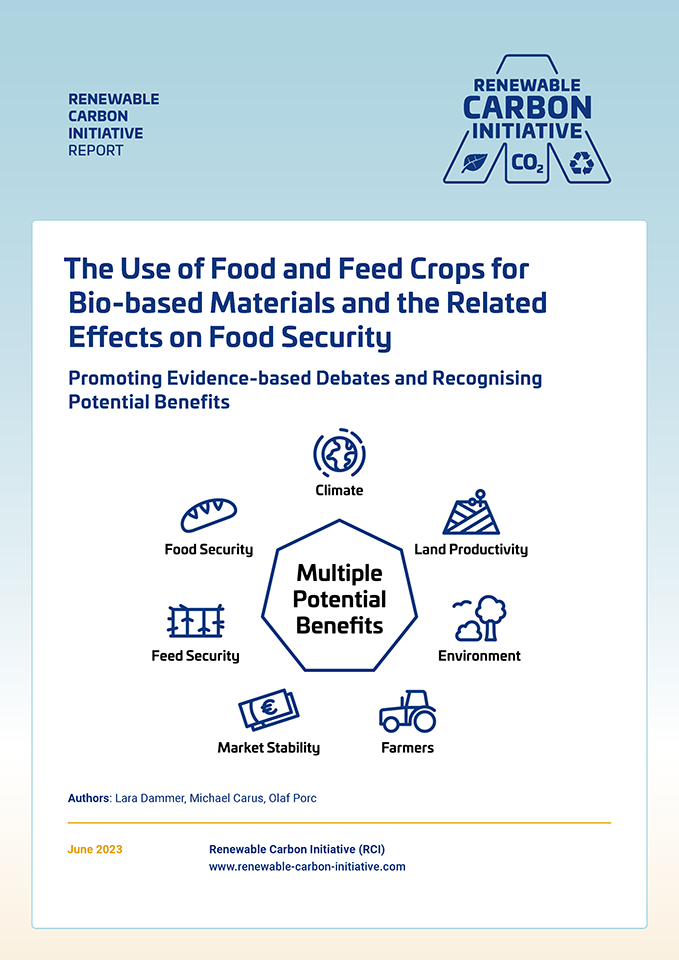
RCI’s scientific background report: “The use of food and feed crops for bio-based materials and the related effects on food security – Promoting evidence-based debates and recognising potential benefits” (June 2023) Long Version
Markets & Economy, Policy, Sustainability & Health, Technology
36 Pages
1737 Downloads
1737 Downloads
2023-06
FREE
1737
DownloadsPromoting Evidence-based Debates and Recognising Potential Benefits
This scientific paper highlights new insights into a hotly debated topic and urges for careful and evidence-based debates.
The paper aims to show that the well-known biomass debate is flawed, subjective and not fully based on evidence. What is detrimental to food security are, according to the World Food Programme in 2023, climate change, conflict, extreme inequalities in wealth distribution, heavy dependence on food imports from industrial countries, overconsumption of meat, losses along the value chain and the impact of the COVID pandemic. Competition between biomass uses is not mentioned among the relevant causes.
The use of biomass for industrial applications, does have the potential to replace fossil feedstocks and thus contribute to the urgently needed reduction of fossil carbon emissions into our atmosphere to mitigate climate change.
While not denying the dire need to combat world hunger, the authors of the paper argue that using food and feed crops for chemicals and materials will not necessarily exacerbate food insecurity, and in fact has the potential to cause multiple benefits for local and global food security, climate mitigation and other factors:
- The climate wins – Bio-based materials are part of the solution to achieve climate change mitigation.
- Land productivity wins – The competition between applications is not for the type of crop grown, but for the land.
- The environment wins – due to increased resource efficiency and productivity of food and feed crops.
- Farmers win – because they have more options for selling stock to different markets.
- Market stability wins – due to increased global availability of food and feed crops.
- Feed security wins – due to the high value of the protein-rich co-products of food and feed crops.
- Food security wins – due to the increased overall availability of edible crops that can be stored and flexibly distributed.
DOI No.: https://doi.org/10.52548/WQXU7327
-
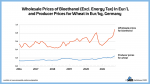
Wholesale Prices of Bioethanol and Wheat (PNG)
Markets & Economy, Policy, Sustainability & Health, Technology
1 Page
85 Downloads
85 Downloads
2023-06
FREE
85
Downloads -
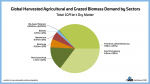
Global Harvested Agricultural and Grazed Biomass Demand by Sectors (PNG)
Markets & Economy, Policy, Sustainability & Health, Technology
1 Page
152 Downloads
152 Downloads
2023-06
FREE
152
Downloads -
Embedded Carbon Demand for Main Sector (PNG)
Markets & Economy, Policy, Sustainability & Health, Technology
1 Page
143 Downloads
143 Downloads
2023-06
FREE
143
Downloads -
Traffic Light Sustainability Risk Evaluation of Bio-based Feedstocks (PNG)
Markets & Economy, Policy, Sustainability & Health, Technology
1 Page
302 Downloads
302 Downloads
2023-06
FREE
302
Downloads -
Corn and its Applications (PNG)
Markets & Economy, Policy, Sustainability & Health, Technology
1 Page
126 Downloads
126 Downloads
2023-06
FREE
126
Downloads -
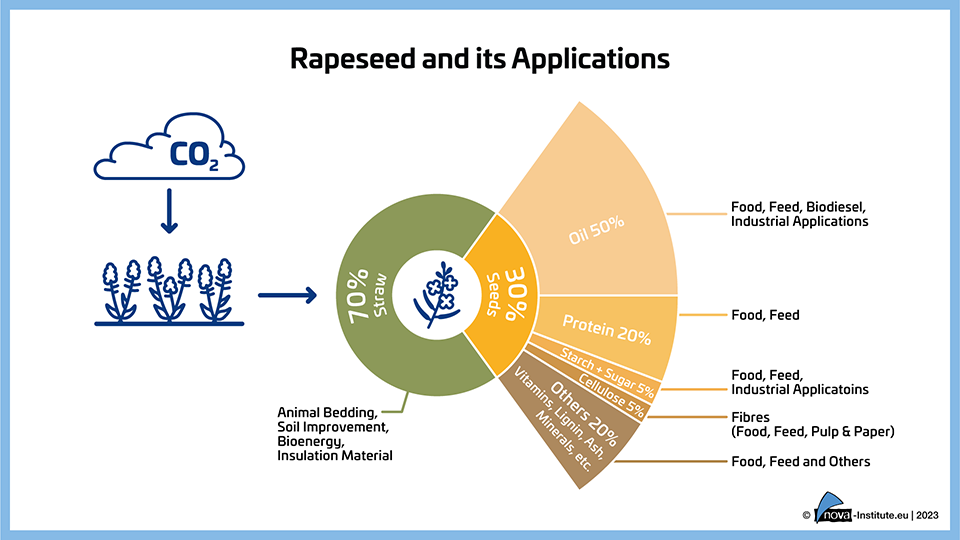
Rapeseed and its Applications (PNG)
Markets & Economy, Policy, Sustainability & Health, Technology
1 Page
98 Downloads
98 Downloads
2023-06
FREE
98
Downloads -
Yield of Fermentable Sugars (PNG)
Markets & Economy, Policy, Sustainability & Health, Technology
1 Page
153 Downloads
153 Downloads
2023-06
FREE
153
Downloads -
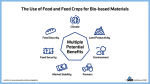
Graphic of the scientific paper „The Use of Food and Feed Crops for Bio-based Materials and the Related Effects on Food Security“ (PNG)
Markets & Economy, Policy, Sustainability & Health, Technology
1 Page
116 Downloads
116 Downloads
2023-06
FREE
116
DownloadsPromoting Evidence-based Debates and Recognising Potential Benefits
The graphic shows the multiple potential benefits of using food and feed crops for bio-based materials, in terms of climate, land productivity, environment, farmers, market stability, feed security and food security.
- The climate wins – Bio-based materials are part of the solution to achieve climate change mitigation.
- Land productivity wins – The competition between applications is not for the type of crop grown, but for the land
- The environment wins – due to increased resource efficiency and productivity of food and feed crops.
- Farmers win – because they have more options for selling stock to different markets.
- Market stability wins – due to increased global availability of food and feed crops.
- Feed security wins – due to the high value of the protein-rich co-products of food and feed crops.
- Food security wins – due to the increased overall availability of edible crops that can be stored and flexibly distributed.
-
Renewable Materials Conference 2023 Proceedings
Markets & Economy, Policy, Sustainability & Health, Technology
233 Downloads
233 Downloads
2023-06
FREE
Plus 19% MwSt.233
DownloadsThe proceedings of the Renewable Materials Conference 2023 (23-25 May 2023, https://renewable-materials.eu) contain all released presentations of three conference days, the conference journal, and the press release of the three winners of the Innovation Award “Renewable Material of the Year 2023“.
-
RCI’s position paper: “Commission proposal for a Packaging and Packaging Waste Regulation” (May 2023)
Policy
3 Pages
295 Downloads
295 Downloads
2023-05
FREE
295
DownloadsThis position paper highlights chances for the EU to lead the way to a sustainable packaging industry and to promote innovation
In November 2022, the Commission adopted the Proposal for a Regulation of the European Parliament and of the Council on packaging and packaging waste, amending Regulation (EU) 2019/1020 and Directive (EU) 2019/904, and repealing Directive 94/62/EC. The proposed regulation includes several rules that would – if implemented – push for a much stronger circular economy in the packaging sector, due to higher re-use and refill quotas, higher use of recycled materials and mandatory composting of certain hard-to-recycle products.
The Renewable Carbon Initiative (RCI) welcomes this proposal and wants to offer several suggestions to strengthen it further and get implementation closer to the market realities of Europe.
1. Set ambitious targets for all types of renewable content:
A complementary renewable content target should be added to the proposal promoting the use of bio- and CO2-based feedstocks in packaging similar to recycling.2. Keep Article 8 as it is – scientific evidence shows that these products offer true environmental benefits from being compostable
The proposal, following scientific evidence, requires that certain types of tea and coffee packaging, sticky labels attached to fruit and vegetables as well as very lightweight plastic carrier bags shall be compostable in industrially controlled conditions in bio-waste treatment facilities.3. Support the market uptake of all state-of-the-art recycling technologies
To actually achieve the ambitious recycling quotas and recycled content targets, technologies will have to evolve. Advanced recycling technologies (i.e. depolymerisation) are key. -
Conference on CO2-based Fuels and Chemicals 2023 Proceedings
Markets & Economy, Policy, Sustainability & Health, Technology
188 Downloads
188 Downloads
2023-05
FREE
Plus 19% MwSt.188
DownloadsThe proceedings of the Conference on CO2-based Fuels and Chemicals (19-20 April 2023, https://co2-chemistry.eu) contain all released presentations, the conference journal, and the press release of the three winners of the Innovation Award “Best CO2 Utilisation 2023″.
Press Release: https://renewable-carbon.eu/news/smart-carbon-capture-and-utilisation-ccu-technologies-and-materials-defossilise-the-economy
-
RCI’s position paper: “Communication on sustainable carbon cycles” (April 2023)
Policy
7 Pages
562 Downloads
562 Downloads
2023-04
FREE
Free Shipping562
DownloadsThe RCI, an interest group of leading companies and pioneers from the chemical and material sector, has a rich history of advocating for policies acknowledging the indispensable need of carbon in a broad range of chemical and material industries. The Communication on Sustainable Carbon Cycles, as published in December 2021, is a milestone in European policy as it acknowledges exactly this value of carbon as a feedstock and its unavoidability for certain sectors. The recently published position paper of the RCI highlights why this is an important step in the right direction and asks policy makers for effective follow-up.


![Proceedings: nova-Session on Policies for Chemicals and Plastics in a Net-Zero Economy (PDF) [Digital]](https://renewable-carbon.eu/publications/wp-content/uploads/2020/05/21-01-07_RC-Publications-Cover-Proceedings_1-100x141.png)
![Renewable Materials Conference 2023 Proceedings [Digital]](https://renewable-carbon.eu/publications/wp-content/uploads/2020/05/21-01-07_RC-Publications-Cover-Proceedings_RMC-100x141.png)
![Conference on CO2-based Fuels and Chemicals 2023 Proceedings [Digital]](https://renewable-carbon.eu/publications/wp-content/uploads/2020/05/21-01-07_RC-Publications-Cover-Proceedings_CO2-based-100x141.png)