Skip to content
Renewable Carbon Publications - LogoRenewable Carbon Publications - Logo
  • Publications
  • Contact
0

No products in the cart.

  • Renewable Carbon
    • Renewable Carbon
    • Events
    • Publications
    • Graphics
    • News
    • Business Directory
    • Newsletter
    • nova-Institute
  • Publications
  • Contact

Renewable Carbon Publications - LogoRenewable Carbon Publications - Logo
0

No products in the cart.

  • Renewable Carbon Publications
  • Policy
  • Page 2
Grid view List view

Showing 21–40 of 233

  • Download Statistics
  • Direct Download
    evaluating lca approaches and methodologies for renewable carbon sources report 1 of 3 – renewable carbon in lca guidelines (march 2025) (pdf)

    Evaluating LCA Approaches and Methodologies for Renewable Carbon Sources Report 1 of 3 – Renewable Carbon in LCA Guidelines (March 2025) (PDF)

    Markets & Economy, Policy, Sustainability & Health

    145 Pages
    909 Downloads

    909 Downloads  

    2025-03

    FREE

    Free Shipping
     

    909
    Downloads

    Direct Download

    Renewable Carbon in LCA Guidelines (146 pages) evaluates methodological choices which impact LCAs for products containing renewable carbon in existing LCA frameworks and guidelines. The study specifically examines the similarities and differences in the methodological choices of guidelines, as well as the implications of these methodological aspects on the resulting LCA outcomes.The frameworks were selected based on their relevance and legitimacy in the industry, academia and policy field, and include: ISO 14040/44, ISO 14067, GHG Protocol Product Standard, PACT’s Pathfinder Framework, the PCF Guideline for the chemical industry by Together for Sustainability (TfS), EPD for the construction industry – ISO 14025 and EN 15804, the Renewable Energy Directive, the Product Environmental Footprint (PEF) and the JRC’s plastics LCA methodology. One field with a particularly large methodological freedom is recycling.

    This report is the first report of a larger RCI project on LCA methodology, which includes two additional publications:

    Report 2 of 3 – Renewable Carbon in Recycling Situations
    Report 3 of 3 – Non-technical Summary

    Please find these additional reports by following the respective links at the bottom of this page.


    DOI No.: https://doi.org/10.52548/VCYM7822

  • Direct Download
    evaluating lca approaches and methodologies for renewable carbon sources report 2 of 3 – renewable carbon in recycling situations (march 2025) (pdf)

    Evaluating LCA Approaches and Methodologies for Renewable Carbon Sources Report 2 of 3 – Renewable Carbon in Recycling Situations (March 2025) (PDF)

    Markets & Economy, Policy, Sustainability & Health

    37 Pages
    630 Downloads

    630 Downloads  

    2025-03

    FREE

    Free Shipping
     

    630
    Downloads

    Direct Download

    This report focuses on renewable carbon in recycling scenarios and the key challenges in LCA and carbon footprint assessments. It examines system boundaries, allocation methods, and biogenic carbon accounting approaches, highlighting their influence on sustainability evaluations. The report emphasises the cut-off and avoided-burden approaches for recycling while recommending the -1/+1 method for biogenic carbon transparency. However, it also identifies contradictions between LCA results and broader sustainability goals, such as the EU waste hierarchy, which prioritises recycling. To address these inconsistencies, the report suggests integrating LCA with additional sustainability metrics like land use and recyclability. Ultimately, refining these methodologies will enhance the accuracy and reliability of environmental assessments for bio-based and recycled materials.

    This report is the second report of a larger RCI project on LCA methodology, which includes two additional publications:

    Report 1 of 3 – Renewable Carbon in LCA Guidelines
    Report 3 of 3 – Non-technical Summary

    Please find these additional reports by following the respective links at the bottom of this page.


    DOI No.: https://doi.org/10.52548/QTVU8642

  • Direct Download
    evaluating lca approaches and methodologies for renewable carbon sources report 3 of 3 – non technical summary (march 2025)

    Evaluating LCA Approaches and Methodologies for Renewable Carbon Sources Report 3 of 3 – Non-technical Summary (March 2025) (PDF)

    Markets & Economy, Policy, Sustainability & Health

    15 Pages
    819 Downloads

    819 Downloads  

    2025-03

    FREE

    Free Shipping
     

    819
    Downloads

    Direct Download

    This Non-technical Summary (15 pages),highlights main insights into the project results and states key take-aways for policy-makers.

    It compares several frameworks, such as ISO 14040, Product Environmental Footprint (PEF), and GHG Protocol, finding both commonalities and critical differences in areas like biogenic carbon accounting and recycling assessment. The study identifies significant methodological flexibility in existing frameworks, leading to inconsistencies in LCA results and challenges in standardisation. Key issues include differing treatment of carbon capture and utilisation (CCU), direct air capture (DAC), and allocation of environmental burdens in multifunctional processes. Policy recommendations emphasise the need for harmonisation, improved biogenic carbon accounting, and clear guidance on emerging technologies like DAC and mass balance attribution. Overall, the study calls for refining LCA methodologies to ensure fair comparison between renewable and fossil-based carbon solutions.

    This report is the third report of a larger RCI project on LCA methodology, which includes two additional publications:

    Report 1 of 3 – Renewable Carbon in LCA Guidelines
    Report 2 of 3 – Renewable Carbon in Recycling Situations

    Please find these additional reports by following the respective links at the bottom of this page.

    DOI No.: https://doi.org/10.52548/ZEKY1803

  • Direct Download
    evaluating lca approaches and methodologies for renewable carbon sources report 3 of 3 – non technical summary (march 2025) (pdf) (copy)

    Core Elements of LCA for Renewable Carbon Solutions (PNG)

    Policy, Sustainability & Health

    1 Page
    109 Downloads

    109 Downloads  

    2025-03

    FREE

    Free Shipping
     

    109
    Downloads

    Direct Download

    Several methodological aspects are relevant for LCA and carbon footprints in general and for products containing renewable carbon in particular.

  • Direct Download
    bio based polymers worldwide (pdf)

    Bio-based Polymers Worldwide (PDF)

    Markets & Economy, Policy, Sustainability & Health

    5 Pages
    755 Downloads

    755 Downloads  

    2025-02

    FREE

    Free Shipping
     

    755
    Downloads

    Direct Download
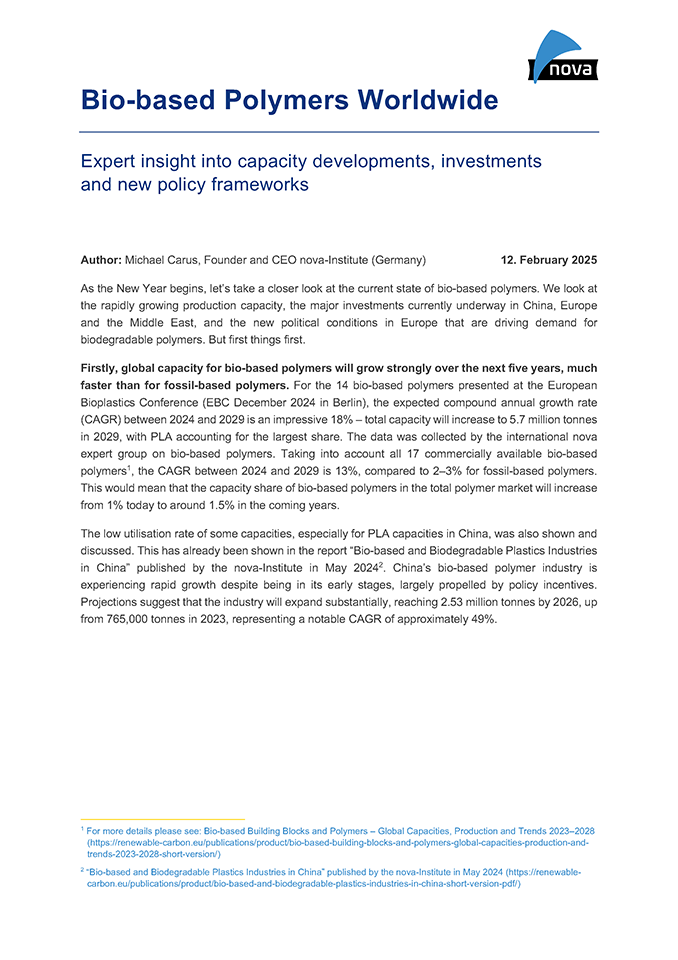
    Expert insight into capacity developments, investments and new policy frameworks:
    • Firstly, global capacity for bio-based polymers will grow strongly over the next five years, much faster than for fossil-based polymers
    • Secondly, investments in new capacity will take place in China, Europe, the Middle East, and the US
    • Thirdly, investment in bio-based polymer capacities is mainly driven by policy frameworks that create demand.
  • Direct Download
    (png)

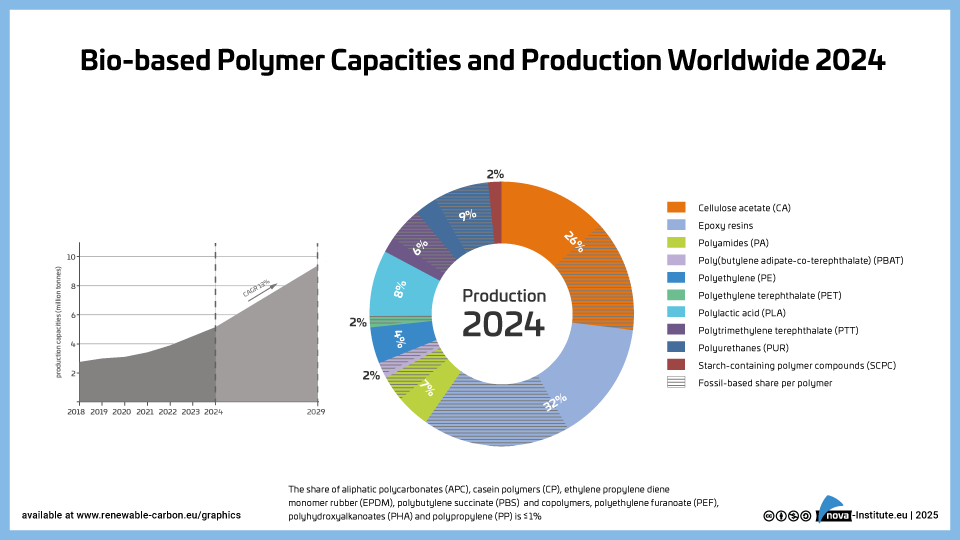
    Bio-based-Polymer-Production-and-Bio-based-shares-2024 (PNG)

    Markets & Economy, Policy, Sustainability & Health

    1 Page
    174 Downloads

    174 Downloads  

    2025-02

    FREE


    174
    Downloads

    Direct Download
  • Direct Download
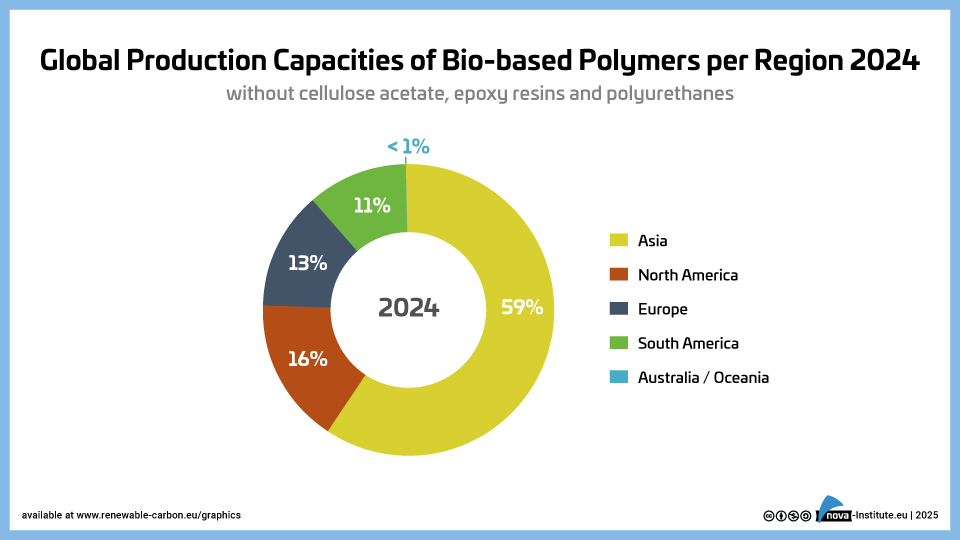
    Global-Production-Capacities-of-Bio-based-Polymers-per-Region-2024

    Global-Production-Capacities-of-Bio-based-Polymers-per-Region-2024 (PNG)

    Markets & Economy, Policy, Sustainability & Health

    1 Page
    39 Downloads

    39 Downloads  

    2025-02

    FREE


    39
    Downloads

    Direct Download
  • Direct Download
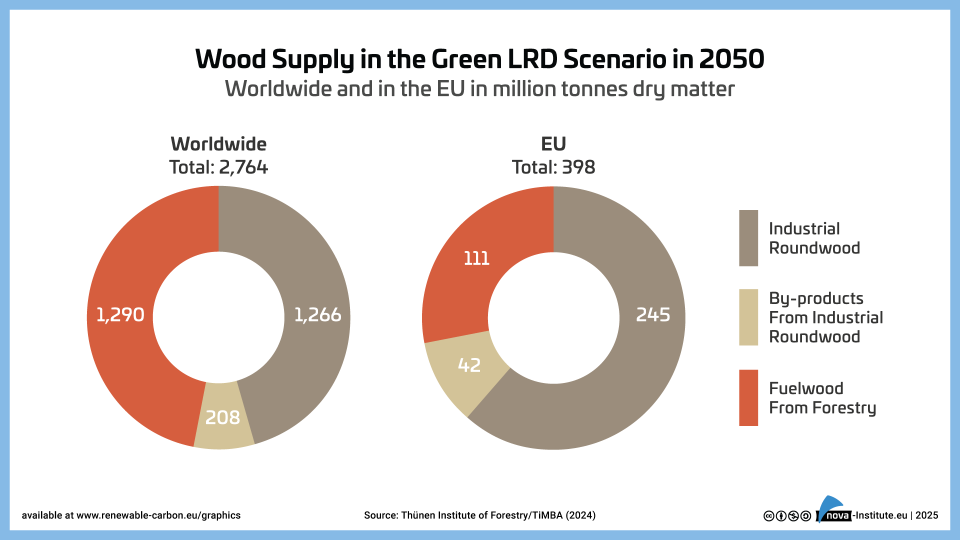
    wood supply in the green lrd scenario in 2050 graphic (png)

    Wood Supply in the Green LRD Scenario in 2050 – Graphic (PNG)

    Markets & Economy, Policy, Sustainability & Health

    1 Page
    9 Downloads

    9 Downloads  

    2025-02

    FREE


    9
    Downloads

    Direct Download
  • Direct Download
    wood supply in the green lrd scenario in 2050 graphic (png) (copy)

    Share of Different Types of Biomass Worldwide 2023-2050 – Graphic (PNG)

    Markets & Economy, Policy, Sustainability & Health

    1 Page
    57 Downloads

    57 Downloads  

    2025-02

    FREE


    57
    Downloads

    Direct Download
  • Direct Download
    share of different types of biomass worldwide 2023 2050 graphic (png) (copy)

    Share-of-Different-Types-of-Biomass-EU-2023–2050 – Graphic (PNG)

    Markets & Economy, Policy, Sustainability & Health

    1 Page
    30 Downloads

    30 Downloads  

    2025-02

    FREE


    30
    Downloads

    Direct Download
  • Direct Download
    share of different types of biomass eu 2023–2050 graphic (png) (copy)

    Supply and Demand of Agriculture Biomass in the EU 2050 – Graphic (PNG)

    Markets & Economy, Policy, Sustainability & Health

    1 Page
    31 Downloads

    31 Downloads  

    2025-02

    FREE


    31
    Downloads

    Direct Download
  • Direct Download
    supply and demand of agriculture biomass in the eu 2050 graphic (png) (copy)

    Supply and Demand of Agriculture Biomass Worldwide 2050 – Graphic (PNG)

    Markets & Economy, Policy, Sustainability & Health

    1 Page
    34 Downloads

    34 Downloads  

    2025-02

    FREE


    34
    Downloads

    Direct Download
  • Direct Download
    supply and demand of agriculture biomass worldwide 2050 graphic (png) (copy)

    Wood Demand in the Green LRD Scenario Worldwide 2050 – Graphic (PNG)

    Markets & Economy, Policy, Sustainability & Health

    1 Page
    14 Downloads

    14 Downloads  

    2025-02

    FREE


    14
    Downloads

    Direct Download
  • Direct Download
    wood demand in the green lrd scenario worldwide 2050 graphic (png) (copy)

    Supply and Demand of Agricultural Biomass in the EU 2050 in HT +5 Scenario – Graphic (PNG)

    Markets & Economy, Policy, Sustainability & Health

    1 Page
    24 Downloads

    24 Downloads  

    2025-02

    FREE


    24
    Downloads

    Direct Download
  • Direct Download
     graphic (png) (copy)

    Supply and Demand of Agricultural Biomass Worldwide 2050 in HT +10 Scenario – Graphic (PNG)

    Markets & Economy, Policy, Sustainability & Health

    1 Page
    36 Downloads

    36 Downloads  

    2025-02

    FREE


    36
    Downloads

    Direct Download
  • Direct Download
    evaluation of recent reports on the future of a net zero chemical industry in 2050 (pdf) (copy)

    Is there Enough Biomass to Defossilise the Chemicals and Derived Materials Sector by 2050? – A Joint BIC and RCI Scientific Background Report (PDF)

    Markets & Economy, Policy, Sustainability & Health

    41 Pages
    1742 Downloads

    1742 Downloads  

    2025-02

    FREE

    Free Shipping
     

    1742
    Downloads

    Direct Download

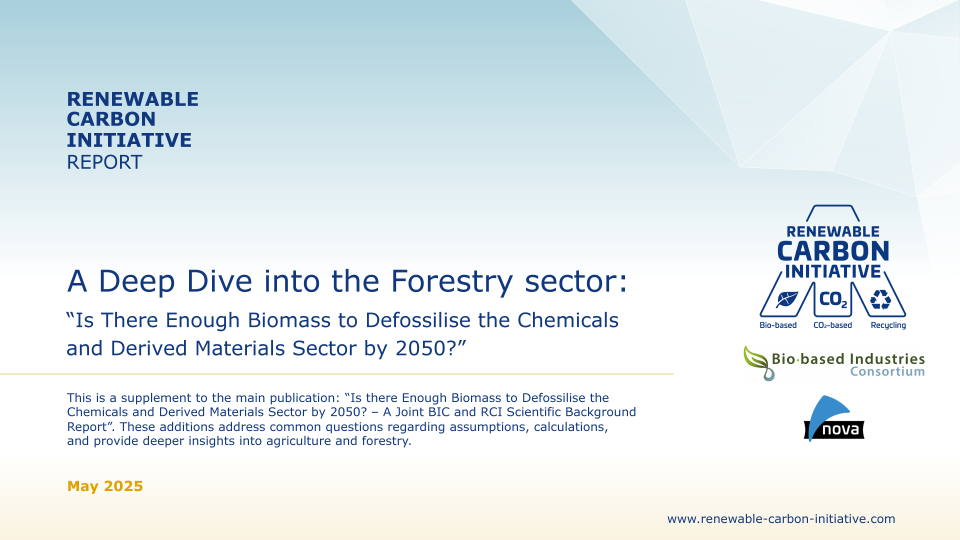
    This reports presents the findings of a joint project of the Bio-based Industries Consortium (BIC) and the Renewable Carbon Initiative (RCI), which focuses on whether agricultural and woody biomass combined sustainably provide enough biomass to meet 20% of the future carbon demand of the chemical and derived materials industries in 2050 (up from 5.5% (EU27) and 10% (global) in 2023).

    This leading question was investigated with professional experts to model a business-as-usual, a low resource depletion, and a high-tech scenario to better analyse the possible ranges of biomass availability under different developments.

    Agriculture: By 2050, under the BAU scenario, production is projected to increase by 31% to 5.07 billion tonnes. Cereals increase by 32% to 3.1 billion tonnes, sugar by 40% to 340 million tonnes and vegetable oils by 45% to 317 million tonnes. In the Green LRD scenarios, production is projected to increase by 24–26%, and in the Green HT scenarios by 38–53% – compared to 31% in the BAU scenario.

    Forestry: Global supply and demand of industrial roundwood (coniferous and non-coniferous) will increase by an estimated 38% between 2020 and 2050, from 0.9 to 1.3 billion tdm. The largest increase in supply is expected in Asia (69%), including China and Russia, but a significant increase of 32% is also seen for Europe.

    The report concludes that sustainably meeting 20% of total carbon demand of the chemicals and derived materials sector in 2050 via biomass seems a realistic and achievable estimate.

    DOI No.: https://doi.org/10.52548/PIRL6916

  • Direct Download
    eu and global: biomass demand for transport fuels, aviation and shipping up to 2050 and implications for biomass supply to the chemical sector (pdf)

    EU and Global: Biomass Demand for Transport Fuels, Aviation and Shipping up to 2050 and Implications for Biomass Supply to the Chemical Sector (PDF)

    Markets & Economy, Policy, Sustainability & Health

    44 Pages
    1258 Downloads

    1258 Downloads  

    2025-01

    FREE

    Free Shipping
     

    1258
    Downloads

    Direct Download

    The Renewable Carbon Initiative’s Scientific Background Report explores three potential future scenarios for carbon-based fuel demand up to 2050 under current policy frameworks. It predicts a sharp rise in the demand for second-generation biomass biofuels, driven primarily by increasing quotas for aviation and shipping fuels. This growth raises concerns about ecological and resource sustainability and creates challenges for sectors like chemicals and materials, which rely on renewable carbon to reduce fossil dependency. Without similar regulatory incentives, these sectors may face limited access to critical feedstocks like biomass and captured carbon.

    The report highlights that while bio-based and synthetic fuel production could indirectly benefit the chemical industry through by-products, competition with the fuel sector poses significant obstacles.The report includes 11 tables, 9 graphics, and a detailed overview of EU fuel regulations. Though focused on Europe, it also provides global insights, making it a valuable resource for stakeholders in biomass and CO2 utilisation sectors.

    DOI: https://doi.org/10.52548/GXVG4189

  • Direct Download
    european biomass demand in mt for biofuel production – graphic (png)

    European Biomass Demand in Mt for Biofuel Production – Graphic (PNG)

    Markets & Economy, Policy, Sustainability & Health

    1 Page
    31 Downloads

    31 Downloads  

    2025-01

    FREE


    31
    Downloads

    Direct Download
  • Direct Download
    global non fossil c fuel demand in the transport sector – strong ccu graphic (png) (copy)

    Industrial Roundwood Production in Three Scenarios in Million m3 – Graphic (PNG)

    Markets & Economy, Policy, Sustainability & Health

    1 Page
    7 Downloads

    7 Downloads  

    2025-01

    FREE


    7
    Downloads

    Direct Download
  • Direct Download
    european biomass demand in mt for biofuel production – graphic (png) (copy)

    European Non-fossil C-fuel Demand in the Transport Sector – Basic – Graphic (PNG)

    Markets & Economy, Policy, Sustainability & Health

    1 Page
    28 Downloads

    28 Downloads  

    2025-01

    FREE


    28
    Downloads

    Direct Download

Renewable Carbon Types

Publications

Topics

  • 1
  • 2
  • 3
  • 4
  • …
  • 12

nova-Logo
contact@nova-institut.de
www.nova-institute.eu

nova-Institut GmbH
Leyboldstr. 16
50354 Hürth / Germany

  • Renewable Carbon
  • Events
  • Publications
  • Graphics
  • News
  • Business Directory
  • Newsletter
  • nova-Institute
  • My account
  • Legal Information
  • Terms and Conditions
  • Data protection regulation
© 2025 nova-Institut GmbH
×
Renewable Carbon Publications - Logo

Login

Lost your password?