Showing 1–20 of 440
-
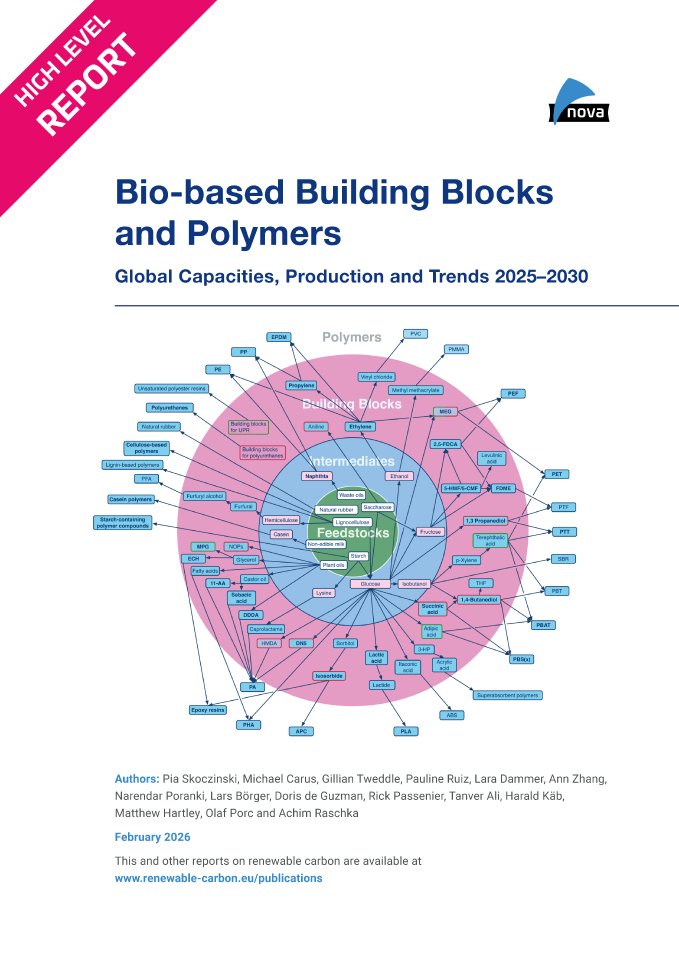
Bio-based Building Blocks and Polymers – Global Capacities, Production and Trends 2025–2030 (PDF)
NewMarkets & Economy
23 Pages
1517 Downloads
1517 Downloads
2026-02
FREE
Free Shipping1517
DownloadsThe new high-level report “Bio‑based Building Blocks and Polymers – Global Capacities, Production and Trends 2025–2030”, compiled by the international biopolymer expert group of the nova-Institute, provides an overview of the capacities and production data of 17 commercially available bio‑based building blocks and polymers in 2025, along with a forecast for 2030. Detailed market data is available via individual workshops and webinars with the biopolymer experts. This data includes capacity development from 2018 to 2030, production data for the years 2024 and 2025, and analyses of market developments per building block, polymer and producers, as well as a statistical analysis of “Mass Balance and Attribution (MBA)” products available worldwide.
2025 was a solid year for bio-based polymers, with an expected overall CAGR of 11 % to 2030 and an average capacity utilisation rate of 86 %. Overall, bio-based non-biodegradable polymers have larger installed capacities and higher utilisation rates than bio-based biodegradable polymers. While 58 % of the total installed capacities are from bio-based non-biodegradable polymers, 42 % are bio-based biodegradable polymers. Bio-based non-biodegradable have an average utilisation rate of 90 % whereas bio-based biodegradable polymers have an average utilisation rate of 81 %. The expected CAGR for both, bio-based non-biodegradable and biodegradable is similar with 10 % and 11 %, respectively.
Epoxy resin and PUR production is growing moderately at 9 and 8 %, respectively, while PE and PP are increasing by 17 % and 94 %. Also, capacities for the biodegradables PHA and PLA are expected to increase until 2030 by 49 % and 16 %, respectively. Commercial newcomers such as casein polymers and PEF have increased production capacity and are expected to continue to grow significantly until 2030.
DOI No.: https://doi.org/10.52548/PILO4285
-
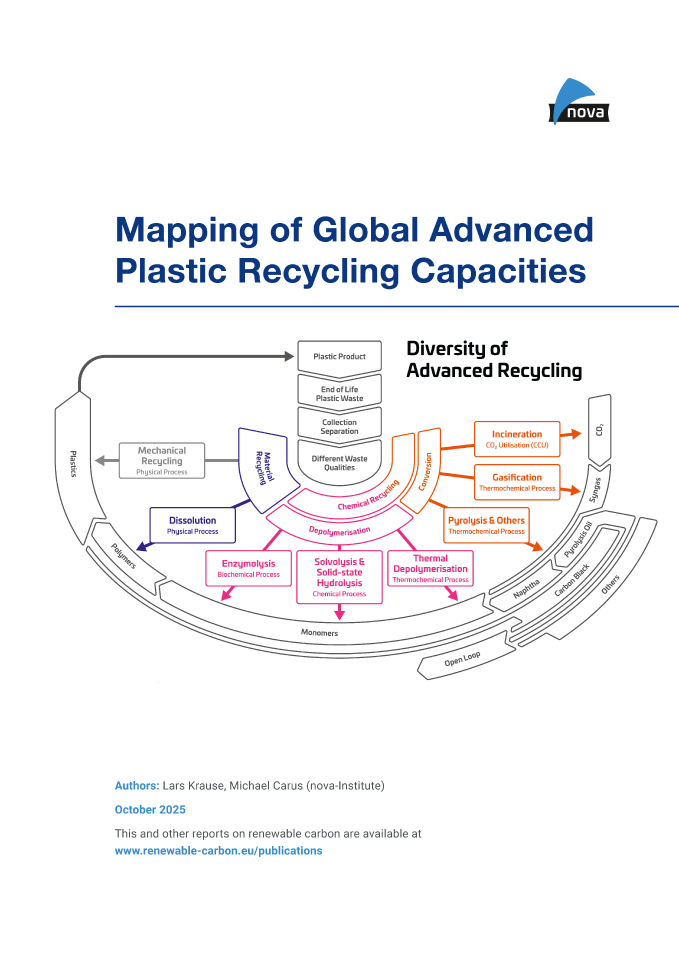
Mapping of Global Advanced Plastic Recycling Capacities (PDF)
NewMarkets & Economy, Policy, Technology
35 Pages
2025-11
500 € – 1,000 €Price range: 500 € through 1,000 € ex. tax
Plus 19% MwSt.Press
release Select
licenceChemical and physical recycling are essential to keeping carbon in the loop and fully establishing a circular economy. Despite delays in policy regulations and investment, experts foresee a bright future for new capacity, both globally and in Europe.
The development of advanced recycling technologies is very dynamic and at a fast pace, with new players constantly appearing on the market, from start-ups to chemistry giants and everything in between. New plants are being built, and new capacities are being achieved. Due to these dynamic developments, it is difficult to keep track of everything. The nova report “Mapping of global advanced plastic recycling capacities” aims to clear up this jungle of information. A comprehensive evaluation of the global input and output capacities was carried out for which 390 planned as well as installed and operating plants including their specific product yields were mapped to provide an overview about global advanced recycling capacities in the past, present, and future.
Further information: The new report represents a short study updating the current and future Advanced Recycling input- and output-capacities for the year 2024-2031. The report does not include any technology- or company-profiles which are published in another study (https://doi.org/10.52548/WQHT8696).
DOI No.: https://doi.org/10.52548/YKWB6074
-
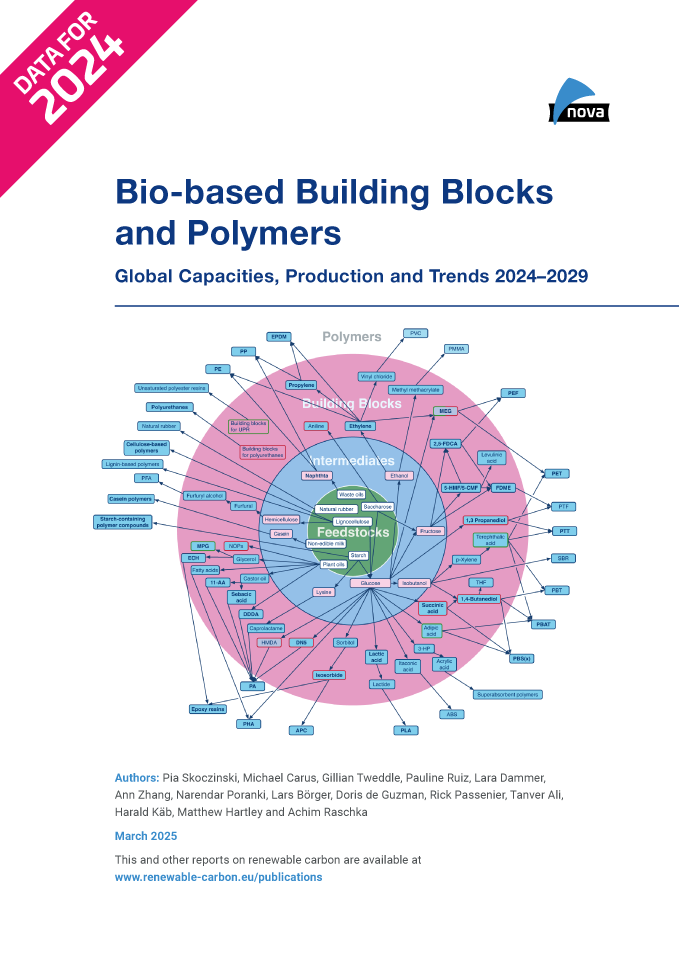
Bio-based Building Blocks and Polymers – Global Capacities, Production and Trends 2024–2029 (PDF)
NewMarkets & Economy
434 Pages
2025-03
3,000 € – 10,000 €Price range: 3,000 € through 10,000 € ex. tax
Plus 19% MwSt.Press
release Select
licence2024 was a respectable year for bio-based polymers, with an overall expected CAGR of 13 % to 2029. Overall, bio-based biodegradable polymers have large installed capacities with an expected CAGR of 17 % to 2029, but the current average capacity utilisation is moderate at 65 %. In contrast, bio-based non-biodegradable polymers have a much higher utilisation rate of 90 %, but will only grow by 10 % to 2029.
Epoxy resin and PUR production is growing moderately at 9 and 8 %, respectively, while PP and cyclic APC capacities are increasing by 30 %. Despite a decline in production of biodegradables, especially for PLA in Asia, capacities have increased by 40 %. The same applies to PHA capacities. Commercial newcomers such as casein polymers and PEF recorded a rise in production capacity and are expected to continue to grow significantly until 2029.
DOI No.: https://doi.org/10.52548/UMTR4695
-
85 Downloads
2026-09
FREE
Free Shipping85
DownloadsInput for DG GROW & Steering Group Consideration ahead of the October GA
Ahead of the second General Assembly, this paper offers constructive input on the first cycle of the EU Critical Chemicals Alliance (CCA). It acknowledges the substantial progress achieved across its four Working Groups, and it flags a limited number of aspects for the Steering Group and DG GROW to consider in a revised mandate: uneven attention to the CCA’s modernisation objective relative to maintaining existing production, skewed stakeholder representation, process-integrity concerns around pre-settled outcomes, and the need for clearer cross-Working-Group coordination and timeline predictability. The paper closes with specific recommendations based on experiences across the different Working Groups,, aimed at making the CCA’s next cycle balanced, transparent and forward-looking.
-
Toward a Defossilized Chemical Industry – Trends in Europe (Affiliate product) (PDF)
Markets & Economy, Sustainability & Health, Technology
37 Pages
2026-08
FREE
Free Shipping0
More
Downloads
infoChemicals are present in more than 90% of manufactured goods, and almost everything from solar panels to pharmaceuticals is made with the help of chemicals. It is still largely based on fossil raw materials and is a major consumer of fossil resources and energy. Because Europe is committed to reducing CO2 emissions from fossil sources in the interest of climate protection, the chemical industry must reduce its fossil fuel footprint. Key measures for achieving this goal are the decarbonization of energy and the defossilization of carbon embedded in chemical products.
In this brief, we discuss the status and future trends of renewable energy supplies in Europe, including hydrogen, and the status and trends of the development of green carbon chemicals through recycling, bioproduction in biorefineries, and the use of CO2 as feedstock (CCU, carbon capture and utilization). We also refer to the current approaches to climate neutrality of major chemical producers in Europe.
Direct download via the renewable-carbon.eu/publications is not possible.
Please follow this link: https://doi.org/10.1016/j.greenca.2026.01.007 -
Biodiversity in Sustainability Assessments – in Particular Life-Cycle-Assessments (LCA) – RCI Report (PDF)
Sustainability & Health
98 Pages
393 Downloads 393 Downloads
2026-08
FREE
Free Shipping393
DownloadsThe chemical and materials industry must reduce reliance on fossil feedstocks to cut emissions, improve resource security, and support Europe’s strategic autonomy. Biomass is an important renewable carbon source, but its expansion must be managed carefully to avoid harming biodiversity. Although the sector currently uses only a small share of global biomass, it could lead efforts to balance sustainable production with biodiversity protection through better assessment tools and responsible sourcing.
The report reviews recent methods for measuring biodiversity impacts in terrestrial Life Cycle Assessment. No single method covers all biodiversity levels and major causes of biodiversity loss, and current approaches remain limited by data gaps, uncertainty, and inconsistent metrics. For high-level business screening, the report recommends UNEP-GLAM and, once available, BioMAPS within the Environmental Footprint framework, supported by field measurements, certification schemes, sensitivity analysis, and other assessment methods.
-
Investments totalling more than 5 billion with a future bio-based quota for plastics in Europe (PDF)
Markets & Economy, Policy
3 Pages
99 Downloads 99 Downloads
2026-05
FREE
Free Shipping99
DownloadsImplementing a 5% bio-based quota for all polymers produced in Europe could be just as successful as the introduction of biofuels.
As a draft scenario, we assume that (1) 30% will come from bio-attributed sources, (2) 25% from dedicated bio-based polymers, and (3) 45% from drop-in bio-based polymers. What would this require in terms of investment? Based on these assumptions, a 5% bio-based (including bio-attributed) polymer quota would generate €5.3 billion in investment, similar to the level of investment in first-generation biofuels. A subsequent 30% bio-based (including bio-attributed) polymer quota would generate €32 billion, similar to the level of investment in sustainable aviation fuels (SAF) in the next decades.
-
Why is Vioneo building its first methanol-to-PP/PE plant in China rather than Europe?
Markets & Economy, Policy
3 Pages
58 Downloads 58 Downloads
2026-05
FREE
Free Shipping58
DownloadsZOOM-Interview with Alex Hogan (CEO of Vioneo) by Michael Carus (nova-Institut/RCI), 11 May 2026
The vision of Vioneo as ‘fossil-free pioneers for the plastics industry, using green methanol to produce fossil-free polypropylene and polyethylene on a commercial scale‘ will be realised in China, not in Europe. Michael asks Alex why this is the case.
Mandatory EU legislation (quotas, definitions, regulatory differentiation) is the single most important enabler for Vioneo — and similar companies — to invest in Europe. Without it, the market remains voluntary, price-driven, and commercially unviable for premium fossil-free products.
As Europe is a more expensive production location than the US or Asia, the only way forward – as Alex Hogan makes clear – is to create clear, strong and lasting framework conditions in Europe to generate robust demand for renewable chemistry and plastics, as well as to build the infrastructure that makes production in the EU possible. These framework conditions are indeed being discussed and are planned, but it is not certain whether they will actually materialise, in what form, or when. But who invests in hopes and announcements?
-
Could the production of European chemicals be achieved without naphtha and steam crackers? What alternative pathways could be viable in the future? (PDF)
Markets & Economy, Policy, Technology
7 Pages
154 Downloads 154 Downloads
2026-05
FREE
Free Shipping154
DownloadsOver the next few decades, naphtha steam cracking will remain the dominant and most efficient process in the European chemical industry. However, naphtha is produced from crude oil, which is linked to several problems: (1) climate change, especially from Scope 3 emissions; (2) a linear instead of a circular economy; (3) most innovation taking place in other areas than crackers; (4) a failure to achieve resilience and strategic autonomy; and (5) Europe’s inability to compete with other regions of the world that have better access to cheaper crude oil and naphtha. Furthermore, (6) renewable naphtha produced from biomass, waste or CO₂ is very expensive (2–3 times more expensive), and (7) other pathways than naphtha and steam crackers are often more efficient for these alternative renewable feedstocks.
These are seven good reasons to discuss what alternative pathways could be viable in the future of Europe’s chemical industry and how they could be implemented. This paper mainly focuses on methanol, ethanol and biodiesel. Before delving into these topics, two brief comments on ammonia production, biotechnology and biomanufacturing and electrochemistry are provided.
-
CO2-based Fuels and Chemicals Conference 2026 (Proceedings, PDF)
Markets & Economy, Policy, Sustainability & Health, Technology
2026-05
150 € ex. tax
Plus 19% MwSt.Press
release Add to
cartThe proceedings of the CO2-based Fuels and Chemicals Conference 2026 (28-29 April 2026, https://co2-chemistry.eu) contain all released presentations (download of the program leaflet, PDF) and the press release of the three winners of the Innovation Award “Best CO2 Utilisation 2026″.
-
Support for bio-based feedstock in plastic packaging analysis under the Packaging and Packaging Waste Regulation (EU) 2025/40 (Affiliate product)
Markets & Economy, Policy, Sustainability & Health, Technology
100 Pages
2026-05
FREE
Free Shipping0
More
Downloads
infoNew publication from nova experts for the European Commission
This report assesses the role of bio-based feedstocks in plastic packaging under the EU’s Packaging and Packaging Waste Regulation (PPWR), with a focus on technological development and environmental performance. Although seventeen bio-based polymers are commercially available, they represent only ~1% of the global plastics market and account for just 4–5% of biogenic carbon in the EU chemical sector. Production capacity is concentrated in Asia (55%), followed by North America (17%) and the EU27+3 (14%). Despite their limited market share, there are no fundamental technical barriers to using them in packaging. Bio-based plastics offer a 30–70% reduction in greenhouse gas emissions compared to fossil-based alternatives, which supports the EU’s decarbonisation and circular economy goals. The report also evaluates the feasibility of setting targets for the use of bio-based materials, their equivalence with recycled materials and how sustainability criteria can be aligned with the Renewable Energy Directive (RED). Key recommendations include setting binding targets for bio-based content, establishing harmonised sustainability criteria, and adapting recycling infrastructure. Leveraging the complementarity of bio -based and recycled content could help to accelerate the EU’s transition to a climate-neutral packaging sector.Direct download via the renewable-carbon.eu/publications is not possible. -
AI Circular Economy Conference 2026 (Proceedings, PDF)
Markets & Economy, Policy, Sustainability & Health, Technology
2026-03
150 € ex. tax
Plus 19% MwSt.Press
release Add to
cartThe proceedings of the AI Circular Economy Conference 2026 (4-5 March, https://ai-circulareconomy.eu ) contain 25 conference presentations and the press release. Download of the program leaflet.
-
336 Downloads
2026-02
FREE
Free Shipping336
DownloadsBased on internal assessment of RCI member companies and joint analysis, this report reveals existing EU legislation which creates several roadblocks for the shift from fossil to renewable carbon, The report identifies ten concrete policy barriers across seven EU frameworks, including the ETS, REDIII, PPWR and SUPD.
Key findings show regulatory misalignment (creating non-level playing fields and regulatory uncertainty), outdated definitions and misleading classifications (excluding innovative, climate-friendly products from incentives and market access) and impractical administrative bureaucracy (often conflicting with industrial realities). The biggest barrier is not identified in a single regulation, but identified as the lack of coherent support for renewable carbon in the chemicals and derived materials economy.
The report provides practical suggestions to amend and fine-tune regulations in upcoming legislative revisions. It complements RCI’s policy proposal study published in 2025.
-
Biorefineries in Asia and the EU – an Explorative Study (PDF)
Markets & Economy, Policy, Technology
58 Pages
180 Downloads 180 Downloads
2026-01
FREE
Free Shipping180
DownloadsThe study aims to provide decision makers with a quick overview over the state of the bioeconomy in Europe and three selected countries in Asia, India, Thailand and Indonesia. Specific attention is placed on biorefineries, as they represent a key building block for the industry. Covered aspects include the political framework, technical pathways and existing infrastructure, alongside case studies. The study provides on-the ground insights from practioners in the field, includes a set of good-practice criteria to assess the prospects of biorefineries and offers a number of specific recommendations for future actions to expand the bioeconomy across continents.
-
195 Downloads
2026-01
FREE
Free Shipping195
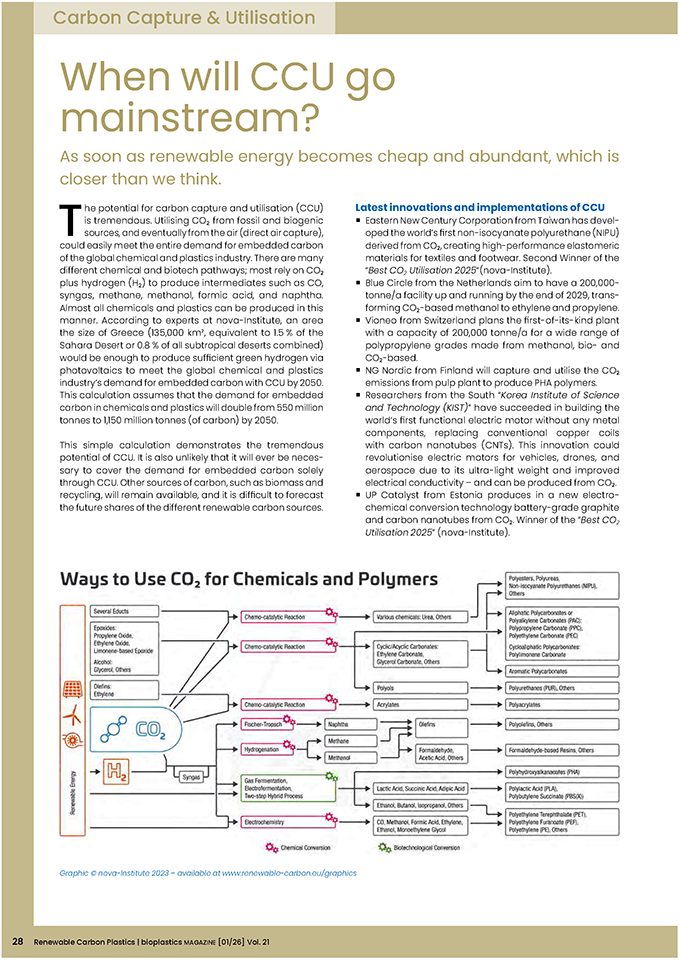
DownloadsAs soon as renewable energy becomes cheap and abundant, which is closer than we think.
The potential for carbon capture and utilisation (CCU) is tremendous. Utilising CO2 from fossil and biogenic sources, and eventually from the air (direct air capture), could easily meet the entire demand for embedded carbon of the global chemical and plastics industry. There are many different chemical and biotech pathways; most rely on CO2 plus hydrogen (H2) to produce intermediates such as CO, syngas, methane, methanol, formic acid, and naphtha.
Almost all chemicals and plastics can be produced in this manner. According to experts at nova-Institute, an area the size of Greece (135,000 km2, equivalent to 1.5 % of the Sahara Desert or 0.8 % of all subtropical deserts combined) would be enough to produce sufficient green hydrogen via photovoltaics to meet the global chemical and plastics industry’s demand for embedded carbon with CCU by 2050. This calculation assumes that the demand for embedded carbon in chemicals and plastics will double from 550 million tonnes to 1,150 million tonnes (of carbon) by 2050. This simple calculation demonstrates the tremendous potential of CCU.
-
Case Studies Based on Peer-reviewed Life Cycle Assessments: Carbon Footprints of Different Renewable Carbon-Based Chemicals and Materials (2nd, Extended Version) – RCI Report (PDF)
Sustainability & Health
67 Pages
1000 Downloads 1000 Downloads
2026-01
FREE
Free Shipping1000
DownloadsThis report broadens the scope of the brochure “Case studies based on peer-reviewed Life Cycle Assessments – Carbon Footprints of Different Carbon-Based Chemicals and Materials”, published in November 2023. The initial brochure presented five peer-reviewed studies that drew strong interest from experts, policymakers, and industry leaders for their insights into the carbon footprints of various carbon-based chemicals and materials.
This second, extended version includes seven peer-reviewed LCAs from participating member companies: Braskem, Econic, Fibenol, LanzaTech, Lenzing (update), Peter Greven and Primient Covation.
These expanded contributions will deepen understanding of carbon footprints and further support RCI’s commitment to
data-driven sustainability.DOI No.: https://doi.org/10.52548/HRPM7087
-
Recycling Becomes Feedstock for Europe – Let’s Dare More Autonomy (PDF)
Policy
65 Pages
557 Downloads 557 Downloads
2026-01
FREE
Free Shipping557
DownloadsThe paper shows how this goal of transformation or defossilisation can be implemented step by step and how legal areas can be better integrated at EU level, which will result in new priorities for both sectors. For example, in waste management, much of what does not contribute to the carbon supply of the chemical industry can be phased out gradually. It also includes enabling all recycling technologies, from mechanical and physical to chemical processes and even incineration with CO₂ capture and utilisation, since all processes are needed in the transformation for the different waste fractions and target products. Overall, the ten proposals derived and analysed in the paper also lead to a significant reduction in bureaucracy.
There are some important proposals that build on instruments already introduced by the EU, such as substitution quotas for selected plastics sectors. The authors also specify proposals that are under discussion or being raised by Member States. However, there are also proposals to phase out existing regulations. It is important that the proposals build on each other and are implemented in a coordinated manner as part of a self-contained, phased overall package.
Fortunately, greater autonomy is becoming mainstream in the EU and is also one of the cornerstones of the new EU Council Presidency. However, unless it becomes practical, greater autonomy and resilience will remain nothing more than a narrative. And the path to achieving this will be fraught with difficulties.
DOI No.: https://doi.org/10.52548/LFPX3960
-
2025-12
FREE
Free Shipping2
More
Downloads
infoThe fashion industry is under growing pressure to shift towards more sustainable production methods and materials. Traditional petroleum-based materials dominate the textile and footwear industry. There is increasing interest in exploring alternative, more sustainable feedstocks, such as bio-based materials derived from carbon capture technologies. These alternatives offer potential environmental benefits but require thorough analysis to understand the technical feasibility, environmental impact, and regulatory considerations involved.
The nova-Institute (hereafter referred to as nova) was engaged by Fashion for Good and some of its partners to conduct an in-depth assessment of sustainable feedstocks and conversion technologies for producing polymers, specifically focusing on bio-(PET, PA, EVA and BDO). The aim was to create a comprehensive understanding of the technological routes available for using bio-based feedstocks and emerging CO2 conversion technologies in the production of polymers used in the textile industry. Additionally, nova assessed sustainability standards and certification schemes to ensure the feedstocks meet stringent environmental and social criteria.
Direct download via the renewable-carbon.eu/publications is not possible.
Please follow this link:
https://www.fashionforgood.com/case-study/biosynthetic-feedstock -
RCI Webinar: Success Stories RCI 2025 and Outlook to 2026 – Project Results and Position Papers (PDF)
Policy, Sustainability & Health
59 Pages
371 Downloads 371 Downloads
2025-12
FREE
Free Shipping371
DownloadsThe free RCI webinar on 9 December 2025 presented the RCI Success Stories 2025 and offered an Outlook to 2026. It showcased RCI’s policy impact at EU, national and international levels, highlighted key publications and scientific results (including the biomass study, Policy Proposals, LCA methodologies, sustainability criteria paper, and analysis of recent updates to methane and fossil CO2 emissions data in Life-Cycle Inventories (LCI)), and summarised member activities such as expert groups, roundtables, and survey insights. The webinar also introduced RCI’s ongoing and upcoming projects for 2026, including biodiversity, policy barriers, carbon flows, LCA case studies, and awareness-building initiatives.
-
Advanced Recycling Conference 2025 (Proceedings, PDF)
Markets & Economy, Policy, Sustainability & Health, Technology
2025-12
150 € ex. tax
Plus 19% MwSt.Press
release Add to
cartThe proceedings of the Advanced Recycling Conference 2025 (19-20 November, https://advanced-recycling.eu) contain 41 conference presentations, the conference journal, sponsor documents and the press release.