 Investments totalling more than 5 billion with a future bio-based quota for plastics in Europe
Success story biofuels in the EU
The EU introduced its first union-wide biofuel quota in the form of Directive 2003/30/EC. This directive set an indicative target of 2% biofuels in transport fuels by 2005, rising to 5.75% by the end of 2010. This resulted in a surge of investment in first-generation biodiesel and bioethanol plants during the early to mid-2000s, with the majority of EU biofuel production capacity being established during that decade. Later, with the 2009 Renewable Energy Directive (RED I, 2009/28/EC), the EU tightened this into a binding 10% renewable energy target in transport for 2020. From the outset, the quotas were introduced against the oil companies – that is, explicitly as a means of imposing burdens on them and driving transformation – even though they were designed at the same time as a ‘market-based’ instrument.
Find the full article as a download here: https://renewable-carbon.eu/publications/product/investments-totalling-more-than-5-billion-with-a-future-bio-based-quota-for-plastics-in-europe-pdf/
Depending on different sources about 50-100 bioethanol and 50-100 biodiesel plants were built in the European Union, the cumulative investment is estimated between 6.5 and 10 billions of euros for EU first-generation biodiesel and bioethanol infrastructure.1
The Commission’s impact assessment for RED II estimated that around 900 million euro per year of investment in advanced bio-refineries from 2021 to 2030 would be required to meet the advanced renewable fuels targets (Annex IX feedstocks).2
The EU Sustainable Transport Investment Plan (STIP) estimates that meeting ReFuelEU Aviation and FuelEU Maritime fuel targets will require about €100 billions of investment by 2035 for sustainable alternative fuels (SAF and maritime e-fuels).3
These are impressive investment figures which demonstrate the significant impact of fuel quotas. But what can we expect from quotas in the field of bio-based plastics?
The impact of bio-based plastic quotas on investment
The scenario presented here assumes that the entire plastic production in Europe (across all application sectors) will have a 5% bio-based quota in the future, representing an increase from the current 1% share. In 2024 the plastic production in Europe was 54.6 Mt/y with a share of 1.1% for bio-based and bio-attributed (see figure 4), equal to 0.6 Mt/y production volume.
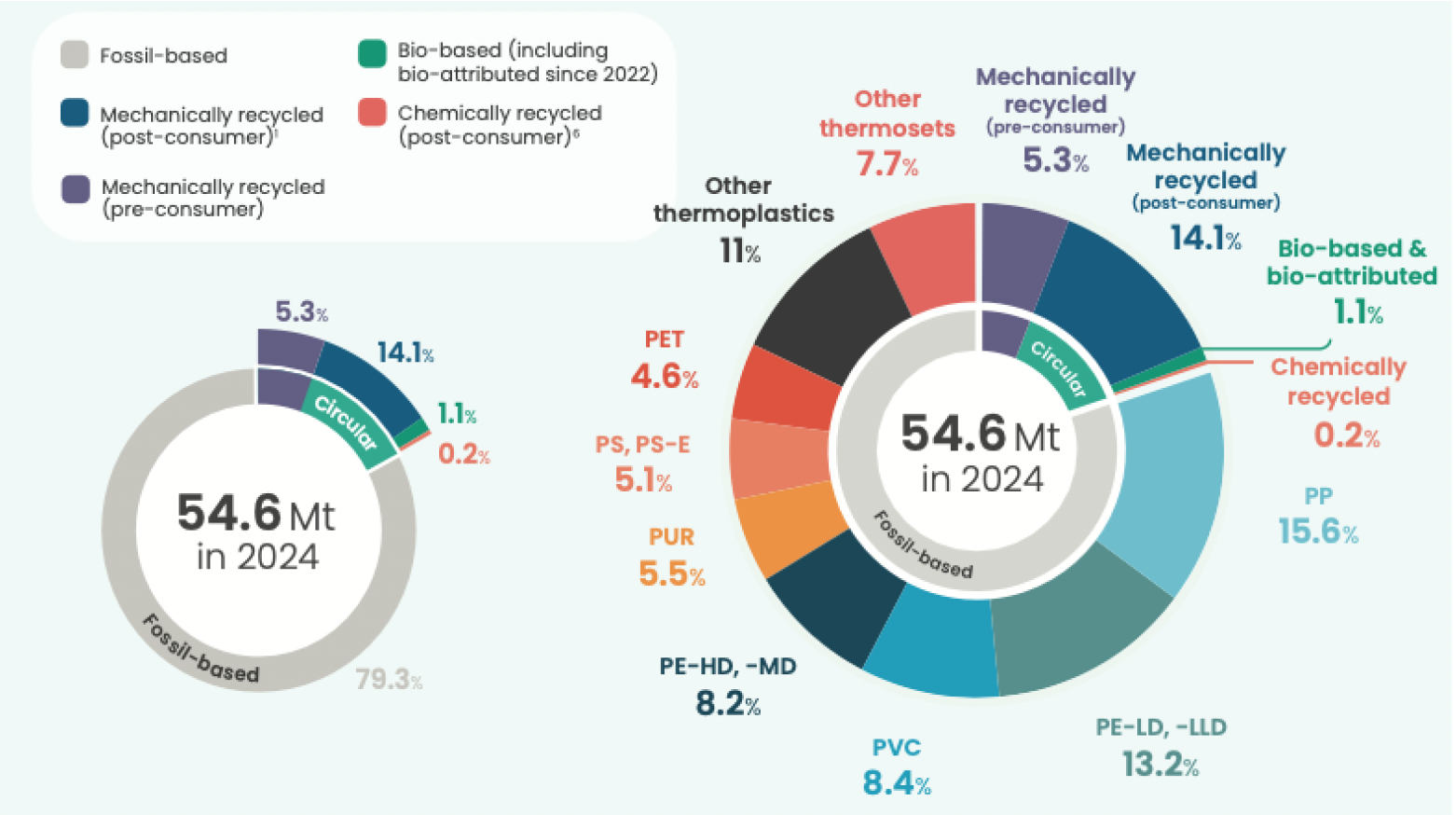
A 5% share would equate to 2.7 Mt/y, so an additional 2.1 Mt/y of bio-production capacity would be required. As a draft scenario, we assume that (1) 30% will come from bio-attributed sources, (2) 25% from dedicated bio-based polymers, and (3) 45% from drop-in bio-based polymers. What would this require in terms of investment?
(1) 30% = 0.63 Mt/y additional “bio-attributed” capacities – no relevant investment
No relevant additional investment is needed, because existing plants can be used. This is the strength (and weakness) of bio-attributed: Fast production of big bio-attributed volumes possible without additional investment, better utilisation of existing facilities.
(2) 25% = 0.53 Mt/y additional “dedicated bio-based” capacities – about €2.1 billion investment
Example PLA: Additional production facilities for monomer lactid acid (LA) and the polymer polylactic acid (PLA) are required. The capital intensity of a combined LA and PLA plant is approximately €4,000 per tonne per year of PLA (inc. LA) produced. This means that an investment of €2.1 billion is necessary for the production of 0.53 Mt/y of PLA.
(3) 45% = 1.0 Mt/y additional “drop-in bio-based” capacities – about €1.5 + €1.7 = €3.2 billion investment
Consider the following two example pathways: (3a) Bioethanol to bio-based polyethylene (PE), and (3b) Biomethanol to bio-based polypropylene (PP) and PE. Each pathway should contribute 0.5 Mt/yr.
(3a) Bioethanol to bio-based PE: To produce bio-based PE existing fossil plants can be utilised – if bio-based ethylene is available. To produced 0.5 Mt PE, almost the same amount of ethylene is needed. The capital intensity of producing bio-based ethylene from bioethanol is approximately €3,000 per tonne per year. For an annual production capacity of 0.5 Mt, an investment of around €1.5 billion is required. The investment is solely for the production of bio-ethylene. If there are no existing polyethylene (PE) production capacities available, additional investment is necessary to produce bio-based polyethylene (PE) from bio-ethylene.
(3b) Biomethanol to bio-based PP and PE (ratio 3:2): To produce bio-based PP and PE existing fossil plants can be utilised – if bio-based olefins (propylene and ethylene) are available. To produced 0.5 Mt PP/PE, almost the same amount of propylene/ethylene is needed. The capital intensity of producing bio-based olefins from methanol is approximately €3,400 per tonne per year for small plants in the size of 0.2 Mt/y. Around €1.7 billion would be required to produce 0.5 Mt/y of olefins in those plants. However, for larger plants with a capacity of 1 Mt/y, such as those in China, the capital intensity could be reduced to €1,800 per tonne per year.
The investment is solely for the production of bio-based olefins. If there are no existing PP/PE production capacities available, additional investment is necessary to produce bio-based PP and PE from the bio-based olefins.
Based on these assumptions, a 5% bio-based (including bio-attributed) polymer quota would generate €5.3 billion in investment, similar to the level of investment in first-generation biofuels. A subsequent 30% bio-based (including bio-attributed) polymer quota would generate €32 billion, similar to the level of investment in sustainable aviation fuels (SAF) in the next decades.
1 Transport & Environment. (2017). Crop-based biofuels – facts and figures about investments and jobs. Brussels: T&E. (based on Ecofys analysis)
2 European Commission. (2016). Impact assessment accompanying the document Proposal for a Directive of the European Parliament and of the Council on the promotion of the use of energy from renewable sources (recast) (REFIT) (SWD(2016) 418 final, Parts 1–4). Brussels: European Commission.
3 https://transport.ec.europa.eu/news-events/news/commission-unveils-sustainable-transport-investment-plan-strategic-approach-boost-renewable-and-low-2025-11-05_en
4 PlasticsEurope 2025: Plastics the Fast Facts 2025
Source
nova-Institute, original text, 2026-05-29.
Supplier
European Commission
European Union
nova-Institut GmbH
Plastics Europe
Share
Renewable Carbon News – Daily Newsletter
Subscribe to our daily email newsletter – the world's leading newsletter on renewable materials and chemicals