Skip to content
Renewable Carbon Publications - LogoRenewable Carbon Publications - Logo
  • Publications
  • Contact
0

No products in the cart.

  • Renewable Carbon
    • Renewable Carbon
    • Events
    • Publications
    • Graphics
    • News
    • Business Directory
    • Newsletter
    • nova-Institute
  • Publications
  • Contact

Renewable Carbon Publications - LogoRenewable Carbon Publications - Logo
0

No products in the cart.

  • Renewable Carbon Publications
  • Sustainability & Health
  • Page 7
Grid view List view

Showing 121–140 of 237

  • Download Statistics
  • Direct Download
    22 07 07 pef plant based pef bottles thumbnail

    Plant-based PEF bottles (PNG)

    Sustainability & Health, Technology

    1 Page
    291 Downloads

    291 Downloads  

    2022-08

    FREE

    Free Shipping
     

    291
    Downloads

    Direct Download

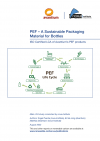
    Avantium has developed a technology to convert plant-based sugars into FDCA (furandicarboxylic acid), the building block of PEF (polyethylene furanoate): a plant-based, fully recyclable polymer with superior performance. FDCA is polymerised with plant-based mono-ethylene glycol (MEG) to make a 100% plant-based PEF polymer. In December 2021, Avantium has taken a positive investment decision concerning the construction of the world’s first FDCA Flagship Plant in Delfzijl (The Netherlands), with construction planned to be completed by the end of 2023 and the aim to be operational in 2024. This will be the world’s first commercial FDCA facility and will have a targeted production capacity of 5,000 tonnes per annum. FDCA is the key building block for the 100% plant-based, recyclable polymer PEF.

  • Direct Download
    22 07 07 pef properties thumbnail

    PEF properties (PNG)

    Sustainability & Health, Technology

    1 Page
    153 Downloads

    153 Downloads  

    2022-08

    FREE

    Free Shipping
     

    153
    Downloads

    Direct Download

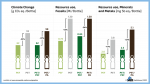
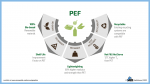
    PEF has enhanced barrier, mechanical and thermal properties compared to today’s widely used
    petroleum-based polymers. The barrier properties of PEF, which are ~10x better for O2, ~15x better
    for CO2 and ~2.5x better for water than PET, represent a revolutionary opportunity compared with traditional packaging solutions regarding performance, price, and sustainability when produced at scale. The improved barrier properties lead to a longer shelf life of packaged products. PEF also offers higher mechanical strength, which means that thinner PEF packaging can be produced and fewer resources are required.
    In terms of thermal properties, PEF has superior ability to withstand heat and can be processed at lower temperatures. PEF has enhanced mechanical stiffness and allows for increasing shaping possibilities.

  • Direct Download
    22 07 07 pef life cycle stages of monolayer pef bottles thumbnail

    Life cycle stages of monolayer PEF bottles (PNG)

    Sustainability & Health, Technology

    1 Page
    134 Downloads

    134 Downloads  

    2022-08

    FREE

    Free Shipping
     

    134
    Downloads

    Direct Download

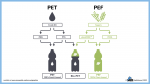
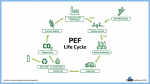
    This figure shows the relevant life cycle stages of monolayer PEF bottles from cradle-to-grave: from the biomass cultivation (wheat for fructose and sugarcane for bio-MEG feedstocks supply) to the production of PEF-based bottles including their end-of-life options (recycling and incineration).
    It is foreseen that the commercialisation of PEF-based products will initially take place in the Netherlands, Belgium, and Germany. In these countries, the rates for average PET bottle waste collection and recycling are relatively high and landfilling is no longer practiced in these countries.

  • Direct Download
    22 07 erneuerbarer kohlenstoff chemanager carus thumbnail

    Erneuerbarer Kohlenstoff – Schlüssel zur Zukunft (PDF)

    Policy, Sustainability & Health, Technology

    2 Pages
    346 Downloads

    346 Downloads  

    2022-07

    FREE

    Free Shipping
     

    346
    Downloads

    Direct Download

    Die chemische Industrie steht aktuell vor einer Vielzahl an Herausforderungen, aus denen eine neue, nachhaltige Chemie erwachsen kann – wenn die große Transformation in den nächsten Jahrzehnten gelingt. Und das muss sie!

    Quelle: „Erneuerbarer Kohlenstoff – Schlüssel zur Zukunft“ – aus CHEManager 7/2022
    https://www.chemanager-online.com/news/erneuerbarer-kohlenstoff-schluessel-zur-zukunft

  • Direct Download
    biomass utilisation factor shop thumbnail

    nova-paper #16: The Biomass Utilisation Factor (BUF)

    Markets & Economy, Policy, Sustainability & Health

    62 Pages
    1455 Downloads

    1455 Downloads  

    2022-06

    FREE


    1455
    Downloads

    Direct Download

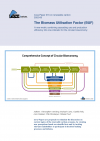
    The Biomass Utilisation Factor (BUF) is a new metric combining cascading use and production efficiency into one indicator to investigate the circularity of materials for the circular bioeconomy. Cascading use captures the repeated use of the original biomass, either for the same or a different purpose. Production efficiency looks at how much of the biomass input is actually transformed into useful products or materials.

    The BUF can serve not only as an indicator for the circular economy principle of keeping materials in use, but also act as an efficient tool for stakeholders and policy makers to identify options that maximize biomass utilisation and keep materials in use for longer. In light of recent political developments in Europe, the BUF can serve as a tool that provides additional insights for achieving sustainable carbon cycles or help to respect the cascading principle of biomass utilisation.

  • Direct Download
    22 05 die neue tugend – kunststoff im kreislauf umweltmagazin michael carus thumbnail

    Die neue Tugend: Kunststoff im Kreislauf (PDF)

    Markets & Economy, Policy, Sustainability & Health

    1 Page
    292 Downloads

    292 Downloads  

    2022-05

    FREE


    292
    Downloads

    Direct Download

    Rohstoffe werden knapp, sowohl Metalle wie auch Mineralien. Nur erneuerbarer Kohlenstoff ist praktisch unbegrenzt verfügbar. Daher werden Kunststoffe in Zukunft noch wichtiger sein als heute, und deshalb müssen sie so nachhaltig wie möglich gestaltet werden: aus erneuerbarem Kohlenstoff und voll recycelbar.

  • Direct Download
    Renewable Materials Conference, 10-12 May 2022 (Proceedings) [Digital]

    Renewable Materials Conference, 10-12 May 2022 (Proceedings)

    Markets & Economy, Policy, Sustainability & Health, Technology


    252 Downloads

    252 Downloads  

    2022-05

    FREE

    Plus 19% MwSt.
     

    252
    Downloads

    Direct Download

    The proceedings of the Renewable Materials Conference (10-12 May 2022, https://renewable-materials.eu) contain conference presentations, the conference journal, and the press release of the three winners of the innovation award “Renewable Material of the Year”!


  • Direct Download
    22 04 28 co2 reduction potential of the chemical industry through ccu tumbnail

    RCI’s scientific background report: “CO2 reduction potential of the chemical industry through CCU” (May 2022)

    Sustainability & Health, Technology

    28 Pages
    1943 Downloads

    1943 Downloads  

    2022-05

    FREE


    1943
    Downloads

    Direct Download

    In an exploratory scenario, this study investigates the CO₂ emission reductions that can be achieved in the global chemical and derived material industries if the entire demand for embedded carbon is met solely and exclusively via CO₂ instead of from fossil sources. Major simplifications are used to achieve transparency and comprehensibility of the issue. Methanol (CH3OH) is considered to cover the needs for hydrocarbons for chemicals and derived materials among the various chemical intermediates as a representative pathway for renewable carbon. It is a plausible scenario to assign methanol a central role in supplying the chemical industry of the future.

    The GHG emissions of CCU-based methanol could be 67 to 77 % lower compared to emissions from releasing embedded carbon of fossil fuels, when using current energy supply based on photovoltaics. With improvements in renewable energy production, the reduction could increase to levels between 96 and 100 %.

    DOI No.: https://doi.org/10.52548/UTRL5869

  • Direct Download
    22 04 28 ccu based resource supply for the chemical industry thumbnail

    CCU-based Resource Supply for the Chemical Industry (PNG)

    Sustainability & Health, Technology

    1 Page
    251 Downloads

    251 Downloads  

    2022-05

    FREE


    251
    Downloads

    Direct Download

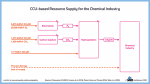
    It is a plausible scenario to assign methanol (CH₃OH) a central role in supplying the chemical industry of the future. Already today, methanol plays an important role in the chemical industry, being one of the most established commodities.

    CCU-based process route for production of methanol includes production of hydrogen via electrolysis, CO₂ capture from the atmosphere or from industrial point sources, and the hydrogenation reaction. Electricity demand for these processes is represented by red arrows. Above the arrow, the specific energy demand is stated, below, the contribution of the process to the total electricity demand of 1 t of methanol is stated. Purification and compression of hydrogen are neglected. For CO₂ hydrogenation, a complete reaction is assumed.

  • Direct Download
    22 04 28 co2 emissions from embedded carbon in chemicals thumbnail

    CO₂ Emissions From Embedded Carbon in Chemicals (PNG)

    Sustainability & Health, Technology

    1 Page
    299 Downloads

    299 Downloads  

    2022-05

    FREE


    299
    Downloads

    Direct Download

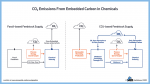
    When fossil feedstock is used, the fossil-based embedded carbon contained in chemicals and materials is emitted to the atmosphere at their end of life, assuming complete oxidation (e.g. through combustion or (bio)degradation).

    When using CCU-based feedstock to replace the fossil feedstock, at the end of life, no additional carbon (or CO2, respectively) is emitted to the air because it was captured from the air (or from point sources) before through carbon capture. Only the electricity demand for CCU-based feedstock production causes CO2 emissions.

  • Direct Download
    22 04 01 emissions reduction potential for replacing fossil feedstock with ccu based methanol thumbnail

    Emission Reduction Potential for Replacing Fossil Feedstock with CCU-based Methanol (PNG)

    Sustainability & Health, Technology

    1 Page
    194 Downloads

    194 Downloads  

    2022-05

    FREE


    194
    Downloads

    Direct Download

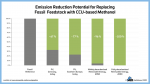
    At end of life, carbon embedded in chemicals and derived materials is released to the atmosphere as CO₂. In the case of fossil-based feedstock, this contributes to global warming. For CCU-based feedstock this is not the case, since all carbon embedded in these products was captured from the air (or from point sources) before through carbon capture. In a simplified model, additional emissions only electricity production for causes emissions for CCU-based feedstock production. Only the use of renewable energy can save emissions.
    The GHG emissions of CCU-based methanol could be 67 to 77 % lower compared to emissions from releasing embedded carbon of fossil fuels, when using current energy supply based on photovoltaics. With improvements in renewable energy production, the reduction could increase to levels between 96 and 100 %.

  • Direct Download
    Conference on CO2-based Fuels and Chemicals 2022 Proceedings [Digital]

    Conference on CO2-based Fuels and Chemicals 2022 Proceedings

    Markets & Economy, Policy, Sustainability & Health, Technology


    106 Downloads

    106 Downloads  

    2022-04

    FREE

    Plus 19% MwSt.
     

    106
    Downloads

    Direct Download

    The proceedings of the Conference on CO2-based Fuels and Chemicals  2022 (23-24 March 2022, https://co2-chemistry.eu) contain 26 presentations, the conference journal, and the press release of the three winners of the Innovation Award “Best CO2 Utilisation 2022“.


  • Direct Download
    International Conference on Cellulose Fibres 2022 Proceedings [Digital]

    International Conference on Cellulose Fibres 2022 Proceedings

    Markets & Economy, Policy, Sustainability & Health, Technology


    169 Downloads

    169 Downloads  

    2022-02

    FREE

    Plus 19% MwSt.
     

    169
    Downloads

    Direct Download

    The proceedings of the International Conference on Cellulose Fibres  2022 (2-3 February 2022, https://cellulose-fibres.eu) contain 26 presentations, the conference journal, and the press release of the three winners of the Cellulose Fibre Innovation of the Year 2021 Award!


  • Direct Download
    22 01 26+the+climate+change+mitigation+star+ +a+sixfold+challenge

    The Climate Change Mitigation Star: A Sixfold Challenge (PNG)

    Policy, Sustainability & Health

    1 Page
    176 Downloads

    176 Downloads  

    2022-02

    FREE


    176
    Downloads

    Direct Download

    Why it is right to choose renewable carbon as a guiding principle for sustainable development in the chemicals and materials sectors.
    The Renewable Carbon Initiative (RCI) publishes this fundamental strategy paper on the defossilisation of the chemical and material industry with eleven policy recommendations. The Renewable Carbon Initiative is an interest group of more than 30 well-known companies from the wide field of the chemical and material value chains. (www.renewable-carbon-initiative.com)

    Read more here: https://renewable-carbon-initiative.com/media/press/?id=315

  • Direct Download
    22 02 14 renewable carbon as a guiding principle for sustainable carbon cycles shop

    RCI’s scientific background report: “Renewable carbon as a guiding principle for sustainable carbon cycles” (February 2022)

    Policy, Sustainability & Health

    41 Pages
    2960 Downloads

    2960 Downloads  

    2022-02

    FREE


    2960
    Downloads

    Direct Download

    Why it is right to choose renewable carbon as a guiding principle for sustainable development in the chemicals and materials sectors.
    The Renewable Carbon Initiative (RCI) publishes this fundamental strategy paper on the defossilisation of the chemical and material industry with eleven policy recommendations. The Renewable Carbon Initiative is an interest group of more than 30 well-known companies from the wide field of the chemical and material value chains. (www.renewable-carbon-initiative.com)

    Read more here: https://renewable-carbon-initiative.com/media/press/?id=315

    DOI No.: https://doi.org/10.52548/QUHG1295

  • Direct Download
    22 01 image kunststoff carus seite 1

    Das wechselhafte Image der Kunststoffe: Von Begeisterung zur Skepsis, vom Siegeszug zum Umweltproblem (PDF)

    Markets & Economy, Sustainability & Health

    2 Pages
    262 Downloads

    262 Downloads  

    2022-01

    FREE


    262
    Downloads

    Direct Download

    Das Image der Kunststoffe steht heute in der Krise. Wie konnte es so weit kommen und was kann man tun, um das Image wieder zu verbessern? Kunststoffe sind wichtiger denn je für eine nachhaltige Zukunft. Alle Technologien stehen zur Verfügung, um Kunststoffe umweltfreundlich zu gestalten und im Kreislauf zu fahren. Wie können wir die Gesellschaft wieder davon überzeugen, dass eine Welt mit den richtigen Kunststoffen komfortabler, ressourcenschonender und klimafreundlicher sein wird als ohne?

  • Direct Download
    21 11 10 biodegradable polymers in various environments 1920x1080 thumbnail

    Biodegradable Polymers in Various Environments According to Established Standards and Certification Schemes – Graphic (PNG, Version 2021)

    Sustainability & Health, Technology

    1 Page
    1926 Downloads

    1926 Downloads  

    2021-11

    FREE

    Free Shipping
     

    1926
    Downloads

    Direct Download

    New updated version of the poster on Biodegradable Polymers in Various Environments According to Established Standards and Certification Schemes

    The popular poster has been once again updated this autumn to depict to most up-to-date status of commercially available polymers which actually biodegrade in accordance with established standards and certification schemes. An additional partner rounds up this team of leading experts in the area of biodegradable polymers.

  • Direct Download
    21 11 18 biodegradable polymers in various environments thumbnail

    Biodegradable Polymers in Various Environments According to Established Standards and Certification Schemes – Graphic (PDF, Version 2021)

    Sustainability & Health, Technology

    1 Page
    3322 Downloads

    3322 Downloads  

    2021-11

    FREE


    3322
    Downloads

    Direct Download

    New updated version of the poster on Biodegradable Polymers in Various Environments According to Established Standards and Certification Schemes

    The popular poster has been once again updated this autumn to depict to most up-to-date status of commercially available polymers which actually biodegrade in accordance with established standards and certification schemes. An additional partner rounds up this team of leading experts in the area of biodegradable polymers.

  • Direct Download
    21 11 rci draws worldwide attention thumbnail

    Renewable Carbon Initiative (RCI) draws worldwide attention (PDF)

    Policy, Sustainability & Health

    2 Pages
    291 Downloads

    291 Downloads  

    2021-11

    FREE


    291
    Downloads

    Direct Download

    The climate crisis is accelerating at an unprecedented pace, with global warming, greenhouse gas emissions and deforestation leading to food insecurity, global health problems and biodiversity loss. Greenhouse gas emissions associated with the use of carbon-containing fossil energy sources such as oil, coal and natural gas have been shown to be a major contributor to climate change. Thus, for decades the focus of climate protection has been predominantly on the energy sector. A new initiative is now expanding this view. Learn about the history and activities of the Renewable Carbon Initiative (RCI).

  • Direct Download
    21 09 14 scenario for the plastic industry 2050 thumbnail

    Scenario for the Plastic Industry 2050 (PNG)

    Markets & Economy, Policy, Sustainability & Health, Technology

    1 Page
    1542 Downloads

    1542 Downloads  

    2021-10

    FREE


    1542
    Downloads

    Direct Download

    The plastics industry of the future will be decoupled from petrochemicals and will meet its carbon needs primarily from recycling. This alone will not close the renewable carbon cycle. The unavoidable losses will then be closed by bio- and CO2-based polymers.

Renewable Carbon Types

Publications

Topics

  • 1
  • …
  • 5
  • 6
  • 7
  • 8
  • 9
  • …
  • 12

nova-Logo
contact@nova-institut.de
www.nova-institute.eu

nova-Institut GmbH
Leyboldstr. 16
50354 Hürth / Germany

  • Renewable Carbon
  • Events
  • Publications
  • Graphics
  • News
  • Business Directory
  • Newsletter
  • nova-Institute
  • My account
  • Legal Information
  • Terms and Conditions
  • Data protection regulation
© 2025 nova-Institut GmbH
Renewable Carbon Publications - Logo

Login

Lost your password?