Skip to content
Renewable Carbon Publications - LogoRenewable Carbon Publications - Logo
  • Publications
  • Contact
1
  • 22 11 28 rc publications cover proceedings arcAdvanced Recycling Conference 2025 (Proceedings, PDF) [Digital] 1 × 150 €
    Plus 19% MwSt.

Subtotal: 150 €

CartCheckout

  • Renewable Carbon
    • Renewable Carbon
    • Events
    • Publications
    • Graphics
    • News
    • Business Directory
    • Newsletter
    • nova-Institute
  • Publications
  • Contact

Renewable Carbon Publications - LogoRenewable Carbon Publications - Logo
1
  • 22 11 28 rc publications cover proceedings arcAdvanced Recycling Conference 2025 (Proceedings, PDF) [Digital] 1 × 150 €
    Plus 19% MwSt.

Subtotal: 150 €

CartCheckout

  • Renewable Carbon Publications
  • Sustainability & Health
Grid view List view
“Advanced Recycling Conference 2025 (Proceedings, PDF)” has been added to your cart. View cart

Showing 1–20 of 247

  • Download Statistics
  • Direct Download
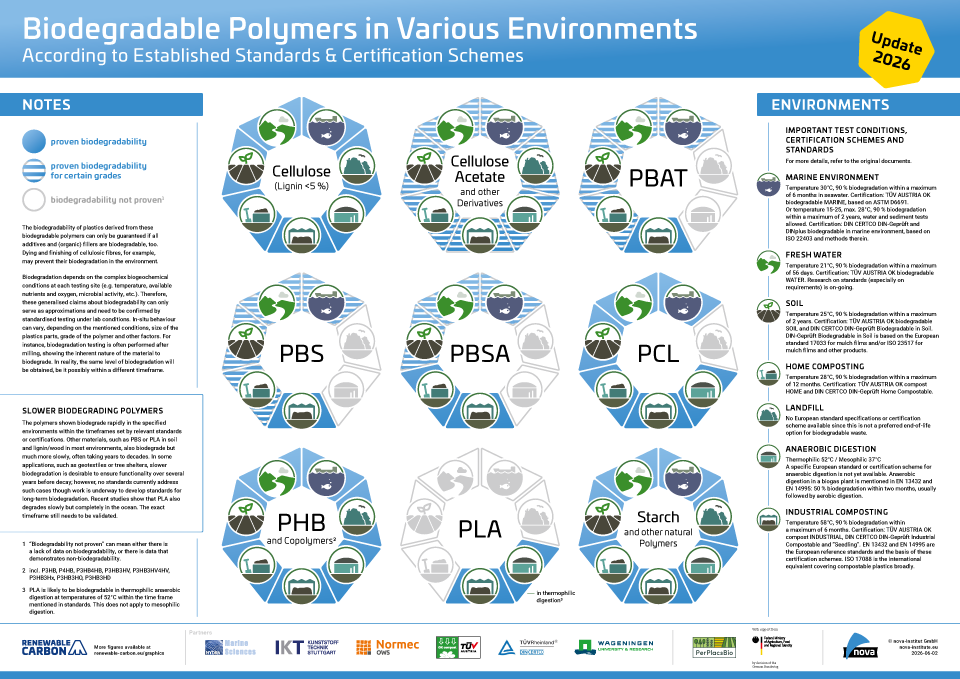
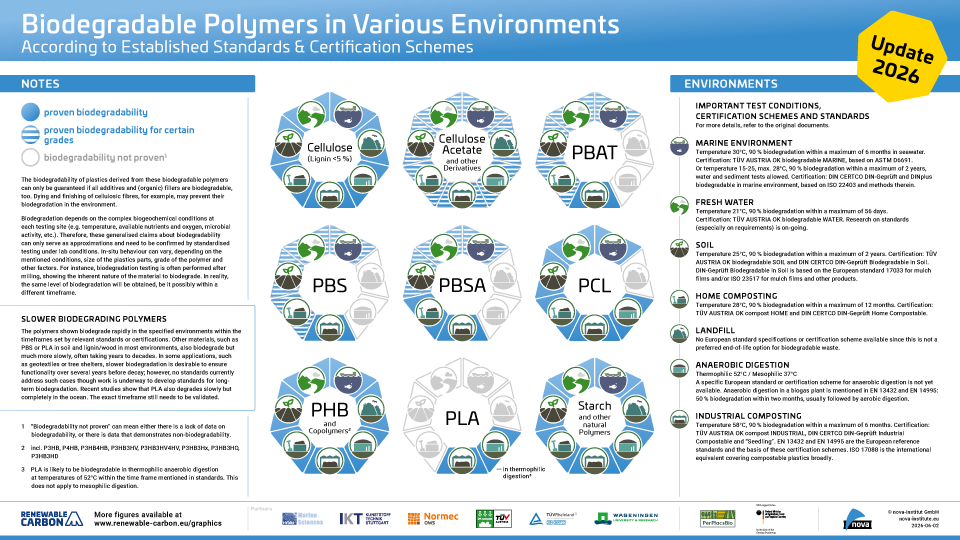
    Newbiodegradable polymers in various environments according to established standards and certification schemes – graphic (png, en, current version)

    Biodegradable Polymers in Various Environments According to Established Standards and Certification Schemes – Graphic (PNG, current version)

    Sustainability & Health

    1 Page
    16 Downloads

    16 Downloads  

    2026-05

    FREE

    Free Shipping
     

    16
    Downloads

    Direct Download

    Fourth update of the well-known poster showing biodegradable polymers in different environments according to established standards and certification schemes. This update has been done within the PerPlacsBio project. The project is funded by the Fachagentur für Nachwachsende Rohstoffe (FNR) in Germany under the “Nachhaltige Erneuerbare Ressourcen” funding program.

    Beginning of 2026, the expert group exchanged about the latest scientific evidence in the field of biodegradable polymers in order to make meaningful changes to the poster. The generic classification on the poster is only supported by tests performed in the context of certification. Therefore, the expert group has decided to include „biodegradability for certain grades“ of PBSA, PBS and PBAT in additional environments, including soil, freshwater and marine conditions, as well as home composting for PBS. Additionally, more precise explanations of the norms used in composting and marine biodegradation have been added, as well as clearer definitions of ‘biodegradability not proven’ and ‘slower biodegrading polymers’.

  • Direct Download
    Newbiodegradable polymers in various environments according to established standards and certification schemes – graphic (png, en, current version)

    Biodegradable Polymers in Various Environments According to Established Standards and Certification Schemes – Graphic (PDF, current version)

    Sustainability & Health

    1 Page
    62 Downloads

    62 Downloads  

    2026-05

    FREE

    Free Shipping
     

    62
    Downloads

    Direct Download

    Fourth update of the well-known poster showing biodegradable polymers in different environments according to established standards and certification schemes. This update has been done within the PerPlacsBio project. The project is funded by the Fachagentur für Nachwachsende Rohstoffe (FNR) in Germany under the “Nachhaltige Erneuerbare Ressourcen” funding program.

    Beginning of 2026, the expert group exchanged about the latest scientific evidence in the field of biodegradable polymers in order to make meaningful changes to the poster. The generic classification on the poster is only supported by tests performed in the context of certification. Therefore, the expert group has decided to include „biodegradability for certain grades“ of PBSA, PBS and PBAT in additional environments, including soil, freshwater and marine conditions, as well as home composting for PBS. Additionally, more precise explanations of the norms used in composting and marine biodegradation have been added, as well as clearer definitions of ‘biodegradability not proven’ and ‘slower biodegrading polymers’.

  • Direct Download
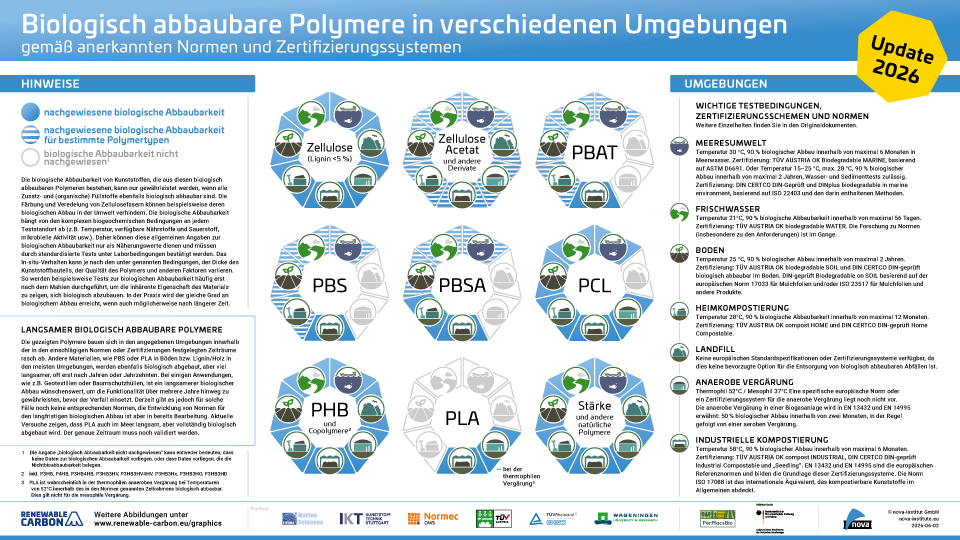
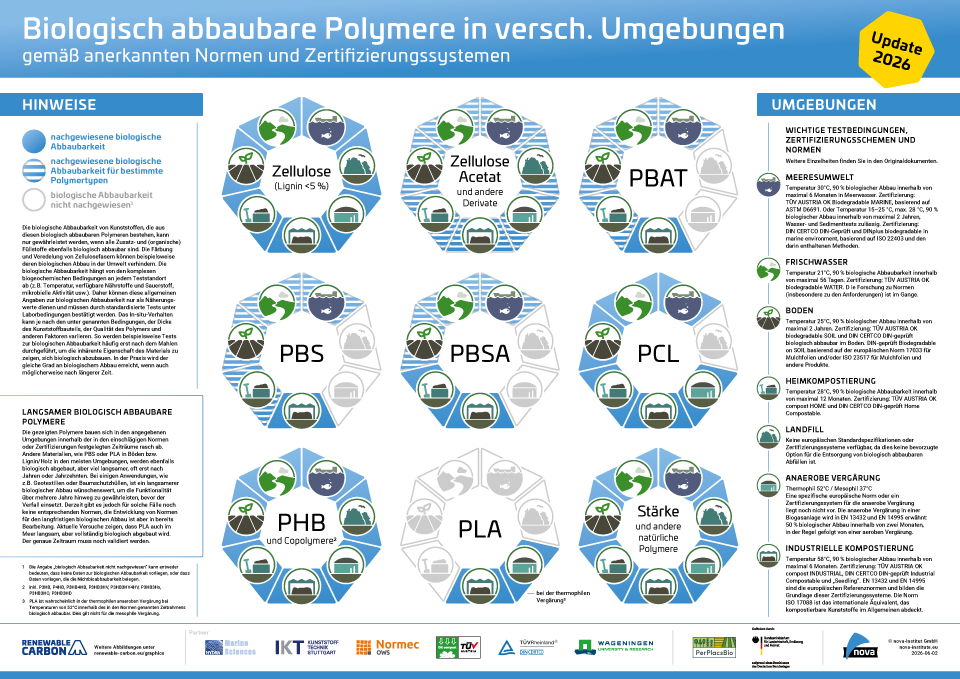
    Newbiologisch abbaubare polymere in versch. umgebungen gemäß anerkannten normen und zertifizierungssystemen – graphik (png, aktuelle version)

    Biologisch abbaubare Polymere in versch. Umgebungen gemäß anerkannten Normen und Zertifizierungssystemen – Graphik (PNG, aktuelle Version)

    Sustainability & Health

    1 Page
    16 Downloads

    16 Downloads  

    2026-05

    FREE

    Free Shipping
     

    16
    Downloads

    Direct Download

    Vierte Aktualisierung des bekannten Posters, das biologisch abbaubare Polymere in verschiedenen Umgebungen gemäß etablierten Normen und Zertifizierungssystemen darstellt. Diese Aktualisierung erfolgte im Rahmen des PerPlacsBio-Projekts. Das Projekt wird von der Fachagentur für Nachwachsende Rohstoffe (FNR) in Deutschland im Rahmen des Förderprogramms „Nachhaltige Erneuerbare Ressourcen“ finanziert.

    Anfang 2026 tauschte sich die Expertengruppe über die neuesten wissenschaftlichen Erkenntnisse im Bereich biologisch abbaubarer Polymere aus, um sinnvolle Änderungen am Poster vorzunehmen. Die allgemeine Klassifizierung auf dem Poster stützt sich ausschließlich auf Tests, die im Rahmen der Zertifizierung durchgeführt wurden. Daher hat die Expertengruppe beschlossen, die „biologische Abbaubarkeit für bestimmte Polymertypen“ von PBSA, PBS und PBAT in weiteren Umgebungen, darunter Boden, Süßwasser und Meeresbedingungen, sowie die Heimkompostierung für PBS aufzunehmen. Darüber hinaus wurden präzisere Erläuterungen zu den bei der Kompostierung und der marinen biologischen Abbaubarkeit verwendeten Normen hinzugefügt sowie klarere Definitionen für „biologische Abbaubarkeit nicht nachgewiesen“ und „langsamer biologisch abbaubare Polymere“.


  • Direct Download
    Newbiologisch abbaubare polymere in versch. umgebungen gemäß anerkannten normen und zertifizierungssystemen – graphik (png, aktuelle version)

    Biologisch abbaubare Polymere in versch. Umgebungen gemäß anerkannten Normen und Zertifizierungssystemen – Graphik (PDF, aktuelle Version)

    Sustainability & Health

    1 Page
    31 Downloads

    31 Downloads  

    2026-05

    FREE

    Free Shipping
     

    31
    Downloads

    Direct Download

    Vierte Aktualisierung des bekannten Posters, das biologisch abbaubare Polymere in verschiedenen Umgebungen gemäß etablierten Normen und Zertifizierungssystemen darstellt. Diese Aktualisierung erfolgte im Rahmen des PerPlacsBio-Projekts. Das Projekt wird von der Fachagentur für Nachwachsende Rohstoffe (FNR) in Deutschland im Rahmen des Förderprogramms „Nachhaltige Erneuerbare Ressourcen“ finanziert.

    Anfang 2026 tauschte sich die Expertengruppe über die neuesten wissenschaftlichen Erkenntnisse im Bereich biologisch abbaubarer Polymere aus, um sinnvolle Änderungen am Poster vorzunehmen. Die allgemeine Klassifizierung auf dem Poster stützt sich ausschließlich auf Tests, die im Rahmen der Zertifizierung durchgeführt wurden. Daher hat die Expertengruppe beschlossen, die „biologische Abbaubarkeit für bestimmte Polymertypen“ von PBSA, PBS und PBAT in weiteren Umgebungen, darunter Boden, Süßwasser und Meeresbedingungen, sowie die Heimkompostierung für PBS aufzunehmen. Darüber hinaus wurden präzisere Erläuterungen zu den bei der Kompostierung und der marinen biologischen Abbaubarkeit verwendeten Normen hinzugefügt sowie klarere Definitionen für „biologische Abbaubarkeit nicht nachgewiesen“ und „langsamer biologisch abbaubare Polymere“.


  • Add to
    cart
    NewCO2-based Fuels and Chemicals Conference 2026 (Proceedings, PDF) [Digital]

    CO2-based Fuels and Chemicals Conference 2026 (Proceedings, PDF)

    Markets & Economy, Policy, Sustainability & Health, Technology


    2026-05

    150 € ex. tax

    Plus 19% MwSt.
    Press
    release
    Add to
    cart

    The proceedings of the CO2-based Fuels and Chemicals Conference 2026 (28-29 April 2026, https://co2-chemistry.eu) contain all released presentations (download of the program leaflet, PDF) and the press release of the three winners of the Innovation Award “Best CO2 Utilisation 2026″.

  • More
    info
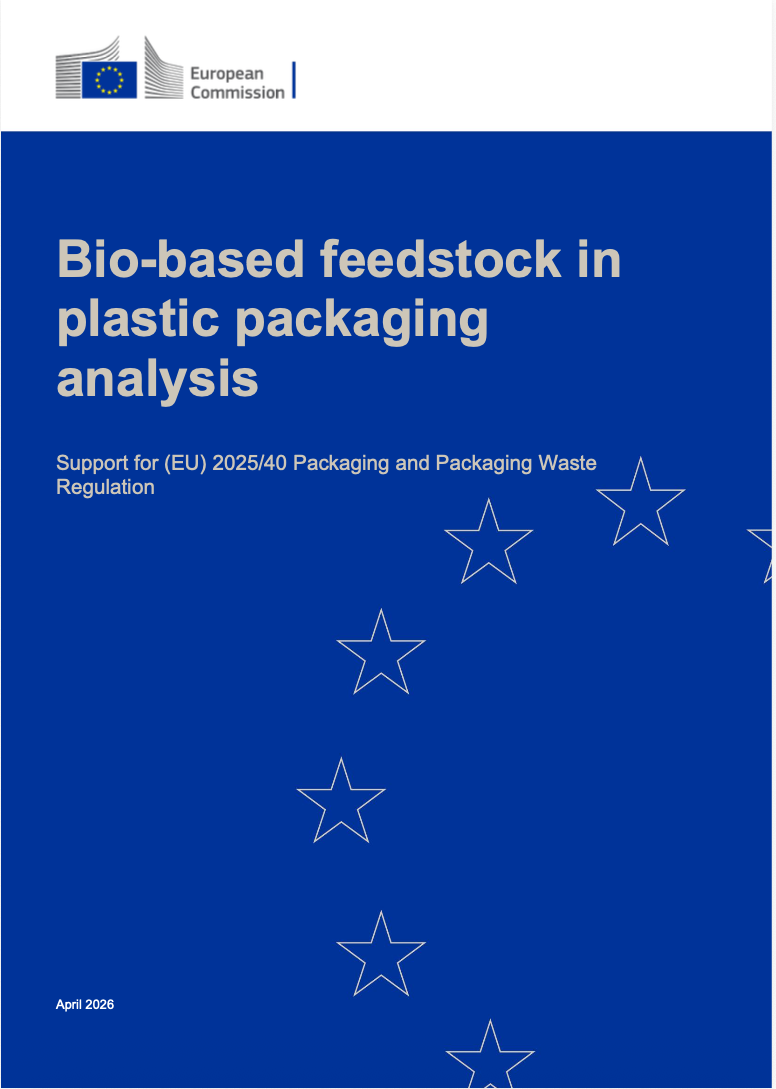
    Newsupport for bio based feedstock in plastic packaging analysis under the packaging and packaging waste regulation (eu) 2025/40 (affiliate product)

    Support for bio-based feedstock in plastic packaging analysis under the Packaging and Packaging Waste Regulation (EU) 2025/40 (Affiliate product)

    Markets & Economy, Policy, Sustainability & Health, Technology

    100 Pages


    2026-05

    FREE

    Free Shipping
     

    0
    Downloads

    More
    info

    New publication from nova experts for the European Commission

    This report assesses the role of bio-based feedstocks in plastic packaging under the EU’s Packaging and Packaging Waste Regulation (PPWR), with a focus on technological development and environmental performance. Although seventeen bio-based polymers are commercially available, they represent only ~1% of the global plastics market and account for just 4–5% of biogenic carbon in the EU chemical sector. Production capacity is concentrated in Asia (55%), followed by North America (17%) and the EU27+3 (14%). Despite their limited market share, there are no fundamental technical barriers to using them in packaging. Bio-based plastics offer a 30–70% reduction in greenhouse gas emissions compared to fossil-based alternatives, which supports the EU’s decarbonisation and circular economy goals. The report also evaluates the feasibility of setting targets for the use of bio-based materials, their equivalence with recycled materials and how sustainability criteria can be aligned with the Renewable Energy Directive (RED). Key recommendations include setting binding targets for bio-based content, establishing harmonised sustainability criteria, and adapting recycling infrastructure. Leveraging the complementarity of bio -based and recycled content could help to accelerate the EU’s transition to a climate-neutral packaging sector.
     
    Direct download via the renewable-carbon.eu/publications is not possible.
    Please follow this link: https://op.europa.eu/en/publication-detail/-/publication/98759f3f-3d27-11f1-814f-01aa75ed71a1/language-en
  • Add to
    cart
    ai circular economy conference 2026 (proceedings, pdf)

    AI Circular Economy Conference 2026 (Proceedings, PDF)

    Markets & Economy, Policy, Sustainability & Health, Technology


    2026-03

    150 € ex. tax

    Plus 19% MwSt.
    Press
    release
    Add to
    cart

    The proceedings of the AI Circular Economy Conference 2026 (4-5 March, https://ai-circulareconomy.eu ) contain 25 conference presentations and the press release. Download of the program leaflet.

  • Direct Download
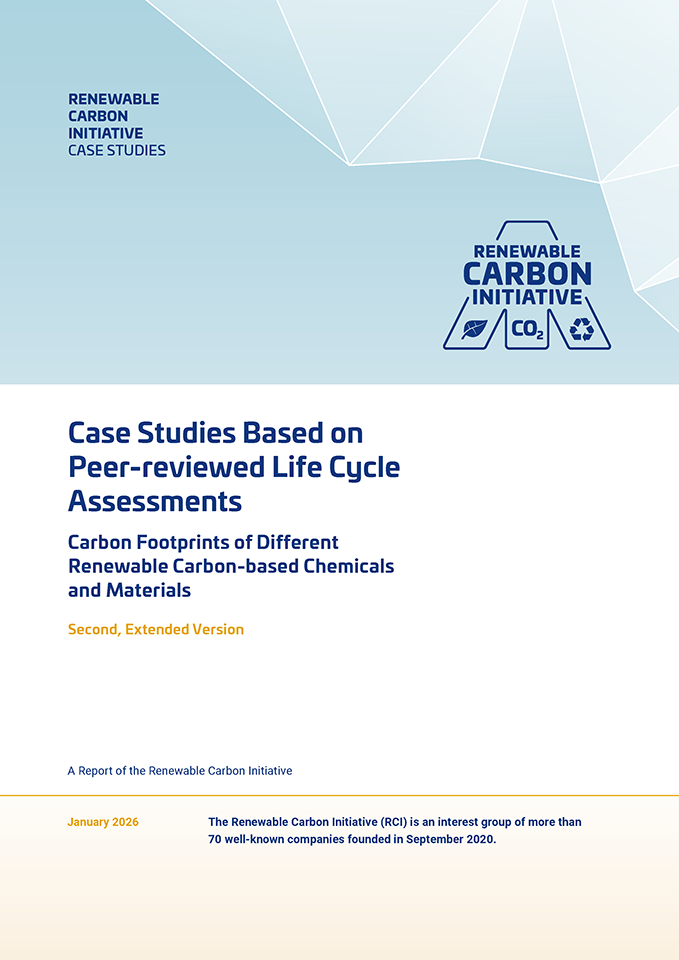
    case studies based on peer reviewed life cycle assessments: carbon footprints of different renewable carbon based chemicals and materials (2nd, extended version) – rci report (pdf)

    Case Studies Based on Peer-reviewed Life Cycle Assessments: Carbon Footprints of Different Renewable Carbon-Based Chemicals and Materials (2nd, Extended Version) – RCI Report (PDF)

    Sustainability & Health

    67 Pages
    754 Downloads

    754 Downloads  

    2026-01

    FREE

    Free Shipping
     

    754
    Downloads

    Direct Download

    This report broadens the scope of the brochure “Case studies based on peer-reviewed Life Cycle Assessments – Carbon Footprints of Different Carbon-Based Chemicals and Materials”, published in November 2023. The initial brochure presented five peer-reviewed studies that drew strong interest from experts, policymakers, and industry leaders for their insights into the carbon footprints of various carbon-based chemicals and materials.

    This second, extended version includes seven peer-reviewed LCAs from participating member companies: Braskem, Econic, Fibenol, LanzaTech, Lenzing (update), Peter Greven and Primient Covation.

    These expanded contributions will deepen understanding of carbon footprints and further support RCI’s commitment to
    data-driven sustainability.

    DOI No.: https://doi.org/10.52548/HRPM7087

  • More
    info
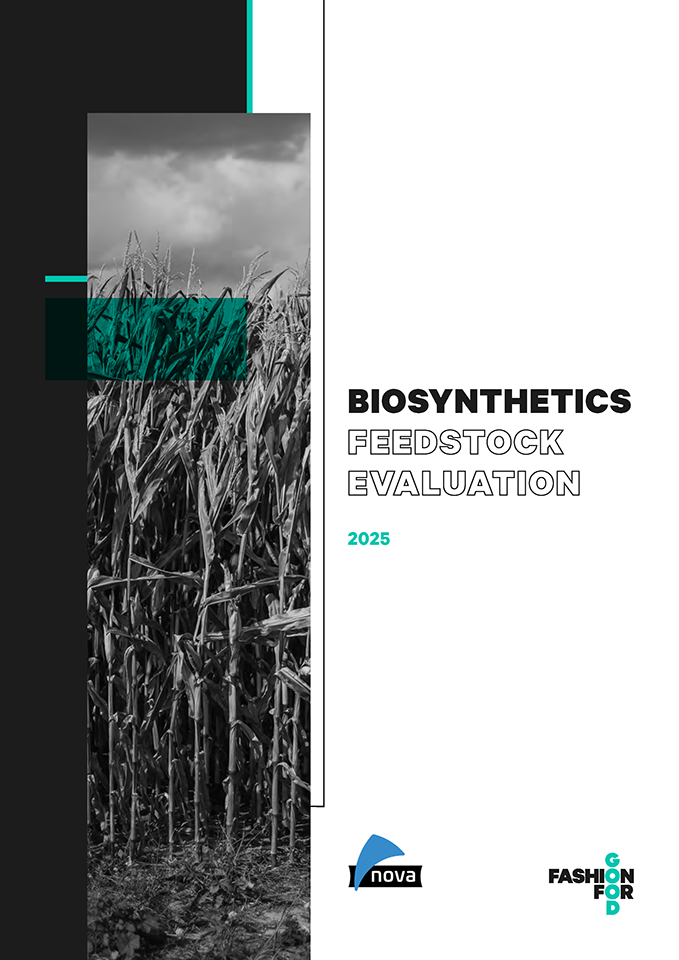
    biosynthetic feedstock evaluation

    Biosynthetic Feedstock Evaluation (Affiliate product)

    Sustainability & Health, Technology

    44 Pages


    2025-12

    FREE

    Free Shipping
     

    2
    Downloads

    More
    info

    The fashion industry is under growing pressure to shift towards more sustainable production methods and materials. Traditional petroleum-based materials dominate the textile and footwear industry. There is increasing interest in exploring alternative, more sustainable feedstocks, such as bio-based materials derived from carbon capture technologies. These alternatives offer potential environmental benefits but require thorough analysis to understand the technical feasibility, environmental impact, and regulatory considerations involved.

    The nova-Institute (hereafter referred to as nova) was engaged by Fashion for Good and some of its partners to conduct an in-depth assessment of sustainable feedstocks and conversion technologies for producing polymers, specifically focusing on bio-(PET, PA, EVA and BDO). The aim was to create a comprehensive understanding of the technological routes available for using bio-based feedstocks and emerging CO2 conversion technologies in the production of polymers used in the textile industry. Additionally, nova assessed sustainability standards and certification schemes to ensure the feedstocks meet stringent environmental and social criteria.

    Direct download via the renewable-carbon.eu/publications is not possible.
    Please follow this link:
    https://www.fashionforgood.com/case-study/biosynthetic-feedstock


  • Direct Download
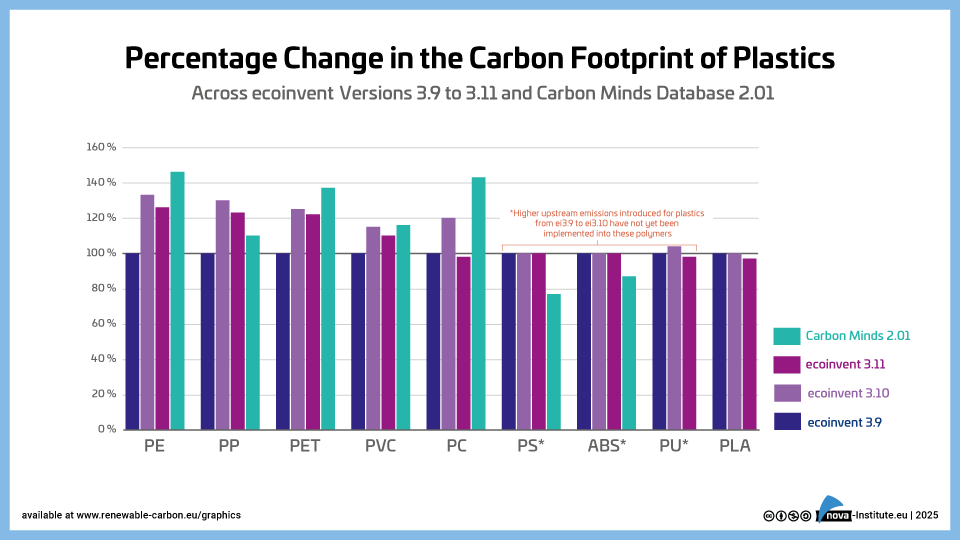
    percentage change in the carbon footprint of plastics (png) (copy)

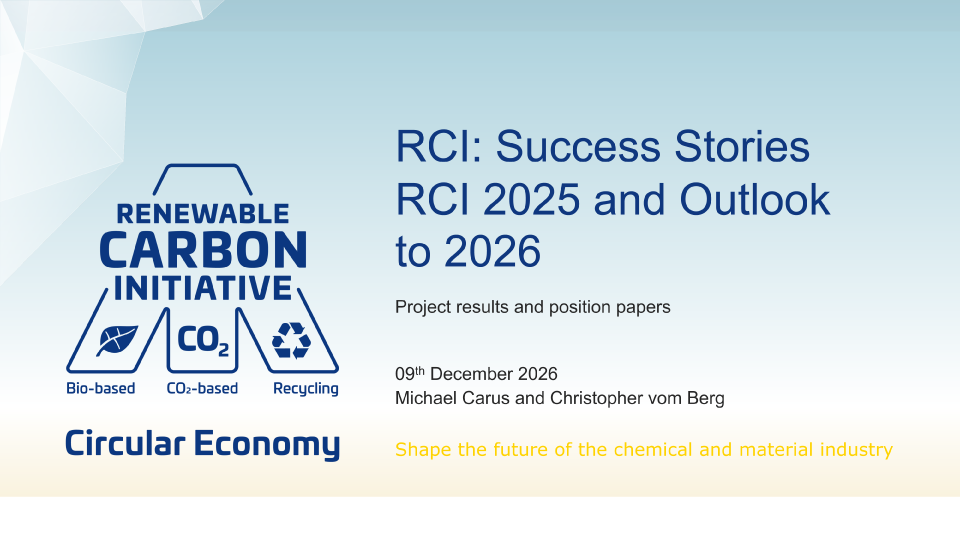
    RCI Webinar: Success Stories RCI 2025 and Outlook to 2026 – Project Results and Position Papers (PDF)

    Policy, Sustainability & Health

    59 Pages
    220 Downloads

    220 Downloads  

    2025-12

    FREE

    Free Shipping
     

    220
    Downloads

    Direct Download

    The free RCI webinar on 9 December 2025 presented the RCI Success Stories 2025 and offered an Outlook to 2026. It showcased RCI’s policy impact at EU, national and international levels, highlighted key publications and scientific results (including the biomass study, Policy Proposals, LCA methodologies, sustainability criteria paper, and analysis of recent updates to methane and fossil CO2 emissions data in Life-Cycle Inventories (LCI)), and summarised member activities such as expert groups, roundtables, and survey insights. The webinar also introduced RCI’s ongoing and upcoming projects for 2026, including biodiversity, policy barriers, carbon flows, LCA case studies, and awareness-building initiatives.

  • Add to
    cart
    22 11 28 rc publications cover proceedings arc

    Advanced Recycling Conference 2025 (Proceedings, PDF)

    Markets & Economy, Policy, Sustainability & Health, Technology


    2025-12

    150 € ex. tax

    Plus 19% MwSt.
    Press
    release
    Add to
    cart

    The proceedings of the Advanced Recycling Conference 2025 (19-20 November, https://advanced-recycling.eu) contain 41 conference presentations, the conference journal, sponsor documents and the press release.

  • Add to
    cart
    Renewable Materials Conference 2025 (Proceedings, PDF) [Digital]

    Renewable Materials Conference 2025 (Proceedings, PDF)

    Markets & Economy, Policy, Sustainability & Health, Technology


    2025-10

    200 € ex. tax

    Plus 19% MwSt.
    Press
    release
    Add to
    cart

    The proceedings of the Renewable Materials Conference 2025 (22-24 September 2025, https://renewable-materials.eu) contain all released 68 presentations, the conference journal and the press release of the three winners of the Innovation Award “Renewable Material of the Year 2025″.

    Download Conference journal (PDF)

  • Direct Download
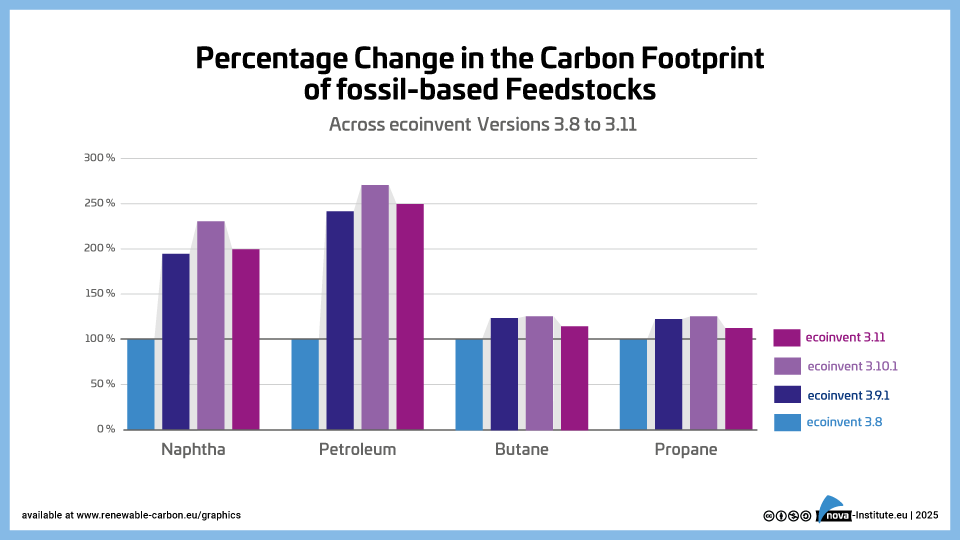
    percentage change in the carbon footprint of aromatics and derivatives (png) (copy)

    Percentage Change in the Carbon Footprint of fossil-based Feedstocks (PNG)

    Sustainability & Health

    1 Page
    38 Downloads

    38 Downloads  

    2025-10

    FREE

    Free Shipping
     

    38
    Downloads

    Direct Download
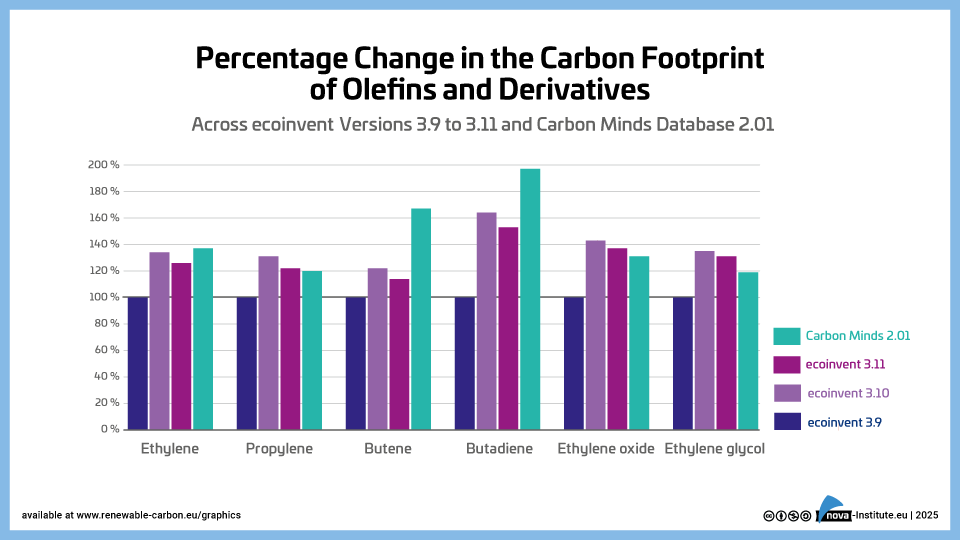
  • Direct Download
    percentage change in the carbon footprint of fossil based feedstocks (png) (copy)

    Percentage Change in the Carbon Footprint of Olefins and Derivatives (PNG)

    Sustainability & Health

    1 Page
    17 Downloads

    17 Downloads  

    2025-10

    FREE

    Free Shipping
     

    17
    Downloads

    Direct Download
  • Direct Download
    percentage change in the carbon footprint of olefins and derivatives (png) (copy)

    Percentage Change in the Carbon Footprint of Plastics (PNG)

    Sustainability & Health

    1 Page
    46 Downloads

    46 Downloads  

    2025-10

    FREE

    Free Shipping
     

    46
    Downloads

    Direct Download
  • Direct Download
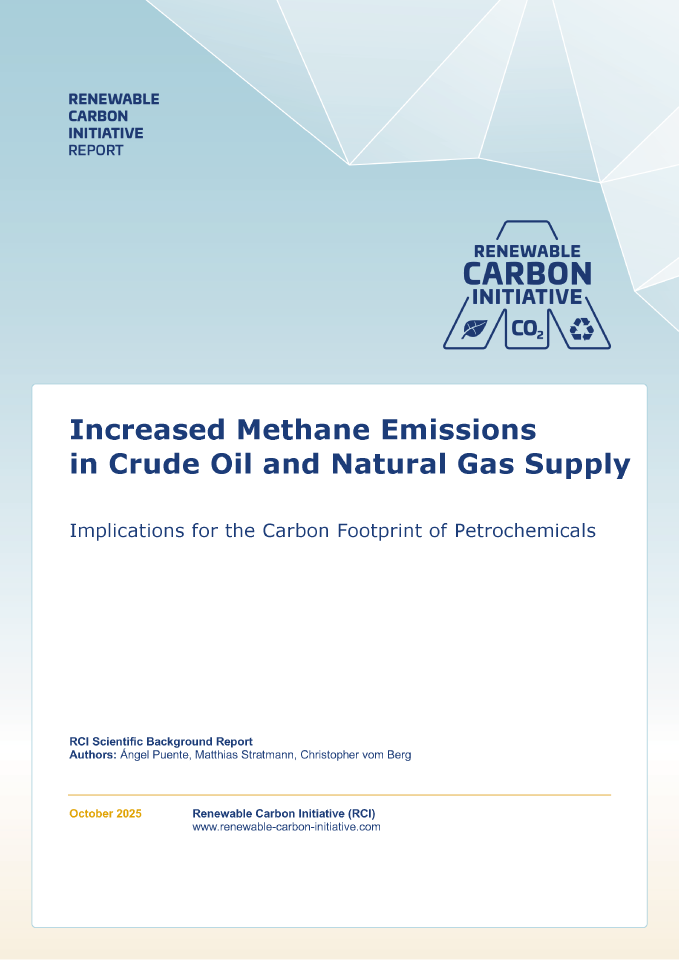
    increased methane emissions in crude oil and natural gas supply: implications for the carbon footprint of petrochemicals – an rci report (pdf)

    Increased Methane Emissions in Crude Oil and Natural Gas Supply: Implications for the Carbon Footprint of Petrochemicals – RCI Report (October 2025)

    Sustainability & Health

    39 Pages
    564 Downloads

    564 Downloads  

    2025-10

    FREE

    Free Shipping
     

    564
    Downloads

    Direct Download

    This scientific background report by RCI shows that recent updates to leading LCI databases (ecoinvent 3.9–3.11) reveal a major underestimation of methane emissions from oil and gas supply chains. Enhanced satellite data on flaring, venting, and leaks highlight large inconsistencies compared to sources such as IEA, IOGP, and the World Bank. For instance, IEA now reports oil-related methane emissions up to 15 times higher than IOGP, with extreme differences for Russia (10-fold) and Saudi Arabia (40-fold). These revisions sharply increase the carbon footprint of fossil feedstocks, with naphtha nearly tenfold higher and significant rises for ethylene, propylene, and ethylene glycol. As a consequence, plastics such as PE, PP, and PET show 20–30% higher footprints. By contrast, renewable carbon alternatives gain ground: bio-based plastics now appear 12–27% more climate-friendly, with even greater advantages when biogenic carbon uptake is included.

    The RCI report urges policymakers to rapidly integrate methane regulation and updated LCI data into climate strategies. Key recommendations include regular database updates, expanded emissions tracking, harmonized reporting, and stronger support for renewable carbon solutions.

    DOI: https://doi.org/10.52548/RQJN5517


  • Direct Download
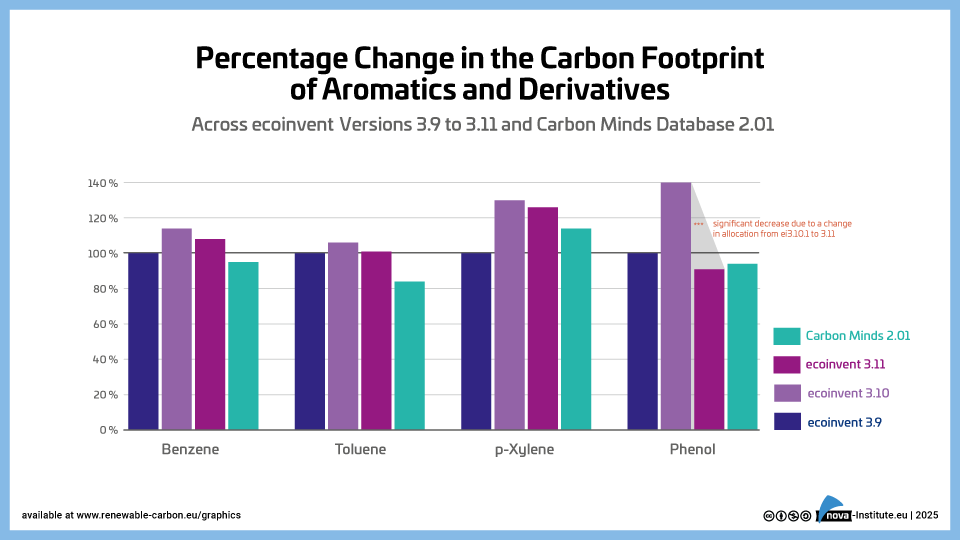
    percentage change in the carbon footprint of aromatics and derivatives (png)

    Percentage Change in the Carbon Footprint of Aromatics and Derivatives (PNG)

    Sustainability & Health

    1 Page
    15 Downloads

    15 Downloads  

    2025-10

    FREE

    Free Shipping
     

    15
    Downloads

    Direct Download
  • Direct Download
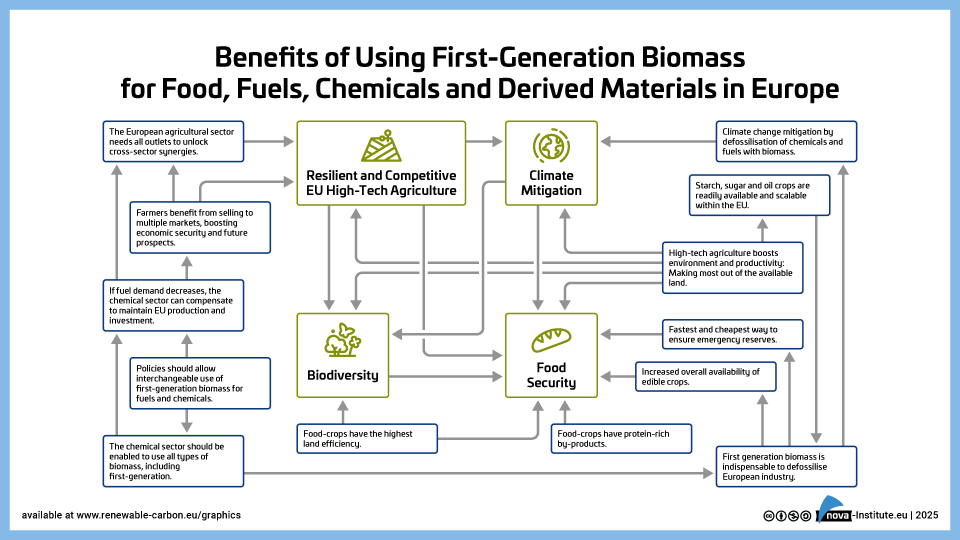
    (png)

    Benefits of Using First-Generation Biomass for Food, Fuel, Materials and Chemicals in Europe (PNG)

    Policy, Sustainability & Health

    1 Page
    129 Downloads

    129 Downloads  

    2025-09

    FREE

    Free Shipping
     

    129
    Downloads

    Direct Download
  • Direct Download
    benefits of using first generation biomass for food, fuel, materials and chemicals in europe (png) (copy)

    Co-production per Tonne Termantable Sugars (PNG)

    Policy, Sustainability & Health

    1 Page
    24 Downloads

    24 Downloads  

    2025-09

    FREE

    Free Shipping
     

    24
    Downloads

    Direct Download
  • Direct Download
    benefits of using first generation biomass for food, fuels, chemicals and derived materials in europe (pdf)

    Benefits of Using First-Generation Biomass for Food, Fuels, Chemicals and Derived Materials in Europe (PDF)

    Policy, Sustainability & Health

    16 Pages
    1087 Downloads

    1087 Downloads  

    2025-09

    FREE

    Free Shipping
     

    1087
    Downloads

    Direct Download

    Key messages – Benefits of using first-generation biomass for food, fuels, chemicals and derived materials

    First-generation biomass in non-food applications increases food security.
    Using first-generation biomass for non-food applications strengthens food security by increasing overall availability of feedstock and market stability. At the same time, it also delivers valuable protein-rich by-products addressing the most critical needs for human and animal nutrition. The ability to shift crops between the food, feed, and industrial markets enables the EU and market players to respond swiftly to changes in demand and mitigate the risks associated with supply chain disruptions. Most importantly, using first-generation biomass for non-food applications offers a fast and economical way to set up and ensure an emergency food reserve.

    • First-generation biomass in non-food applications enhances a resilient and competitive EU agriculture
    • First-generation biomass in non-food applications supports climate change mitigation
    • First-generation biomass in non-food applications supports biodiversity protection
    • High-tech agriculture further enhances the benefits of first-generation biomass.

    DOI No.: https://doi.org/10.52548/GCJC4981

Renewable Carbon Types

Publications

Topics

  • 1
  • 2
  • 3
  • …
  • 13

nova-Logo
contact@nova-institut.de
www.nova-institute.eu

nova-Institut GmbH
Leyboldstr. 16
50354 Hürth / Germany

  • Renewable Carbon
  • Events
  • Publications
  • Graphics
  • News
  • Business Directory
  • Newsletter
  • nova-Institute
  • My account
  • Legal Information
  • Terms and Conditions
  • Data protection regulation
© 2026 nova-Institut GmbH
Renewable Carbon Publications - Logo

Login

Lost your password?