Skip to content
Renewable Carbon Publications - LogoRenewable Carbon Publications - Logo
  • Publications
  • Contact
1
  • Cellulose Fibres Conference 2024 (Proceedings, PDF) [Digital]Cellulose Fibres Conference 2024 (Proceedings, PDF) [Digital] 1 × 50 €
    Plus 19% MwSt.

Subtotal: 50 €

CartCheckout

  • Renewable Carbon
    • Renewable Carbon
    • Events
    • Publications
    • Graphics
    • News
    • Business Directory
    • Newsletter
    • nova-Institute
  • Publications
  • Contact

Renewable Carbon Publications - LogoRenewable Carbon Publications - Logo
1
  • Cellulose Fibres Conference 2024 (Proceedings, PDF) [Digital]Cellulose Fibres Conference 2024 (Proceedings, PDF) [Digital] 1 × 50 €
    Plus 19% MwSt.

Subtotal: 50 €

CartCheckout

  • Renewable Carbon Publications
  • Technology
  • Page 2
Grid view List view
“Cellulose Fibres Conference 2024 (Proceedings, PDF)” has been added to your cart. View cart

Showing 21–40 of 133

  • Download Statistics
  • Direct Download
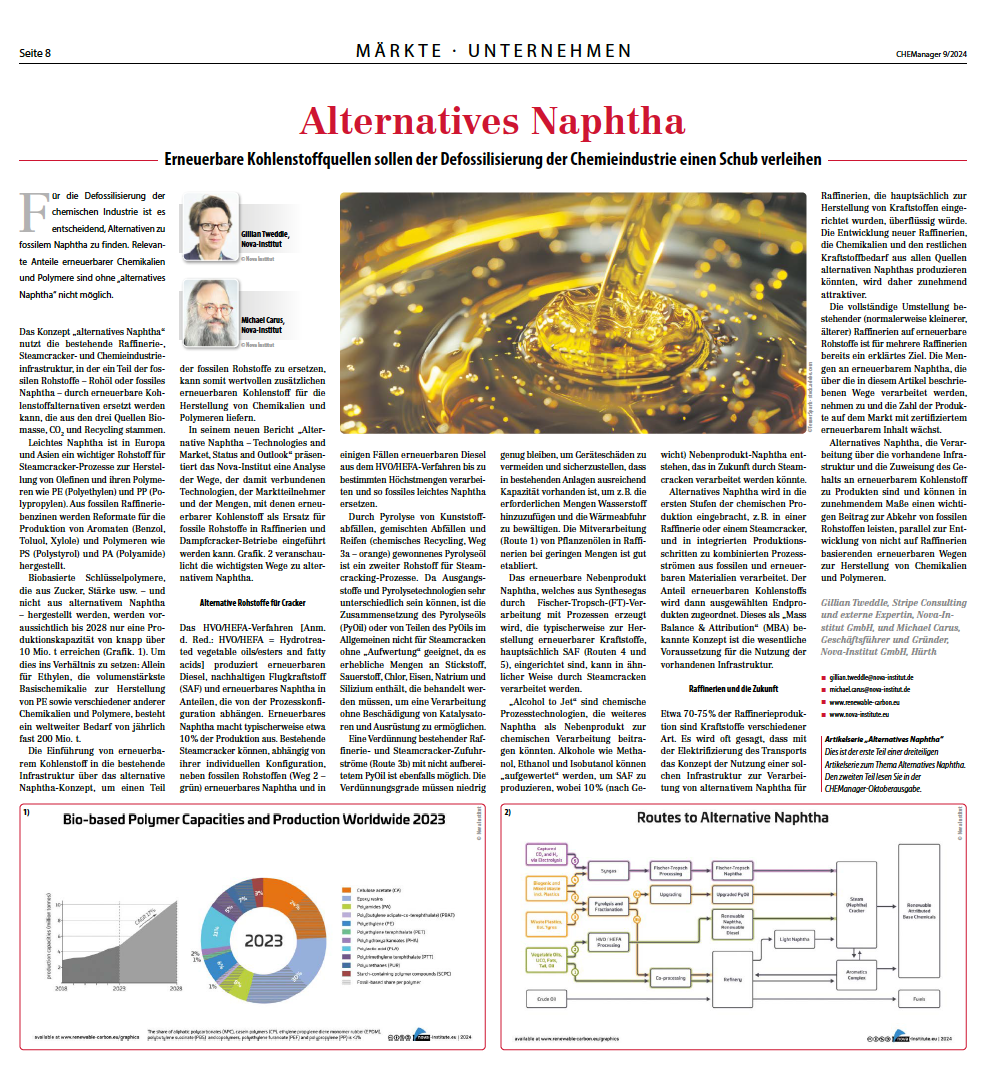
    alternatives naphtha – Artikel 1 im CHEManager

    Alternatives Naphtha – Erneuerbare Kohlenstoffquellen sollen der Defossilisierung der Chemieindustrie einen Schub verleihen (Gastbeitrag Teil 1) (PDF)

    Markets & Economy, Technology

    1 Page
    45 Downloads

    45 Downloads  

    2024-09

    FREE


    45
    Downloads

    Direct Download

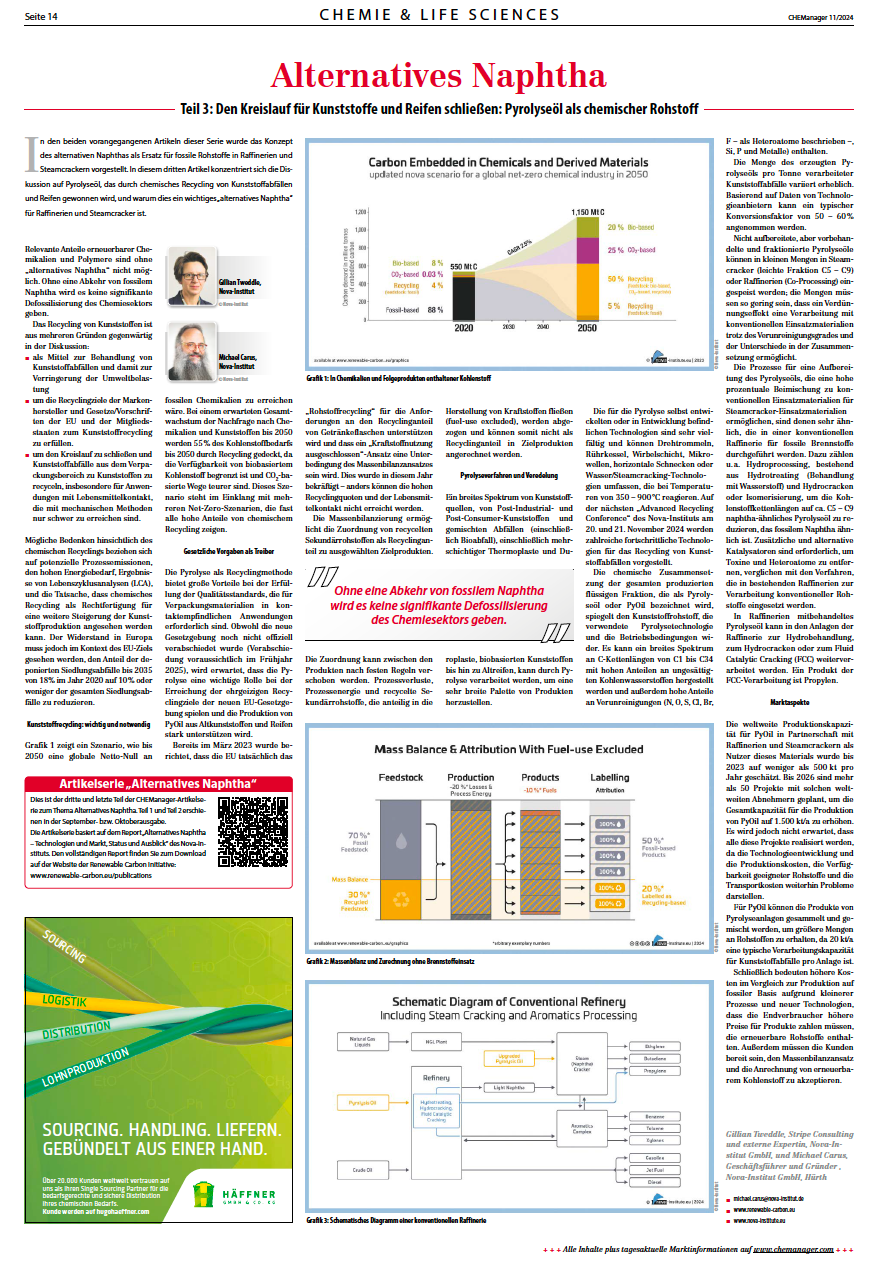
    Für die Defossilisierung der chemischen Industrie ist es entscheidend, Alternativen zu fossilem Naphtha zu finden. Relevante Anteile erneuerbarer Chemikalien und Polymere sind ohne „alternatives Naphtha“ nicht möglich.

    Das Konzept „alternatives Naphtha“ nutzt die bestehende Raffinerie-, Steamcracker- und Chemieindustrieinfrastruktur, in der ein Teil der fossilen Rohstoffe – Rohöl oder fossiles Naphtha – durch erneuerbare Kohlenstoffalternativen ersetzt werden kann, die aus den drei Quellen Biomasse, CO2 und Recycling stammen.

    Dieser Artikel ist im Rahmen einer Serie von Gastbeiträgen im CHEManager erschienen. Es handelt sich um „Alternatives Naphtha Teil 1“ – aus CHEManager 09/2024.

    Hier finden sie den Artikel auch bei CHEManager.


  • Direct Download
    renewable carbon initiative (rci) webinar slides – july 2024 (pdf)

    Renewable Carbon Initiative (RCI) Webinar slides – July 2024 (PDF)

    Policy, Sustainability & Health, Technology

    60 Pages
    508 Downloads

    508 Downloads  

    2024-07

    FREE

    Free Shipping
     

    508
    Downloads

    Direct Download

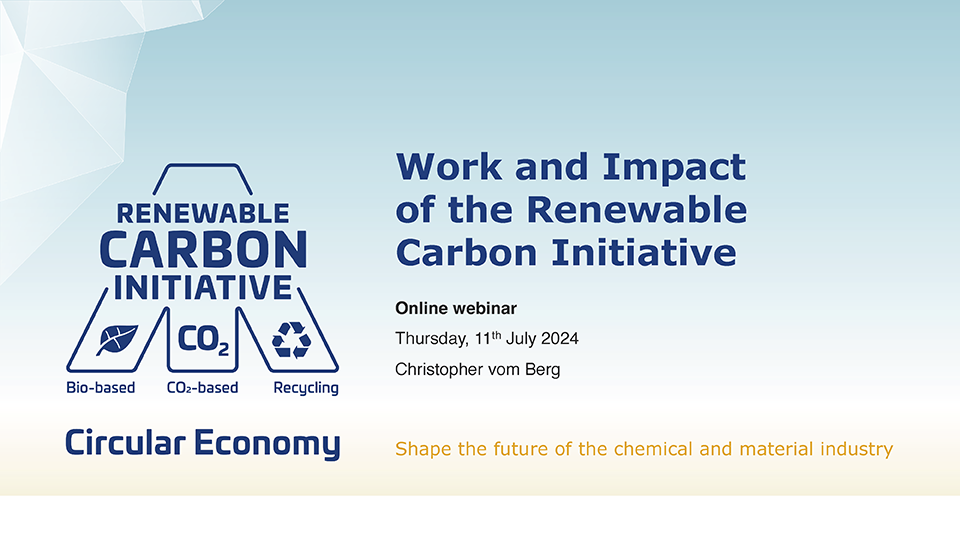
    This document contains a generic set of slides to introduce the concept of renewable carbon and the Renewable Carbon Initiative. The focus of this webinar is the work and impact of the RCI. Moreover, Arndt Scheidgen, Head of Product Stewardship at Henkel Consumer Brands joined the webinar to give insights as an industry leader.

  • Direct Download
    alternative naphtha – technologies and market, status and outlook (pdf)

    Alternative Naphtha – Technologies and Market, Status and Outlook (PDF) – Short Version

    Markets & Economy, Technology

    20 Pages
    1163 Downloads

    1163 Downloads  

    2024-07

    FREE


    1163
    Downloads

    Direct Download

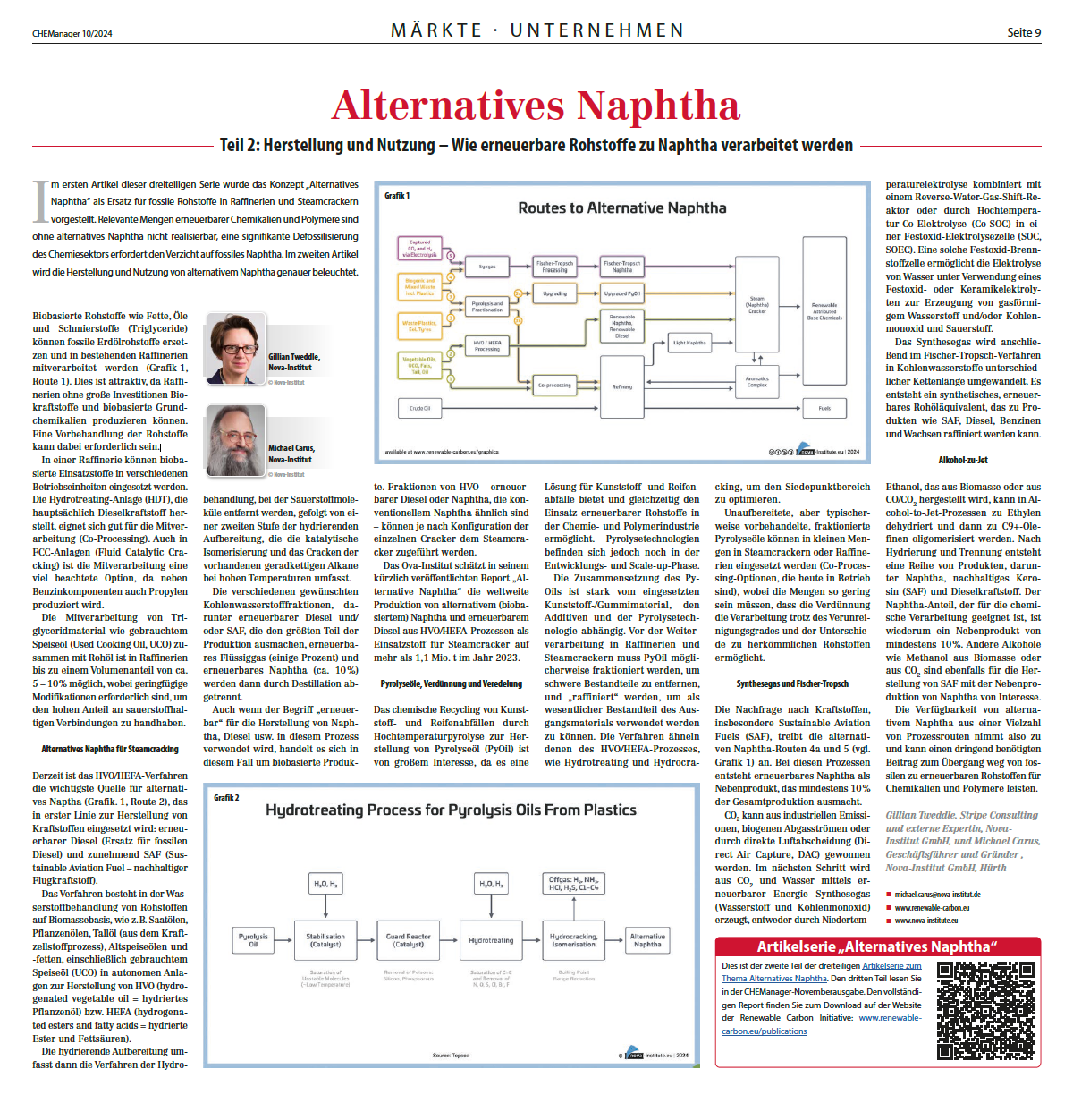
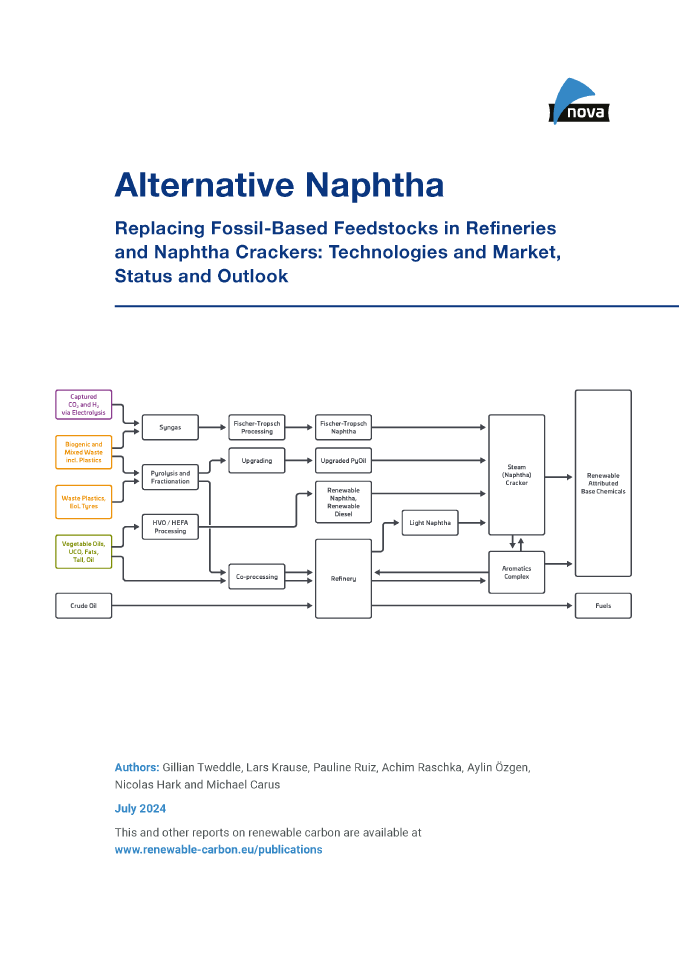
    For the defossilisation of the chemical industry, it is crucial to find alternatives to fossil-based naphtha. The “alternative naphtha” concept makes use of existing refinery, steam cracking and chemical industry infrastructure where a proportion of fossil-based feedstocks – crude oil or fossil-based naphthas can be replaced by renewable carbon alternatives derived from the three sources of renewable carbon: CO2, biomass and recycling.

    This new report by nova-Institute presents an analysis of the routes, associated technologies, market players and volumes by which renewable carbon can be introduced to refinery and steam cracking operations as replacement for fossil based feedstocks.

    With 188 pages, 22 tables and illustrated by 48 graphics the report provides a comprehensive view on the growth in capacity for these alternative sources of naphtha as chemical industry feedstock, production routes and the need for “upgrading”, key companies and partnerships and the regulatory environment.

    DOI No.: https://doi.org/10.52548/JICP8041

  • Select
    licence
    alternative naphtha – technologies and market, status and outlook (pdf)

    Alternative Naphtha – Technologies and Market, Status and Outlook (PDF)

    Markets & Economy, Technology

    188 Pages


    2024-07

    2,500 € – 9,000 €Price range: 2,500 € through 9,000 € ex. tax

    Plus 19% MwSt.
     
    Select
    licence

    For the defossilisation of the chemical industry, it is crucial to find alternatives to fossil-based naphtha. The “alternative naphtha” concept makes use of existing refinery, steam cracking and chemical industry infrastructure where a proportion of fossil-based feedstocks – crude oil or fossil-based naphthas can be replaced by renewable carbon alternatives derived from the three sources of renewable carbon: CO2, biomass and recycling.

    This new report by nova-Institute presents an analysis of the routes, associated technologies, market players and volumes by which renewable carbon can be introduced to refinery and steam cracking operations as replacement for fossil based feedstocks.

    With 188 pages, 22 tables and illustrated by 48 graphics the report provides a comprehensive view on the growth in capacity for these alternative sources of naphtha as chemical industry feedstock, production routes and the need for “upgrading”, key companies and partnerships and the regulatory environment.

    DOI No.: https://doi.org/10.52548/JICP8041

  • Add to
    cart
    Renewable Materials Conference 2024 (Proceedings, PDF) [Digital]

    Renewable Materials Conference 2024 (Proceedings, PDF)

    Markets & Economy, Policy, Sustainability & Health, Technology


    2024-06

    200 € ex. tax

    Plus 19% MwSt.
    Press
    release
    Add to
    cart

    The proceedings of the Renewable Materials Conference 2024 (11-13 June 2024, https://renewable-materials.eu) contain all released presentations, the conference journal, and the press release of the three winners of the Innovation Award “Renewable Material of the Year 2024″.

    Program (PDF)

    Download Conference journal (PDF)

  • Direct Download
    mass balance & attribution with fuel use excluded
 (png)

    Mass Balance & Attribution With Fuel-use Excluded
 (PNG)

    Markets & Economy, Policy, Sustainability & Health, Technology

    1 Page
    284 Downloads

    284 Downloads  

    2024-06

    FREE


    284
    Downloads

    Direct Download

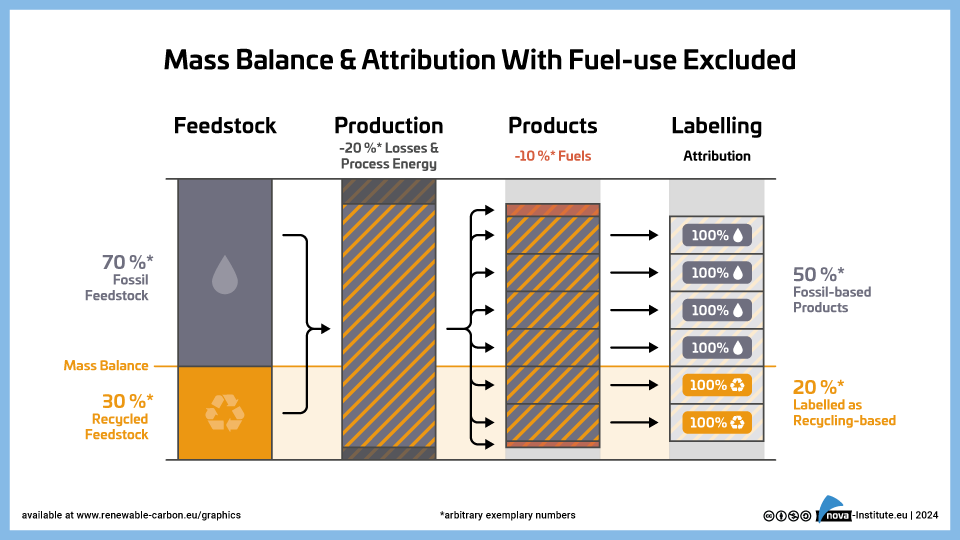
    The graphic shows the approach of mass balance and attribution with fuel-use excluded which allows to track the fossil and recycled share of feedstock. The recycled content can be attributed to products after deducting lossess and proess energy during production and, if applicable, produced energy carriers (fuel-use excluded). This approach ensures that a transparent amount of fossil feedstock is replaced by recycled feedstock in the production process and that only recycled feedstock that actually ends up in products can be attributed.

  • Direct Download
    rci position paper on chemical and physical recycling (pdf)

    RCI Position Paper on Chemical and Physical Recycling (PDF)

    Policy, Technology

    4 Pages
    979 Downloads

    979 Downloads  

    2024-05

    FREE

    Free Shipping
     

    979
    Downloads

    Direct Download

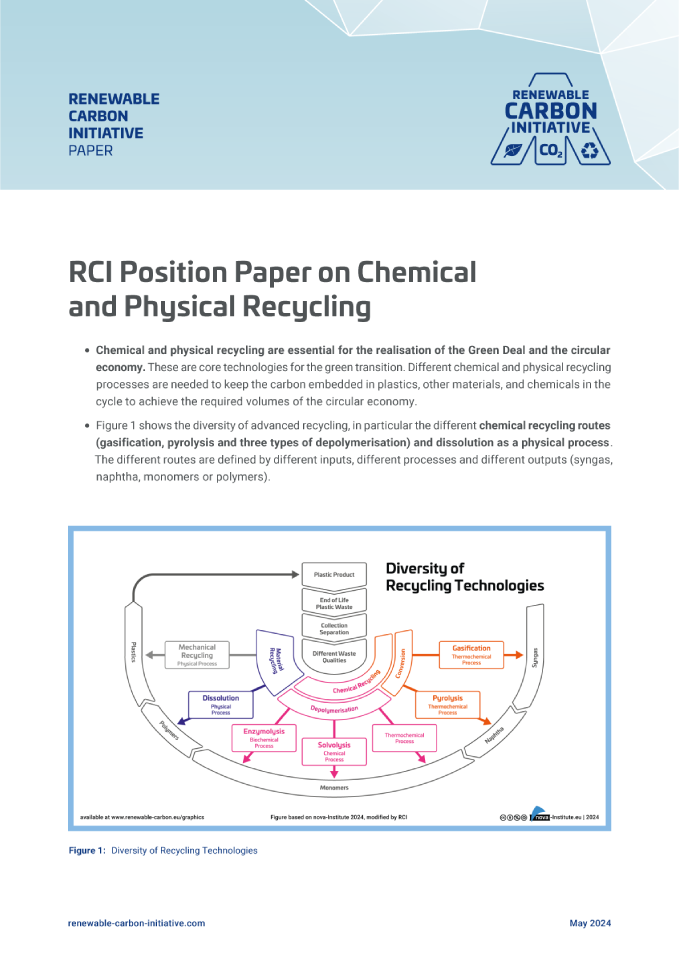
    In this position paper, the RCI describes that chemical and physical recycling play essential roles in realising the objectives of the Green Deal and advancing the circular economy. These technologies are indispensable for the green transition.

    This position paper identifies eleven requirements to create secure demand, drive investment and further improve the technology field. These include general acceptance of the technology; mandatory recycled content for all polymers/plastics in all applications; recognition and clarification of rules for the calculation of recycling rates; full acceptance of mass balance & attribution with fuel-use excluded; accelerated approval of new chemical and physical recycling facilities; expansion of recycling infrastructure for all sectors beyond packaging; and the extension of CO2 pricing for waste incineration in the ETS combined with a landfill ban.

    Additionally, RCI advocates for a pragmatic approach, emphasising that while closed-loop recycling is a noble goal for sectors such as packaging, textiles and automobiles, it should not be approached too dogmatically. Flexibility is essential to prevent environmental and economic inefficiencies. If the waste stream of one sector can be better used in another, this should be possible.

  • Direct Download
    renewable carbon initiative (rci) webinar slides – april 2024 (pdf)

    Renewable Carbon Initiative (RCI) Webinar slides – April 2024 (PDF)

    Markets & Economy, Policy, Technology

    43 Pages
    208 Downloads

    208 Downloads  

    2024-05

    FREE

    Free Shipping
     

    208
    Downloads

    Direct Download

    This document contains a generic set of slides to introduce the concept of renewable carbon and the Renewable Carbon Initiative. The focus of this webinar was the upcoming position paper on Chemical and Physical Recycling.

  • Add to
    cart
    CO2-based Fuels and Chemicals Conference 2024 (Proceedings, PDF) [Digital]

    CO2-based Fuels and Chemicals Conference 2024 (Proceedings, PDF)

    Markets & Economy, Policy, Sustainability & Health, Technology


    2024-05

    50 € ex. tax

    Plus 19% MwSt.
    Press
    release
    Add to
    cart

    The proceedings of the CO2-based Fuels and Chemicals Conference 2024 (17-18 April 2024, https://co2-chemistry.eu) contain all released presentations, the conference journal, and the press release of the three winners of the Innovation Award “Best CO2 Utilisation 2024″.

  • Add to
    cart
    Cellulose Fibres Conference 2024 (Proceedings, PDF) [Digital]

    Cellulose Fibres Conference 2024 (Proceedings, PDF)

    Markets & Economy, Policy, Sustainability & Health, Technology


    2024-04

    50 € ex. tax

    Plus 19% MwSt.
    Press
    release
    Add to
    cart

    The conference covered the entire value chain, from lignocellulose, chemical pulp, cellulose fibres such as rayon, viscose, modal or lyocell and new developments to a wide range of applications:
    Textiles from renewable fibres, non-wovens such as wet wipes as well as new areas such as composites, hygiene, packaging or nanocellulose in the food industry. The conference offered deep insights into the promising future of cellulose fibres, which perfectly fits the current trends of circular economy, recycling and sustainable carbon cycles.

    The Cellulose Fibres Conference Proceedings (https://cellulose-fibres.eu, 13-14 March 2024, Cologne, hybrid) include all released conference presentations, the conference journal, sponsor documents, a Fiber2Fashion Knowledgepaper and the conference press release.

  • Direct Download
    eu27+3 advanced recycling waste input capacity

    EU27+3 Advanced Recycling Waste Input Capacity (PNG)

    Markets & Economy, Technology

    1 Page
    133 Downloads

    133 Downloads  

    2024-03

    FREE


    133
    Downloads

    Direct Download

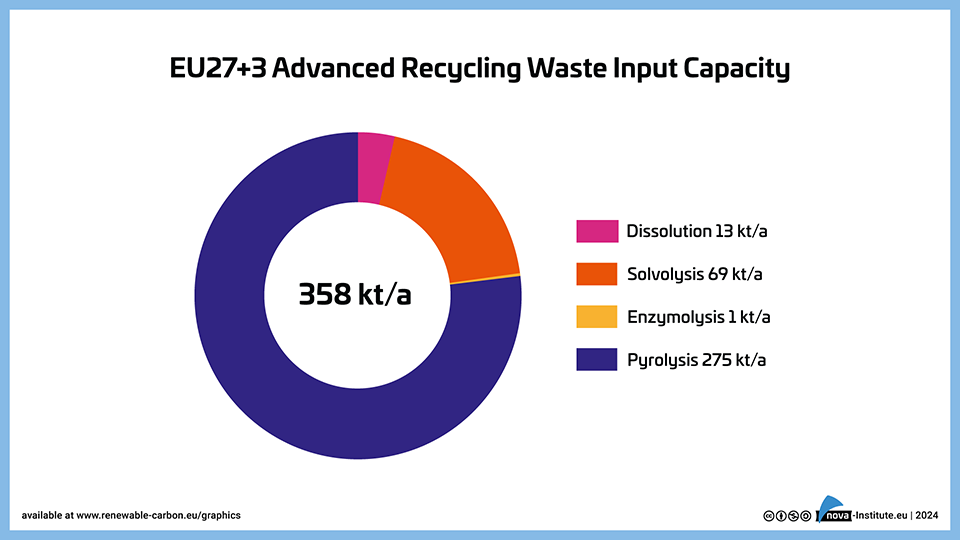
    Installed input capacities for different advanced recycling technologies in EU27+3.

  • Direct Download
    eu27+3 advanced recycling waste input capacity (copy)

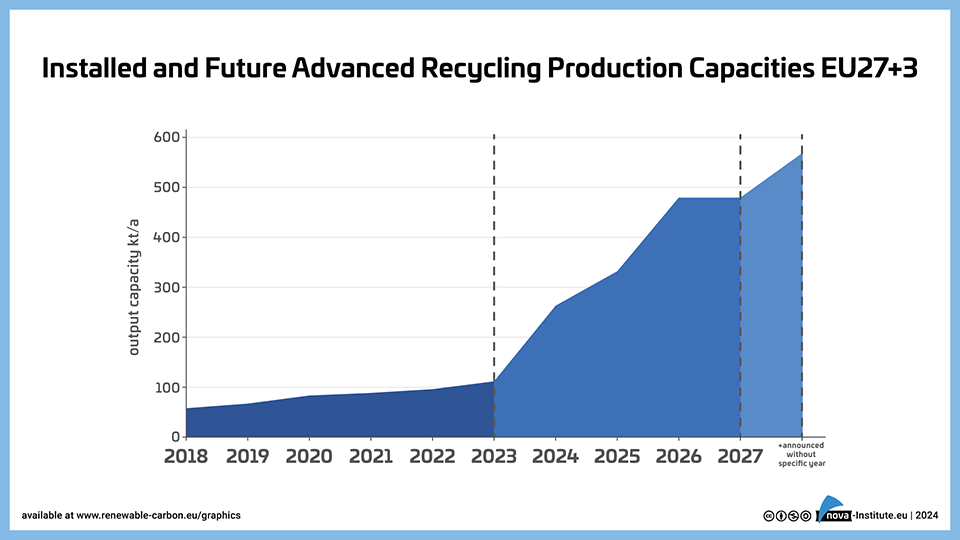
    Installed and Future Advanced Recycling Production Capacities EU 27+3 (PNG)

    Markets & Economy, Technology

    1 Page
    175 Downloads

    175 Downloads  

    2024-03

    FREE


    175
    Downloads

    Direct Download

    Installed and future production capacities of naphtha, monomers and polymers through advanced recycling in the EU27+3.

  • Direct Download
    installed and future advanced recycling production capacities eu 27+3 (copy)

    EU27+3 Advanced Recycling Product Output Capacity (PNG)

    Markets & Economy, Technology

    1 Page
    133 Downloads

    133 Downloads  

    2024-03

    FREE


    133
    Downloads

    Direct Download
  • Select
    licence
    mapping of advanced plastic waste recycling technologies and their global capacities (pdf)

    Mapping of Advanced Plastic Waste Recycling Technologies and their Global Capacities (PDF)

    Markets & Economy, Technology

    276 Pages


    2024-02

    3,000 € – 10,000 €Price range: 3,000 € through 10,000 € ex. tax

    Plus 19% MwSt.
     
    Select
    licence

    Advanced recycling technologies are developing at a fast pace, with new players constantly appearing on the market, from start-ups to giants and everything in between – new plants are being built, new capacities are being achieved, and new partnerships are established. Due to these developments, it is difficult to keep track of everything. The report “Mapping of advanced plastic waste recycling technologies and their global capacities” aims to clear up this jungle of information providing a structured, in-depth overview and insight. It has an exclusive focus on profiling available technologies and providers of advanced recycling including the addition of new technologies and updated/revised profiles. Furthermore, for the first time a comprehensive evaluation of the global input and output capacities was carried out for which more than 340 planned as well as installed and operating plants including their specific product yields were mapped.

    Further information:
    The new report “Mapping of advanced plastic waste recycling technologies and their global capacities” differs from the old report “Chemical Recycling – Status, Trends and Challenges” as follows:

    • All technology provider profiles from the old report included + updated to 2023.
    • Overall >120 technologies and providers (vs. >70 technologies and providers in the old report)
    • Global capacities

    In summary, this report is suitable for interested readers who have already dealt with the advanced recycling topic and are looking for an up-to-date overview of all identified providers and a detailed description of the technologies.


    DOI No.: https://doi.org/10.52548/WQHT8696

  • Direct Download
    mapping of advanced plastic waste recycling technologies and their global capacities (pdf)

    Mapping of Advanced Plastic Waste Recycling Technologies and their Global Capacities – Short Version (PDF)

    Markets & Economy, Technology

    12 Pages
    2182 Downloads

    2182 Downloads  

    2024-02

    FREE


    2182
    Downloads

    Direct Download

    Advanced recycling technologies are developing at a fast pace, with new players constantly appearing on the market, from start-ups to giants and everything in between – new plants are being built, new capacities are being achieved, and new partnerships are established. Due to these developments, it is difficult to keep track of everything. The report “Mapping of advanced plastic waste recycling technologies and their global capacities” aims to clear up this jungle of information providing a structured, in-depth overview and insight. It has an exclusive focus on profiling available technologies and providers of advanced recycling including the addition of new technologies and updated/revised profiles. Furthermore, for the first time a comprehensive evaluation of the global input and output capacities was carried out for which more than 340 planned as well as installed and operating plants including their specific product yields were mapped.

    Further information:
    The new report “Mapping of advanced plastic waste recycling technologies and their global capacities” differs from the old report “Chemical Recycling – Status, Trends and Challenges” as follows:

    • All technology provider profiles from the old report included + updated to 2023.
    • Overall >120 technologies and providers (vs. >70 technologies and providers in the old report)
    • Global capacities

    In summary, this report is suitable for interested readers who have already dealt with the advanced recycling topic and are looking for an up-to-date overview of all identified providers and a detailed description of the technologies.

    Click here for the the full version of the study.

  • Add to
    cart
    22 11 28 rc publications cover proceedings arc

    Advanced Recycling Conference 2023 (Proceedings)

    Markets & Economy, Policy, Sustainability & Health, Technology


    2023-12

    50 € ex. tax

    Plus 19% MwSt.
    Press
    release
    Add to
    cart

    The proceedings of the Advanced Recycling Conference 2023 (28-29 November, https://advanced-recycling.eu) contain conference presentations, the conference journal, sponsor documents and the press release. Download of the conference journal incl. the program.

  • Direct Download
    23 06 13 cover food paper short version thumbnail

    RCI’s scientific background report: “The use of food and feed crops for bio-based materials and the related effects on food security – Promoting evidence-based debates and recognising potential benefits” (June 2023) Short Version

    Markets & Economy, Policy, Sustainability & Health, Technology

    2 Pages
    988 Downloads

    988 Downloads  

    2023-11

    FREE


    988
    Downloads

    Direct Download

    Promoting Evidence-based Debates and Recognising Potential Benefits

    This short version of the scientific paper highlights on two pages new insights into a hotly debated topic and urges for careful and evidence-based debates.

    The paper aims to show that the well-known biomass debate is flawed, subjective and not fully based on evidence. What is detrimental to food security are, according to the World Food Programme in 2023, climate change, conflict, extreme inequalities in wealth distribution, heavy dependence on food imports from industrial countries, overconsumption of meat, losses along the value chain and the impact of the COVID pandemic. Competition between biomass uses is not mentioned among the relevant causes.

    The use of biomass for industrial applications, does have the potential to replace fossil feedstocks and thus contribute to the urgently needed reduction of fossil carbon emissions into our atmosphere to mitigate climate change.

    While not denying the dire need to combat world hunger, the authors of the paper argue that using food and feed crops for chemicals and materials will not necessarily exacerbate food insecurity, and in fact has the potential to cause multiple benefits for local and global food security, climate mitigation and other factors:

    1. The climate wins – Bio-based materials are part of the solution to achieve climate change mitigation.
    2. Land productivity wins – The competition between applications is not for the type of crop grown, but for the land.
    3. The environment wins – due to increased resource efficiency and productivity of food and feed crops.
    4. Farmers win – because they have more options for selling stock to different markets.
    5. Market stability wins – due to increased global availability of food and feed crops.
    6. Feed security wins – due to the high value of the protein-rich co-products of food and feed crops.
    7. Food security wins – due to the increased overall availability of edible crops that can be stored and flexibly distributed.
  • Direct Download
    "bio and co2 based economy: feedstocks, processes and products" − graphic – update

    “Bio- and CO2-based Economy: feedstocks, processes and products” − Graphic – Update

    Markets & Economy, Sustainability & Health, Technology

    1 Page
    3401 Downloads

    3401 Downloads  

    2023-09

    FREE


    3401
    Downloads

    Direct Download
  • Direct Download
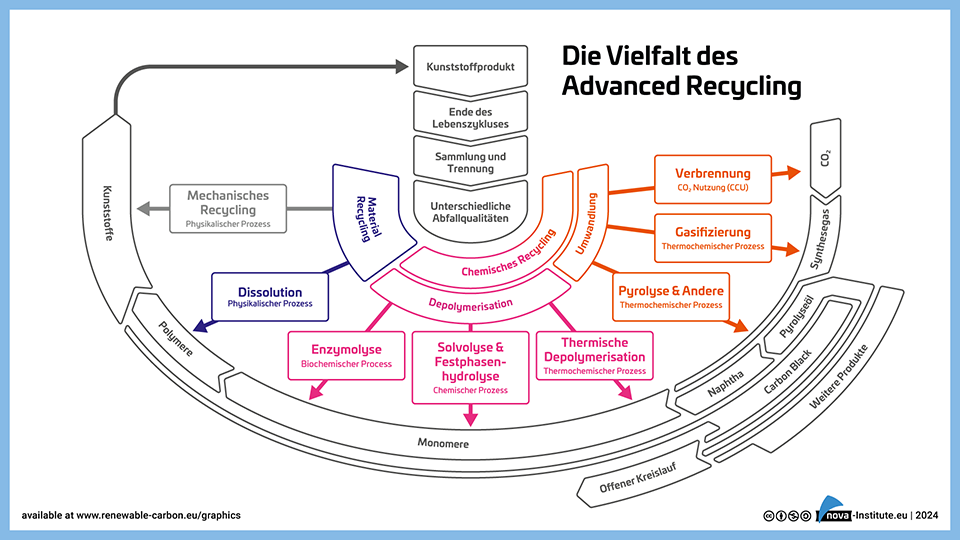
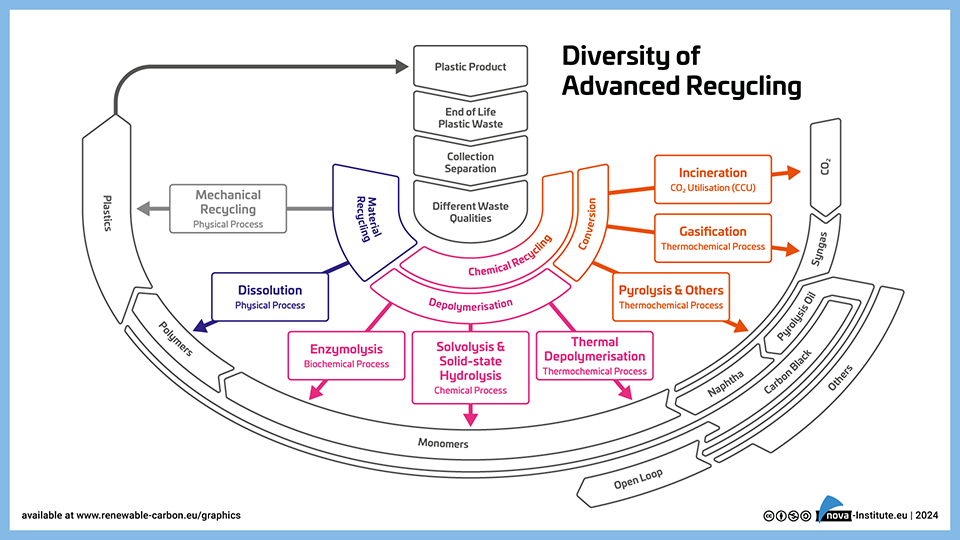
    23 07 21 diversity of advanced recycling thumbnail

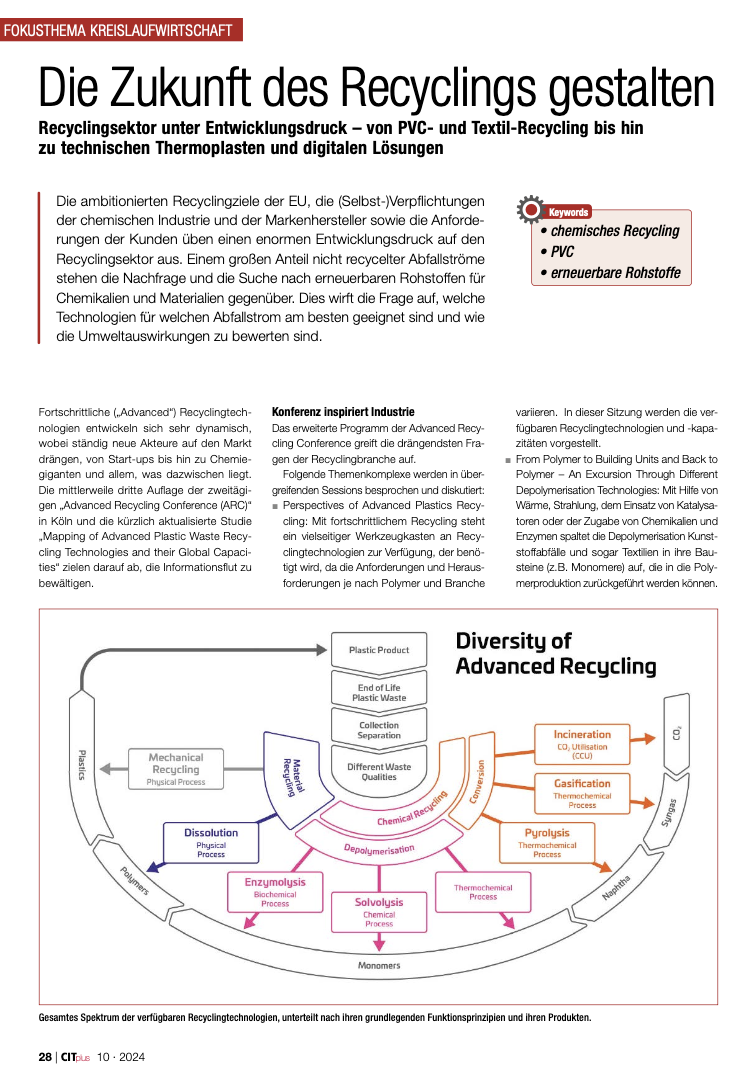
    Diversity of Advanced Recycling (PNG)

    Technology

    1 Page
    1361 Downloads

    1361 Downloads  

    2023-07

    FREE

    Free Shipping
     

    1361
    Downloads

    Direct Download

    Full spectrum of available recycling technologies divided by their basic working principles and their products.

  • Direct Download
    23 07 12 making a case for ccu shop

    RCI’s scientific background paper: “Making a case for Carbon Capture and Utilisation (CCU) – It is much more than just a carbon removal technology” (July 2023)

    Markets & Economy, Policy, Sustainability & Health, Technology

    48 Pages
    2082 Downloads

    2082 Downloads  

    2023-07

    FREE

    Free Shipping
     

    2082
    Downloads

    Direct Download

    This scientific background paper highlights the importance of Carbon Capture and Utilisation (CCU) and the need for more political recoginition and support for CCU.

    CCU enables the substitution of fossil carbon in sectors where carbon is necessary, supports the full defossilisation of the chemical and derived material industries, creates a circular economy, reduces the emission gap, promotes sustainable carbon cycles, fosters innovation, generates local value and stimulates job growth.

    CCU is much more than a carbon removal technology: the technology offers multiple solutions to pressing problems of our modern world and can support several Sustainable Development Goals if implemented properly.

    In total, 14 different benefits and advantages of CCU are described and discussed in the paper. A key advantage is that CCU supplies renewable carbon to – and thereby substitutes fossil carbon in – sectors that will require carbon in the long run. This includes the chemical sectors and products like polymers, plastics, solvents, paints, detergents, cosmetics or pharmaceuticals. But CCU is also essential to a long-term net-zero strategy, crucial for creating a sustainable circular economy, providing solutions for scaling up the renewable energy system, and bringing multiple benefits for innovation and business.

    The relevance of the technology is not yet accepted in Europe, but the RCI wants to make a very clear statement: CCU is a central pillar for the biggest transformation of the chemical and material industry since the industrial revolution.

    DOI No.: https://doi.org/10.52548/VYKR3129

Renewable Carbon Types

Publications

Topics

  • 1
  • 2
  • 3
  • 4
  • …
  • 7

nova-Logo
contact@nova-institut.de
www.nova-institute.eu

nova-Institut GmbH
Leyboldstr. 16
50354 Hürth / Germany

  • Renewable Carbon
  • Events
  • Publications
  • Graphics
  • News
  • Business Directory
  • Newsletter
  • nova-Institute
  • My account
  • Legal Information
  • Terms and Conditions
  • Data protection regulation
© 2025 nova-Institut GmbH
Renewable Carbon Publications - Logo

Login

Lost your password?