Skip to content
Renewable Carbon Publications - LogoRenewable Carbon Publications - Logo
  • Publications
  • Contact
1
  • Renewable Materials Conference 2025 (Proceedings, PDF) [Digital]Renewable Materials Conference 2025 (Proceedings, PDF) [Digital] 1 × 200 €

    Plus 19% MwSt.

Subtotal: 200 €

CartCheckout

  • Renewable Carbon
    • Renewable Carbon
    • Events
    • Publications
    • Graphics
    • News
    • Business Directory
    • Newsletter
    • nova-Institute
  • Publications
  • Contact

Renewable Carbon Publications - LogoRenewable Carbon Publications - Logo
1
  • Renewable Materials Conference 2025 (Proceedings, PDF) [Digital]Renewable Materials Conference 2025 (Proceedings, PDF) [Digital] 1 × 200 €
    Plus 19% MwSt.

Subtotal: 200 €

CartCheckout

  • Renewable Carbon Publications
  • Technology
Grid view List view
“Renewable Materials Conference 2025 (Proceedings, PDF)” has been added to your cart. View cart

Showing 1–20 of 133

  • Download Statistics
  • Add to
    cart
    New22 11 28 rc publications cover proceedings arc

    Advanced Recycling Conference 2025 (Proceedings, PDF)

    Markets & Economy, Policy, Sustainability & Health, Technology


    2025-12

    150 € ex. tax

    Plus 19% MwSt.
    Press
    release
    Add to
    cart

    The proceedings of the Advanced Recycling Conference 2025 (19-20 November, https://advanced-recycling.eu) contain 41 conference presentations, the conference journal, sponsor documents and the press release.

  • Select
    licence
    Newmapping of global advanced plastic recycling capacities (pdf)

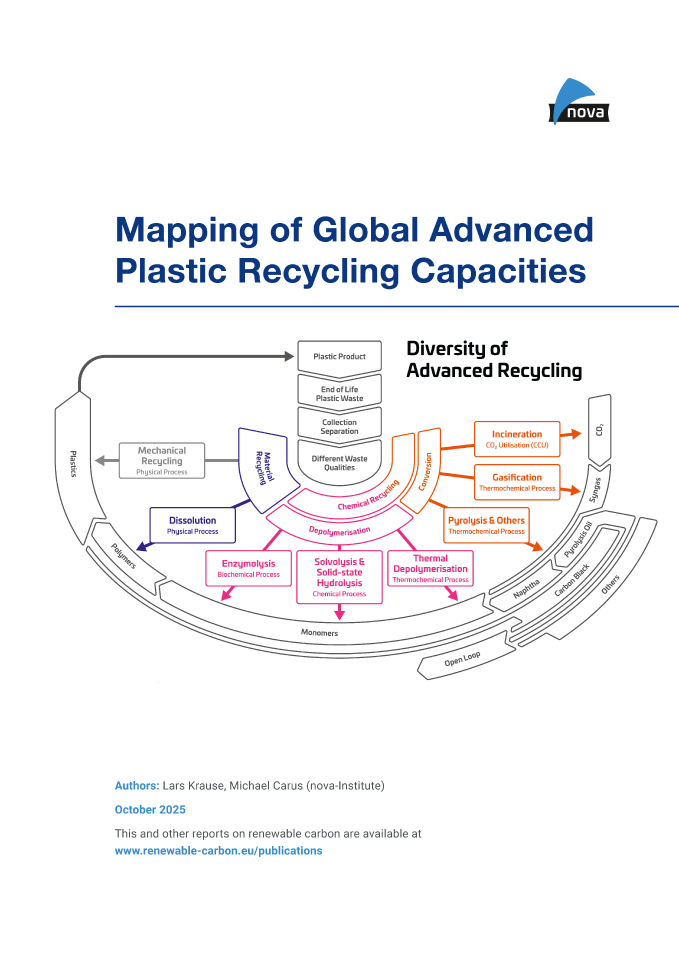
    Mapping of Global Advanced Plastic Recycling Capacities (PDF)

    New

    Markets & Economy, Policy, Technology

    35 Pages


    2025-11

    500 € – 1,000 €Price range: 500 € through 1,000 € ex. tax

    Plus 19% MwSt.
    Press
    release
    Select
    licence

    Chemical and physical recycling are essential to keeping carbon in the loop and fully establishing a circular economy. Despite delays in policy regulations and investment, experts foresee a bright future for new capacity, both globally and in Europe.

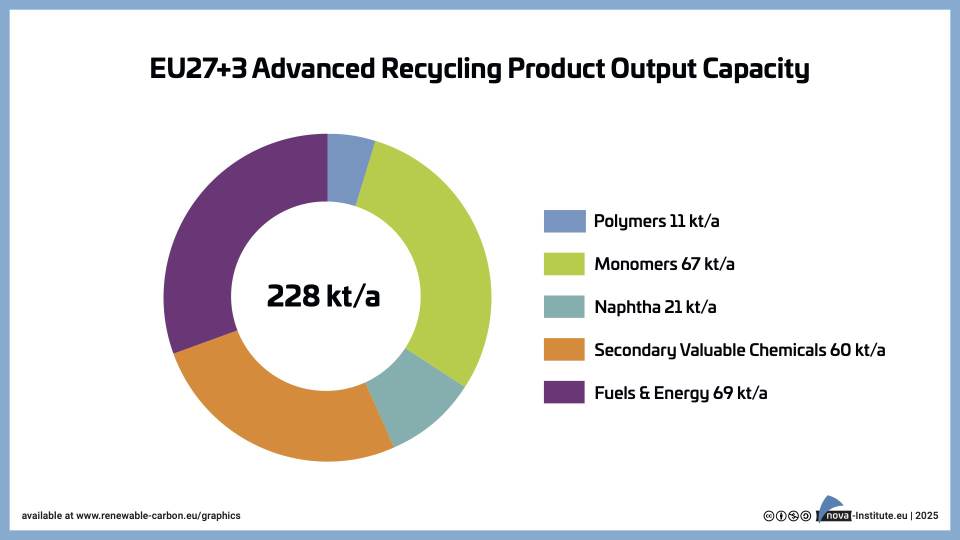
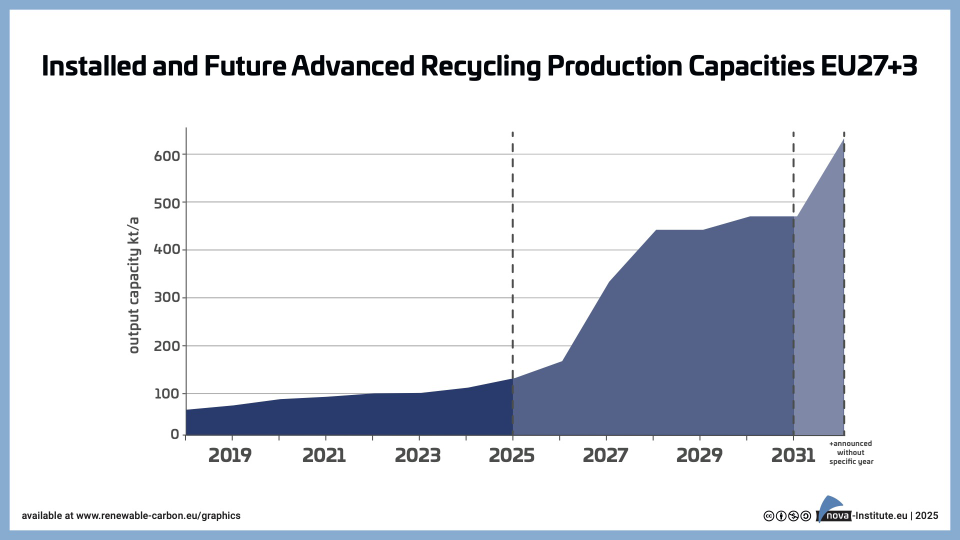
    The development of advanced recycling technologies is very dynamic and at a fast pace, with new players constantly appearing on the market, from start-ups to chemistry giants and everything in between. New plants are being built, and new capacities are being achieved. Due to these dynamic developments, it is difficult to keep track of everything. The nova report “Mapping of global advanced plastic recycling capacities” aims to clear up this jungle of information. A comprehensive evaluation of the global input and output capacities was carried out for which 390 planned as well as installed and operating plants including their specific product yields were mapped to provide an overview about global advanced recycling capacities in the past, present, and future.

    Further information: The new report represents a short study updating the current and future Advanced Recycling input- and output-capacities for the year 2024-2031. The report does not include any technology- or company-profiles which are published in another study (https://doi.org/10.52548/WQHT8696).

    DOI No.: https://doi.org/10.52548/YKWB6074

  • Add to
    cart
    NewRenewable Materials Conference 2025 (Proceedings, PDF) [Digital]

    Renewable Materials Conference 2025 (Proceedings, PDF)

    Markets & Economy, Policy, Sustainability & Health, Technology
     

    2025-10

    200 € ex. tax

    Plus 19% MwSt.
    Press
    release
    Add to
    cart

    The proceedings of the Renewable Materials Conference 2025 (22-24 September 2025, https://renewable-materials.eu) contain all released 68 presentations, the conference journal and the press release of the three winners of the Innovation Award “Renewable Material of the Year 2025″.

    Download Conference journal (PDF)

  • Direct Download
    pef – a circular bio based plastic with improved properties and environmental performance (pdf)

    PEF – A Circular Bio-Based Plastic with Improved Properties and Environmental Performance (PDF)

    Sustainability & Health, Technology

    19 Pages
    180 Downloads

    180 Downloads  

    2025-09

    FREE

    Free Shipping
     

    180
    Downloads

    Direct Download

    The chemical technology company Avantium (NL) partnered with nova-Institut GmbH under the framework of the PEFerence project, to perform a full cradle-to-grave Life Cycle Assessment (LCA) for the YXY® Technology, assessing the potential environmental impacts of PEF packaging solutions in comparison to conventional PET packaging. The LCA is performed according to the ISO 14040/44 standard methodology. A critical peer review of the study, including experts of incumbent technologies, was conducted in order to verify whether the LCA met the requirements for methodology, data, interpretation, and reporting. This presentation from the 1st PEF World Congress summarises the main aspects about the environmental sustainability of PEF-based bottles.

  • Direct Download
    the fossil fuel trap: why defossilising chemistry is essential – and feasible! (pdf)

    The fossil fuel trap: Why defossilising chemistry is essential – and feasible! (PDF)

    Markets & Economy, Policy, Technology

    8 Pages
    199 Downloads

    199 Downloads  

    2025-07

    FREE

    Free Shipping
     

    199
    Downloads

    Direct Download

    How can we escape the fossil fuel trap, our dependence on fossil fuels and the vulnerability that comes with it? In the long term, recycling, together with biogenic carbon and CO₂, can completely replace fossil carbon from crude oil or natural gas as a raw material for plastics production. This will enable the European Union to become independent of fossil carbon imports and increase its resilience and competitiveness. To achieve this, it is crucial to shape the transition phase in a politically astute and rapid manner so that the transformation of the chemical industry in Europe is successful – after all, Europe is the birthplace of modern chemistry. This is the only way to prevent the EU from remaining stuck in a fossil fuel trap while other regions successfully transform their economies.

  • Direct Download
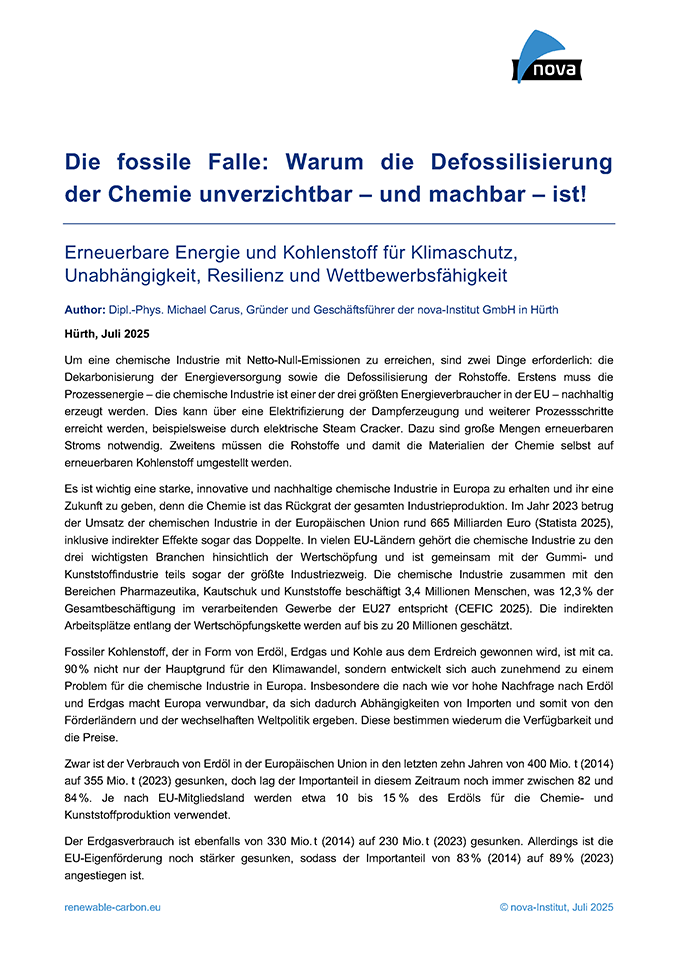
    die fossile falle: warum die defossilisierung der chemie unverzichtbar – und machbar – ist! (pdf)

    Die fossile Falle: Warum die Defossilisierung der Chemie unverzichtbar – und machbar – ist! (PDF)

    Markets & Economy, Policy, Technology

    8 Pages
    54 Downloads

    54 Downloads  

    2025-07

    FREE

    Free Shipping
     

    54
    Downloads

    Direct Download

    Wie kommen wir raus aus der fossilen Falle, aus der fossilen Abhängigkeit und Verwundbarkeit? Langfristig kann Recycling zusammen mit biogenem Kohlenstoff und CO₂ den fossilen Kohlenstoff aus Erdöl oder Erdgas als Rohstoff für die Kunststoffproduktion komplett ersetzen. So kann die Europäische Union unabhängig von fossilen Kohlenstoffimporten werden und ihre Widerstandsfähigkeit und Wettbewerbsfähigkeit steigern. Dafür ist es entscheidend, die Übergangsphase politisch klug und rasch zu

    gestalten, damit die Transformation der Chemieindustrie in Europa gelingt – schließlich ist Europa die Ursprungsregion der modernen Chemie. Nur so kann vermieden werden, dass die EU in der fossilen Sackgasse stecken bleibt, während anderen Regionen die Transformation gelingt.

  • Direct Download
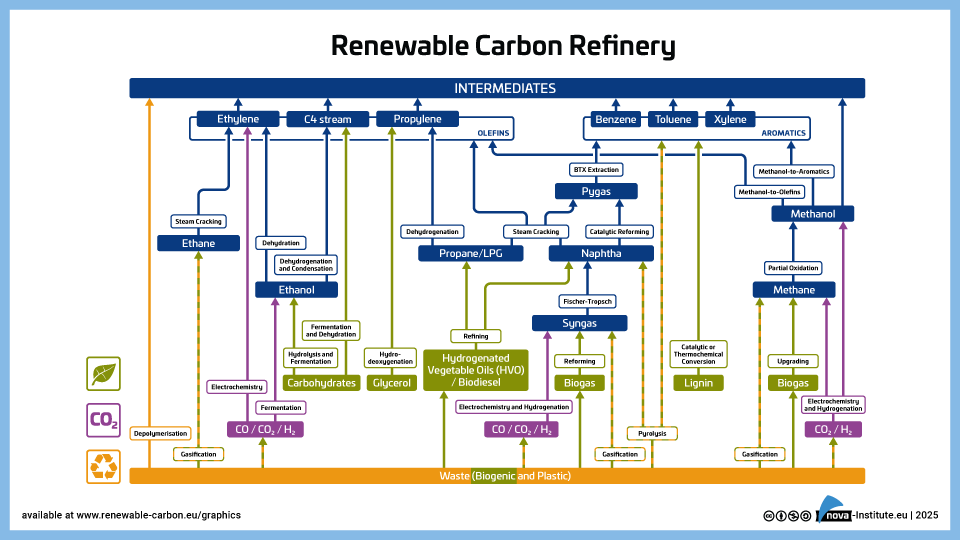
    renewable carbon refinery (png)

    Renewable Carbon Refinery (PNG)

    Technology

    1 Page
    2115 Downloads

    2115 Downloads  

    2025-06

    FREE


    2115
    Downloads

    Direct Download

    What will refineries of the future look like. Can the commodities of chemistry also be produced without crude oil or natural gas? The graphic shows options for fully meeting the needs of today’s large-scale chemical industry even with biomass, CO2 and recycled raw materials. Updated version 2025; feedback is welcome. Please mail to michael.carus@nova-institut.de

  • Add to
    cart
    CO2-based Fuels and Chemicals Conference 2025 (Proceedings, PDF) [Digital]

    CO2-based Fuels and Chemicals Conference 2025 (Proceedings, PDF)

    Markets & Economy, Policy, Sustainability & Health, Technology


    2025-05

    150 € ex. tax

    Plus 19% MwSt.
    Press
    release
    Add to
    cart

    The proceedings of the CO2-based Fuels and Chemicals Conference 2025 (29-30 April 2025, https://co2-chemistry.eu) contain all released presentations, the conference journal, and the press release of the three winners of the Innovation Award “Best CO2 Utilisation 2025″.

  • Direct Download
    policy proposals for facilitating the transition to renewable carbon (pdf)

    RCI Policy Proposals for Facilitating the Transition to Renewable Carbon (PDF)

    Markets & Economy, Policy, Sustainability & Health, Technology

    70 Pages
    1030 Downloads

    1030 Downloads  

    2025-04

    FREE

    Free Shipping
     

    1030
    Downloads

    Direct Download

    The report outlines a strategic roadmap for transforming Europe’s chemical industry by transitioning from fossil-based to renewable carbon sources. It highlights the industry’s current crisis which is driven by global competition, high energy costs, and regulatory pressure, and stresses the urgency of reducing dependence on fossil feedstocks. The report aruges that the transition to renewable carbon is not just about environmental sustainability; it is about securing Europe’s industrial future and maintaining its global competitiveness in a rapidly changing world. By pioneering renewable carbon technologies, the EU can unlock economic benefits and unleash its innovation potential while advancing climate neutrality ambitions.

    The Renewable Carbon Initiative (RCI) proposes ten comprehensive policy measures including mandatory renewable carbon targets, adaptation of emissions trading systems, and financial support mechanisms. These proposals aim to create market demand, drive innovation and build industrial resilience. Key enablers include harmonised standards, robust certification, infrastructure development, and stakeholder engagement.

    DOI No.: https://doi.org/10.52548/DZRU4577


  • Direct Download
    overview of rcis policy proposals (png)

    Overview of RCIs Policy Proposals (PNG)

    Markets & Economy, Policy, Sustainability & Health, Technology

    1 Page
    43 Downloads

    43 Downloads  

    2025-04

    FREE

    Free Shipping
     

    43
    Downloads

    Direct Download
  • Direct Download
    renewable energy and defossilisation (png)

    Renewable Energy and Defossilisation (PNG)

    Markets & Economy, Policy, Sustainability & Health, Technology

    1 Page
    35 Downloads

    35 Downloads  

    2025-04

    FREE

    Free Shipping
     

    35
    Downloads

    Direct Download
  • Direct Download
    trackling the european implementation gap for renewable carbon solutions (png)

    Trackling the European Implementation Gap for Renewable Carbon Solutions (PNG)

    Markets & Economy, Policy, Sustainability & Health, Technology

    1 Page
    41 Downloads

    41 Downloads  

    2025-04

    FREE

    Free Shipping
     

    41
    Downloads

    Direct Download
  • Add to
    cart
    Cellulose Fibres Conference 2025 (Proceedings, PDF) [Digital]

    Cellulose Fibres Conference 2025 (Proceedings, PDF)

    Markets & Economy, Policy, Sustainability & Health, Technology
     

    2025-03

    150 € ex. tax

    Plus 19% MwSt.
    Press
    release
    Add to
    cart

    The Cellulose Fibres Conference 2025 – New with Biosynthetics! (https://cellulose-fibres.eu, 12-13 March 2025, Cologne, hybrid) covered the entire value chain of the sustainable textile industry, from lignocellulose, pulp, cellulose fibres such as rayon, viscose, modal or lyocell and new developments to a wide range of applications:
    Textiles from renewable fibres, non-wovens such as wet wipes, as well as areas such as composites, hygiene, packaging or nano cellulose in the food industry. This year, for the first time, the conference included a dedicated session on biosynthetics – a promising area to complement the alternative for bio-based textiles. Deep insights have been offered into the future of cellulose fibres, which fits perfectly with the current shift towards circular economy, recycling and sustainable carbon cycles.

    The Cellulose Fibres Conference Proceedings include all released conference presentations, the conference journal, sponsor documents and the conference press release.

  • Add to
    cart
    22 11 28 rc publications cover proceedings arc

    Advanced Recycling Conference 2024 (Proceedings)

    Markets & Economy, Policy, Sustainability & Health, Technology

     

    2024-12

    150 € ex. tax

    Plus 19% MwSt.
    Press
    release
    Add to
    cart

    The proceedings of the Advanced Recycling Conference 2024 (20-21 November, https://advanced-recycling.eu) contain 42 conference presentations, the conference journal, sponsor documents and the press release.

  • Direct Download
    alternatives naphtha – den kreislauf für kunststoffe und reifen schließen: pyrolyseöl als chemischer rohstoff (gastbeitrag teil 3) (pdf)

    Alternatives Naphtha – Den Kreislauf für Kunststoffe und Reifen schließen: Pyrolyseöl als chemischer Rohstoff (Gastbeitrag Teil 3) (PDF)

    Markets & Economy, Technology

    1 Page
    95 Downloads

    95 Downloads  

    2024-11

    FREE


    95
    Downloads

    Direct Download

    In den beiden vorangegangenen Artikeln dieser Serie wurde das Konzept des alternativen Naphthas als Ersatz für fossile Rohstoffe in Raffinerien und Steamcrackern vorgestellt. In diesem dritten Artikel konzentriert sich die Diskussion auf Pyrolyseöl, das durch chemisches Recycling von Kunststoffabfällen und Reifen gewonnen wird, und warum dies ein wichtiges „alternatives Naphtha“ für Raffinerien und Steamcracker ist.

    Relevante Anteile erneuerbarer Chemikalien und Polymere sind ohne „alternatives Naphtha“ nicht möglich. Ohne eine Abkehr von fossilem Naphtha wird es keine signifikante Defossilisierung des Chemiesektors geben.

    Dieser Artikel ist im Rahmen einer Serie von Gastbeiträgen im CHEManager erschienen. Es handelt sich um „Alternatives Naphtha Teil 3“ – aus CHEManager 11/2024.

    Hier finden sie den Artikel auch bei CHEManager.


  • Direct Download
    die vielfalt des advanced recycling (2024)

    Die Vielfalt des Advanced Recycling (2024)

    Technology

    1 Page
    273 Downloads

    273 Downloads  

    2024-11

    FREE


    273
    Downloads

    Direct Download

    Das gesamte Spektrum der verfügbaren Recyclingtechnologien, unterteilt nach ihren grundlegenden Funktionsprinzipien und ihren Produkten.

  • Direct Download
    biodegradable polymers in various environments according to established standards and certification schemes – graphic (png, current version) (copy)

    Diversity of Advanced Recycling (2024)

    Technology

    1 Page
    707 Downloads

    707 Downloads  

    2024-11

    FREE


    707
    Downloads

    Direct Download

    Full spectrum of available recycling technologies divided by their basic working principles and their products.

  • Direct Download
    alternatives naphtha – herstellung und nutzung – wie erneuerbare rohstoffe zu naphtha verarbeitet werden (gastbeitrag teil 2) (pdf)

    Alternatives Naphtha – Herstellung und Nutzung – Wie erneuerbare Rohstoffe zu Naphtha verarbeitet werden (Gastbeitrag Teil 2) (PDF)

    Markets & Economy, Technology

    1 Page
    49 Downloads

    49 Downloads  

    2024-10

    FREE


    49
    Downloads

    Direct Download

    Im ersten Artikel dieser dreiteiligen Serie wurde das Konzept „Alternatives Naphtha“ als Ersatz für fossile Rohstoffe in Raffinerien und Steamcrackern vorgestellt. Relevante Mengen erneuerbarer Chemikalien und Polymere sind ohne alternatives Naphtha nicht realisierbar, eine signifikante Defossilisierung des Chemiesektors erfordert den Verzicht auf fossiles Naphtha. Im zweiten Artikel wird die Herstellung und Nutzung von alternativem Naphtha genauer beleuchtet.

    Biobasierte Rohstoffe wie Fette, Öle und Schmierstoffe (Triglyceride) können fossile Erdölrohstoffe ersetzen und in bestehenden Raffinerien mitverarbeitet werden. Dies ist attraktiv, da Raffinerien ohne große Investitionen Biokraftstoffe und biobasierte Grundchemikalien produzieren können. Eine Vorbehandlung der Rohstoffe kann dabei erforderlich sein.

    Dieser Artikel ist im Rahmen einer Serie von Gastbeiträgen im CHEManager erschienen. Es handelt sich um „Alternatives Naphtha Teil 2“ – aus CHEManager 10/2024.

    Hier finden sie den Artikel auch bei CHEManager.

  • Direct Download
    innovative bio based products for a clean transition (pdf)

    Forest-Based Biorefineries: Innovative Bio-Based Products for a clean Transition (PDF)

    Markets & Economy, Policy, Technology

    8 Pages
    385 Downloads

    385 Downloads  

    2024-10

    FREE

    Free Shipping
     

    385
    Downloads

    Direct Download

    A new study conducted by the nova-Institute and commissioned by the Confederation of European Paper Industries (Cepi) unveils a significant surge in the European biorefinery sector, with forest-based biorefineries more than doubling their turnover to €6 billion since 2020. This remarkable growth underscores the rising demand for sustainable, bio-based alternatives to fossil-based products.

    The research, focused on the pulp and paper industry that produce additional bio-based products which land on the market beyond pulp and paper, identifies a total of 143 biorefineries across Europe, with 126 currently operational and 17 in development. The largest number of biorefineries is in Sweden, Finland, Germany, Portugal and Austria. The study points to a bright future for biorefineries, with projected annual growth rates of up to 5% until 2050.
    The products of these biorefineries provide sustainable solutions across various industries, from aviation to fashion, offering alternatives in materials, chemicals, fuels, food, and pharmaceuticals. Importantly, biorefineries contribute to Europe’s climate targets, with bio-based products already substituting over 3.1 megatons of CO2 emissions that would have been produced by fossil-based industries.

    The study emphasises that these advancements are not replacing traditional pulp and paper-making activities but are creating new revenue streams and increasing resource efficiency, providing a pathway to sustainable economic growth.

    Source: https://www.cepi.org/report-pulp-and-paper-biorefineries-in-europe-innovative-bio-based-products-for-a-clean-transition

  • Direct Download
    die zukunft des recycling gestalten (pdf)

    Die Zukunft des Recyclings gestalten (PDF)

    Markets & Economy, Policy, Sustainability & Health, Technology
    2 Pages
    569 Downloads

    569 Downloads  

    2024-10

    FREE

    Free Shipping
     

    569
    Downloads

    Direct Download

    Die ambitionierten Recyclingziele der EU, die (Selbst-)Verpflichtungen der chemischen Industrie und der Markenhersteller sowie die Anforderungen der Kunden üben einen enormen Entwicklungsdruck auf den Recyclingsektor aus. Einem großen Anteil nicht recycelter Abfallströme stehen die Nachfrage und die Suche nach erneuerbaren Rohstoffen für Chemikalien und Materialien gegenüber. Dies wirft die Frage auf, welche Technologien für welchen Abfallstrom am besten geeignet sind und wie die Umweltauswirkungen zu bewerten sind.

    Quelle: Advanced Recycling: Technologien und Markttrends für eine nachhaltige Kreislaufwirtschaft“ – aus CITplus 10/2024

Renewable Carbon Types

Publications

Topics

  • 1
  • 2
  • 3
  • …
  • 7

nova-Logo
contact@nova-institut.de
www.nova-institute.eu

nova-Institut GmbH
Leyboldstr. 16
50354 Hürth / Germany

  • Renewable Carbon
  • Events
  • Publications
  • Graphics
  • News
  • Business Directory
  • Newsletter
  • nova-Institute
  • My account
  • Legal Information
  • Terms and Conditions
  • Data protection regulation
© 2025 nova-Institut GmbH
Renewable Carbon Publications - Logo

Login

Lost your password?