Showing 21–40 of 412
-
122 Downloads
2025-03
FREE
Free Shipping122
Downloads -
60 Downloads
2025-03
FREE
Free Shipping60
Downloads -
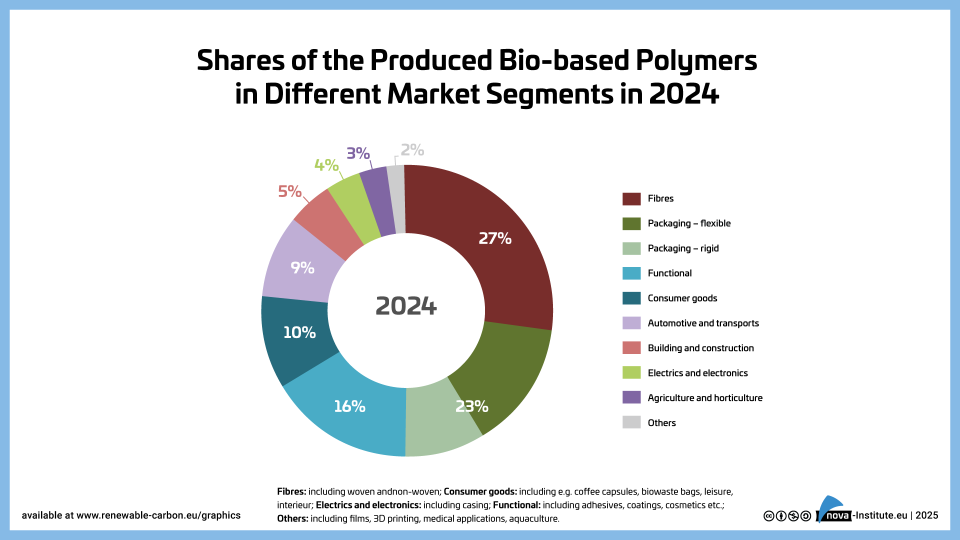
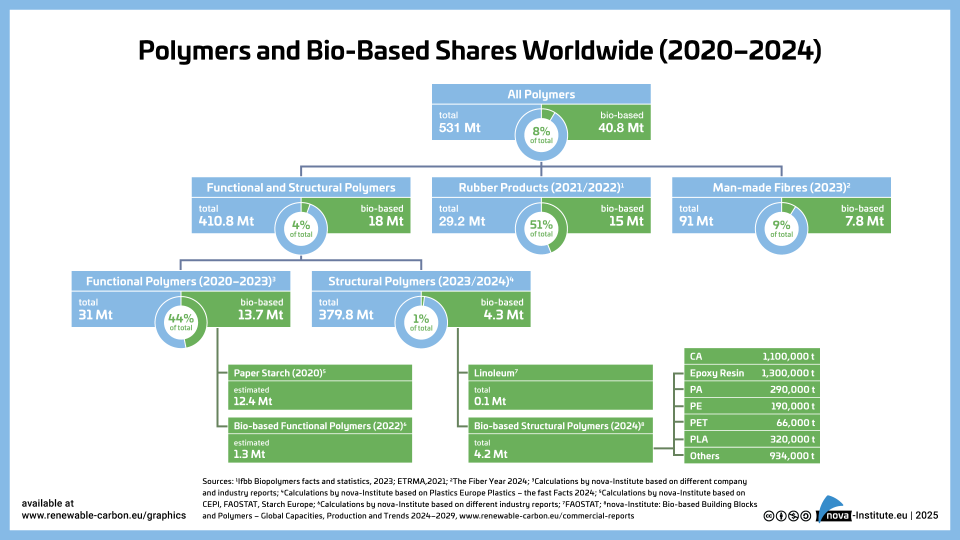
Shares of the Produced Bio-based Polymers in Different Market Segments in 2024 (PNG)
Markets & Economy
1 Page
123 Downloads
123 Downloads
2025-03
FREE
Free Shipping123
Downloads -
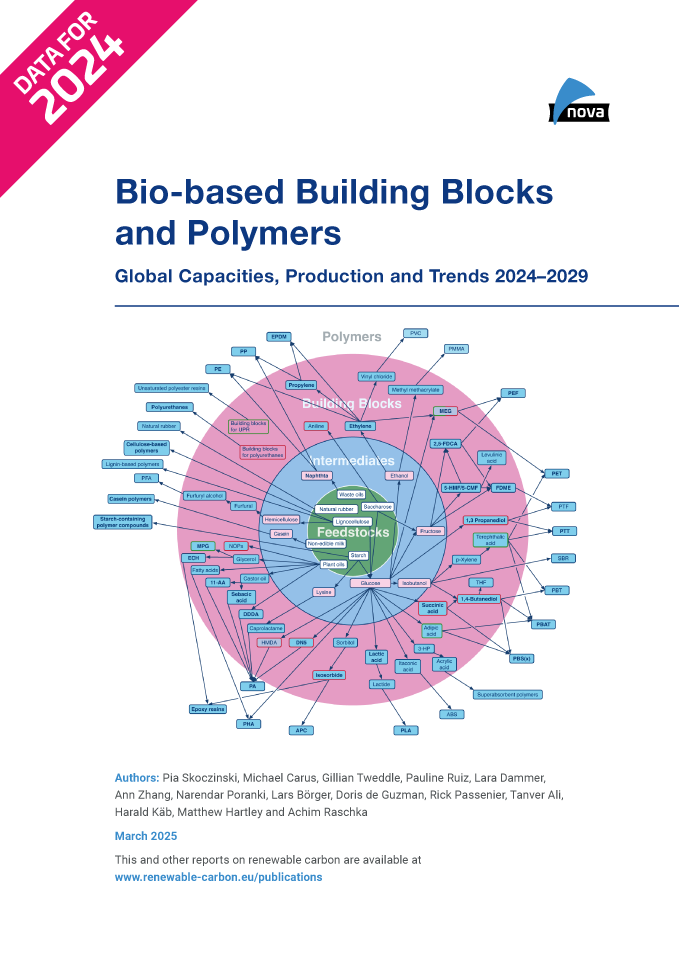
Bio-based Building Blocks and Polymers – Global Capacities, Production and Trends 2024–2029 (PDF)
NewMarkets & Economy
434 Pages
2025-03
3,000 € – 10,000 €Price range: 3,000 € through 10,000 € ex. tax
Plus 19% MwSt.Press
release Select
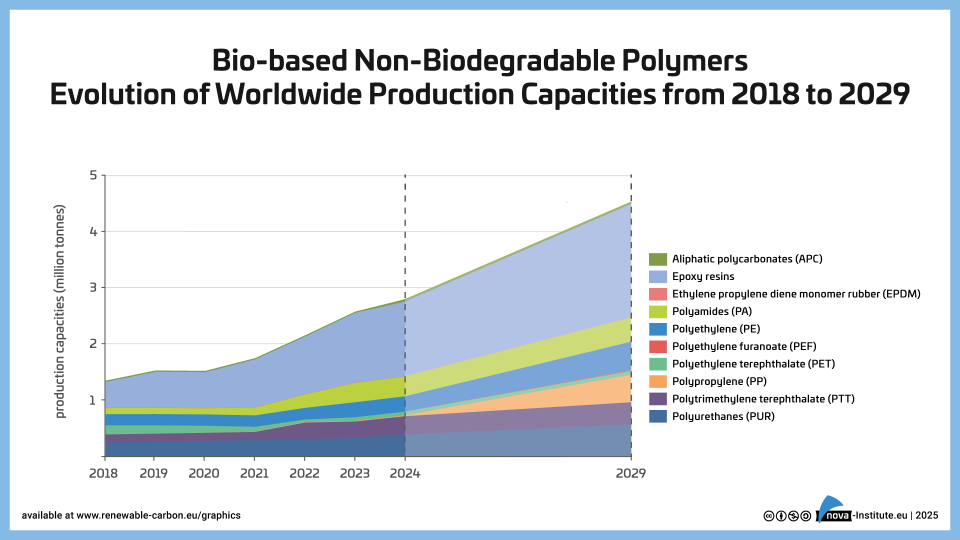
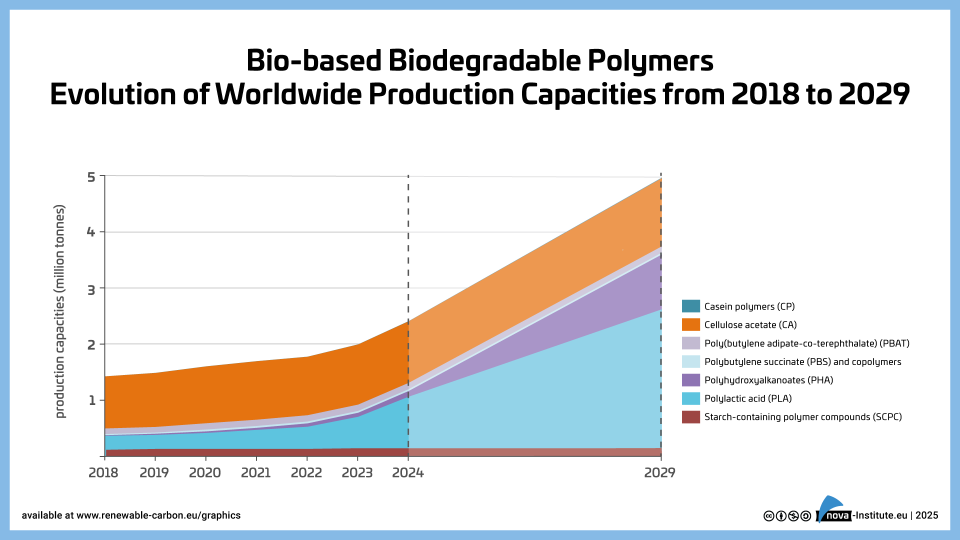
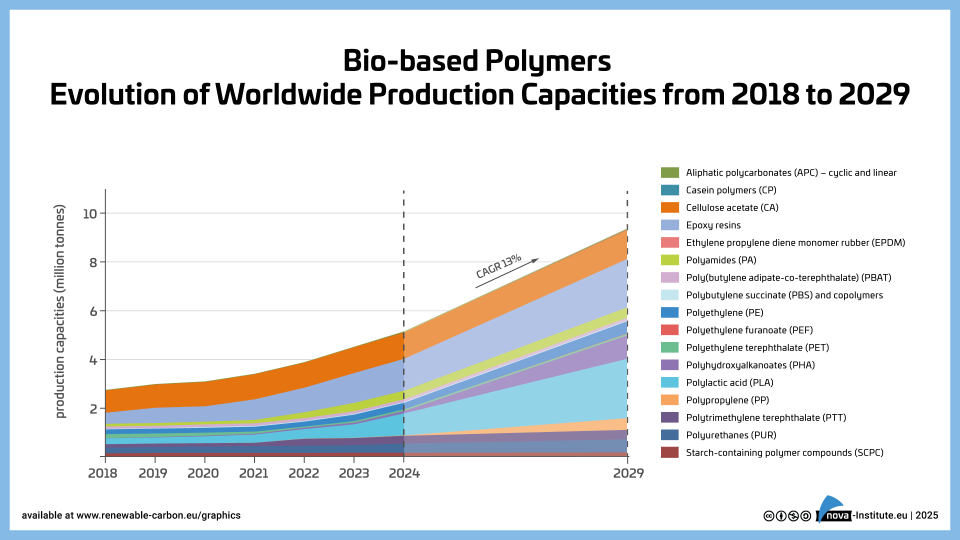
licence2024 was a respectable year for bio-based polymers, with an overall expected CAGR of 13 % to 2029. Overall, bio-based biodegradable polymers have large installed capacities with an expected CAGR of 17 % to 2029, but the current average capacity utilisation is moderate at 65 %. In contrast, bio-based non-biodegradable polymers have a much higher utilisation rate of 90 %, but will only grow by 10 % to 2029.
Epoxy resin and PUR production is growing moderately at 9 and 8 %, respectively, while PP and cyclic APC capacities are increasing by 30 %. Despite a decline in production of biodegradables, especially for PLA in Asia, capacities have increased by 40 %. The same applies to PHA capacities. Commercial newcomers such as casein polymers and PEF recorded a rise in production capacity and are expected to continue to grow significantly until 2029.
DOI No.: https://doi.org/10.52548/UMTR4695
-
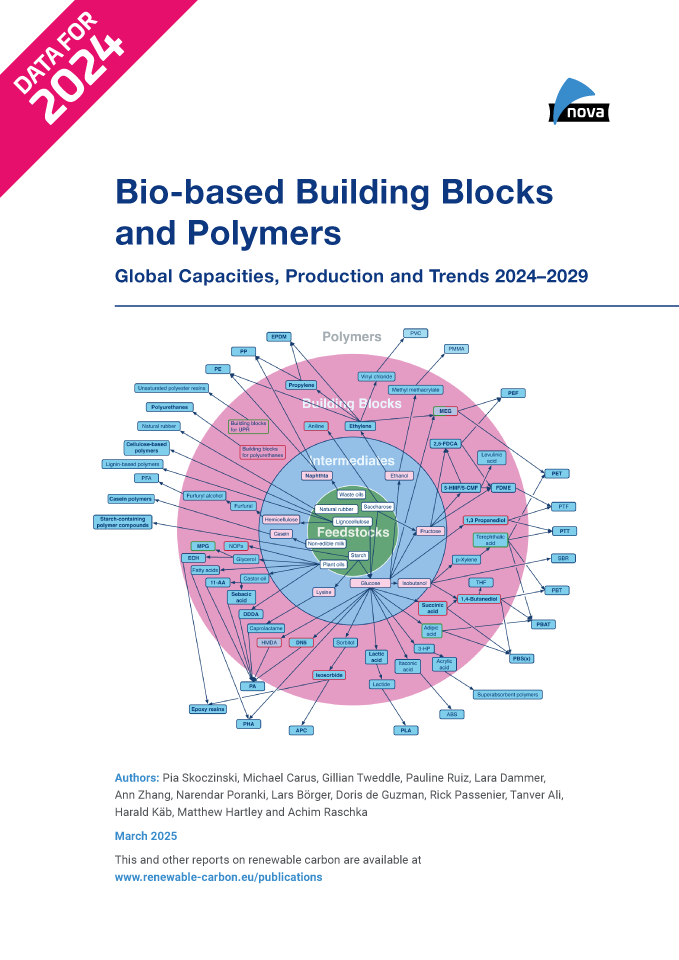
Bio-based Building Blocks and Polymers Global Capacities, Production and Trends 2024–2029 – Short Version (PDF)
NewMarkets & Economy
28 Pages
1472 Downloads
1472 Downloads
2025-03
FREE
Free Shipping1472
Downloads2024 was a respectable year for bio-based polymers, with an overall expected CAGR of 13 % to 2029. Overall, bio-based biodegradable polymers have large installed capacities with an expected CAGR of 17 % to 2029, but the current average capacity utilisation is moderate at 65 %. In contrast, bio-based non-biodegradable polymers have a much higher utilisation rate of 90 %, but will only grow by 10 % to 2029.
Epoxy resin and PUR production is growing moderately at 9 and 8 %, respectively, while PP and cyclic APC capacities are increasing by 30 %. Despite a decline in production of biodegradables, especially for PLA in Asia, capacities have increased by 40 %. The same applies to PHA capacities. Commercial newcomers such as casein polymers and PEF recorded a rise in production capacity and are expected to continue to grow significantly until 2029.
-
Bio-based Non Biodegradable Polymers Evolution of Worldwide Prod Capacities 2029 (PNG)
Markets & Economy
1 Page
137 Downloads
137 Downloads
2025-03
FREE
Free Shipping137
Downloads -
Bio-based Biodegradable Polymers Evolution of Worldwide Production Capacities 2029 (PNG)
Markets & Economy
1 Page
158 Downloads
158 Downloads
2025-03
FREE
Free Shipping158
Downloads -
Bio-based polymers – Evolution of worldwide production capacities from 2018 to 2029 (PNG)
Markets & Economy
1 Page
106 Downloads
106 Downloads
2025-03
FREE
Free Shipping106
Downloads -
161 Downloads
2025-03
FREE
Free Shipping161
Downloads -
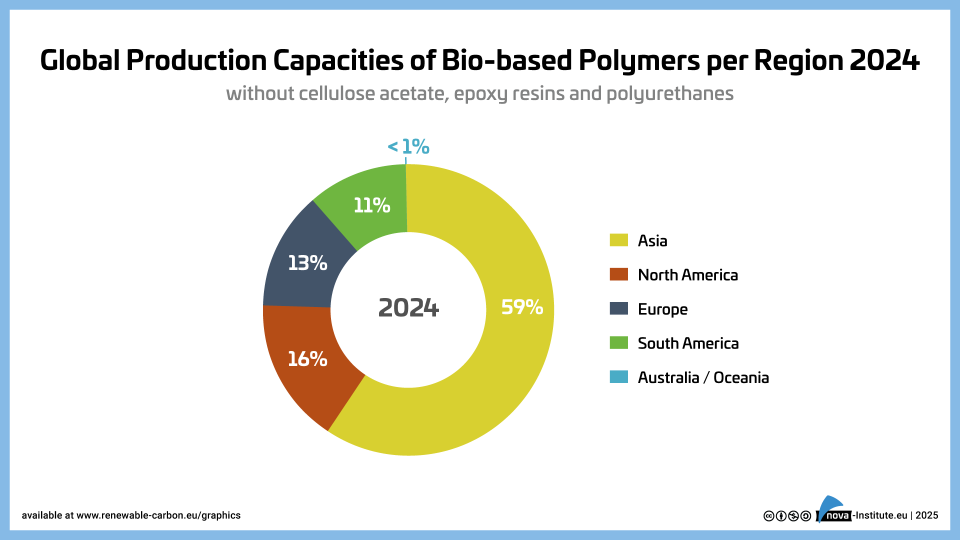
Global Production Capacities of Bio-based Polymers per region 2024 (PNG)
Markets & Economy
1 Page
74 Downloads
74 Downloads
2025-03
FREE
Free Shipping74
Downloads -
137 Downloads
2025-03
FREE
Free Shipping137
Downloads -
184 Downloads
2025-03
FREE
Free Shipping184
Downloads -
Evaluating LCA Approaches and Methodologies for Renewable Carbon Sources Report 2 of 3 – Renewable Carbon in Recycling Situations (March 2025) (PDF)
Markets & Economy, Policy, Sustainability & Health
37 Pages
680 Downloads
680 Downloads
2025-03
FREE
Free Shipping680
DownloadsThis report focuses on renewable carbon in recycling scenarios and the key challenges in LCA and carbon footprint assessments. It examines system boundaries, allocation methods, and biogenic carbon accounting approaches, highlighting their influence on sustainability evaluations. The report emphasises the cut-off and avoided-burden approaches for recycling while recommending the -1/+1 method for biogenic carbon transparency. However, it also identifies contradictions between LCA results and broader sustainability goals, such as the EU waste hierarchy, which prioritises recycling. To address these inconsistencies, the report suggests integrating LCA with additional sustainability metrics like land use and recyclability. Ultimately, refining these methodologies will enhance the accuracy and reliability of environmental assessments for bio-based and recycled materials.
This report is the second report of a larger RCI project on LCA methodology, which includes two additional publications:
Report 1 of 3 – Renewable Carbon in LCA Guidelines
Report 3 of 3 – Non-technical SummaryPlease find these additional reports by following the respective links at the bottom of this page.
DOI No.: https://doi.org/10.52548/QTVU8642
-
Evaluating LCA Approaches and Methodologies for Renewable Carbon Sources Report 3 of 3 – Non-technical Summary (March 2025) (PDF)
Markets & Economy, Policy, Sustainability & Health
15 Pages
877 Downloads
877 Downloads
2025-03
FREE
Free Shipping877
DownloadsThis Non-technical Summary (15 pages),highlights main insights into the project results and states key take-aways for policy-makers.
It compares several frameworks, such as ISO 14040, Product Environmental Footprint (PEF), and GHG Protocol, finding both commonalities and critical differences in areas like biogenic carbon accounting and recycling assessment. The study identifies significant methodological flexibility in existing frameworks, leading to inconsistencies in LCA results and challenges in standardisation. Key issues include differing treatment of carbon capture and utilisation (CCU), direct air capture (DAC), and allocation of environmental burdens in multifunctional processes. Policy recommendations emphasise the need for harmonisation, improved biogenic carbon accounting, and clear guidance on emerging technologies like DAC and mass balance attribution. Overall, the study calls for refining LCA methodologies to ensure fair comparison between renewable and fossil-based carbon solutions.
This report is the third report of a larger RCI project on LCA methodology, which includes two additional publications:
Report 1 of 3 – Renewable Carbon in LCA Guidelines
Report 2 of 3 – Renewable Carbon in Recycling SituationsPlease find these additional reports by following the respective links at the bottom of this page.
DOI No.: https://doi.org/10.52548/ZEKY1803
-
Evaluating LCA Approaches and Methodologies for Renewable Carbon Sources Report 1 of 3 – Renewable Carbon in LCA Guidelines (March 2025) (PDF)
Markets & Economy, Policy, Sustainability & Health
145 Pages
983 Downloads
983 Downloads
2025-03
FREE
Free Shipping983
DownloadsRenewable Carbon in LCA Guidelines (146 pages) evaluates methodological choices which impact LCAs for products containing renewable carbon in existing LCA frameworks and guidelines. The study specifically examines the similarities and differences in the methodological choices of guidelines, as well as the implications of these methodological aspects on the resulting LCA outcomes.The frameworks were selected based on their relevance and legitimacy in the industry, academia and policy field, and include: ISO 14040/44, ISO 14067, GHG Protocol Product Standard, PACT’s Pathfinder Framework, the PCF Guideline for the chemical industry by Together for Sustainability (TfS), EPD for the construction industry – ISO 14025 and EN 15804, the Renewable Energy Directive, the Product Environmental Footprint (PEF) and the JRC’s plastics LCA methodology. One field with a particularly large methodological freedom is recycling.
This report is the first report of a larger RCI project on LCA methodology, which includes two additional publications:
Report 2 of 3 – Renewable Carbon in Recycling Situations
Report 3 of 3 – Non-technical SummaryPlease find these additional reports by following the respective links at the bottom of this page.
DOI No.: https://doi.org/10.52548/VCYM7822
-
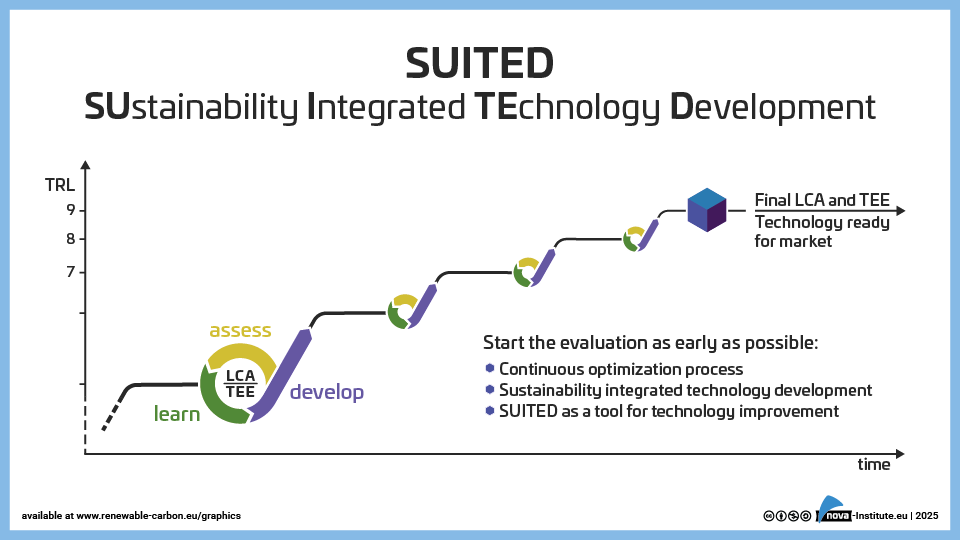
SUITED approach: SUstainable Integrated TEchnology Development (PNG)
Markets & Economy, Sustainability & Health
1 Page
20 Downloads
20 Downloads
2025-02
FREE
20
DownloadsStart the ecological and economic evaluation of your technology as early as possible:
- Continuous optimization process
- Sustainability integrated technology development
- SUITED as a tool for technology improvement
-
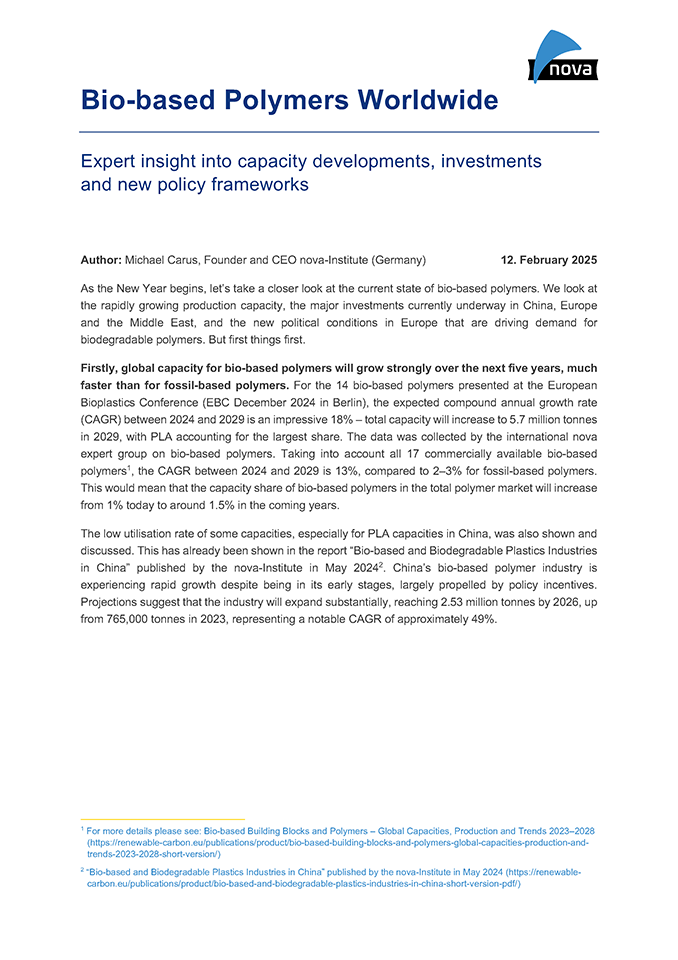
Bio-based Polymers Worldwide (PDF)
Markets & Economy, Policy, Sustainability & Health
5 Pages
806 Downloads
806 Downloads
2025-02
FREE
Free Shipping806
DownloadsExpert insight into capacity developments, investments and new policy frameworks:- Firstly, global capacity for bio-based polymers will grow strongly over the next five years, much faster than for fossil-based polymers
- Secondly, investments in new capacity will take place in China, Europe, the Middle East, and the US
- Thirdly, investment in bio-based polymer capacities is mainly driven by policy frameworks that create demand.
-
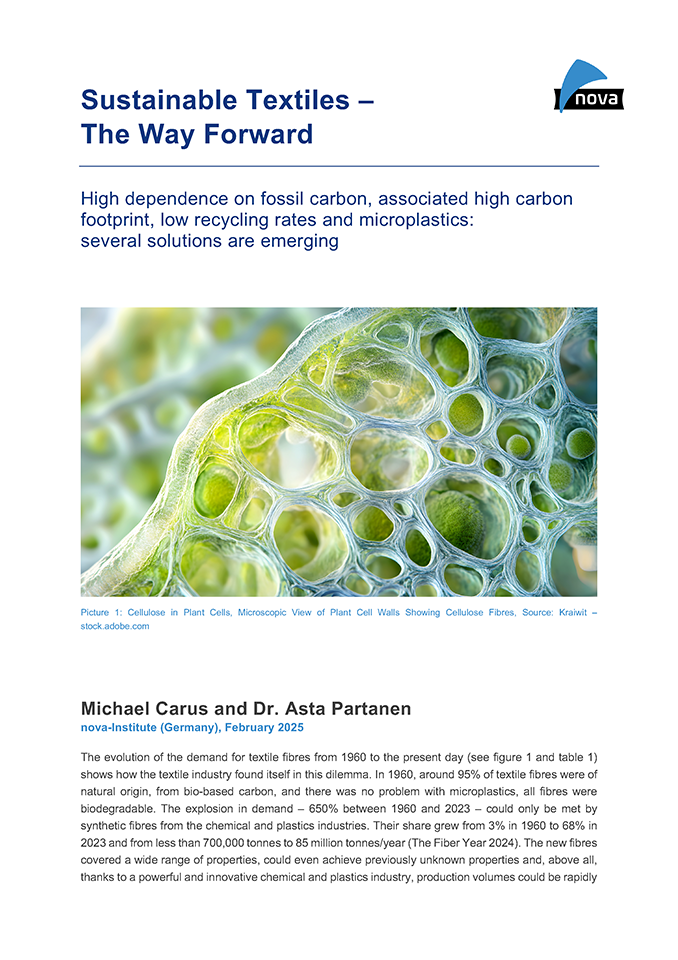
Sustainable textiles – the way forward (PDF)
Markets & Economy, Sustainability & Health
6 Pages
568 Downloads
568 Downloads
2025-02
FREE
Free Shipping568
DownloadsHigh reliance on fossil carbon, associated high carbon footprint, low recycling rates and microplastics:Several solutions are emerging. The article analyses the evolution of the textile industry from 1960 to today, fossil and bio-based as well as recycling.The future of sustainable textilesThe sustainable textile industry of the future will be built on a foundation of cotton fibres and fast-growing cellulose fibres, later strongly supported by bio- and CO2-based synthetic fibres (“biosynthetics”) and high recycling rates for all types of fibres. This combination can eventually replace most fossil-based synthetic fibres by 2050. -
Global Major Fibre Types by Production in % (PNG)
Markets & Economy, Sustainability & Health
1 Page
41 Downloads
41 Downloads
2025-02
FREE
41
Downloads -
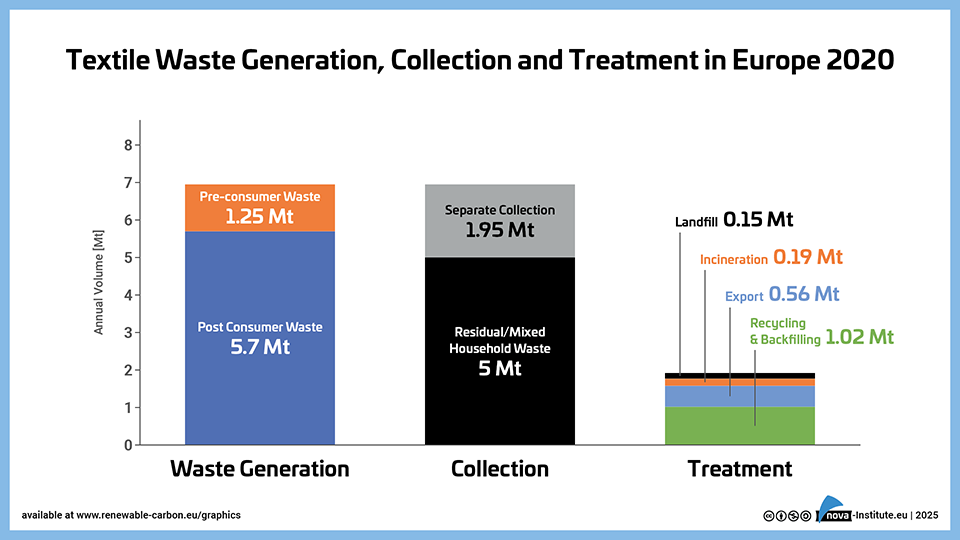
Textile-Waste-Generation-Collection-and-Treatment-in-Europe-2020 (PNG)
Markets & Economy, Sustainability & Health
1 Page
48 Downloads
48 Downloads
2025-02
FREE
48
Downloads

Cellulose Fibres Conference 2023 (Proceedings, PDF) [Digital]