 Important Study from nova-Institute Recognised by Nature Magazine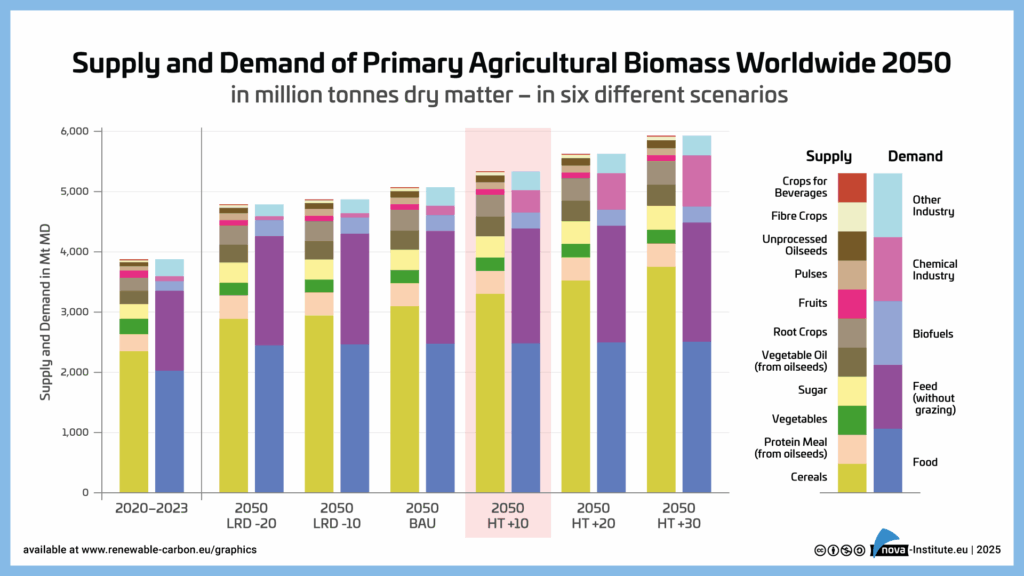
A recent editorial in Nature (649, 267, 2026) highlights the growing importance of defossilisation — the shift away from fossil carbon — while acknowledging that carbon is still vital for modern societies. A comprehensive modelling study by nova-Institute in Hürth (Germany) and leading academic partners commissioned by the Renewable Carbon Initiative (RCI), is central to this discussion. This study has now received prominent international recognition.
Is there Enough Biomass to Defossilise the Chemicals and Derived Materials Sector by 2050?
At the heart of the study lies a key question concerning the future of the chemical and materials industries. Can biomass contribute to the sector’s decarbonisation by 2050 in a sustainable way, without compromising its use in food, feed and other essential applications? To address this issue, nova has developed an extensive, data-driven modelling approach that combines global agricultural modelling (CAPRI), forest sector modelling (TiMBA) and detailed scenario analysis. This approach integrates competing demands for biomass from food, feed, bioenergy and biofuels (including aviation and shipping), and chemical and materials, providing one of the most robust assessments available today. This approach was developed in nova’s recent flagship study, ”Is there Enough Biomass to Defossilise the Chemicals and Derived Materials Sector by 2050?” (DOI No.: https://doi.org/10.52548/PIRL6916)
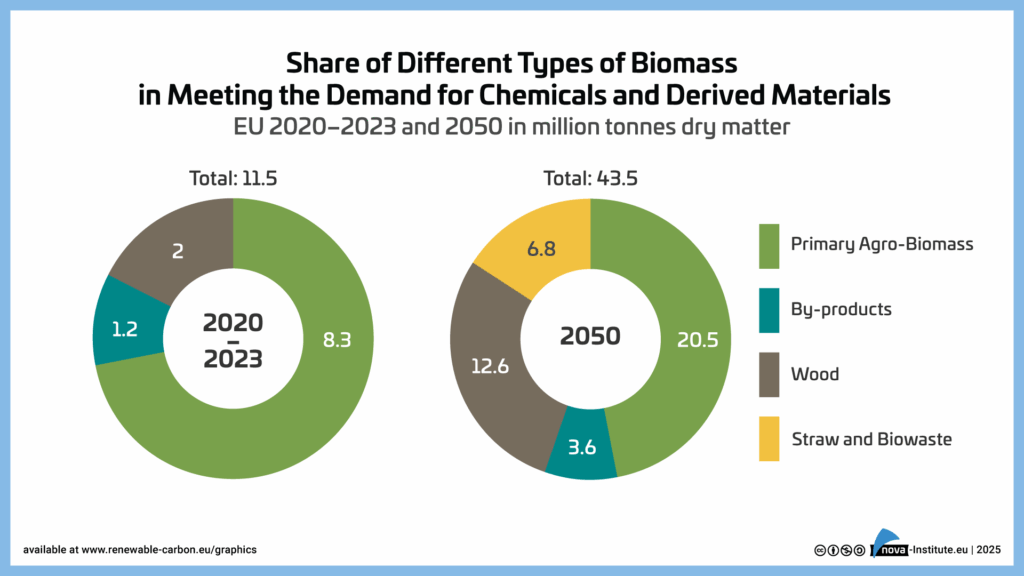
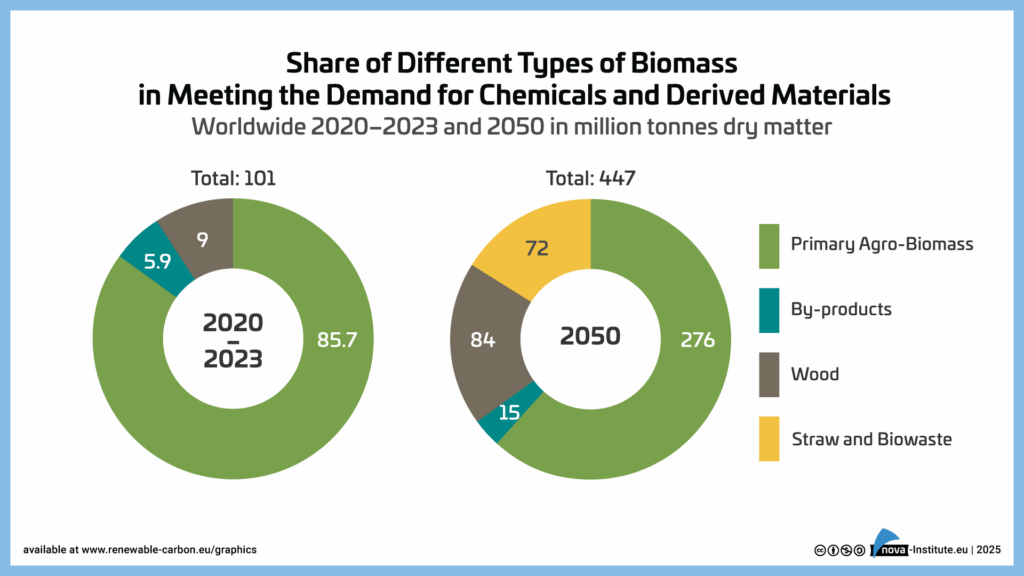
The results are clear: while biomass can play a crucial role, this is subject to certain limits. Under a realistic, moderate ‘Green High-Tech’ agriculture scenario characterised by higher yields, greater efficiency and a smaller environmental footprint, it is possible to sustainably supply around 20–30% of the chemical and materials sector’s carbon demand by 2050 using biomass from agriculture and forestry. This can be achieved while fully meeting demand for food and feed and covering the demand from bioenergy/biofuels.
The above figures illustrate the significant evolution of biomass use by 2050, with a substantial increase in agricultural biomass and growing contributions from wood, residues, and biowaste. At the same time, overall demand is set to increase sharply, highlighting the scale of the transformation challenge.
A key finding of the study is the importance of system-wide constraints. Biomass is not available in isolation; it is part of a tightly balanced system in which food, feed, and energy/fuels take priority. Modelling shows that efficient, technology-driven agricultural scenarios are the only way to keep supply in line with rising demand. Even in these scenarios, the balance remains tight. Supply and demand are closely aligned, with only moderate high-tech pathways achieving equilibrium. More conservative scenarios fall short, particularly when accounting for competing uses, such as those for sustainable aviation fuels.
Examining the scenarios more closely reveals that only the green high-tech pathways can meet the additional biomass demand projected for 2050. The modelling indicates that sufficient biomass could be mobilised globally and in Europe, but only under these favourable conditions, which depend on higher productivity, efficient land use, and technological progress in agriculture and forestry. At the same time, the results confirm that the amount available to the chemical industry is limited once priority demands such as food, feed and biofuels have been met.
This leads to the key conclusion of the nova study: biomass alone cannot achieve full defossilisation. Rather, it is one pillar of a broader system, alongside recycling and carbon capture and utilisation (CCU). The nova scenario shows that, by 2050, a fully defossilised chemical industry will rely on a balanced mix of renewable carbon sources, including biomass, CO₂-based feedstocks, and recycling, to meet a demand for carbon that is expected to more than double.
By highlighting nova-Institute’s findings, Nature emphasises both the scientific depth and strategic relevance of this work. The study combines complex modelling, real-world constraints and interdisciplinary expertise, supported by the extensive Renewable Carbon Initiative network. The message is clear: defossilisation is not about eliminating carbon, but managing it sustainably. While the future economy cannot be carbon-free, it must become free of fossil carbon.
Source
nova-Institute, original text, 2026-05-29.
Supplier
European Commission
European Union
nature (Journal)
nova-Institut GmbH
Share
Renewable Carbon News – Daily Newsletter
Subscribe to our daily email newsletter – the world's leading newsletter on renewable materials and chemicals