Credit: Yuanzuo Gao
A Yale-led research team has developed the first standalone device that produces the liquid fuel methanol using only sunlight, water, and carbon dioxide as the ingredients.
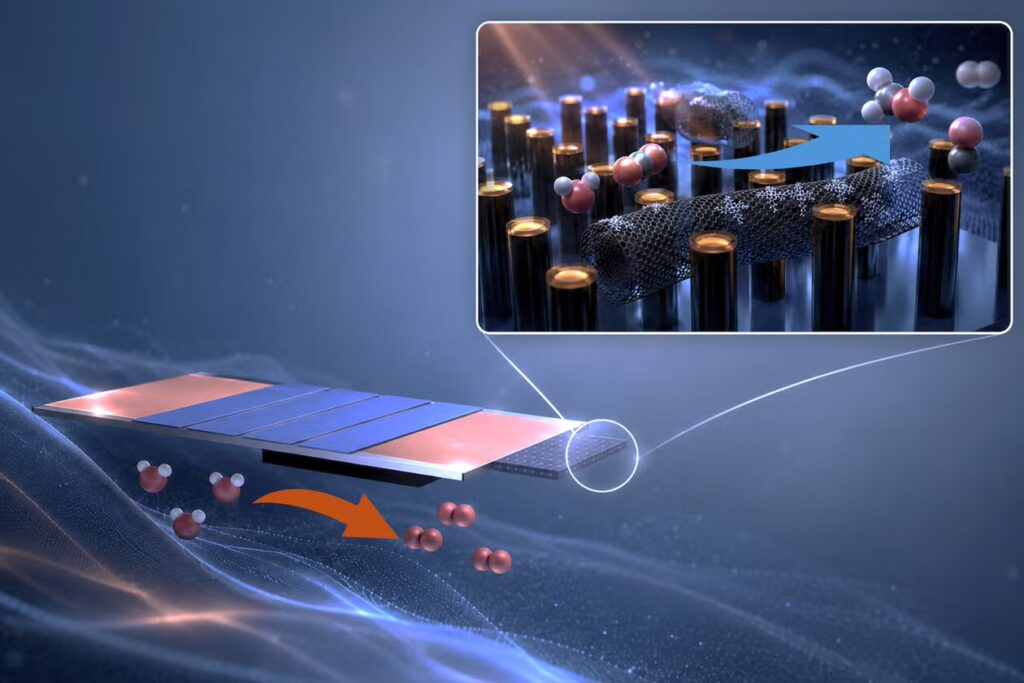
The artificial “leaf,” like its namesake in nature, is a chemistry marvel. It brings the scientific mimicry of photosynthesis — the process of converting sunlight and water into chemical energy — to a new level, converting sunlight to methanol 32 times more efficiently than the previous conversion record for artificial leaf technologies that generate alcohol products.
What You Need to Know
What is photosynthesis?
Photosynthesis is the process in nature by which plants (plus algae and certain bacteria) convert sunlight into chemical energy, transforming carbon dioxide and water into glucose and releasing oxygen into the atmosphere.
What is an artificial leaf?
An artificial leaf replicates photosynthesis by using catalysts and sunlight to convert carbon dioxide and water into chemical fuels.
How is the new, Yale-led artificial leaf concept distinct?
The artificial leaf developed in the lab of Yale chemist Hailiang Wang and funded by the Center for Hybrid Approaches in Solar Energy to Liquid Fuels (CHASE) is the first standalone device that produces the liquid fuel methanol using only sunlight, water, and carbon dioxide as the ingredients.
“This looks promising, with a concept that is comparable to what nature does,” said Hailiang Wang, a professor of chemistry in Yale’s Faculty of Arts and Sciences, member of the Yale Energy Sciences Institute and Yale Center for Natural Carbon Capture, and senior author of a new study in the Journal of the American Chemical Society. “From the moment that we saw the first results it was super exciting.”
The new “leaf” offers several commercial and environmental benefits. It pulls carbon dioxide, a greenhouse gas and main contributor to climate change, from the air; it creates methanol, an increasingly popular chemical feedstock and alternative liquid fuel; and it suggests a viable new method for converting and storing solar energy.
The study is also a research milestone for the Center for Hybrid Approaches in Solar Energy to Liquid Fuels (CHASE), a federally funded solar energy research hub comprised of seven U.S. research institutions and based at the University of North Carolina-Chapel Hill (UNC-Chapel Hill). In addition to Yale, the new study includes researchers from North Carolina State University-Raleigh, UNC-Chapel Hill, and the University of Pennsylvania.
Wang and Bo Shang, a student in Yale’s Graduate School of Arts and Sciences and a researcher in the Wang lab, led the design of the new system, which was part of Shang’s doctoral dissertation.
At the heart of the new system is a pair of discoveries made and refined over the past decade in the Wang lab: a unique catalyst and an innovative photoelectrode that combine for a more powerful, streamlined conversion process that may be scalable for wider use.

Credit: Bo Shang
First came the catalyst, developed in 2019, that converts carbon dioxide and water into methanol using electricity. It’s a type of catalyst called a heterogeneous molecular electrocatalyst — “heterogeneous” because it’s a solid catalyst material operating in a liquid electrolyte, and “molecular” because the active site of the catalyst is a molecular structure.
The distinct structure of the catalyst is the key, Wang said.
He and his team anchored individual molecules of cobalt phthalocyanine (or its derivative) onto the surface of carbon nanotubes, nanometer-diametered tubes of rolled up graphene layers. The nanotubes act like a highway for electrons, creating a rapid and continuous delivery of electrons to the catalytic sites for converting carbon dioxide to methanol. It is a six-electron reduction process, the researchers said, meaning that six electrons are injected into one carbon dioxide molecule.
Prior to this discovery, a more limited delivery of electrons — a two-electron reduction process — meant molecular catalysts were only able to convert carbon dioxide into products such as carbon monoxide.
Next came a photoelectrode, developed by Shang, consisting of an array of silicon micropillars coated with a layer of fullerene carbon. This structural design, which had a desirable geometry for charge generation and separation, a tailored interface for electron transfer, and an increased surface area for anchoring the catalyst, yielded the most efficient photoelectrocatalytic conversion of CO2 to methanol, based on silicon, ever reported.
“When I started, getting a device like this to run on its own felt like a long shot,” said Shang, first author of the new study. “Over five years of work in CHASE, we developed every part of the device from the ground up. To watch it turn just sunlight, water, and CO₂ into a usable fuel is incredibly rewarding — and it really feels like only the beginning of what the approach can do.”
The research team continued improving the structure of its new leaf to boost conversion efficiency — a process that will continue now that the approach has proven to be effective, Wang said.
“CHASE’s demonstration of a monolithic artificial leaf is an example of how hypothesis-driven fundamental research can lead to technological advances,” said CHASE director Jillian Dempsey. “Several years of collaborative research within CHASE led to enhancements in the performance metrics of the methanol-producing photocathode, setting the stage for the team to pursue an integrated light-to-methanol production system. The work is an enabling milestone for our team and the field.”
Yale co-authors of the study are Kunpeng Yu, Haozhou Yang, Yuanzuo Gao, Jindou Yang, Jing Li, Min Li, Jinquan Shi, and Mengxia Liu. Additional co-authors are Hannah Margavio and Gregory Parsons of North Carolina State University-Raleigh, Jillian Dempsey and Gerald Meyer of the University of North Carolina-Chapel Hill, and Thomas Mallouk of the University of Pennsylvania.
CHASE, an Energy Innovation Hub funded by the U.S. Department of Energy’s Office of Science, supported the research.
Source
Yale University, press release, 2026-06-04.
Supplier
North Carolina State University
University of North Carolina at Chapel Hill
University of Pennsylvania
US Department of Energy (DoE)
Yale University
Share
Renewable Carbon News – Daily Newsletter
Subscribe to our daily email newsletter – the world's leading newsletter on renewable materials and chemicals