Introduction
As climate action increasingly extends beyond direct production emissions to entire value chains, reliable carbon footprint data is becoming essential. It helps businesses, policymakers and consumers understand where greenhouse gas emissions occur and provides a credible basis for informed decisions about products and packaging. Against this background, the platform The Paper Bag commissioned the first carbon footprint study for kraft paper carrier bags in Europe.
About the research
The analysis has been carried out by RISE, Research Institutes of Sweden. It assesses the cradle-to-gate fossil carbon footprint of machine-glazed (MG) and machine-finished (MF) kraft paper commonly used to manufacture paper carrier bags, as well as the bags themselves.
Cradle-to-gate covers emissions from raw material extraction through production up to the factory gate. The results reflect the market and technology situation in 2024.
The calculations follow guidelines and tools for paper-based packaging developed by the International Confederation of Paper and Board Converters in Europe (CITPA)1 and the Confederation of European Paper Industries (CEPI)2.
Data Sources
The calculations are based on 2024 life cycle inventory data collected by CEPI Eurokraft and EUROSAC from 13 European mills producing MG/MF kraft paper and six facilities converting kraft paper into paper bags. The mill data covers more than 95% of European MG/MF kraft paper production. While the sample of converting plants is smaller, the data was benchmarked against other studies and found to be closely aligned.3
The inventory covers resources, energy, emissions and waste associated with the production of average MG/MF kraft paper and paper bags in Europe. Electricity-related emissions reflect the actual electricity mix used by participating mills where available; for converting plants, an average European grid electricity mix was applied. Carbon and electricity emissions factors were sourced from Ecoinvent 3.11.
Carrier bag specifications
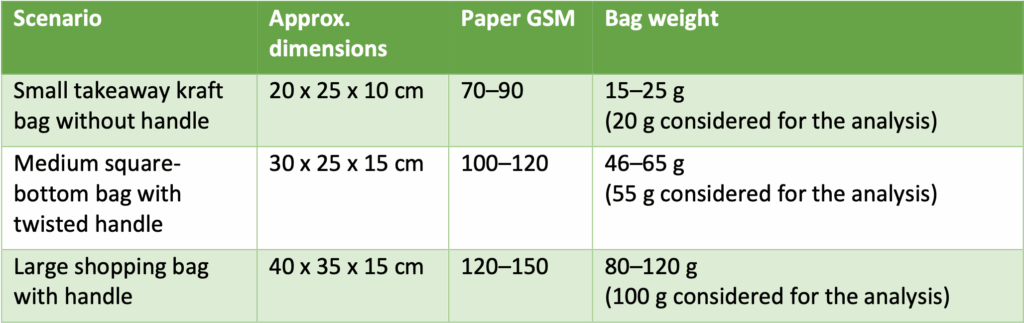
Paper bags are primarily made from virgin-fibre kraft paper supplied by members of CEPI Eurokraft. Bags with a high recycled content are available but are not included in this study. The analysis considers three representative bag types covering typical applications and sizes:
Key Findings
Carbon footprint of paper carrier bags
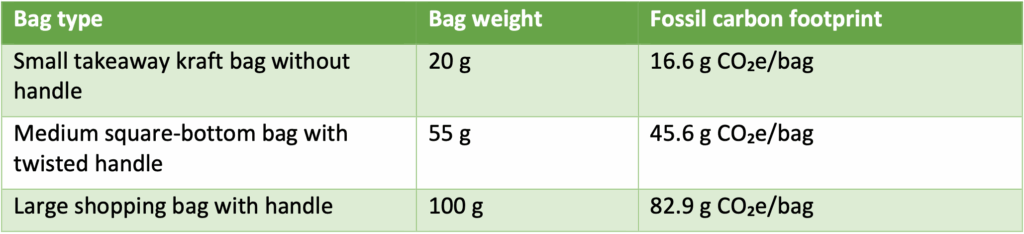
The study calculates a cradle-to-gate fossil carbon footprint of 829 kg CO₂e per tonne of paper bags. For the three representative bag types considered in the study, this translates into:
Putting the numbers into perspective
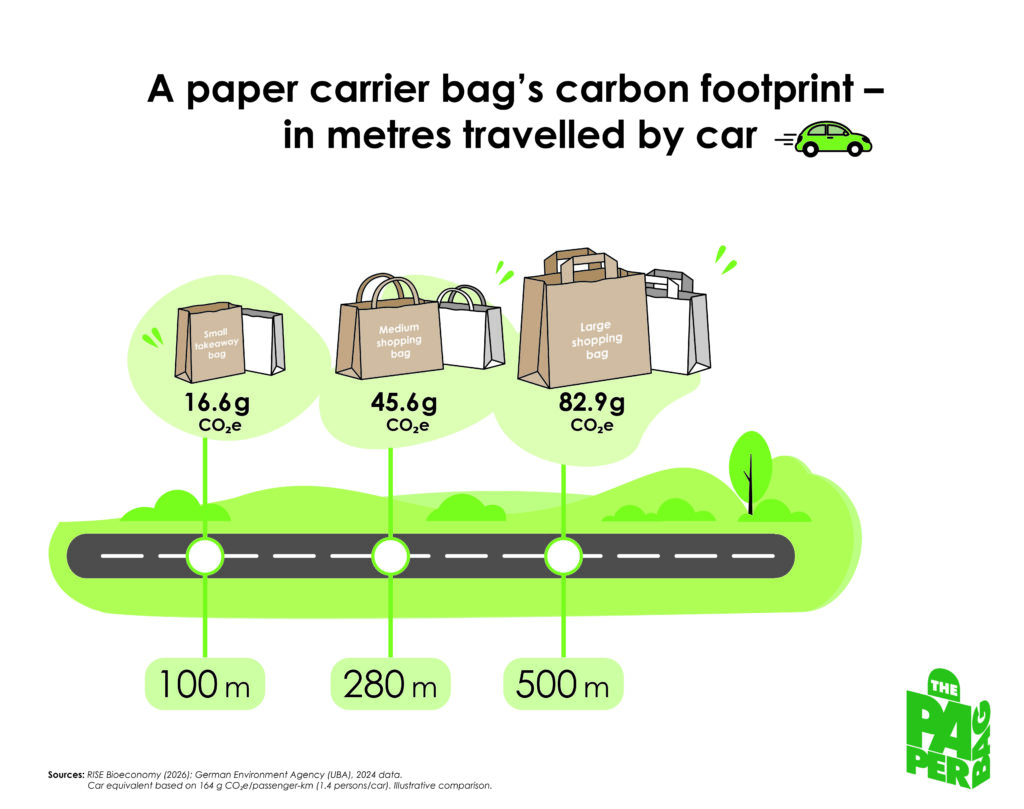
For illustrative purposes, the study results can be put into an everyday context by comparing them with passenger car travel. This comparison is not part of the RISE study. Based on 2024 data from the German Environment Agency (UBA), average passenger car travel accounts for 164 g CO₂e per passenger-kilometre, assuming an average occupancy of 1.4 persons per car.
This means that the footprint of the three paper bags corresponds to approximately 100 m, 280 m and 500 m of passenger car travel respectively. Calculation example: medium bag: 45.6 g CO₂e ÷ 164 g CO₂e/passenger-km = 0.278 km ≈ 280 m
Main contributors to the carbon footprint
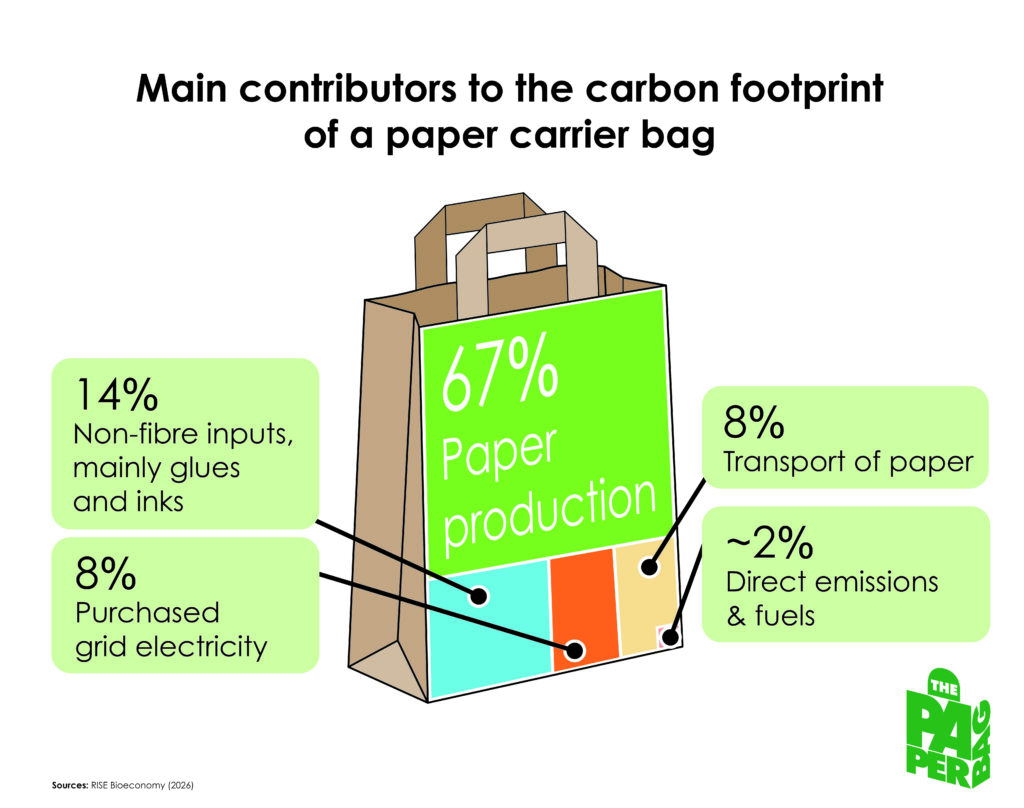
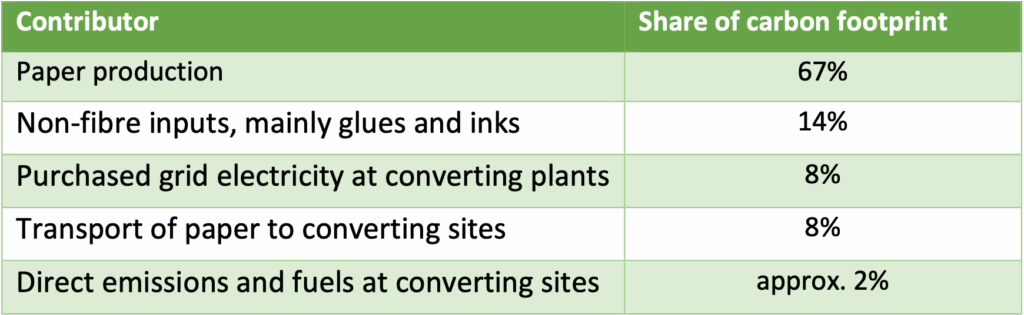
Paper production is by far the largest contributor, accounting for around 67% of the cradle- to-gate fossil carbon footprint. The remaining footprint mainly comes from non-fibre inputs, electricity and transport:
In Summary
The study provides the first quantified basis for understanding the cradle-to-gate fossil carbon footprint of kraft paper carrier bags manufactured in Europe. The results provide a new reference point for the sector and a basis for tracking future developments. Paper bags are made from a renewable, bio-based material and can be recycled after use.
Recycling keeps paper fibres in circulation for longer and should therefore be encouraged at end-of-life.
About The Paper Bag

The Paper Bag “The Paper Bag” platform was founded in 2017 by the leading European kraft paper manufacturers and producers of paper bags. They dedicate themselves to promoting the advantages of paper packaging. “The Paper Bag” is steered by the organisations CEPI Eurokraft and EUROSAC. thepaperbag.org
About CEPI Eurokraft
CEPI Eurokraft is the European Association for Producers of Sack Kraft Paper for the Paper Sack Industry and Kraft Paper for the Packaging Industry. It has ten member companies representing a volume of 3.0 million tonnes of paper produced in eleven countries. www.cepi-eurokraft.org
About EUROSAC

EUROSAC is the European Federation of Multiwall Paper Sack Manufacturers. The federation represents over 80% of European paper sack manufacturers. Its members operate in 20 different countries. They produce more than 5 billion paper sacks per year, representing 630,000 tonnes of paper converted in 55 plants. Sack manufacturers from all continents and bag manufacturers also contribute to the federation as corresponding members, and more than 30 suppliers (paper, film, machine or glue manufacturers) are registered as associate members. www.eurosac.org
1 Guidelines for calculating carbon footprints for paper-based packaging, CITPA, November 2025
2 Framework for the Development of Carbon Footprints for Paper and Board Products, CEPI, April 2017
3 E.g., “Life Cycle Assessment of grocery carrier bags”, Ministry of Environment and Food Denmark, Environmental Protection Agency, February 2018
4 German Environment Agency (UBA), Comparison of average emissions from different modes of passenger transport, reference year 2024; TREMOD 6.71B (10/2025).
Source
The Paper Bag, Cepi Eurokraft and EUROSAC, joint press release, 2026-10-06.
Supplier
CITPA
Confederation of European Paper Industries (CEPI)
EUROSAC
Research Institutes of Sweden (RISE)
The Danish Environmental Protection Agency
Umweltbundesamt UBA
Share
Renewable Carbon News – Daily Newsletter
Subscribe to our daily email newsletter – the world's leading newsletter on renewable materials and chemicals