 Enzymatic Recycling: Sustainable Valorisation of Plastic Waste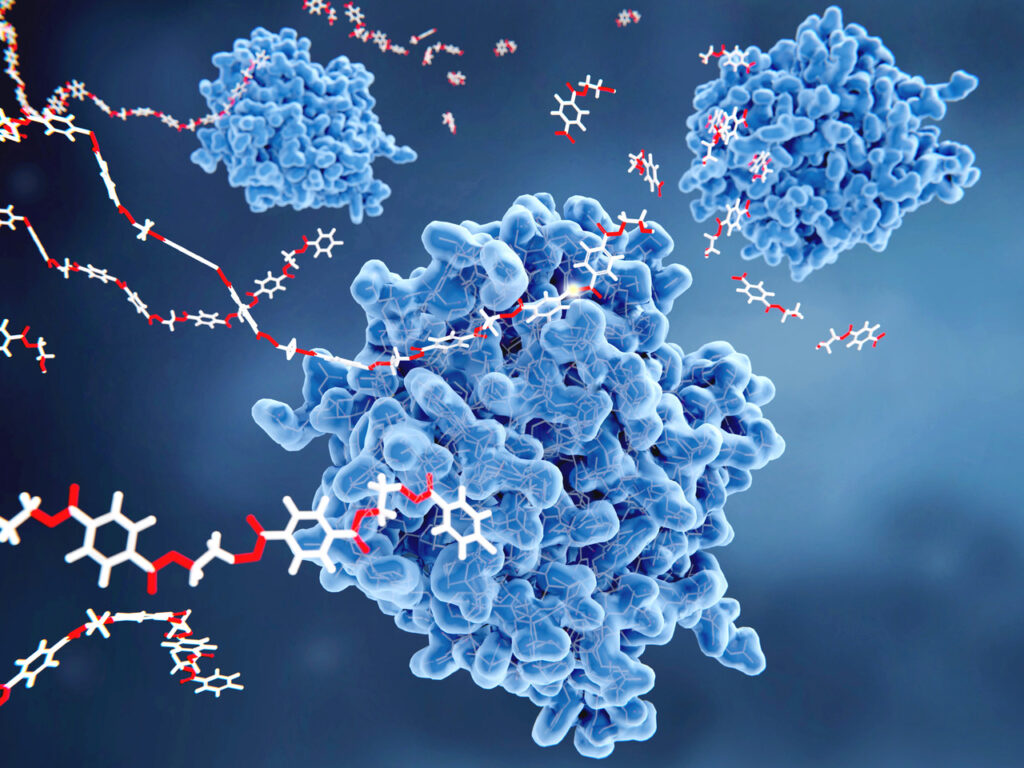
Plastic pollution has become one of the most urgent environmental issues of modern societies. While conventional mechanical recycling often results in lower material qualities, making it unsuitable for high-value applications, chemical recycling offers an alternative path to recycle plastic waste but typically involves high energy consumption (e.g. for the production route from waste to plastic) and operation under harsh conditions (e.g. higher temperature levels). Recently, enzymatic recycling has emerged as a promising approach for plastic waste valorisation rooted in biotechnology, offering a more sustainable and effective route to reclaim and utilise plastic monomers for the production of new polymers.
Understanding Enzymatic Depolymerisation
At the core of enzymatic recycling are (engineered) enzymes. These biological molecules catalyse chemical reactions with high specificity and efficiency. Engineered enzymes selectively break down polymers into monomers under mild conditions, offering new avenues for true circularity. Specifically, in the context of plastics, enzymes called PET hydrolases catalyse the breakdown of PET, a common thermoplastic used in bottles and textiles.
Unlike traditional chemical processes, enzymatic depolymerisation operates under mild conditions, typically below 70 degrees Celsius and at atmospheric pressure. It hereby significantly reduces energy requirements and greenhouse gas emissions. Additionally, the process can handle plastic waste with contaminants such as dyes or residual adhesives, provided the polymers consist predominantly of PET.
From Laboratory to Pilot Scale: A Catalyst for Transformation
Importantly, enzymatic recycling research extends beyond PET. Plastics such as polyamides (found in textiles and automotive parts) and polyurethanes (used in foams and coatings) are promising targets due to their amide and urethane bonds, which some enzymes can selectively cleave. Xu et al. emphasize the comprehensive strategy leveraging microbial processes to transform mixed plastics of fossil-derived polymers such as PP, PE, PU, PET, and PS, most notably polyesters, in conjunction with potential biodegradable alternatives such as PLA and PHA (Xu et al., 2025). Other polyesters with similar ester bonds also hold potential for enzymatic treatment (Utomo et al., 2022).
Enzymatic recycling is advancing rapidly. Cutting-edge enzyme engineering, process optimisation, and microbial upcycling are translating lab breakthroughs into industrial applications, highlighting the sector’s potential to revolutionise plastic waste management. Large-scale pilots will showcase efficient treatment of complex, mixed plastics, producing high-purity monomers for reuse and upcycling. As research lowers costs and improves stability, enzymatic recycling is poised to become a cornerstone of sustainable, circular plastics systems.
Enzymatic Recycling at the Advanced Recycling Conference 2025
The Advanced Recycling Conference (ARC) 2025, taking place on 19-20 November in Cologne, Germany and online, will prominently showcase the transformative potential of enzymatic recycling in driving the future of plastic waste management. This focus reflects the growing recognition of enzymatic recycling’s promise to revolutionise the sector through sustainable, energy-efficient pathways enabling true circularity.
A dedicated session will bring together leading experts in this field:
- Ren Wei from (University of Greifswald) – Recent Advances in Enzymatic Plastic Recycling and Upcycling
- Kristina Schell (Covestro) – Enzymatic Polymer Recycling
- Nick Wierckx (Forschungszentrum Jülich) – Bio-upcycling of Plastics Through Enzymatic and Biological Conversion.
- Mariana Rangel Pereira (Evoralis) – From Hits to Hotspots: Ultra‑High‑Throughput Directed Evolution for Nylon Depolymerisation
- Oliver Borek (Entzimatiko) – Entzimatiko, a Single Step Enzymatic Hydrolysis for the Low Cost Production of Monomers
- Ronny Frank (Ester Biotech) – Accelerating Enzyme Engineering for Plastic Recycling with Electrochemical Impedance Spectroscopy and Advanced Computational Methods
The session will be chaired by Pia Skoczinski from the nova-Institute and Professor Lars Blank of RWTH Aachen University, a driving force in enzymatic recycling research.
Register here to join this unique event: https://advanced-recycling.eu/registration/
Further information on the Advanced Recycling Conference 2025: https://advanced-recycling.eu
References
Utomo, Romualdus Nugraha Catur (2022); Upcycling of plastic monomers by mixed microbial cultures, in Applied Microbiology Vol. 28, http://publications.rwth-aachen.de/record/849918/files/849918.pdf
Xu et al. (2025), Exploring biotechnology for plastic recycling, degradation and upcycling for a sustainable future, in Biotechnol Adv 2025 Jul-Aug, 81:108544. doi: 10.1016/j.biotechadv.2025.108544 https://pubmed.ncbi.nlm.nih.gov/40024585/
Source
nova-Institut, press release, 2025-10-23.
Supplier
nova-Institut GmbH
Rheinisch-Westfälische Technische Hochschule Aachen (RWTH)
Share
Renewable Carbon News – Daily Newsletter
Subscribe to our daily email newsletter – the world's leading newsletter on renewable materials and chemicals