© Fraunhofer UMSICHT
Since 2016, industry and academia have been collaborating on the Carbon2Chem® project to explore how climate-damaging industrial emissions can be put to good use. The goal: to stop viewing carbon dioxide merely as an emission and instead treat it as a raw material for new products. As the project marks its 10th anniversary, this approach works – even on an industrial scale.
June 26, 2016, marks the official launch of Carbon2Chem®: In the presence of Prof. Dr. Johanna Wanka (then Federal Minister of Education and Research) and Svenja Schulze (then Minister of Innovation, Science, and Research for the State of North Rhine-Westphalia), the collaborative project begins its work. It is funded by the Federal Ministry. Coordination is shared by Fraunhofer UMSICHT, the Max Planck Institute for Chemical Energy Conversion and thyssenkrupp. They represent applied research, basic research and industry, respectively. The mission of the 14 partners from industry and science is to use carbon monoxide and carbon dioxide from industrial exhaust gases generated during steel production – so-called metallurgical gases – to produce basic chemical raw materials.
The project takes a systemic approach that integrates gas purification, electrolysis, hydrogen production, synthesis, system integration, and life cycle assessment – thereby mapping, for the first time, the entire process from exhaust gas to a practical product. Already in the first two project phases – which were primarily research- and pilot-driven (2016 to 2020, 2020 to 2024) – the partners have demonstrated that the necessary technological building blocks can be operated in a stable, flexible, and combinable manner.
“A key milestone is the development and operation of gas purification and conditioning concepts that reliably manage the highly fluctuating compositions of real metallurgical gases (e.g., with regard to impurities),” explains Prof. Robert Schlögl (Overall Coordination / Max Planck Institute for Chemical Energy Conversion). “At the same time, we have designed electrochemical and catalytic processes so that they function stably even under dynamic operating conditions, such as when the supply of renewable energy fluctuates.”
From exhaust gas to platform chemical: Sustainable methanol on an industrial scale
Methanol synthesis is of particular importance. In the Carbon2Chem® approach, methanol serves as a platform chemical from which a wide variety of other products, such as plastics and fuels, can be produced.
“Following successful laboratory and pilot tests, we have gradually scaled up methanol production,” said Prof. Görge Deerberg (Overall Coordination/Fraunhofer UMSICHT). “Since 2023, sustainable methanol has been produced continuously in a demonstration plant at the Duisburg steelworks using actual process gases. Specifically, we have already produced more than 9 metric tons of methanol from the steelwork’s gases.”
The results show that the quality and purity of the methanol produced meets industrial specifications. Developments in the areas of gas purification and catalysts are proceeding smoothly; no differences were observed between processes using synthetic gases and those using actual steel mill gases. The components developed and tested are working together as planned, marking a decisive step from research toward industrial application.
Ten years after the project began, Carbon2Chem® methanol was being used outside the project for the first time. In other projects, it serves as a feedstock for chemical products, including precursors for plastics. This completes an industrial value chain from waste gas to a marketable product.
Applicability to other industries with unavoidable CO₂ emissions
“At the same time, we were able to demonstrate in the project that the Carbon Capture and Utilization (CCU) concepts we developed can be applied to other industries where CO₂ emissions are unavoidable due to the nature of the processes. These include the cement, lime, and waste management industries,” says Dr. Markus Oles (Overall Coordination/thyssenkrupp Carbon2Chem®), highlighting another success. “Carbon2Chem® is designed as a modular technology platform for an industrial carbon cycle economy, in which individual components can be combined and adapted depending on the industry.”
Shared infrastructure and outlook for industrial implementation
The three coordinators attribute these successes, among other things, to the daily collaboration between industry, basic research, and applied research. Joint research and demonstration infrastructures were established as part of the project both at the Carbon2Chem® laboratory in Oberhausen and at the pilot plant at the Duisburg steelworks site. In addition, a shared data space and expert communities on topics such as simulation, process design, life cycle assessment and cost estimation ensure the internal exchange of all results within the project.
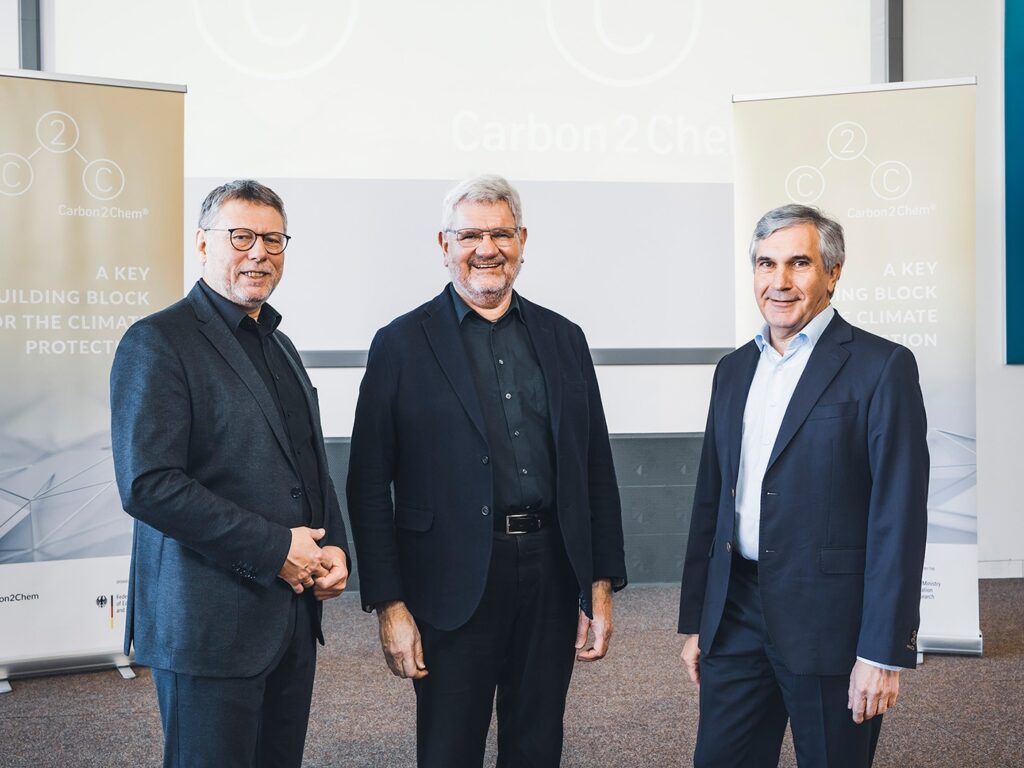
As they mark this anniversary, Görge Deerberg, Markus Oles and Robert Schlögl are also looking ahead. In the current third and final project phase, the focus is on further scaling, economic evaluation, new fields of application – such as sustainable aviation fuels – and the transfer of knowledge to industrial implementation. Their message: Carbon2Chem®has demonstrated that CCU is technically feasible. The next step is broad-scale industrial application.
Carbon2Chem® by the numbers
- The project consists of 3 phases.
- Carbon2Chem® ends in 2028.
- The Federal Ministry of Research, Technology and Space and its predecessors have provided 200 million euros in funding for the collaborative project.
- The Carbon2Chem® laboratory on the Fraunhofer UMSICHT campus in Oberhausen covers an area of 500 m2.
- The Carbon2Chem® technical center covers an area of 3,700 m2.
- Over 4.6 million Nm³ of steel mill gases (real gas) were purified.
- More than 1,000 metric tons of H2 were produced via water electrolysis.
- Up to 75 liters of crude methanol are produced per day in the demonstration plant.
- The demonstration plant at the steel mill in Duisburg operated for over 4,000 hours using real gas.
Source
Fraunhofer-Institute UMSICHT, press release, 2026-06-30.
Supplier
Bundesministerium für Bildung und Forschung (BMBF)
Fraunhofer-Institut für Umwelt-, Sicherheits- und Energietechnik (UMSICHT)
Max-Planck-Institut für chemische Energiekonversion
Ministerium für Innovation, Wissenschaft und Forschung des Landes NRW
thyssenKrupp AG
Share
Renewable Carbon News – Daily Newsletter
Subscribe to our daily email newsletter – the world's leading newsletter on renewable materials and chemicals