 Driving Innovation in Chemical Recycling for Complex Material-Waste: Interview with Addible Offers Insights Ahead of the Advanced Recycling Conference 2025

Each year, the Advanced Recycling Conference brings together leading experts and innovators committed to transforming and advancing the recycling landscape. Fergal Byrne, Chief Technology Officer of Addible, explains how their OxyCycle technology advances the recycling of complex waste streams such as tyres, textiles, and composites. By breaking down materials at the molecular level, this solution unlocks high-value resources, that are difficult to recover using traditional methods. Such innovations are vital to promoting renewable carbon use and fostering a circular economy. Both aspects are key themes at this year’s Advanced Recycling Conference taking place on 19–20 November in in Cologne, Germany and online.
Register here: https://advanced-recycling.eu/registration/
ARC 2025 Interview Series: Innovators at work

Innovative chemical recycling pathways for sectors with complex materials, e.g. automotive and textiles – with Fergal Byrne, CTO of Addible
1. Innovation & Sustainability
Advancements in chemical recycling offer sustainable solutions to complex materials and various additives commonly found in automotive applications like tyres, plastics, and composite parts. Traditional recycling methods like mechanical shredding or incineration often fall short in efficiently recovering such valuable materials. Addible’s OxyCycle technology uses a process called oxidative devulcanisation, a chemical reaction with oxygen designed to break down end of life tyres at the molecular level.
Could you explain how it contributes to transforming challenging automotive waste streams into valuable raw materials? What are the key sustainability advantages of your approach over traditional recycling methods, and how do these innovations support the broader circular economy ambitions within the automotive sector?
Fergal: The recycling of rubber from end-of-life tyres remains one of the biggest challenges in the circular economy. Current routes such as mechanical shredding and pyrolysis have clear limitations: shredded rubber faces upcoming EU restrictions and can only be down-cycled into low-value infill or flooring materials, while pyrolysis consumes large amounts of energy yet recovers only a fraction of the rubber as low-grade oils and carbon black containing ash. Our OxyCycle process overcomes these limitations through a proprietary oxidative devulcanisation step that breaks the sulfur crosslinks binding the rubber polymers under mild, energy-efficient conditions. This enables complete disassembly of tyres into clean, separate streams: virgin-quality carbon black, high-purity steel and textiles, and unsaturated rubber polymers that can be re-vulcanised or compounded into new high-performance products.
Unlike thermal or mechanical routes, OxyCycle typically recovers more than 98 % of the input mass as valuable materials rather than waste residues. When applied to unprocessed whole tyres, the process can even separate the different layers, yielding defined polymer grades ready for reintegration into manufacturing. By drastically improving both the quality and quantity of recovered materials, OxyCycle transforms tyres, hoses, seals (even tennis balls!) from an environmental burden into a strategic raw-material source, a practical step toward a true circular economy in mobility and beyond.
2. Sustainability Gains Through Breakthrough Technology
Enzymatic recycling and other innovative technologies have the potential to significantly reduce greenhouse gas emissions and energy consumption compared to conventional recycling. In practice, how has Addible’s technology translated these possibilities into real-world gains? Could you share insights from your experiments or industrial trials on specific improvements in process efficiency, product purity, or lifecycle environmental impacts? Furthermore, how do you integrate environmental considerations when choosing between different recycling routes for tyres and/or other waste streams?
Fergal: Quantifying total lifecycle impacts is ongoing, but from a chemical-engineering and green-chemistry perspective, the sustainability gains of OxyCycle are already clear. Traditional recycling methods depend on high-temperature pyrolysis or chemical reagents with limited recovery potential. In contrast, OxyCycle operates at mild temperatures and employs a reagent system that is largely recyclable and inherently low-toxicity. In our trials, over 99 % of our active proprietary reagent is recovered and reused, with only small additions of fresh oxidant (H₂O₂) required to maintain performance. The reagent itself can be synthesised from bio-derived feedstocks, enabling a renewable supply chain from the outset.
The chemistry was developed under safe-and-sustainable-by-design principles, avoiding persistent or hazardous compounds and ensuring that all input and output streams can be handled safely. Operating at a fraction of the energy demand of thermal routes, OxyCycle substantially reduces CO₂ emissions, waste generation and water use. Because the system can treat mixed or contaminated rubber feedstocks without pre-sorting, it delivers high recovery at minimal environmental cost, turning a waste problem into a renewable resource opportunity aligned with emerging EU sustainability frameworks.
3. Challenges & Opportunities
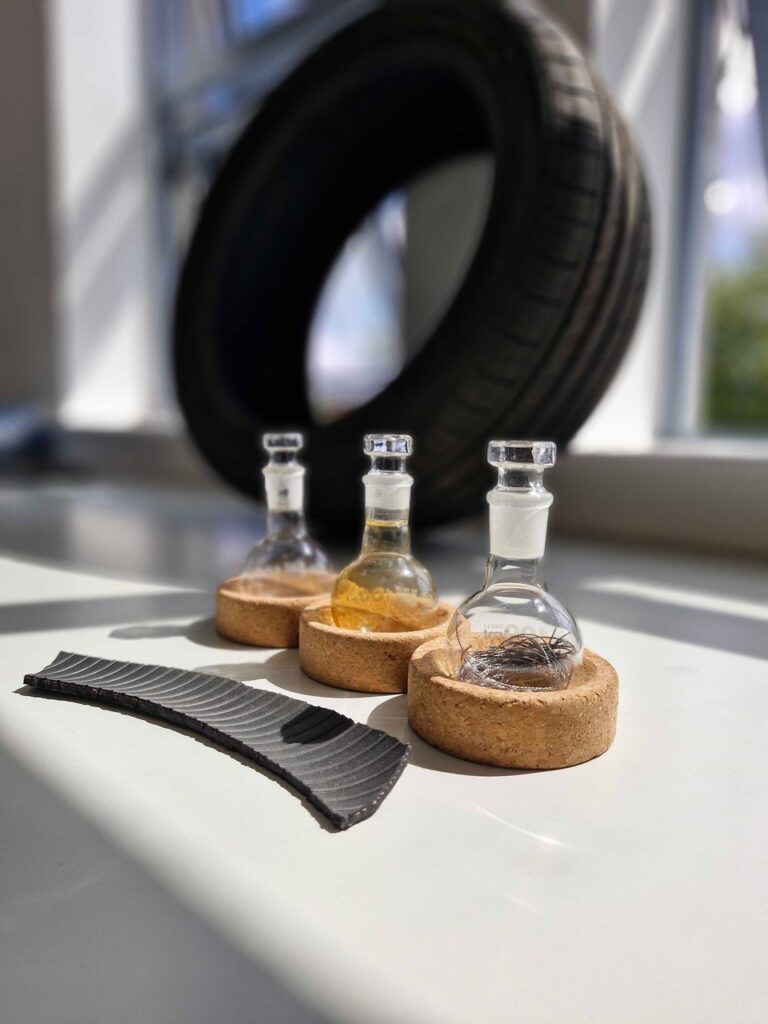
Automotive recycling is complicated by the presence of diverse polymers, additives, and contaminants which impede straightforward recovery processes. From your experience, what are the most critical technical and operational challenges encountered in processing such complex waste streams? How do your chemical recycling solutions overcome issues of material heterogeneity and contamination to produce outputs meeting industry-grade standards?
Fergal: Automotive rubber waste is highly heterogeneous. Tyres alone contain multiple polymer types, steel, textiles, plasticisers, fillers and environmental contaminants, and traditional approaches struggle with this complexity. OxyCycle was designed for exactly such mixed waste. The process combines controlled swelling, selective extraction, oxidative devulcanisation and staged separation, each step exploiting intrinsic material differences, for example, swelling removes additives and surface dirt before the devulcanisation step cleaves sulfur crosslinks. Differences in polymer reactivity, particle size and density then enable clean separation of metals, textiles, carbon black and rubber fractions. Because the process deconstructs materials in a sequence of mild, selective reactions, it can handle variable feedstocks and still deliver consistent, high-purity outputs.
4. Collaboration & Industry Dynamics
The success of advanced recycling technologies hinges on an ecosystem of cross-sector partnerships involving manufacturers, recyclers, chemical engineers, and policy makers. From your perspective, what forms of collaboration have proven most effective in overcoming market and regulatory barriers, and achieving commercial scalability? How does Addible proactively engage with different stakeholders across the value chain to align incentives and foster trust? Additionally, could you shed light on current market dynamics, e.g., evolving customer demand, supply chain shifts, or policy frameworks shaping the landscape for advanced recycling?
Fergal: Collaboration is essential for scaling any new recycling technology. At Addible, we work closely with tyre manufacturers, compounders, and recycling operators to ensure that the materials we recover meet the specifications required for reintegration into production. We view recycling as a systems challenge: efficient logistics for collecting and pre-sorting waste are as important as the chemistry itself. By aligning with existing collection networks and rubber waste feedstocks, we ensure that OxyCycle can plug seamlessly into today’s infrastructure. Our partnerships with carbon-black producers and rubber converters allow real-world validation of product performance, while engagement with policymakers helps shape frameworks that reward high-value, low-impact recycling routes. Market demand for recycled, traceable rubber and carbon black is accelerating under upcoming EU End-of-Life Tyre and sustainable-materials regulations, and OxyCycle positions us to deliver those materials at the quality levels the industry demands.
5. Future Innovations
As the automotive industry shifts towards electric vehicles and lightweight designs, the use of advanced polymers and composites is growing, making recycling even more complex. At the same time green chemistry, which focuses on creating safer and environmentally favourable chemical processes, is becoming increasingly vital. Looking ahead, which advances in green chemistry or chemical technologies do you believe will have the greatest influence on closing the recycling loop? Are there specific materials where you see the most significant opportunities for breakthrough innovations, and what role will cross-industry collaborations play in achieving these goals?
Addible also addresses difficult waste-groups like multi-layer packaging, which shares complexity and contamination challenges with automotive materials. Could you discuss how insights or technologies from packaging recycling might be translated to automotive recycling? What opportunities do you see for cross-sector collaboration to accelerate circularity and sustainability across both industries?
Fergal: There are many materials currently in use that are easily recycled and more that are almost impossible to recycle. The future of recycling has to depend on designing materials and processes together. Advances in green and safe-by-design chemistry now allow us to introduce technology such as reversible bonds or other built-in “release” mechanisms into polymers, enabling controlled de-crosslinking or delamination at end-of-life. At Addible we see huge potential in chemically smart, bio-based materials, where rubbers, composites and packaging can be dismantled and reused through mild chemical steps similar to those used in OxyCycle. Our work in recycling processes directly informs our approach next-generation polymer design, where multilayer or composite structures pose similar recycling challenges. By transferring knowledge between sectors and partnering with manufacturers at the design-for-circularity stage, we can collectively ensure that new materials we design are fit for circularity from the outset. Achieving this vision requires cross-industry collaboration between polymer chemists, product designers, recyclers and policymakers, creating a truly circular materials economy rather than treating recycling as an afterthought.
Source
nova-Institute, original text, 2025-10-16.
Supplier
Share
Renewable Carbon News – Daily Newsletter
Subscribe to our daily email newsletter – the world's leading newsletter on renewable materials and chemicals