 LCA and sLCA in support of sustainability goals of the EU-funded project WaterProof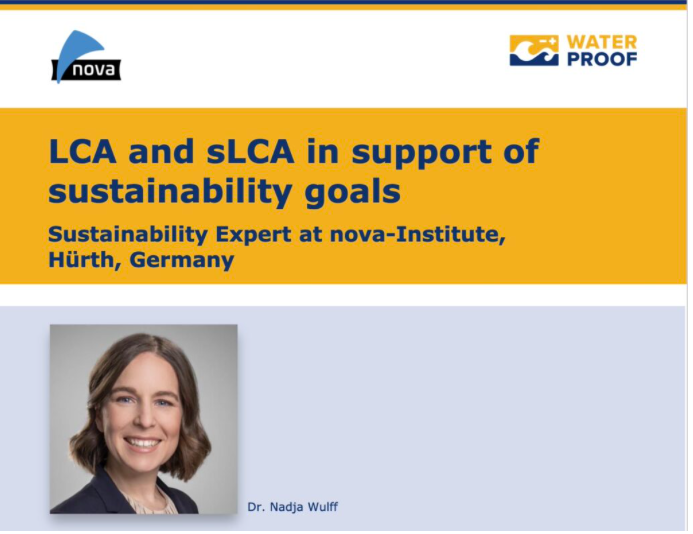
What is your role in the WaterProof project?
At nova-Institute, I contribute as a sustainability expert within the WaterProof project. My responsibilities include conducting the Life Cycle Assessment (LCA) and, at a later stage, the Social Life Cycle Assessment (S-LCA). These assessments provide a comprehensive evaluation of the environmental and social sustainability of the WaterProof process, from the utilization of captured CO₂ to the production of formic acid. With a background in chemistry and a doctoral degree, I work at the interface of scientific understanding and sustainability evaluation.
Why is LCA useful in WaterProof and how does it work?
LCA is a standardised method (ISO 14040/44) to assess the environmental impacts of a product or process across its full life cycle. This means looking at material and energy inputs and related emissions or resource use. In WaterProof, we apply LCA to understand the effects of using CO₂ from waste(water) and turning it into formic acid. The LCA consists of four phases:
- Goal and scope definition
- Life cycle inventory (LCI) (data collection)
- Life cycle impact assessment (LCIA)
- Interpretation of results
It supports early decision-making, helps identify environmental hotspots, and enables comparison with fossil-based alternatives.
What have you found so far in your assessment?
Our preliminary LCA shows that the WaterProof formic acid can have lower environmental impacts compared to fossil-based formic acid but only if renewable energy is used in the process. For example, climate change impacts can be reduced by up to 57%, and impacts in resource use, particulate matter emissions, and freshwater eutrophication can also be significantly lowered.
However, we also identified environmental hotspots: especially potassium hydroxide (KOH), which is used in the electrochemical production process. Its production has a strong influence on several impact categories. Future improvements should focus on the efficient use and recycling of KOH to further reduce impacts.
How do you compare the WaterProof process to conventional formic acid production?
We carried out a benchmark analysis comparing WaterProof formic acid with fossil-based production under different energy supply scenarios. When using renewable electricity, the WaterProof process performs better in all evaluated categories. But when using the European electricity mix, the environmental impacts are sometimes even higher than the fossil benchmark. This shows that the WaterProof process depends strongly on clean energy to achieve sustainability goals.
What is Social Life Cycle Assessment (S-LCA), and how will it be used?
While LCA focuses on environmental impacts, S-LCA looks at social and socio-economic aspects, such as working conditions, fair pay, community impacts, and human rights. We will use S-LCA later in the project to understand the social effects along the value chain of WaterProof formic acid and the products made from it. This helps ensure that both environmental and social aspects are considered together.
How does your work support broader sustainability goals like circularity or CSR?
By combining LCA and S-LCA, we can support projects/companies in understanding the full impact of their processes. This enables better design, transparency, and communication. For WaterProof, we hope this will support industrial transformation, the use of CO₂ as a resource, and the transition to circular, low-carbon production systems.
On the WaterProof project
WaterProof (urban WAste and water Treatment Emission Reduction by utilizing CO₂ for the PROduction Of Formate derived chemicals) is developing an electrochemical process that converts CO₂ emissions from consumer waste incineration and wastewater treatment facilities into formic acid. This can then be used in everyday applications such as detergents and leather tanning, as well as for the generation of deep eutectic solvents for metal recovery. The process also generates peroxides that help remove pharmaceuticals and pesticides from wastewater – creating a clean water cycle with zero emissions.
With this approach, WaterProof directly contributes to:
- Replacing fossil carbon with renewable feedstocks,
- Driving climate neutrality through electrification and CO₂ utilisation,
- Building circular connections across industries, and
- Creating new opportunities while ensuring social responsibility.
Projects such as WaterProof are essential steps toward a climate-neutral and circular Europe.
Visit https://waterproof-project.eu/

Funded by the European Union. Views and opinions expressed are however those of the author(s) only and do not necessarily reflect those of the European Union or European Health and Digital Executive Agency. Neither the European Union nor the granting authority can be held responsible for them.
Source
nova-Institut GmbH, WaterProof Project, original text, 2025-09-08.
Supplier
Avantium Technologies B.V.
nova-Institut GmbH
WaterProof Project
Share
Renewable Carbon News – Daily Newsletter
Subscribe to our daily email newsletter – the world's leading newsletter on renewable materials and chemicals