Showing 1–20 of 32
-
Biorefineries in Asia and the EU – an Explorative Study (PDF)
NewMarkets & Economy, Policy, Technology
58 Pages
29 Downloads
29 Downloads
2026-01
FREE
Free Shipping29
DownloadsThe study aims to provide decision makers with a quick overview over the state of the bioeconomy in Europe and three selected countries in Asia, India, Thailand and Indonesia. Specific attention is placed on biorefineries, as they represent a key building block for the industry. Covered aspects include the political framework, technical pathways and existing infrastructure, alongside case studies. The study provides on-the ground insights from practioners in the field, includes a set of good-practice criteria to assess the prospects of biorefineries and offers a number of specific recommendations for future actions to expand the bioeconomy accross continents.
-
Recycling Becomes Feedstock for Europe – Let’s Dare More Autonomy (PDF)
NewPolicy
65 Pages
305 Downloads
305 Downloads
2026-01
FREE
Free Shipping305
DownloadsThe paper shows how this goal of transformation or defossilisation can be implemented step by step and how legal areas can be better integrated at EU level, which will result in new priorities for both sectors. For example, in waste management, much of what does not contribute to the carbon supply of the chemical industry can be phased out gradually. It also includes enabling all recycling technologies, from mechanical and physical to chemical processes and even incineration with CO₂ capture and utilisation, since all processes are needed in the transformation for the different waste fractions and target products. Overall, the ten proposals derived and analysed in the paper also lead to a significant reduction in bureaucracy.
There are some important proposals that build on instruments already introduced by the EU, such as substitution quotas for selected plastics sectors. The authors also specify proposals that are under discussion or being raised by Member States. However, there are also proposals to phase out existing regulations. It is important that the proposals build on each other and are implemented in a coordinated manner as part of a self-contained, phased overall package.
Fortunately, greater autonomy is becoming mainstream in the EU and is also one of the cornerstones of the new EU Council Presidency. However, unless it becomes practical, greater autonomy and resilience will remain nothing more than a narrative. And the path to achieving this will be fraught with difficulties.
DOI No.: https://doi.org/10.52548/LFPX3960
-
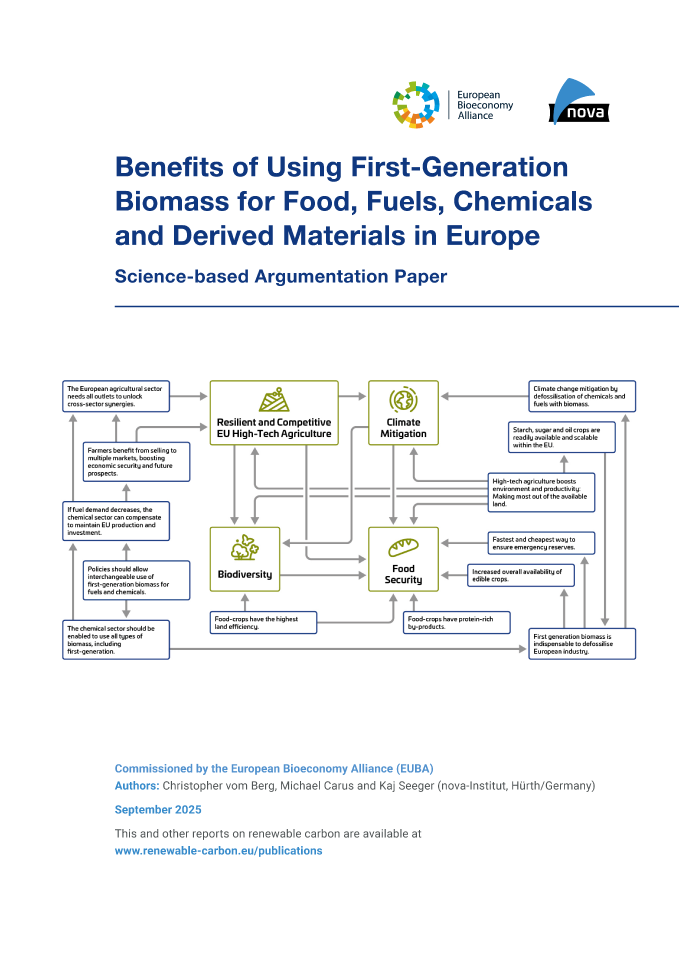
Benefits of Using First-Generation Biomass for Food, Fuels, Chemicals and Derived Materials in Europe (PDF)
Policy, Sustainability & Health
16 Pages
838 Downloads
838 Downloads
2025-09
FREE
Free Shipping838
DownloadsKey messages – Benefits of using first-generation biomass for food, fuels, chemicals and derived materials
First-generation biomass in non-food applications increases food security.
Using first-generation biomass for non-food applications strengthens food security by increasing overall availability of feedstock and market stability. At the same time, it also delivers valuable protein-rich by-products addressing the most critical needs for human and animal nutrition. The ability to shift crops between the food, feed, and industrial markets enables the EU and market players to respond swiftly to changes in demand and mitigate the risks associated with supply chain disruptions. Most importantly, using first-generation biomass for non-food applications offers a fast and economical way to set up and ensure an emergency food reserve.- First-generation biomass in non-food applications enhances a resilient and competitive EU agriculture
- First-generation biomass in non-food applications supports climate change mitigation
- First-generation biomass in non-food applications supports biodiversity protection
- High-tech agriculture further enhances the benefits of first-generation biomass.
DOI No.: https://doi.org/10.52548/GCJC4981
-
PEF – A Circular Bio-Based Plastic with Improved Properties and Environmental Performance (PDF)
Sustainability & Health, Technology
19 Pages
277 Downloads
277 Downloads
2025-09
FREE
Free Shipping277
DownloadsThe chemical technology company Avantium (NL) partnered with nova-Institut GmbH under the framework of the PEFerence project, to perform a full cradle-to-grave Life Cycle Assessment (LCA) for the YXY® Technology, assessing the potential environmental impacts of PEF packaging solutions in comparison to conventional PET packaging. The LCA is performed according to the ISO 14040/44 standard methodology. A critical peer review of the study, including experts of incumbent technologies, was conducted in order to verify whether the LCA met the requirements for methodology, data, interpretation, and reporting. This presentation from the 1st PEF World Congress summarises the main aspects about the environmental sustainability of PEF-based bottles.
-
The fossil fuel trap: Why defossilising chemistry is essential – and feasible! (PDF)
Markets & Economy, Policy, Technology
8 Pages
222 Downloads
222 Downloads
2025-07
FREE
Free Shipping222
DownloadsHow can we escape the fossil fuel trap, our dependence on fossil fuels and the vulnerability that comes with it? In the long term, recycling, together with biogenic carbon and CO₂, can completely replace fossil carbon from crude oil or natural gas as a raw material for plastics production. This will enable the European Union to become independent of fossil carbon imports and increase its resilience and competitiveness. To achieve this, it is crucial to shape the transition phase in a politically astute and rapid manner so that the transformation of the chemical industry in Europe is successful – after all, Europe is the birthplace of modern chemistry. This is the only way to prevent the EU from remaining stuck in a fossil fuel trap while other regions successfully transform their economies.
-
Die fossile Falle: Warum die Defossilisierung der Chemie unverzichtbar – und machbar – ist! (PDF)
Markets & Economy, Policy, Technology
8 Pages
63 Downloads
63 Downloads
2025-07
FREE
Free Shipping63
DownloadsWie kommen wir raus aus der fossilen Falle, aus der fossilen Abhängigkeit und Verwundbarkeit? Langfristig kann Recycling zusammen mit biogenem Kohlenstoff und CO₂ den fossilen Kohlenstoff aus Erdöl oder Erdgas als Rohstoff für die Kunststoffproduktion komplett ersetzen. So kann die Europäische Union unabhängig von fossilen Kohlenstoffimporten werden und ihre Widerstandsfähigkeit und Wettbewerbsfähigkeit steigern. Dafür ist es entscheidend, die Übergangsphase politisch klug und rasch zu
gestalten, damit die Transformation der Chemieindustrie in Europa gelingt – schließlich ist Europa die Ursprungsregion der modernen Chemie. Nur so kann vermieden werden, dass die EU in der fossilen Sackgasse stecken bleibt, während anderen Regionen die Transformation gelingt.
-
nova-paper #17: Science-based Definition of Natural Polymers (PDF)
Markets & Economy, Policy, Sustainability & Health
22 Pages
762 Downloads
762 Downloads
2024-09
FREE
Free Shipping762
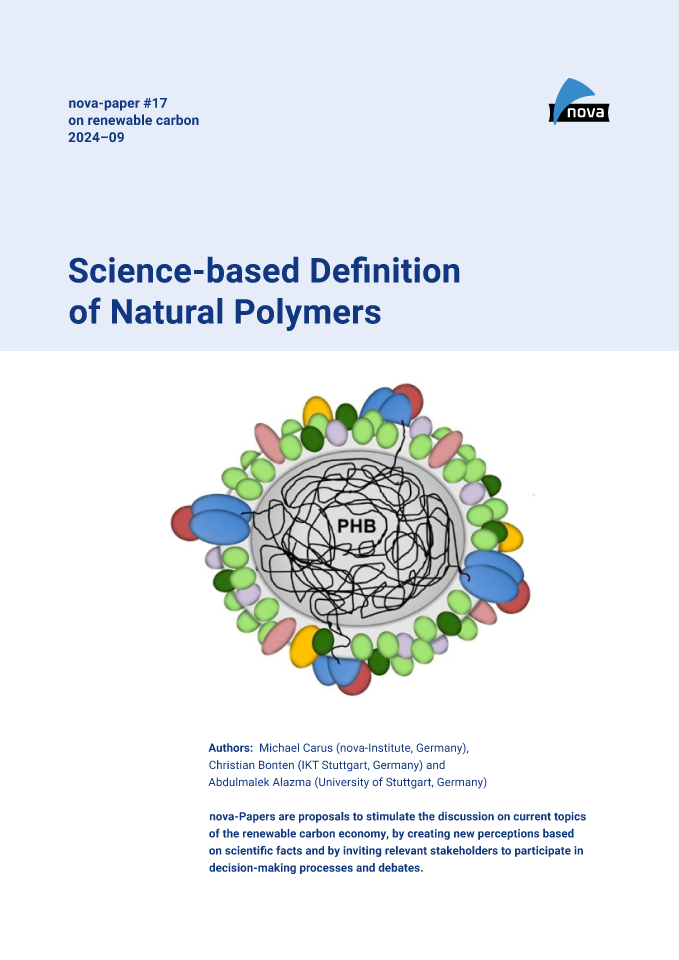
DownloadsEuropean policy has defined „natural polymers“ in a way that has caused much concern and debate among scientists and industry, and has created a barrier to innovation. The authors of this report have carried out a comprehensive scientific evaluation of how the scientific literature defines „natural polymers“, and the result is: The European policy definition is partly in clear contrast to the scientific definitions.
„Occurring in nature“ is the basis for every definition of „natural polymers“ in the scientific literature and in policy. All scientific definitions include biotechnological processes for the production of natural polymers. Not a single definition mentions the place of polymerisation as a criterion – in clear contrast to European policy. Industrial practice confirms this finding: A long list of widely accepted natural polymers includes biotechnologically processed polymers and the place of polymerisation is not a criterion.
Conclusion: A policy definition of „natural polymers“ that is at odds with almost all scientific definitions and at odds with business reality, and which is a major barrier to innovation, green investment and lower carbon footprints, needs to be revised.
The essence of the scientific definitions evaluated in this report is simple and leads to the following proposed definition: „Natural polymers are those that occur in nature, are produced in and extracted from nature, or can be produced identically using biotechnological processes“.DOI No.: https://doi.org/10.52548/UGBZ5516
-
nova-paper #16: The Biomass Utilisation Factor (BUF)
Markets & Economy, Policy, Sustainability & Health
62 Pages
1466 Downloads
1466 Downloads
2022-06
FREE
1466
DownloadsThe Biomass Utilisation Factor (BUF) is a new metric combining cascading use and production efficiency into one indicator to investigate the circularity of materials for the circular bioeconomy. Cascading use captures the repeated use of the original biomass, either for the same or a different purpose. Production efficiency looks at how much of the biomass input is actually transformed into useful products or materials.
The BUF can serve not only as an indicator for the circular economy principle of keeping materials in use, but also act as an efficient tool for stakeholders and policy makers to identify options that maximize biomass utilisation and keep materials in use for longer. In light of recent political developments in Europe, the BUF can serve as a tool that provides additional insights for achieving sustainable carbon cycles or help to respect the cascading principle of biomass utilisation.
-
nova-paper #15: A Tax on Fossil Carbon is More Effective Than a Tax on CO2 Emissions
Policy
12 Pages
723 Downloads
723 Downloads
2021-06
FREE
723
DownloadsThis paper describes a fossil carbon tax as a potential realisation of the planned Carbon Border Adjustment Mechanism of the EU. It provides several advantages compared to a CO2 emission tax, such as complexity, carbon leakage, eligibility to WTO rules or taxation coverage of all sectors in the economy. With its focus on the raw material aspect, it is a much simpler and elegant approach than an end-of-pipe solution that looks at CO2 emissions.
-
nova-paper #13: Bio-based products: Green premium prices and consumer perception of different biomass feedstocks
Markets & Economy
30 Pages
2080 Downloads
2080 Downloads
2020-12
FREE
Plus 19% MwSt.2080
Downloads -
Highlights of in-depth psychological market research on bio-based products
Markets & Economy
193 Downloads
193 Downloads
2020-11
FREE
Free Shipping193
DownloadsIn recent years, numerous B2C online surveys and focus group analyses have been conducted to understand what consumers think of bio-based products. It is well known, however, that other methods such as in-depth psychological interviews are better suited to explore deep-seated opinions, prejudices and contexts. This gap is being filled now by the novel approach used in this project. Instead of conducting the umpteenth standard survey, nova-Institute used the expertise of the renowned specialist market research company september Strategie & Forschung (Cologne, Germany) to gather the information needed about the consumer mind set. september is one of Germany’s market leaders in deep psychological market research.
-
nova-Paper #14: Are new food and biomass technologies more sustainable? A review − Full version
Sustainability & Health
22 Pages
631 Downloads
631 Downloads
2020-11
FREE
631
Downloads -
nova-paper #13: Bio-based products: Green premium prices and consumer perception of different biomass feedstocks − Article in bioplastics MAGAZINE
Markets & Economy
2 Pages
497 Downloads
497 Downloads
2020-10
FREE
497
Downloads -
nova-Paper #12: Renewable Carbon – Key to a Sustainable and Future-oriented Chemical and Plastic Industry − Full version
Policy
25 Pages
4963 Downloads
4963 Downloads
2020-09
FREE
4963
Downloads -
nova-Paper #11: Hitchhiker’s Guide to Carbon Capture Utilisation (CCU) − Full version
Technology
24 Pages
1940 Downloads
1940 Downloads
2019-02
FREE
1940
Downloads -
nova-Paper #10: Renewable Carbon is Key to a Sustainable and Future-Oriented Chemical Industry − Full version
Markets & Economy, Policy
11 Pages
2191 Downloads
2191 Downloads
2018-08
FREE
2191
Downloads -
nova-Paper #10: Renewable Carbon is Key to a Sustainable and Future-Oriented Chemical Industry − Langfassung
Markets & Economy, Policy
11 Pages
1085 Downloads
1085 Downloads
2018-08
FREE
1085
Downloads -
nova-Paper #10: Renewable Carbon is Key to a Sustainable and Future-Oriented Chemical Industry − Graphic
Markets & Economy
586 Downloads
586 Downloads
2018-08
FREE
586
Downloads -
nova-Paper #9: The “Circular Bioeconomy” – Concepts, Opportunities and Limitations − Full version
Policy
9 Pages
6998 Downloads
6998 Downloads
2018-01
FREE
6998
Downloads -
nova-Paper #5 on bio-based economy: “New Methodology for Techno-Economic Evaluations of Innovative Industrial Processes by nova-Institute (nTEE)” − Full version
Markets & Economy
14 Pages
1940 Downloads
1940 Downloads
2016-04
FREE
1940
Downloads


![nova-paper #13: Bio-based products: Green premium prices and consumer perception of different biomass feedstocks [Digital]](https://renewable-carbon.eu/publications/wp-content/uploads/2020/12/novapaper13-100x141.png)