Showing 81–100 of 460
-
Alternative Naphtha – Technologies and Market, Status and Outlook (PDF)
Markets & Economy, Technology
188 Pages
2024-07
2,500 € – 9,000 €Price range: 2,500 € through 9,000 € ex. tax
Plus 19% MwSt.Select
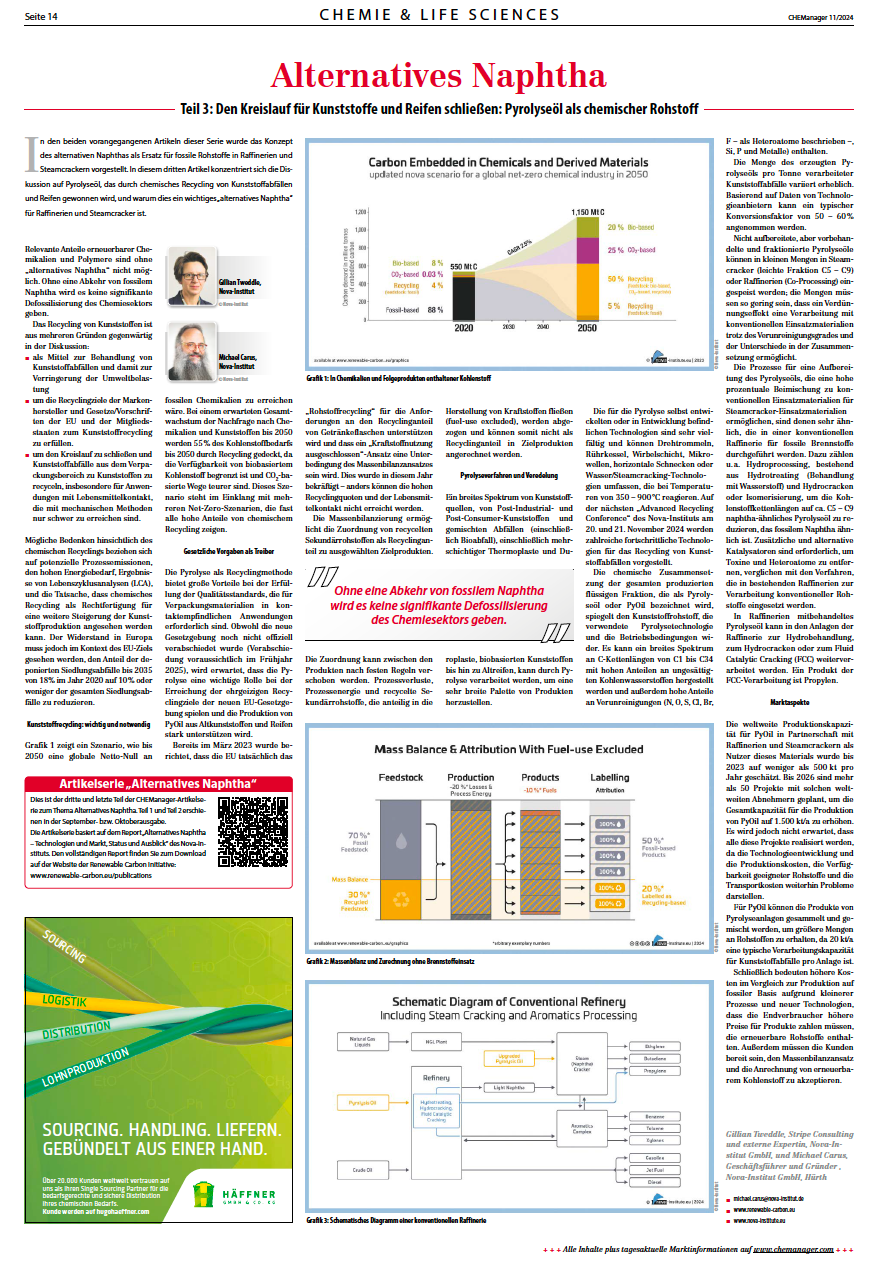
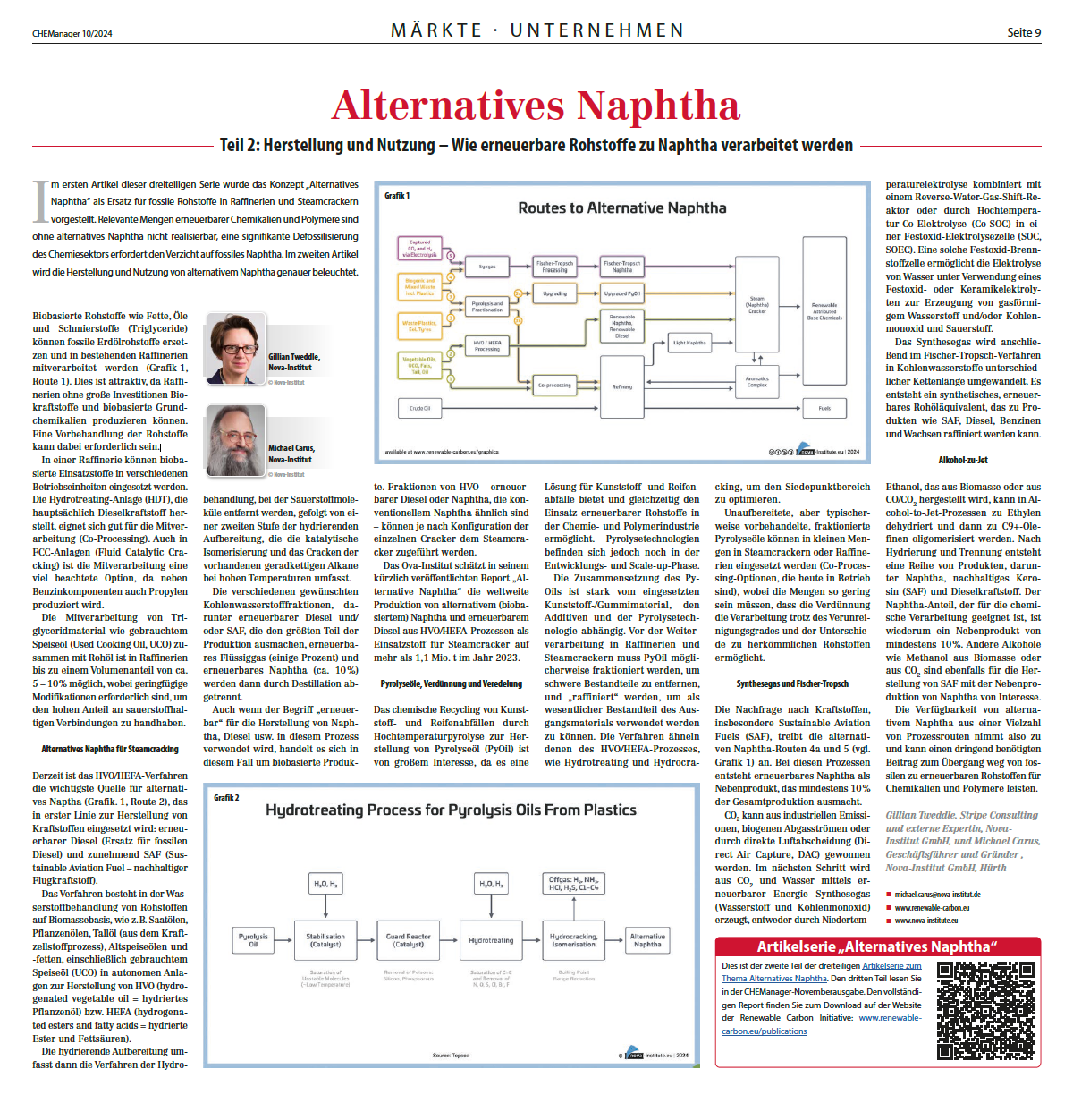
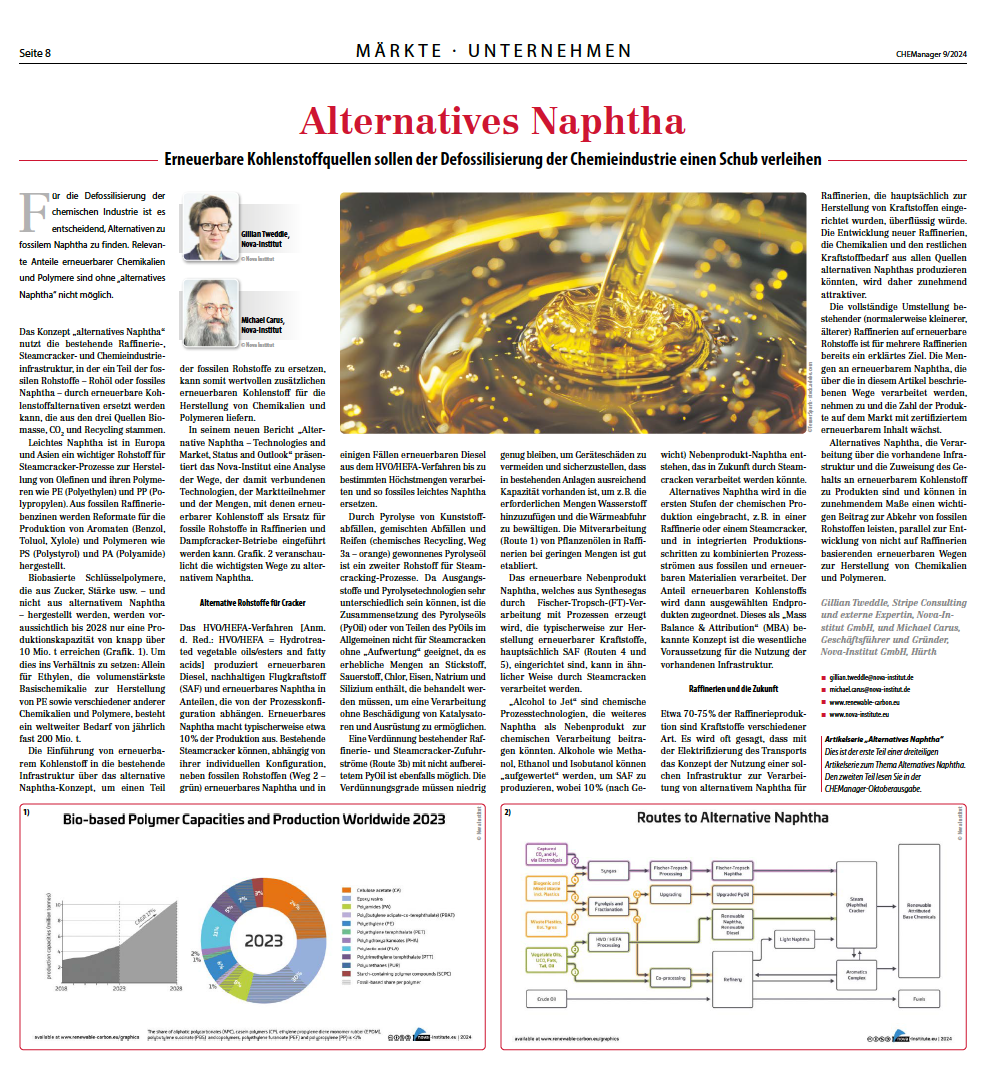
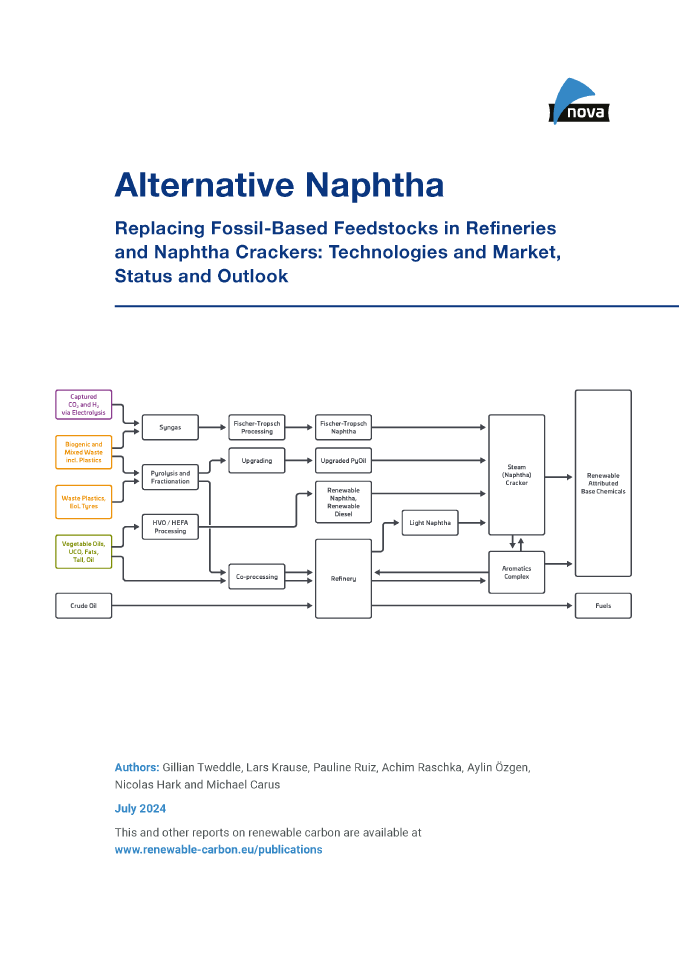
licenceFor the defossilisation of the chemical industry, it is crucial to find alternatives to fossil-based naphtha. The “alternative naphtha” concept makes use of existing refinery, steam cracking and chemical industry infrastructure where a proportion of fossil-based feedstocks – crude oil or fossil-based naphthas can be replaced by renewable carbon alternatives derived from the three sources of renewable carbon: CO2, biomass and recycling.
This new report by nova-Institute presents an analysis of the routes, associated technologies, market players and volumes by which renewable carbon can be introduced to refinery and steam cracking operations as replacement for fossil based feedstocks.
With 188 pages, 22 tables and illustrated by 48 graphics the report provides a comprehensive view on the growth in capacity for these alternative sources of naphtha as chemical industry feedstock, production routes and the need for “upgrading”, key companies and partnerships and the regulatory environment.
DOI No.: https://doi.org/10.52548/JICP8041
-
Alternative Naphtha – Technologies and Market, Status and Outlook (PDF) – Short Version
Markets & Economy, Technology
20 Pages
1163 Downloads
1163 Downloads
2024-07
FREE
1163
DownloadsFor the defossilisation of the chemical industry, it is crucial to find alternatives to fossil-based naphtha. The “alternative naphtha” concept makes use of existing refinery, steam cracking and chemical industry infrastructure where a proportion of fossil-based feedstocks – crude oil or fossil-based naphthas can be replaced by renewable carbon alternatives derived from the three sources of renewable carbon: CO2, biomass and recycling.
This new report by nova-Institute presents an analysis of the routes, associated technologies, market players and volumes by which renewable carbon can be introduced to refinery and steam cracking operations as replacement for fossil based feedstocks.
With 188 pages, 22 tables and illustrated by 48 graphics the report provides a comprehensive view on the growth in capacity for these alternative sources of naphtha as chemical industry feedstock, production routes and the need for “upgrading”, key companies and partnerships and the regulatory environment.
DOI No.: https://doi.org/10.52548/JICP8041
-
RCI’s position paper: “Towards an ambitious Industrial Carbon Management for the EU – A Call for Speedy and Coherent Implementation of Policy Measures (PDF)”
Markets & Economy, Policy, Sustainability & Health
3 Pages
496 Downloads
496 Downloads
2024-07
FREE
496
DownloadsThe Renewable Carbon Initiative’s position paper emphasizes the need for a comprehensive industrial carbon management strategy in the EU that goes beyond CO2 emissions to include all carbon sources, promoting the use of renewable carbon from biomass, CCU, and recycling. It calls for the establishment of a regulatory framework with specific sub-targets and incentives by 2025 to accelerate the adoption of circular carbon technologies and reduce dependence on fossil feedstocks. The paper argues that recognising carbon as a raw material is essential for achieving sustainable carbon cycles and meeting the EU’s climate neutrality goals by 2050.
-
Joint Statement PEF TAB – biogenic carbon modelling (PDF)
Markets & Economy, Policy, Sustainability & Health
4 Pages
498 Downloads
498 Downloads
2024-06
FREE
498
DownloadsThe RCI along with the organisations APAG Oleochemicals Europe, Bio-based Industries Consortium, BioChem Europe, EuropaBio, GO!PHA, IKT Kunststofftechnik Stuttgart and Plastics Europe submitted this Joint Statement to the members of the Technical Advisory Boyard of the Product Environmental Footprint (PEF TAB). The purpose of this submission is to address the ongoing discussions on carbon modelling in the EF, which have been frequently discussed in recent PEF TAB meetings. With this joint statement we advocate for enabling -1/+1 accounting of biogenic and atmospheric carbon in the LCA methodology.
-
Renewable Materials Conference 2024 (Proceedings, PDF)
Markets & Economy, Policy, Sustainability & Health, Technology
2024-06
200 € ex. tax
Plus 19% MwSt.Press
release Add to
cartThe proceedings of the Renewable Materials Conference 2024 (11-13 June 2024, https://renewable-materials.eu) contain all released presentations, the conference journal, and the press release of the three winners of the Innovation Award “Renewable Material of the Year 2024″.
-
Mass Balance & Attribution With Fuel-use Excluded (PNG)
Markets & Economy, Policy, Sustainability & Health, Technology
1 Page
285 Downloads
285 Downloads
2024-06
FREE
285
DownloadsThe graphic shows the approach of mass balance and attribution with fuel-use excluded which allows to track the fossil and recycled share of feedstock. The recycled content can be attributed to products after deducting lossess and proess energy during production and, if applicable, produced energy carriers (fuel-use excluded). This approach ensures that a transparent amount of fossil feedstock is replaced by recycled feedstock in the production process and that only recycled feedstock that actually ends up in products can be attributed.
-
Ein Plädoyer für Carbon Capture and Utilisation – Carbon Capture and Utilisation ist viel mehr als nur eine Technologie zur Entnahme von Kohlenstoffdioxid (PDF)
Markets & Economy, Policy, Sustainability & Health
4 Pages
400 Downloads
400 Downloads
2024-06
FREE
400
DownloadsZur Eindämmung des Klimawandels ist eine drastische Reduzierung fossiler Kohlenstoffemissionen erforderlich. Während Energie- und Verkehrssysteme dekarbonisiert werden können, benötigen Chemie- und Werkstoffsektoren Kohlenstoff als Rohstoff. Diese Sektoren sollten auf erneuerbaren Kohlenstoff aus Biomasse, CCU und Recycling umsteigen, wie von der Renewable Carbon Initiative (RCI) gefördert.
CCU bietet zahlreiche Vorteile, darunter die Defossilisierung der Industrie und die Reduzierung der Treibhausgasemissionen.
Trotz ihrer Bedeutung wird CCU politisch noch nicht ausreichend anerkannt. Eine stärkere Unterstützung und der Einsatz erneuerbarer Energien sind notwendig, um CCU als Schlüssel- technologie für eine nachhaltige Zukunft zu etablieren.
Weitere Informationen:
https://www.chemanager-online.com/news/ein-plaedoyer-fuer-carbon-capture-and-utilisation
-
Call for Member States to support an EU Sustainable Carbon Policy Package as a part of a future green EU Industrial Deal (PDF)
Markets & Economy, Policy, Sustainability & Health
2 Pages
417 Downloads
417 Downloads
2024-05
FREE
Free Shipping417
DownloadsThe signatories of this proposal urge Member States to support the EU Sustainable Carbon Policy Package for the 2024-2029 term of the European Commission.
The Netherlands, the Czech Republic, France, and Ireland are advocating for an EU Sustainable Carbon Policy Package to transition the chemicals sector from fossil carbon to sustainable sources. This proposal, to be discussed at the Competitiveness Council on May 24, aims to enhance EU competitiveness, achieve climate targets, and secure raw material supplies by developing sustainable carbon markets and promoting innovative technologies. The initiative aligns with the Antwerp Declaration, the Enrico Letta Report, and the European Council Conclusions, and seeks to support job creation, industry growth, and climate neutrality.
-
Bio-based and Biodegradable Plastics Industries in China – Short Version (PDF)
Markets & Economy, Policy, Sustainability & Health
14 Pages
1214 Downloads
1214 Downloads
2024-05
FREE
1214
DownloadsChina has emerged as a global leader in strategic technologies such as 5G, renewable energy, and electric vehicles in the past two decades. This dominance may leave European companies impressed and concerned about competition while also sparking curiosity about China’s leapfrogging advancement in these areas.
Paving the way to a net-zero chemical industry in 2060, using renewable biomass to produce bio-based chemicals has been one of the promising transitional solutions for the global chemical industry. As China and Europe strive to follow this path, a similar question may exist within the European chemical industry: What is the status of the bio-based industry in China? Can China and Europe find a cooperative and win-win way to develop this industry?
-
Bio-based and Biodegradable Plastics Industries in China (PDF)
Markets & Economy, Policy, Sustainability & Health
71 Pages
2024-05
1,500 € – 8,000 €Price range: 1,500 € through 8,000 € ex. tax
Plus 19% MwSt.Press
release Select
licenceChina has emerged as a global leader in strategic technologies such as 5G, renewable energy, and electric vehicles in the past two decades. This dominance may leave European companies impressed and concerned about competition while also sparking curiosity about China’s leapfrogging advancement in these areas.
Paving the way to a net-zero chemical industry in 2060, using renewable biomass to produce bio-based chemicals has been one of the promising transitional solutions for the global chemical industry. As China and Europe strive to follow this path, a similar question may exist within the European chemical industry: What is the status of the bio-based industry in China? Can China and Europe find a cooperative and win-win way to develop this industry?
-
Bioplastics Production Capacity in China 2019–2026 – Graphic (PNG)
Markets & Economy, Policy, Sustainability & Health
1 Page
47 Downloads
47 Downloads
2024-05
FREE
47
Downloads -
Biodegradable Plastics PLA and PBAT Production Capacity 2021-2025 – Graphic (PNG)
Markets & Economy, Policy, Sustainability & Health
1 Page
39 Downloads
39 Downloads
2024-05
FREE
39
Downloads -
RCI Position Paper on Chemical and Physical Recycling (PDF)
Policy, Technology
4 Pages
979 Downloads
979 Downloads
2024-05
FREE
Free Shipping979
DownloadsIn this position paper, the RCI describes that chemical and physical recycling play essential roles in realising the objectives of the Green Deal and advancing the circular economy. These technologies are indispensable for the green transition.
This position paper identifies eleven requirements to create secure demand, drive investment and further improve the technology field. These include general acceptance of the technology; mandatory recycled content for all polymers/plastics in all applications; recognition and clarification of rules for the calculation of recycling rates; full acceptance of mass balance & attribution with fuel-use excluded; accelerated approval of new chemical and physical recycling facilities; expansion of recycling infrastructure for all sectors beyond packaging; and the extension of CO2 pricing for waste incineration in the ETS combined with a landfill ban.
Additionally, RCI advocates for a pragmatic approach, emphasising that while closed-loop recycling is a noble goal for sectors such as packaging, textiles and automobiles, it should not be approached too dogmatically. Flexibility is essential to prevent environmental and economic inefficiencies. If the waste stream of one sector can be better used in another, this should be possible.
-
Renewable Carbon Initiative (RCI) Webinar slides – April 2024 (PDF)
Markets & Economy, Policy, Technology
43 Pages
208 Downloads
208 Downloads
2024-05
FREE
Free Shipping208
DownloadsThis document contains a generic set of slides to introduce the concept of renewable carbon and the Renewable Carbon Initiative. The focus of this webinar was the upcoming position paper on Chemical and Physical Recycling.
-
CO2-based Fuels and Chemicals Conference 2024 (Proceedings, PDF)
Markets & Economy, Policy, Sustainability & Health, Technology
2024-05
50 € ex. tax
Plus 19% MwSt.Press
release Add to
cartThe proceedings of the CO2-based Fuels and Chemicals Conference 2024 (17-18 April 2024, https://co2-chemistry.eu) contain all released presentations, the conference journal, and the press release of the three winners of the Innovation Award “Best CO2 Utilisation 2024″.
-
Advanced Recycling erwartet rasanten globalen und europäischen Wachstumstrend (PDF)
Markets & Economy
3 Pages
173 Downloads
173 Downloads
2024-04
FREE
173
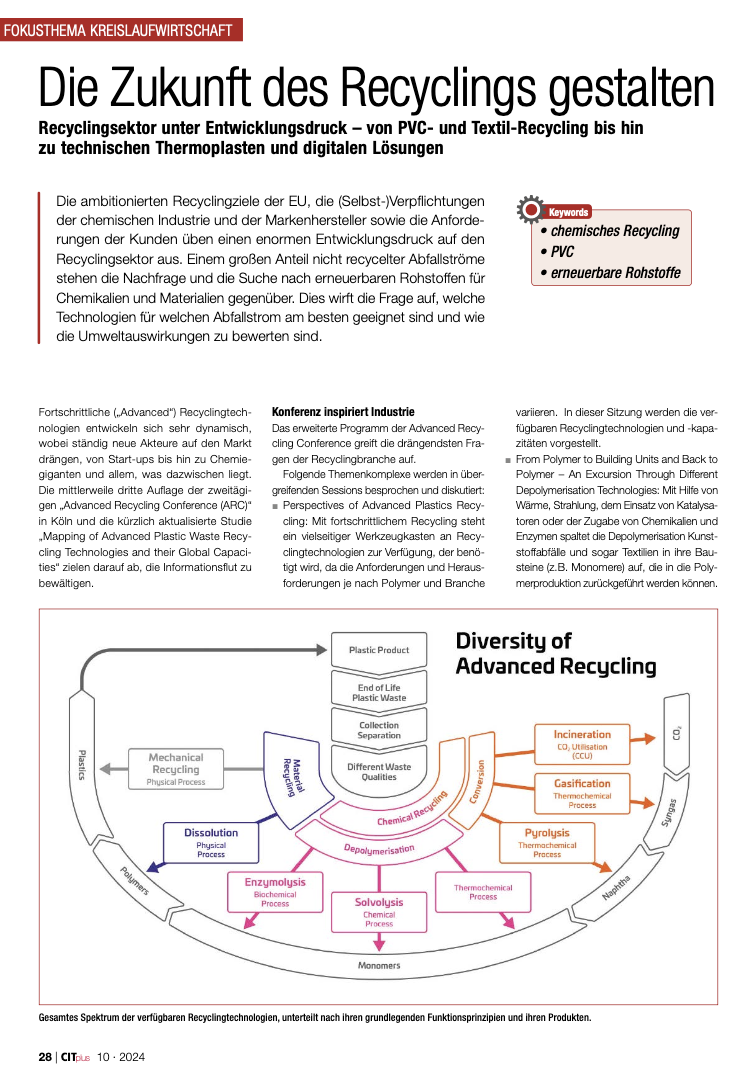
DownloadsDer neue Bericht „Mapping of advanced plastic waste recycling technologies and their global capacities“ bietet einen strukturierten und umfassenden Überblick rund um das Thema Advanced Recycling. Das aktuelle Update präsentiert die verfügbaren Advanced Recycling Technologien sowie Vor- und Nachbereitungstechnologien in mehr als 130 Unternehmensprofilen. Die Unternehmensprofile aus dem vorherigen Bericht wurden überarbeitet, für das Jahr 2023 aktualisiert, und um neue Profile ergänzt.
Quelle: Advanced Recycling erwartet rasanten globalen und europäischen Wachstumstrend – aus kunststoffland NRW report 01/2024, 26-28
-
Cellulose Fibres Conference 2024 (Proceedings, PDF)
Markets & Economy, Policy, Sustainability & Health, Technology
2024-04
50 € ex. tax
Plus 19% MwSt.Press
release Add to
cartThe conference covered the entire value chain, from lignocellulose, chemical pulp, cellulose fibres such as rayon, viscose, modal or lyocell and new developments to a wide range of applications:
Textiles from renewable fibres, non-wovens such as wet wipes as well as new areas such as composites, hygiene, packaging or nanocellulose in the food industry. The conference offered deep insights into the promising future of cellulose fibres, which perfectly fits the current trends of circular economy, recycling and sustainable carbon cycles.The Cellulose Fibres Conference Proceedings (https://cellulose-fibres.eu, 13-14 March 2024, Cologne, hybrid) include all released conference presentations, the conference journal, sponsor documents, a Fiber2Fashion Knowledgepaper and the conference press release.
-
Bio-based Building Blocks and Polymers – Global Capacities, Production and Trends 2023–2028 – Short Version (PDF)
Markets & Economy
28 Pages
2439 Downloads
2439 Downloads
2024-03
FREE
2439
DownloadsNew report released on the global bio‑based polymer market 2023 – a deep and comprehensive insight into a dynamically growing market
The year 2023 was a promising year for bio‑based polymers: PLA capacities have been increased by almost 50 %, and at the same time polyamide capacities are steadily increasing, as well as epoxy resin production. Capacities for 100 % bio-based PE have been expanded and PE and PP made from bio‑based naphtha are being further established with growing volumes. Current and future expansions for PHAs are still on the horizon. After hinting at a comeback in 2022 bio-based PET production dropped in 2023 by 50 %.
DOI No.: https://doi.org/10.52548/VXTH2416
-
Schematic Differentiation of Pathways of Drop-in, Smart Drop-in and Dedicated Bio-based Chemicals and Polymers (PNG)
Markets & Economy
1 Page
219 Downloads
219 Downloads
2024-03
FREE
219
Downloads -
Bio-based Building Blocks and Polymers – Global Capacities, Production and Trends 2023–2028 (PDF)
Markets & Economy
438 Pages
2024-03
1,000 € – 3,000 €Price range: 1,000 € through 3,000 € ex. tax
Plus 19% MwSt.Select
licenceNew report released on the global bio‑based polymer market 2023 – a deep and comprehensive insight into a dynamically growing market
The year 2023 was a promising year for bio‑based polymers: PLA capacities have been increased by almost 50 %, and at the same time polyamide capacities are steadily increasing, as well as epoxy resin production. Capacities for 100 % bio-based PE have been expanded and PE and PP made from bio‑based naphtha are being further established with growing volumes. Current and future expansions for PHAs are still on the horizon. After hinting at a comeback in 2022 bio-based PET production dropped in 2023 by 50 %.
DOI No.: https://doi.org/10.52548/VXTH2416


![Renewable Materials Conference 2024 (Proceedings, PDF) [Digital]](https://renewable-carbon.eu/publications/wp-content/uploads/2020/05/21-01-07_RC-Publications-Cover-Proceedings_RMC-100x141.png)


![CO2-based Fuels and Chemicals Conference 2024 (Proceedings, PDF) [Digital]](https://renewable-carbon.eu/publications/wp-content/uploads/2020/05/21-01-07_RC-Publications-Cover-Proceedings_CO2-based-100x141.png)

![Cellulose Fibres Conference 2024 (Proceedings, PDF) [Digital]](https://renewable-carbon.eu/publications/wp-content/uploads/2020/05/21-01-07_RC-Publications-Cover-Proceedings_Cellulose-Fibres-100x141.png)