When will CCU go mainstream? (PDF)
FREE
As soon as renewable energy becomes cheap and abundant, which is closer than we think.
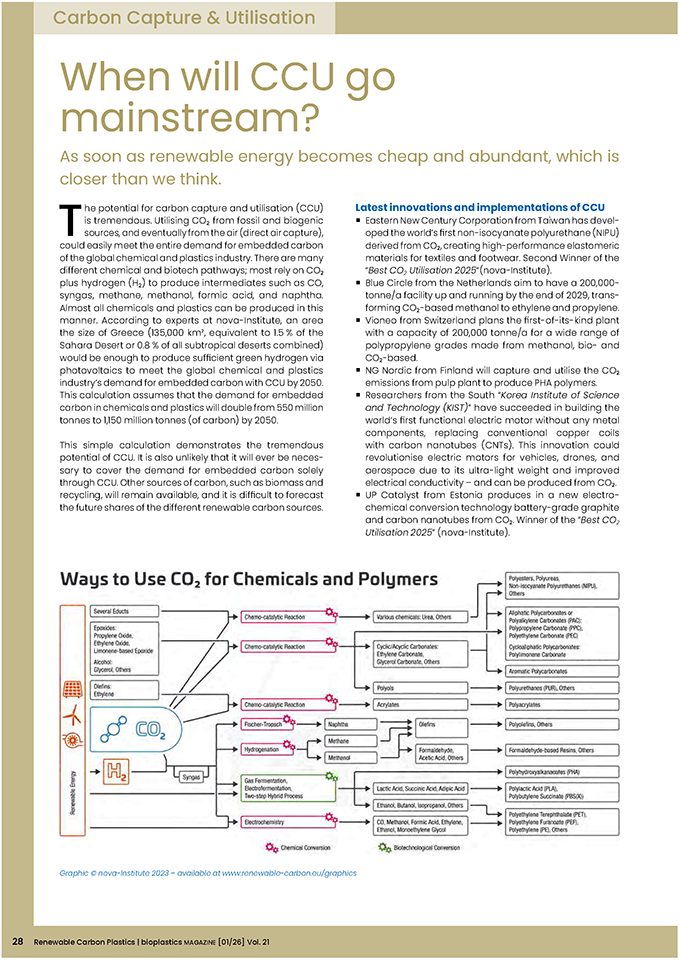
The potential for carbon capture and utilisation (CCU) is tremendous. Utilising CO2 from fossil and biogenic sources, and eventually from the air (direct air capture), could easily meet the entire demand for embedded carbon of the global chemical and plastics industry. There are many different chemical and biotech pathways; most rely on CO2 plus hydrogen (H2) to produce intermediates such as CO, syngas, methane, methanol, formic acid, and naphtha.
Almost all chemicals and plastics can be produced in this manner. According to experts at nova-Institute, an area the size of Greece (135,000 km2, equivalent to 1.5 % of the Sahara Desert or 0.8 % of all subtropical deserts combined) would be enough to produce sufficient green hydrogen via photovoltaics to meet the global chemical and plastics industry’s demand for embedded carbon with CCU by 2050. This calculation assumes that the demand for embedded carbon in chemicals and plastics will double from 550 million tonnes to 1,150 million tonnes (of carbon) by 2050. This simple calculation demonstrates the tremendous potential of CCU.

-
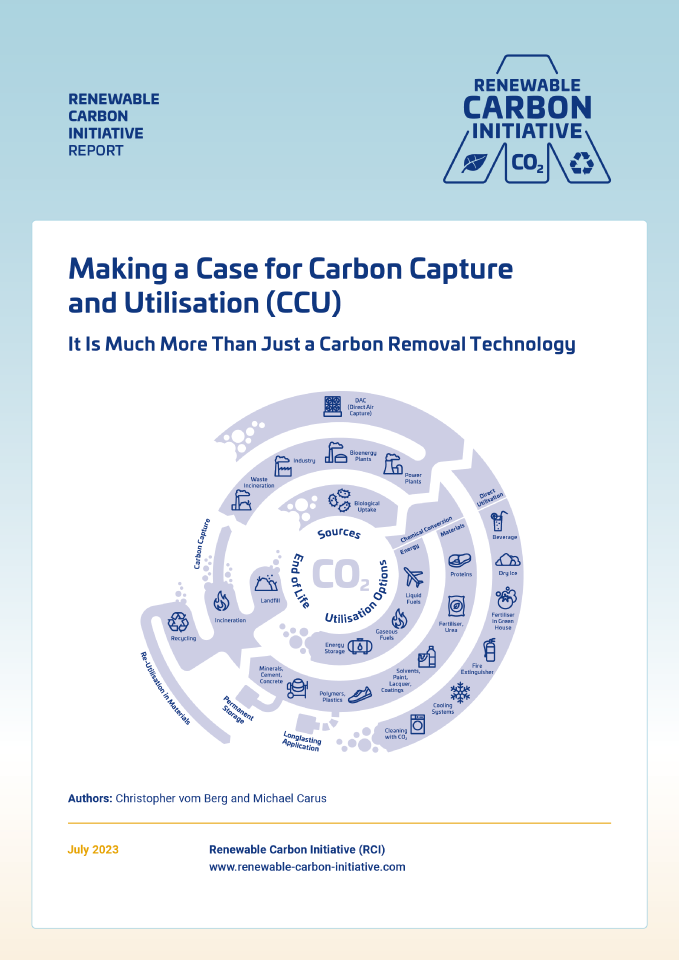
Making a Case for Carbon Capture and Utilisation (CCU): It Is Much More than Just a Carbon Removal Technology” – RCI Report (July 2023)
Markets & Economy, Policy, Sustainability & Health, Technology
48 Pages
2163 Downloads
-
CO2 Reduction Potential of the Chemical Industry Through CCU: A simplified exploratory scenario for CCU-based supply of embedded carbon for the global chemicals and derived materials sector – RCI Report (May 2022)
Sustainability & Health, Technology
28 Pages
1973 Downloads