Industrial-Urban Symbiosis (I-US) enables new business opportunities though the collaboration of diverse stakeholders across various sectors. Hereby, this innovative approach facilitates the exchange of underutilised resources, e.g. by-products, residues, energy, water, capacities, and expertise, keeping materials productive longer. By repurposing outputs as inputs, I-US can minimise resource extraction, cut costs, and advance objectives of the EU Circular Economy Action Plan.
Key criteria of this value creation are aligned stakeholder interest and the exchange of perspectives. Businesses benefit from reduced raw material costs, supply chain resilience, lower disposal expenses, and new revenue opportunities. Meanwhile local authorities and regions can profit from healthier ecosystems, economic vitality, and new job opportunities. These complementary goals drive economic resilience and systemic change towards sustained resource loops, higher recycling rates and enhanced regional sustainability.
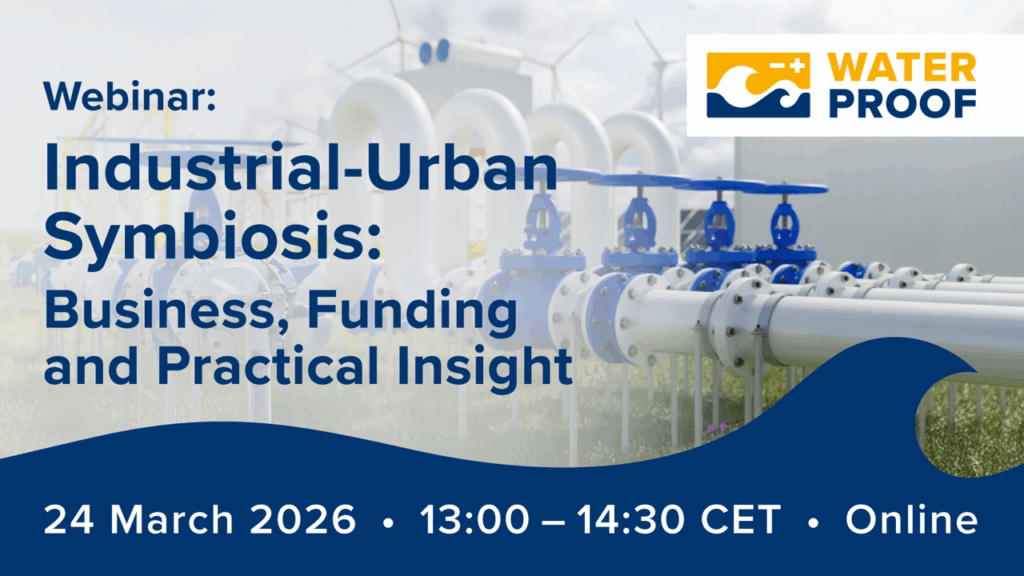
To turn theory into practice, the EU-funded WaterProof project hosts the webinar “Industrial-Urban Symbiosis: Business, Funding, and Practical Insights”. Join on 24 March 2026 from 13:00 to 14:30 CET for targeted strategies and practical insights that will equip industry professionals and practitioners with proven I-US skills.
The EU-funded research project WaterProof implements I-US by developing a cutting-edge CO2 conversion technology . Powered by renewable energy, this unique electrochemical process converts CO₂ captured from wastewater treatment and waste incineration into formic acid. It hereby turns emissions into a sustainable carbon feedstock replacing fossil resources. The generated formic acid will be tested in applications like fish leather tanning and consumer cleaning products as well as the formulation of Formic-derived Acidic Deep Eutectic Solvents (ADES). The project’s synergies perfectly illustrate I-US potentials: Urban CO₂ emissions supply chemical industries. Peroxide by-products treat wastewater contaminated with pesticides, antibiotics, and pharmaceuticals. Formic-derived Acidic Deep Eutectic Solvents (ADES) extract precious metals from ash and sludge, creating closed loop circular systems.
The webinar will feature presentations from leading experts:
Alena Jahns/Mara Wagner (IZES): Introduction to the WaterProof project and Industrial Urban Symbiosis.
James Woodcock (International Synergies Limited & H4C ECoP): Business cases and funding for I-US
Hannes Utikal (Provadis School, Process4Sustainability at Industrial Park Höchst, Frankfurt): Practical example: Industrial Symbiosis collaboration at Höchst Industrial Park.
Eric Schuler (Avantium): Embedding CCU/the volta technology in the I-US context
Funded by the European Union. Views and opinions expressed are however those of the author(s) only and do not necessarily reflect those of the European Union or European Health and Digital Executive Agency. Neither the European Union nor the granting authority can be held responsible for them.

 WaterProof Webinar on Industrial-Urban Symbiosis: Business, Funding, and Practical Insights