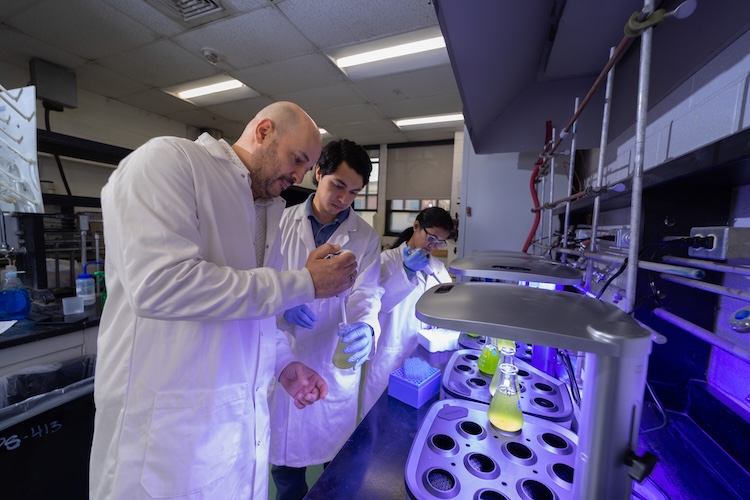
The study, recently published in ACS Applied Bio Materials, focuses on the microalga Chlorella vulgaris, a fast-growing species commonly found in freshwater environments that is used to produce biofuels. Led by Hamidreza Sharifan, Ph.D., assistant professor in UTEP’s Department of Chemistry and Biochemistry, the team showed that controlled doses of zinc oxide (ZnO) nanoparticles can dramatically increase the organism’s lipid content, including the triacylglycerol used to produce biofuels.
Under normal growth conditions, the research team observed C. vulgaris cells contained about 14 percent lipids. But when exposed to moderate concentrations (30–50 mg/L) of synthesized ZnO nanoparticles, the cells increased their lipid content to as much as 48 percent of their mass – more than triple the baseline – without significant harm to the cells.
“Sometimes when people are stressed, they gain weight or, in other words, accumulate more lipids,” Sharifan said. “We found that a similar thing happens to the cells of the microalgae when we induce stress, in our case, by exposing them to zinc oxide nanoparticles, due to the effect of reactive oxygen species.”
The team also observed that higher concentrations of ZnO (above 50 mg/L) caused oxidative damage to the cells, reducing their biofuel potential – highlighting the importance of threshold levels.
In addition to these findings, the researchers developed the Biofuel Suitability Score (BSS) – a new, scalable framework that evaluates and optimizes biofuel production conditions. Sharifan explained that the BSS integrates multiple factors, providing actionable insights to guide future strategies in sustainable energy production.
“This research exemplifies the innovative work our scientists are doing to address global energy challenges,” said Robert Kirken, Ph.D., dean of UTEP’s College of Science. “The team’s work significantly advances our understanding of sustainable bioenergy solutions, setting the stage for impactful environmental applications.”
The research team will now continue to refine their process in hopes of demonstrating its viability at large scale, also possibly using other species of microalgae that can thrive in environments such as wastewater and saltwater.
The study was conducted in collaboration with the Universidad Autónoma de Chihuahua and supported by UTEP’s U.S.-Mexico Collaboration Fellowship and a grant from the USDA’s National Institute of Food and Agriculture.
About The University of Texas at El Paso
The University of Texas at El Paso is America’s leading Hispanic-serving university. Located at the westernmost tip of Texas, where three states and two countries converge along the Rio Grande, 84% of our 25,000 students are Hispanic, and more than half are the first in their families to go to college. UTEP offers 171 bachelor’s, master’s and doctoral degree programs at the only open-access, top-tier research university in America.
Source
The University of Texas at El Paso, press release, 2025-07-24.
Supplier
The University of Texas at El Paso
United States Department of Agriculture’s National Institute of Food and Agriculture
Universidad Autónoma de Chihuahua
Share
Renewable Carbon News – Daily Newsletter
Subscribe to our daily email newsletter – the world's leading newsletter on renewable materials and chemicals