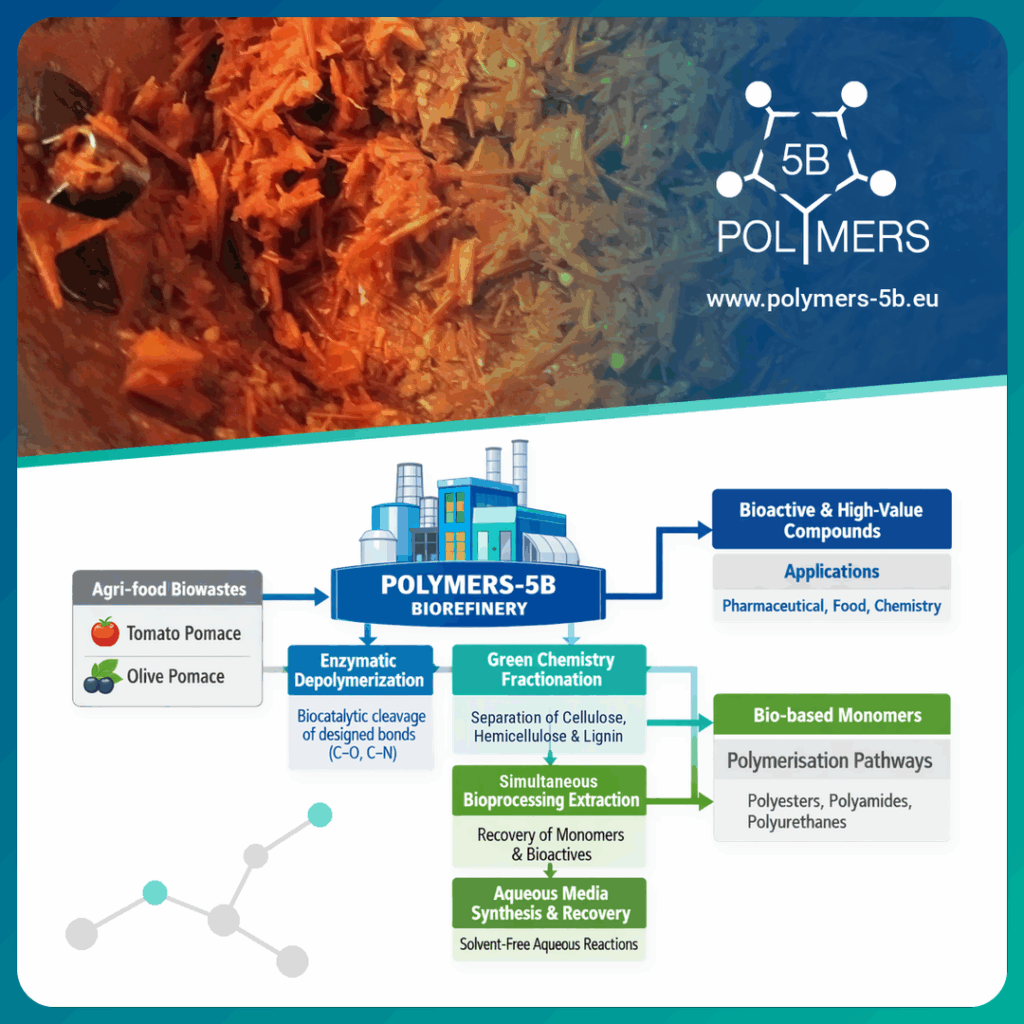
Tomato pomace and olive pomace are generated every year in large volumes across Mediterranean food-processing regions. While these by-products are commonly directed to low-value recovery routes, the European project POLYMERS-5B is developing a cascading enzymatic biorefinery capable of recovering multiple products from the same biomass stream, including natural food ingredients, cosmetic actives and precursors for bio-based plastics. On 3 November at Ecomondo 2026, the consortium will present the latest technical and market results supporting this approach.
One waste stream, four markets
The POLYMERS-5B biorefinery applies an integrated enzymatic cascade that sequentially extracts multiple product families from tomato and olive residues:
- Lycopene for food and nutraceutical applications.
- Hydroxytyrosol-rich antioxidant extracts for cosmetic and wellness markets.
- Pectin for food formulations.
- Monomers and intermediates for high-performance bio-based polyesters.
Unlike conventional approaches that focus on a single product stream, the POLYMERS-5B concept aims to maximise the value recovered from each tonne of biomass through multiple cascading valorisation steps.
“Mediterranean agri-food industries generate significant volumes of tomato and olive residues every season. The core idea behind POLYMERS-5B is to treat these streams as secondary raw materials and recover several valuable products from the same biomass through an integrated biorefinery approach.” – Luis Fonseca, POLYMERS-5B coordinator, IST-ID / iBB.
Bio-based plastics that can take the heat
The project’s polyesters stay rigid up to 80 °C, ten degrees more than a commercial reference material. The next goal is to make them stiffer, to match the rigid bio-based materials already on the market.
“Heat resistance is often where bio-based plastics fall short, and ours already outperform a commercial reference. Once we close the gap on stiffness, these materials can start replacing fossil-based plastics in demanding, structural uses.” – Andrea Jester, Business Developer, NSBproject.
A differentiated model in a growing bioeconomy market
The market analysis performed within POLYMERS-5B with NSBproject’s C-Tech Navigator® platform identified established commercial demand for all major product categories targeted by the project, including lycopene, hydroxytyrosol-based extracts and bio-based materials. The analysis also found no equivalent commercial service currently offering on-site valorisation of tomato and olive pomace directly at large Iberian food-processing facilities.
According to the market assessment, the global lycopene market is estimated at around USD 160 million with annual growth exceeding 5%, while estimates for the hydroxytyrosol market diverge widely across sources and point to a high-value but still emerging niche.
Bringing the biorefinery to the biomass
Rather than transporting large volumes of by-products to distant processing facilities, POLYMERS-5B is investigating an industrial model in which the biorefinery is integrated directly alongside food-processing plants. The approach aims to simplify logistics, increase traceability and support local circular-economy value chains.
The project’s market assessment indicates that the main competitive alternative is not another biorefinery provider but the current destination of the biomass itself, including landfill, low-value recovery routes and conventional pomace processing channels.
“Our analysis shows that all the molecules targeted by POLYMERS-5B are already traded in established markets. What remains largely unavailable is transparent evidence on biomass utilisation, processing economics and delivered costs. We believe that demonstrating these parameters at industrial scale could become a key differentiator for the next generation of circular bioeconomy business models.” – Riccardo Varotto, Project Manager, NSBproject.
More Information
- The paper: “Circular Bioplastics from Mediterranean Waste: High-Performance Polymers via Cascaded Biorefinery and Enzymatic Polycondensation” (L. Fonseca, R. Varotto, A. Jester). Selected through the Ecomondo Call for Papers as one of 27 oral presentations in the “Plastics, bioplastics & textiles” track.
- The session: “Technological solutions for resources recovery from end-of-life products and materials in the Mediterranean landscape”, chaired by Fabrizio Passarini (Ecomondo Scientific Technical Committee, University of Bologna), Lucia Rigamonti (Politecnico di Milano) and ATIA–ISWA.
- Technical data: pilot production campaigns have already produced polyester monomers in reproducible batches of up to 15 kg (TRL 5), with enzyme catalyst reuse. The project’s bio-based polyesters have achieved a glass transition temperature of approximately 80°C, exceeding a commercial thermoset benchmark used for comparison (70°C); elastic modulus about 2 GPa vs 3.2–3.85 GPa for commercial rigid bio-based benchmarks.
- Market analysis highlights: C-Tech Navigator® Technology Positioning analysis (October 2026). Nine industrial and research organisations were benchmarked across four technology families; no dominant provider of on-site valorisation services for tomato and olive pomace was identified in the target market; the main point of differentiation is the integrated enzymatic cascade, combining the recovery of multiple products from the same feedstock.
- Business case: on-site valorisation at the processing plant (tolling model), with zero transport cost for tomato pomace, olive pomace sourced within 25 km, and stored biomass or grape and orange residues covering the months outside the 5–6-month campaigns.
About POLYMERS-5B
POLYMERS-5B (GA 101157840) is a 48-month project (June 2024 – May 2028) funded by the European Union under HORIZON-JU-CBE-2023 and supported by the Circular Bio-based Europe Joint Undertaking and its members. The project is coordinated by IST-ID. More information: www.polymers-5b.eu
About C-Tech Navigator®
C-Tech Navigator® is the proprietary strategic intelligence and decision-support system developed by NSBproject. It combines artificial intelligence with competitive analysis, technology assessment and the direct experience of NSBproject’s experts in research, innovation and technology transfer. By integrating technological, patent, scientific, industrial and market sources, it turns fragmented signals into structured analyses, scenarios and technology roadmaps. Companies, start-ups, research centres and investors use these outputs to make evidence-based R&D and innovation decisions. More information: https://c-technavigator.com/ / https://www.nsbproject.com/
The project 101157840 — POLYMERS-5B — HORIZON-JU-CBE-2023 is funded by the European Union and supported by the Circular Bio-based Europe Joint Undertaking and its members. Views and opinions expressed are however those of the author(s) only and do not necessarily reflect those of the European Union or the CBE JU.
Source
NSB news, press release, 2026-10-28.
Supplier
Circular Bio-based Europe Joint Undertaking (CBE JU)
European Union
Horizon Europe
NSBproject
Share
Renewable Carbon News – Daily Newsletter
Subscribe to our daily email newsletter – the world's leading newsletter on renewable materials and chemicals