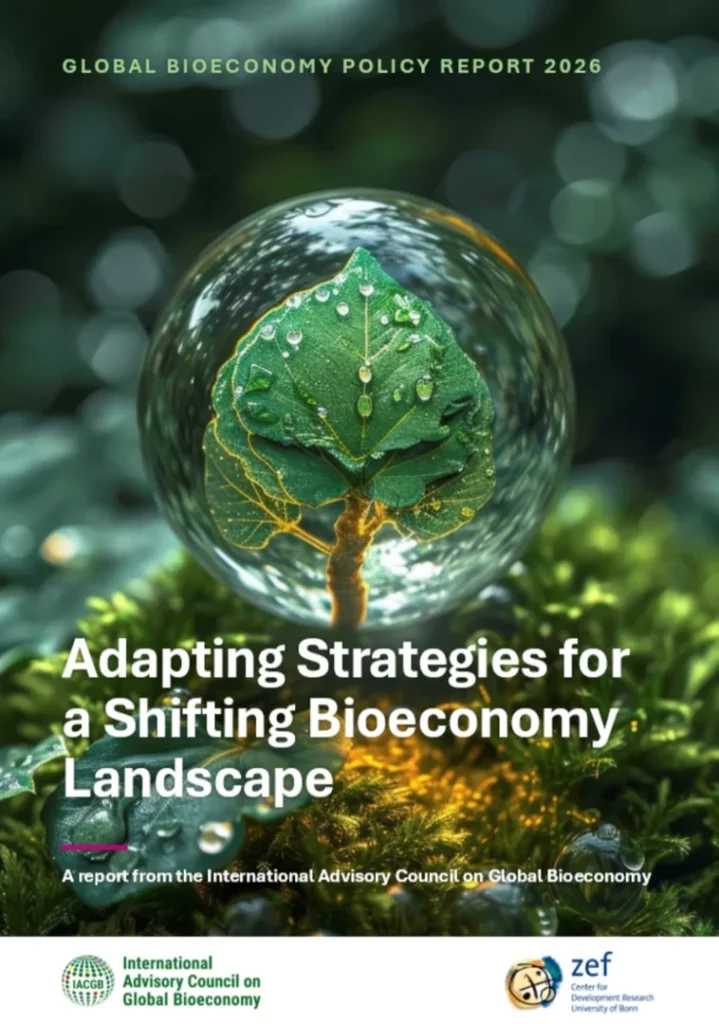
Oil and natural gas still account for the vast majority of the world’s energy and raw materials, with all the associated environmental and biodiversity consequences. The bioeconomy is an approach to overcoming this dependence: instead of using fossil fuels, it uses renewable resources such as plants, microorganisms, and organic waste. The goal is for economic growth to go hand in hand with protecting species, the climate, and soils. The updated edition of the Global Bioeconomy Policy Report 2026, produced by the International Advisory Council on Global Bioeconomy (IACGB), has been launched in Dublin on 20 October. The Global South, in particular, is increasingly recognizing the bioeconomy as a sustainable and equitable economic model.
The summit is the world’s leading conference on the bioeconomy. Researchers from the Center for Development Research (ZEF) and the Institute for Food and Resource Economics (ILR) at the University of Bonn served as lead authors on the global analysis of bioeconomy strategies. The report shows how countries and regions are driving economic transformation toward a bio-based economy that benefits both people and the environment.
Africa and Latin America are gaining momentum
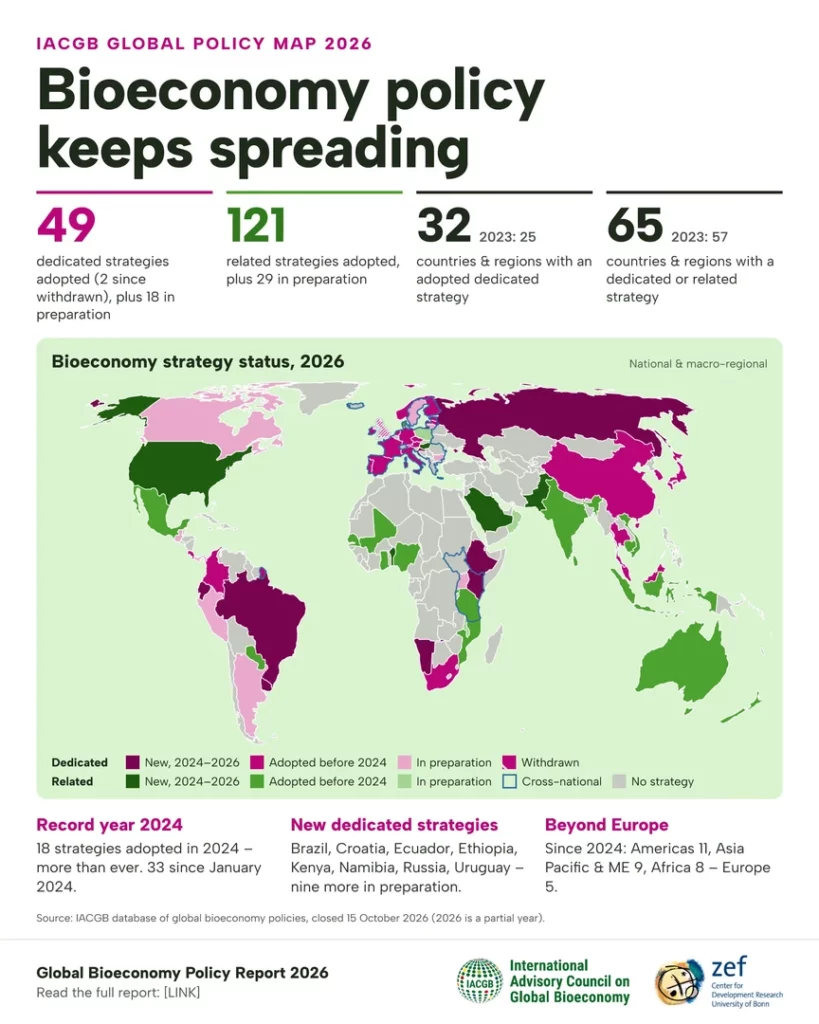
A key finding is that the development of bioeconomy strategies is progressing rapidly, with 63 countries and regions now having adopted such measures. The Global South, in particular, is increasingly recognizing the bioeconomy as a sustainable and equitable economic model. New national strategies in Namibia, Ethiopia and Kenya demonstrate Africa’s growing leadership role. Latin America has also strengthened its position through the strategies adopted by Brazil, Uruguay and Ecuador.
Alongside these national measures, international cooperation has evolved too, as evidenced by the first multilateral document on the bioeconomy. During Brazil’s G20 presidency, countries agreed upon the “10 High-Level Principles on the Bioeconomy”.
Diverse Visions, Shared Challenges
The strategies set out different priorities for achieving a sustainable bioeconomy, ranging from bioresources (34%) and biotechnology (32%) to bioecology (20%) and biosocial goals (14%). The growing share of biosocial approaches signals an increased focus on social inclusion and community benefits.
Competitiveness and sustainability must go hand in hand
Geoeconomic competition and the new multipolar world order are driving the strategic development of the bioeconomy. Alongside sustainability and equity, security and competition are becoming increasingly important, including biotechnology-based defense. The report calls for policy measures that reconcile economic opportunities with the protection of biodiversity, the sustainable use of resources, and inclusive development.
Funding and coordination remain crucial
Despite growing political ambition, implementation gaps persist. While 94% of strategies refer to public research and development, only 47% allocate a dedicated budget for this purpose.
‘To turn strategies into results, it is important to mobilize private capital for bio-based value creation and strengthen accountability,’ explains Dr Gideon Tups, one of the lead authors from ZEF.
The authors view the bioeconomy as a key pathway for transforming future economic systems. A shared global vision could ensure the bioeconomy promotes climate protection, biodiversity, economic resilience and social well-being.
About the IACGB
The International Advisory Council on the Global Bioeconomy (IACGB) monitors global policy developments in the bioeconomy sector and encourages dialogue and collaboration to facilitate the transition to a sustainable bioeconomy worldwide. Since launching its report series in 2015, the IACGB has documented 217 policy documents from 74 countries and macroregions, including 67 specific bioeconomy strategies and 150 related policy measures. The momentum is growing: Since January 2024, 44 documents have been published, making 2024 the most active year on record since the series began.
The report was written by researchers from the University of Bonn (Dr Gideon Tups (ZEF), Prof Dr Jan Börner (ZEF/ILR), Daniel Braun (ZEF) and Thao Dao (ILR)) and the University of Münster (Prof Dr Thomas Dietz). Forty-six members of the IACGB and other regional experts contributed as co-authors.
This report has been funded by the German Federal Ministry of Agriculture, Food and Regional Identity (by resolution of the German Bundestag) through the programme “Nachhaltige Erneuerbare Ressourcen” of the Fachagentur Nachwachsende Rohstoffe e.V. (FNR).
Publication
Tups, G., Dao, T., Braun, D., Börner, J., Dietz, T., Ait Kadi, M., Alvarado Vargas, J., Birner, R., Bogdanski, A., Chavarría, H., Cranston, E., Del Hierro Calvachi, A., Domke Venegas, N., Durham, B., Ecuru, J., Fahmi, A., Fava, F., Garcia Caffaro, I., Greimel, M., Huertas, C., Kengran, L. V., Kirtikara, K., Kitney, R., Lang, C., Leip, A., Li, Y., Liebeton, J., MacRae, E., Maxon, M., Mizunashi, W., Mungeyi, P., Ní Choncubhair, Ó., O’Hara, I., Patermann, C., Pittaluga, L., Popov, V., Ramirez, J., Regúnaga, M., Rodríguez, A., Schurr, U., Shifeta, B., Shiraishi, K., Shitalangaho, A. I., Ssendagala, G. W., Tavakoli, O., Tibazarwa, F. I., Trigo, E., van Paddenburg, A., Vargas, D., Virgin, I., von Braun, J., & Wehrheim, P. (2026). Global Bioeconomy Policy Report 2026: Adapting Strategies for a Shifting Bioeconomy Landscape. International Advisory Council on Global Bioeconomy (IACGB). https://www.iacgb.net/lw_resource/datapool/systemfiles/elements/files/2e27a1ca-cb88-11f1-a776-dead53a91d31/live/document/IACGB-GlobalPolicyReport-2026.pdf
Contact
Dr. Gideon Tups
Center for Development Research, University of Bonn
Email: gtups@uni-bonn.de
Source
Universität Bonn, press release, 2026-10-19.
Supplier
Bundesministerium für Landwirtschaft, Ernährung und Heimat (BMLEH) (formerly BMEL)
Fachagentur Nachwachsende Rohstoffe e.V. (FNR)
Institute for Food and Resource Economics (ILR) (Universität Bonn)
International Advisory Council on Global Bioeconomy (IACGB - Asia-Pacific)
Universität Bonn
Westfälische Wilhelms-Universität (WWU) Münster
Zentrum für Entwicklungsforschung (ZEF)
Share
Renewable Carbon News – Daily Newsletter
Subscribe to our daily email newsletter – the world's leading newsletter on renewable materials and chemicals