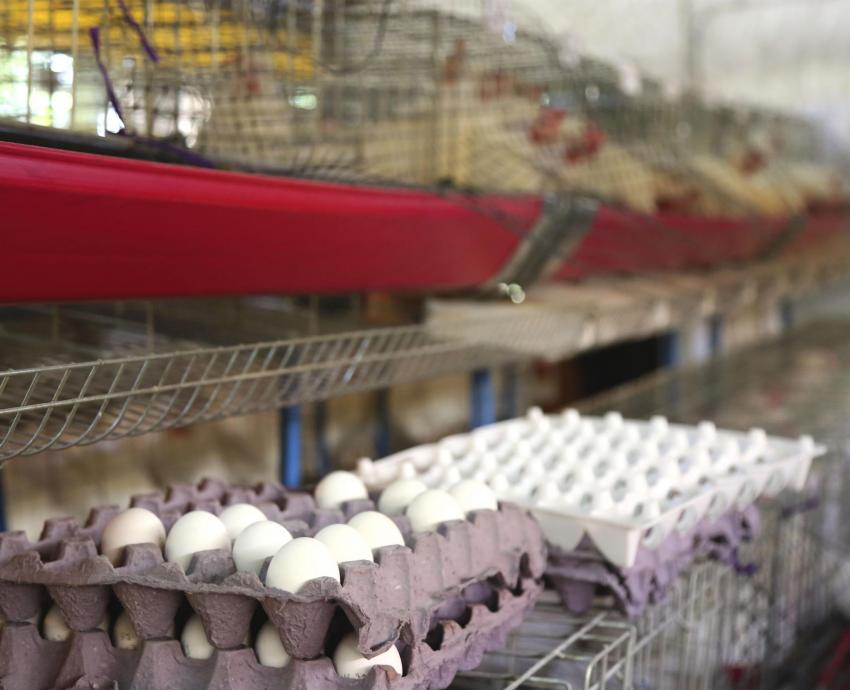
Eggshells are the raw material that two students from the University Center of Los Altos (CUAltos) are using to manufacture eco-friendly plastic as part of the Polei project. The resulting material could be used to make biodegradable flowerpots, plates, cups, and disposable cutlery, reported Luis Enrique Angulo Orozco, a tenth-semester student of Veterinary Medicine and Animal Science.
The pots can be used in greenhouses or nurseries, and when a plant is sold, the buyer can transplant it with the pot still in place, since the bioplastic also works as an organic fertilizer; in addition, it will begin to biodegrade when the roots are buried.
Bioplastic production is inexpensive, as a viable portion for making a disposable plate costs around 70 cents when produced at home. What students Orozco Angulo and Katia García Íñiguez—who is also in her tenth semester of Veterinary Medicine and Animal Science—want is to industrialize the process and make it more efficient to further reduce production costs.
The plastic produced by the students is a combination of five ingredients, including eggshells, which provide firmness and greater biodegradability. Depending on the mixtures, a more moldable material, like foam paper, or a firmer one can be achieved.
Bioplastic can biodegrade in less than two weeks, and when the consistency is firmer, it begins to do so after three months, reported Angulo Orozco, who added that it can also biodegrade in an aqueous medium.
The product can be comparable in resistance and strength to polystyrene, although it is sensitive to heat, characteristics that will be corrected to slow down the degradation process in the face of temperature changes by using ecological protectors.
The production of this biodegradable material is important in a context where around 300 million tons of plastic are produced globally; of which eight million end up polluting seas and oceans. If current trends continue, by 2050 there will be 30 tons of plastic per person in the world, which is alarming, he said, adding that less than 30 percent of the plastic used is recycled.
According to the United Nations Environment Programme, the invasion of seas and oceans by plastic is one of the planet’s major environmental problems.
The Polei project began as an idea two years ago, stemming from the International Egg Fair held annually in Tepatitlán, as the Los Altos region of Jalisco is considered one of the country’s main egg-producing areas. Jalisco’s poultry sector contributes 55 percent of Mexico’s table egg production.
“We listened to a lecture on how plastic could be made from the inner membrane of the eggshell, and from there we started to learn more. I looked for literature, and we tried to use the whole eggshell, since it is very difficult to remove the inner membrane, and we obtained good results, since we can obtain bioplastic with a firmer consistency and greater biodegradability,” Angulo Orozco said.
In Los Altos, there are egg pasteurization plants and bakeries. Therefore, there is ample opportunity to supply raw materials to the students, who are interested in acquiring suitable machinery and funding for their project. By achieving these goals and having sufficient raw materials, they could easily produce between 5 and 6 units of the product daily.
So far, some egg pasteurization plants and bakeries are interested in supplying raw materials to the students, since they use the egg white and yolk, and throw the shell away.
Source
Universidad de Guadalajara, press release, 2020-02-10.
Supplier
CUAltos (UDG)
Universidad de Guadalajara UDG
Share
Renewable Carbon News – Daily Newsletter
Subscribe to our daily email newsletter – the world's leading newsletter on renewable materials and chemicals