 Strengthening Europe’s Bioeconomy through Smarter Certification – What Policy can do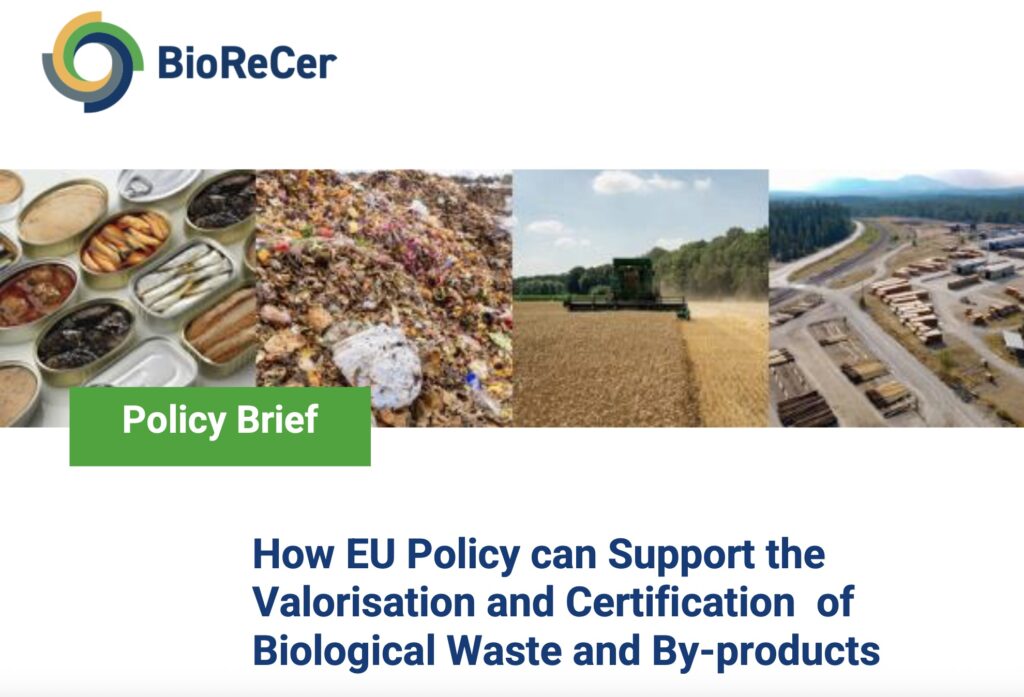
As Europe accelerates its transition toward a sustainable, independent and competitive bioeconomy, CSLs are taking centre stage. These systems are essential for ensuring traceability, building trust and aligning market practices with the EU’s sustainability goals. However, as the Horizon Europe BioReCer project highlights, current certification approaches struggle to keep pace with the challenges of certifying biological feedstocks, especially biogenic waste and residues, and complex bio-based value-chains. Without effective CSLs, the uptake of bio-based products is slowed, undermining both competitiveness and sustainability of the EU.
BioReCer (Biological Resources Certifications Schemes) therefore aims at assessing and complementing current certification schemes for biological resources according to the new EU sustainability goals to enhance bio-based circular systems. To this end, BioReCer has drafted a policy brief that addresses how EU policy can support the valorisation and certification of biological waste and by-products.
Key challenges of bio-based value-chains
Biological feedstocks differ significantly from fossil raw-materials. Their natural variability and seasonal availability require assessment frameworks tailored to biological cycles. Infrastructure Gaps, i.e. lack of hubs and collection systems, weakens viability. At the same time, complex or fragmented supply chains hamper transparency and traceability. Furthermore, inconsistent regulations across EU member states, and the difficulties estimating the economic value of certification create major barriers for businesses, especially SMEs.
Tailor-made solutions offered by BioReCer
In its three-year runtime, BioReCer tackled these challenges by developing an assessment framework for bio-based value-chains based on biogenic waste, wastewater and residues in four relevant business areas: forestry, agriculture, fishery and municipality. Furthermore, product passports and a digital tracking tool (BioReCer ICT tool, BIT) for bio-based value-chains were created. The project members also implemented new sustainability and circularity indicators into existing CSLs to fit them to biological feedstocks, hereby supporting their use and valorisation.
Stakeholder-specific recommendations for the up-take of biological feedstock and bio-based value-chains
The BioReCer project culminated in the development of a concise policy brief based on these solutions and other findings, containing recommendations that address three different target groups, that are important for the acceptance of bio-based products by industry and the general public:
For Businesses
Tracking & Traceability (T&T) systems and electronic identification passports should be adopted to verify bio-based claims and simplify audits.
Tools like the BioReCer BIT platform can be used to navigate the certification landscape and choose the right CSLs.
CSLs should be integrated into business strategy to anticipate regulations, cut compliance costs and gain a competitive edge.
For CSL Owners & Stakeholders
- Modular certification packages needs to be developed to make entry more affordable for SMEs.
- Regional biomass registries and digital traceability solutions should be established for consistent feedstock supply.
- Certification should be expanded to include circularity criteria and innovative feedstocks, supporting emerging industries.
- Alignment with EU policies such as the Circular Economy Action Plan and the Ecodesign for Sustainable Products Regulation need to be improved.
For Policy Makers & Governments
- An EU-wide “green-tag” coding system for customs and certification bodies should be created, and statistical databases with bio-based indicators is needed.
- An EU Bioeconomy Certification Observatory and technical committees should be established to harmonise CSLs.
- Fiscal incentives and progressive certification pathways to ease adoption are necessary.
- It is worthwhile to invest in infrastructure, waste valorisation, and consumer awareness campaigns.
- Binding EU standards should be introduced, and legal definitions around waste and secondary feedstocks need to be clarified.
The full policy brief can be accessed here:
https://biorecer.eu/wp-content/uploads/2025/08/25-12-29_2nd-biorecer-policy-brief_final.pdf
About BioReCer
In order to complement current certification schemes for biological resources, BioReCer included new criteria that align with EU taxonomy and EU corporate due diligence regulations into guidelines for certifying biological resources’ sustainability, origin, tracking and traceability (T&T), and by ensuring applicability at EU and global scale. By promoting the sustainability and trade of biological resources, BioReCer will increase the added value, use, as well as social acceptance of bio-based products.
The solutions and guidelines will be presented in the final BioReCer event taking place in Santiago de Compostela on 29 October 2025: https://biorecer.eu/events/
Read more on BioReCer here: https://biorecer.eu/
Follow BioReCer’s LinkedIn group: https://www.linkedin.com/groups/12905706/

Funded by the European Union. Views and opinions expressed are however those of the author(s) only and do not necessarily reflect those of the European Union or European Research Executive Agency. Neither the European Union nor the granting authority can be held responsible for them.
Source
nova-Institut, original text, 2025-10-20.
Supplier
BioReCer
Cetaqua
European Union
Horizon Europe
nova-Institut GmbH
Share
Renewable Carbon News – Daily Newsletter
Subscribe to our daily email newsletter – the world's leading newsletter on renewable materials and chemicals