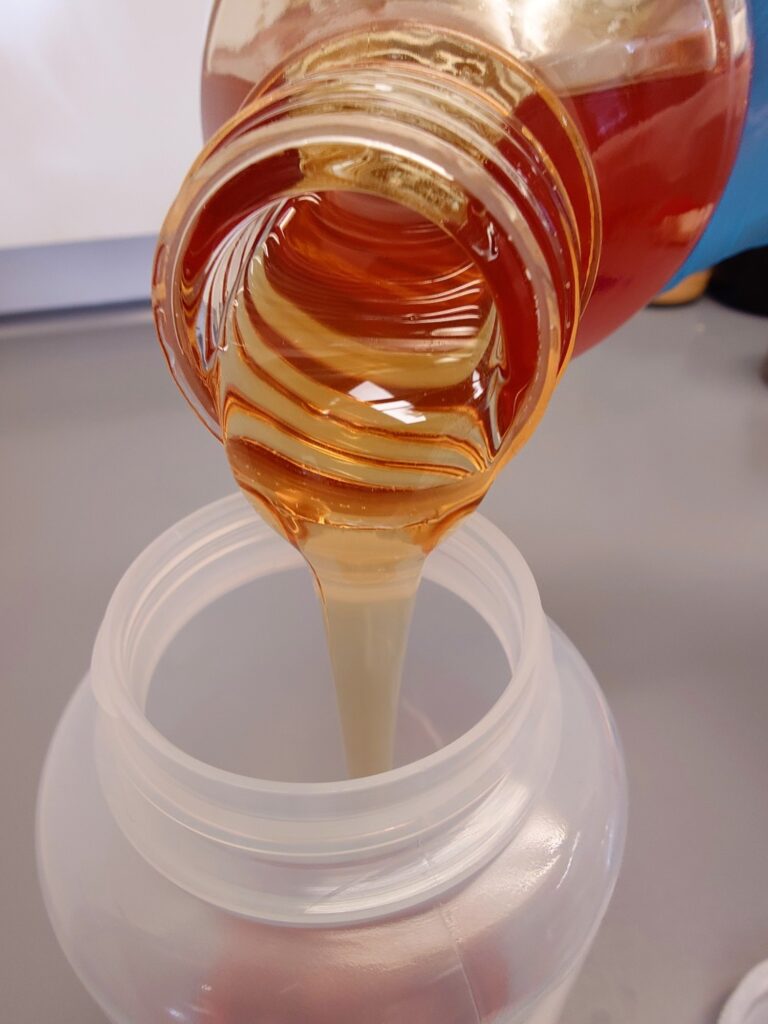
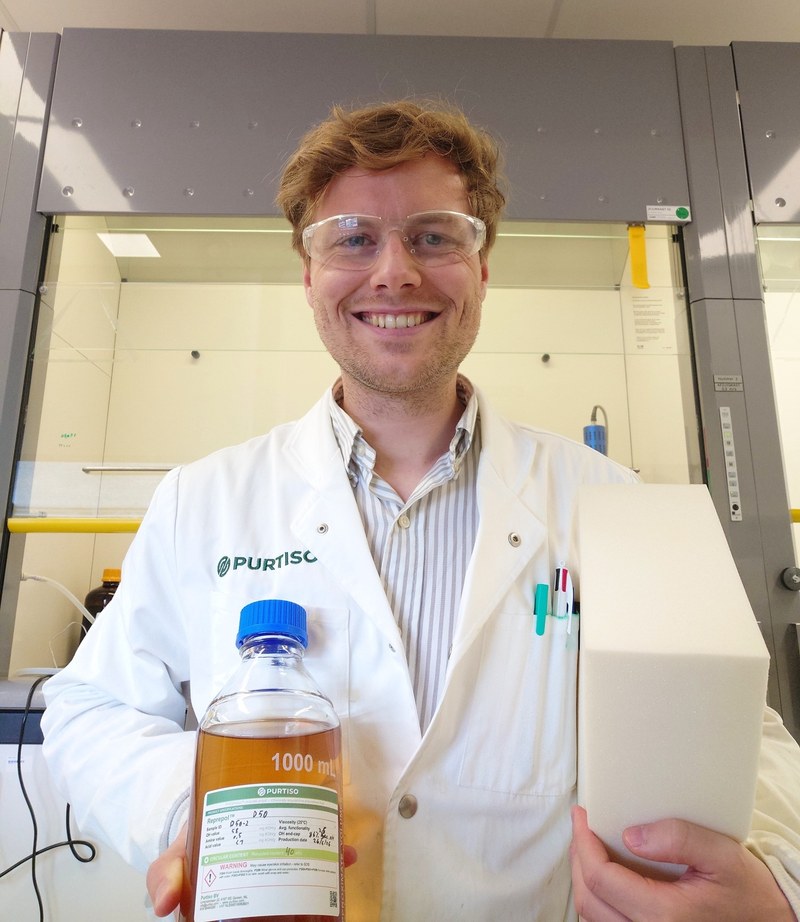
In recent years, a unique chemical process has been developed at KU Leuven’s Faculty of Bioscience Engineering. This process breaks down the ubiquitous plastic polyurethane, turning it back into its pure building blocks. These building blocks can then be used as raw materials for the production of new plastics, creating a circular model in the chemical industry. The new KU Leuven spin-off Purtiso will now scale up the process, run pilot tests, and introduce the process to the market.
Did you sleep on a mattress under an insulated roof last night? Did you take your breakfast out of the fridge this morning and then put on your sneakers to drive to work? And are you now sitting in a comfortable office chair? If so, you have already come into contact with polyurethane at least six times. It is one of our most versatile plastics. Because this material can be hard, soft or flexible, and is also durable, it is found in countless everyday applications. An estimated eight percent of all plastics worldwide consist of polyurethane.
However, this plastic also has its drawbacks. Its building blocks – so-called ‘polyols’ and ‘isocyanates’ – are still largely produced from fossil-based raw materials. In addition, the production of isocyanates involves a highly toxic process called ‘phosgenation’, which requires strict safety measures in the chemical industry. Furthermore, polyurethane cannot be recycled in an easy way. Most types of polyurethane cannot be remelted like other plastics. As a result, discarded polyurethane products currently end up either shredded or ground up for low-value applications, or are sent to a landfill.
Recovering building blocks
A research team led by Dirk De Vos, Professor in Bioscience Engineering at KU Leuven, found a solution to this problem. Former postdoctoral researcher Niels Van Velthoven developed a chemical recycling process that breaks down the popular plastic, turning it back into its original building blocks.
’We succeeded in extracting the polyols and isocyanates from polyurethane waste. The quality of the extracted compounds is so high that they can immediately be used as building blocks again,’ he says. ‘The process forms the basis for a circular business model, transforming waste into raw material.’
‘Phosgenation is no longer involved in this process, and neither are oil or gas. Our unique, patented process therefore allows us to become less dependent on fossil raw materials for the production of plastics. The process can be applied to all major polyurethane waste streams, including the less pure ones. That makes this KU Leuven invention one of the first truly universal solutions for the chemical recycling of mattresses, insulation foams, and other products made from this plastic.’
Pilot tests
With the support from Flanders Innovation & Entrepreneurship (VLAIO) – through an Innovation Mandate and its ‘Moonshot’ programme – and the Industrial Research Fund (IOF), Niels Van Velthoven has been able to develop the recycling process over the past few years at KU Leuven. Now that the technology has reached sufficient maturity, the spin-off Purtiso was founded.
‘Purtiso will introduce the process to the market step by step,’ he says. ‘Together with industrial partners, we will start pilot tests next year. After that, we want to build a commercial demonstration plant, for which the initial discussions are already ongoing.’
’Our ambition is to eventually provide modular plants that can convert polyurethane waste into polyols and isocyanates on an industrial scale. Because this is such a versatile plastic, our customers can also be diverse: from mattress manufacturers to, for example, producers of insulation materials and shoe soles. Together, we are working on a solution for this complex plastic waste!’