 Smarter, Faster, Greener: How Digital and AI-Based Technologies Are Transforming Recycling Systems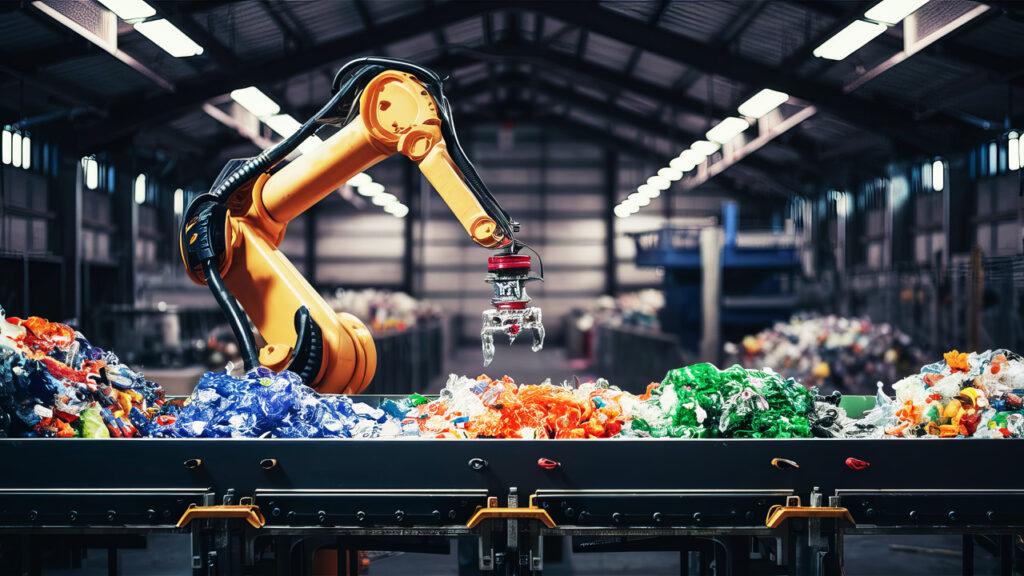
Recycling is entering a new era. As waste streams grow more complex and market conditions volatile, the sector faces pressure to deliver high quality, efficiency, and verified sustainability. Traditional mechanical and chemical recycling often struggle with inconsistent feedstocks and high energy use. Digitalisation and artificial intelligence (AI) now offer tangible solutions, enabling systems that analyse, adapt, and optimise recycling in real time.
Smart sensors, machine learning, and process modelling are shifting recycling from manual control to data intelligence, hereby making circularity measurable and controllable rather than aspirational.
Smarter Sorting and Process Optimisation
As recycling systems become increasingly complex, the ability to identify, separate, and process materials with precision determines both economic viability and environmental impact. The latest advances in sensing, modelling, and automation are enabling unprecedented levels of control and efficiency across recycling operations.
AI-based sensing
Intelligent recognition systems, particularly near-infrared (NIR) and hyperspectral imaging, now distinguish fibres and plastics by spectral signature and morphology. Studies show that AI-assisted NIR sorting can accurately separate polyester-rich textiles and improve recycling yields (Becker et al., 2024). AI, and robotics underscore the importance to enhance AI for precise categorisation. Here, data augmentation, data synthesis, generative AI, and transfer learning have been identified as crucial techniques to enhance dataset quality and categorization accuracy, even in construction waste (Dodampega et al.). Meanwhile compact NIR scanners linked to cloud data make sorting traceable, feeding material identity directly into digital records for compliance and transparency.
Digital twins in plant control
“Digital twins” are virtual plant replicas that combine live sensor data with predictive algorithms to model and optimise sorting lines. A recent study demonstrated how such twins stabilise output quality and cut energy demand through automated feedback control. By clarifying the influence of throughput fluctuations on industrial-scale sensor-based sorting (SBS) performance and simulating different SBS cascade designs, digital twins can pave the way towards improved design and operation of sorting plants and a more circular future (Kroell et al., 2023). This approach transforms recycling facilities into adaptive systems capable of learning from operational data rather than relying on static settings (Campana et al. 2025).
AI in chemical recycling
Machine learning also supports molecular-level recovery. Algorithms can predict solvent performance, catalyst efficiency, and polymer quality, helping recyclers adapt to volatile and variable feedstocks while reducing emissions (Aoki et al., 2023). These tools close the quality gap between recycled and virgin polymers and illustrate how digital chemistry complements mechanical recycling advances.
Data-Driven Efficiency and Market Foresight
Cloud-based platforms now integrate data across sensors, laboratories, and enterprise systems, giving operators a combined view of performance. Linking process data with environmental indicators enables predictive maintenance, improved energy management, and also transparent reporting.
Beyond plant operations, AI-driven forecasting tools originally designed for commodities and energy are entering recycling markets. By modelling price relations, policy developments, and trade flows, such systems support more resilient procurement and planning. Predictive analytics thus extend circularity from material flows to market intelligence.
Traceability and Human-Centred Automation
Digitalisation also strengthens the integrity of recycling chains. Combining blockchain systems, spectral watermarks, and automated record-keeping enable end-to-end traceability, preventing fraud and verifying recycled content (Bhubalan et al. 2022). Standardisation of these systems underpins emerging product-passport frameworks across Europe.
Automation further improves safety and workforce quality. As repetitive sorting is delegated to robotics, staff can focus on quality control, maintenance, and data interpretation, resulting in a more skilled, tech-enabled recycling labour force. These and other social benefits of AI deployment are often-overlooked.
Towards Autonomous, Adaptive Recycling
The next step for digital and AI driven systems is the fully connected “smart facility” where AI, Internet-of-Things (IoT) sensors, and edge computing enable plants to self-optimise. Predictive maintenance, dynamic scheduling, and automatic carbon-footprint tracking are already proven in other industries and now entering recycling.
In essence, digitalisation provides the feedback intelligence the circular economy has long needed and can successfully link environmental performance with operational control.
Process Optimisation and Market Forecasting
The Advanced Recycling Conference 2025, taking place on 19–20 November in Cologne, Germany and online, will explore these developments in the dedicated session “Digital Solutions for Process Optimisation and Market Forecasting.”
Speakers include:
- Matthias Hermann (Citrine Informatics, US) on AI in chemical and mechanical recycling;
- Martina Walzer (Siemens, DE) on cloud-based optimisation of recycling plants;
- Peter Jetzer (Recycario Data Science Institute, DE) on AI market forecasting for recyclates;
- Hans Chan (Matoha, UK) on AI sensing for textile identification.
- Dmitrii Didenko (Weatherford, US) on digital platforms and predictive analytics for sustainable, data-driven recycling operations
Together, they exemplify how digital and AI systems can make recycling smarter, more transparent, and ready for the circular economy of tomorrow.
Register here and join the conversion: https://advanced-recycling.eu/registration/
References
Aoki, Y. et al. (2025), Multitask Machine Learning to Predict Polymer–Solvent Miscibility Using Flory–Huggins Interaction Parameters, in Macromolecules Vol 56/Issue 14, Available at: https://pubs.acs.org/doi/10.1021/acs.macromol.2c02600
Becker, N. et al. (2024), Near-infrared-based sortability of polyester-containing textile waste, Resources, Conservation & Recycling Advances, 206, 21, 100175. Available at: https://www.nilskroell.com/publication/becker_2024_nirtextiles/Becker_2024_NIRTextiles.pdf
Bhubalan et al. (2022), Leveraging blockchain concepts as watermarkers of plastics for sustainable waste management in progressing circular economy, Environmental Research, 213, 113631, Available at: https://www.sciencedirect.com/science/article/pii/S0013935122009586
Campana et al. (2025), Artificial Intelligence and Digital Twins for Sustainable Waste Management: A Bibliometric and Thematic Review, in Applied Sciences, 15(11), 6337. Available at: https://www.mdpi.com/2076-3417/15/11/6337
Dodampegama, S. et al. (2024), Revolutionizing construction and demolition waste sorting: Insights from artificial intelligence and robotic applications, in Resources, Conservation and Recycling Volume 202, March 2024, 107375, available at https://www.sciencedirect.com/science/article/pii/S0921344923005098
Kroell et al. (2023), Towards digital twins of waste sorting plants: Developing data-driven machine learning with near-infrared-based process monitoring, in Resources, Conservation & Recycling 200 (2024) 107257, Available at: https://publications.rwth-aachen.de/record/972852/files/978852.pdf
Source
nova-Institute, original text, 2025-10-29.
Supplier
Share
Renewable Carbon News – Daily Newsletter
Subscribe to our daily email newsletter – the world's leading newsletter on renewable materials and chemicals