 Several roadblocks identified on the way to a net-zero chemical industry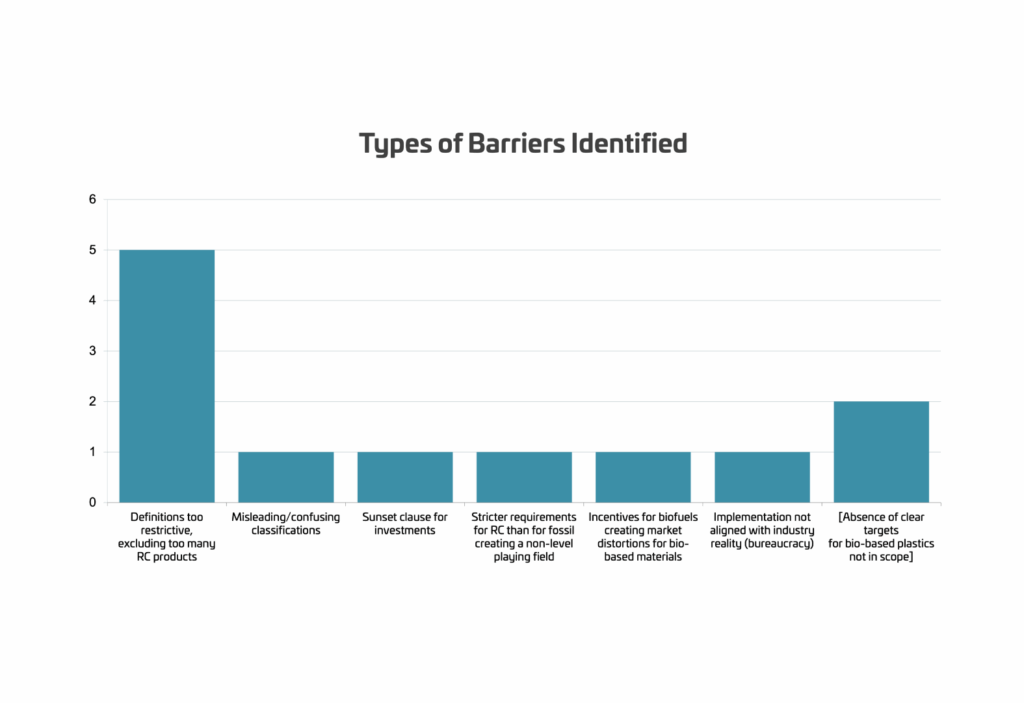
A study published today by the Renewable Carbon Initiative (RCI) reveals that existing EU policies continue to create significant barriers for renewable carbon-based chemicals and materials – despite growing political ambition to defossilise the European economy. The report pinpoints specific barriers to regulations and even the relevant articles, explains why they represent a problem and provides practical suggestions for upcoming legislative revisions.
The new background report “Policy Barriers for Renewable Carbon Uptake”, identifies, based on a survey among RCI member companies, ten specific policy barriers across seven EU legislative frameworks, including the EU Emissions Trading System Directive (ETS), the Renewable Energy Directive (REDIII), the Packaging and Packaging Waste Regulation (PPWR), and the Single-Use Plastics Directive (SUPD). These barriers delay the transition from fossil to bio-based, carbon capture and utilisation (CCU)-based and recycled carbon sources.
For policy-makers, the following key findings are particularly relevant:
Regulatory misalignment: The study demonstrates that current rules often create a “non-level playing field.” For example, bio-based products face stricter sustainability proof requirements than fossil alternatives, while biofuel subsidies distort feedstock markets for material uses. A major concern is regulatory uncertainty for CCU investments due to the sunset clause, where time-limited recognition of fossil-derived CO2 creates investment horizons that are incompatible with industrial financing cycles. This threatens to delay or cancel CCU projects that are essential for climate-neutral value chains, especially in hard-to-abate sectors.
Outdated definitions and misleading classifications: The most common barrier stems from overly restrictive definitions which exclude too many renewable carbon products. Current overly restrictive definitions, such as those in the Emission Trading System (ETS) or the Packaging and Packaging Waste Regulation (PPWR), exclude entire categories of innovative, climate-friendly products from incentives or market access. Particularly critical is the limitation of Carbon Capture and Utilisation (CCU) to products with lifetimes longer than several centuries in the ETS, ignoring the circular substitution of virgin fossil feedstocks through CCU. Keeping products in the loop through recycling is completely neglected in this framework so far.
Misleading classifications create barriers, such as the SUPD definition of ‘natural polymer,’ which excludes industrially produced nature-identical polymers, and the PPWR Annex, which groups all biodegradable plastics together regardless of biodegradability or recyclability, potentially causing confusion in the value chain.
Bureaucracy vs practical reality: The implementation of requirements often fails to align with industrial production realities, diverting resources needed for the actual transformation. For example, calculating minimum post-consumer recyclate (PCR) content for each plant and product format is highly impractical, diverting time and resources from scaling up PCR use and improving overall recycling rates. Rules and regulations aimed at increasing renewable feedstock in the chemical and materials industries should be designed to allow companies to implement them efficiently and with reasonable effort.
The biggest barrier is not a single regulation, but the lack of a coherent support framework for renewable carbon in the chemicals and derived materials economy. RCI members consistently point to the absence of clear targets and incentives for renewable carbon materials as the biggest hindrance.
The suggested solutions in the report include amending restrictive definitions e.g. in ETS and PPWR, introducing more nuanced rules for CCU sources, adopting more practical solutions to reduce unnecessary administrative burdens, and align rules and sustainability requirements for carbon both for different use cases and different origin.
This report is designed to complement RCI’s Policy Proposal Study published in 2025.
For further information on the study and its implications, please find the full report at https://renewable-carbon.eu/publications/product/policy-barriers-for-renewable-carbon-uptake-rci-report-pdf/ or contact christopher.vomberg@renewable-carbon-initiative.com
Source
Renewable Carbon Initiative (RCI), press release, 2026-02-03.
Supplier
European Commission
European Union
nova-Institut GmbH
Renewable Carbon Initiative (RCI)
Share
Renewable Carbon News – Daily Newsletter
Subscribe to our daily email newsletter – the world's leading newsletter on renewable materials and chemicals