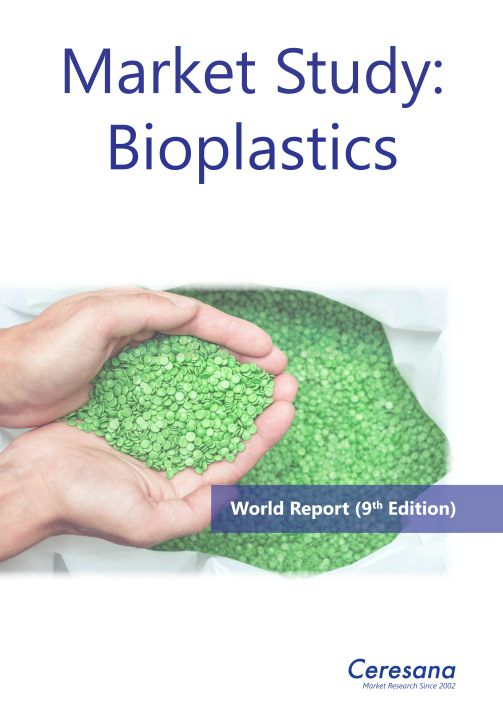
The latest and already ninth edition of Ceresana’s bioplastics market report anticipates market growth: Market researchers forecast that the global biobased and biodegradable plastic market size will reach around USD 12 billion by 2034.
The bioplastics market report primarily analyzes the global market for thermoplastics made from renewable raw materials that are biodegradable i.e. can be decomposed by microorganisms in nature or at least composted in industrial plants. PHA from sugar and TPS from starch, for example, are bio-based and biodegradable. However, there are also plastics made from biogenic raw materials that are not compostable, such as PEF made from fructose or bio-polyethylene based on sugar cane. The market study also covers petrochemical, biodegradable plastics such as polycaprolactone (PCL), polybutylene adipate terephthalate (PBAT), or polybutylene succinate (PBS).
In addition to market data and forecasts, the study also contains information on the regulatory framework as well as on the general economic environment and the situation in the packaging industry (including key companies, market size, recycling rates) in each country.
This study does not cover biobased elastomers, thermosets, natural fibre-reinforced plastics (NFRP), nor composites such as wood-plastic composites (WPC).
Innovations for Sustainable Applications
The packaging industry is the largest consumer of plastics today. The advantages of the following bioplastics, which are currently by far the best-selling materials, are particularly evident in flexible packaging: Polylactic acids (PLA) and starch polymers (especially TPS) offer higher permeability, biodegradability, and a good “green” image among consumers. For the starch-based bioplastics and polylactic acid market, Ceresana’s latest market report expects further volume growth of 7.7% per year until 2034.
For biobased but non-biodegradable plastics, such as bio-polyethylene, bio-PET, or bio-PA, growth is expected to be lower at 5.3% per year. Like conventional petrochemical plastics, the various polymers made from biogenic raw materials each have areas of application for which they are particularly well suited. Biocompatibility, for example, is an advantage for medical implants. Compostability is required for agricultural films and flowerpots. In 3D printing, biofilaments are valued not least because they do not smell of burnt plastic. The analysts at Ceresana are currently registering the highest growth rates for innovative bioplastics in the automotive and electronics sectors.
Current Global Bioplastics Market Report
Chapter 1 of the new market study provides a comprehensive presentation and analysis of the global bioplastics market with forecasts up to 2034: The development of demand (in tonnes), revenues (in USD and EUR), and production (in tonnes) is shown for each region. In addition, 6 bioplastic applications are examined individually. Demand is also analyzed for 7 types of bioplastics, while 4 product groups are considered for the analysis of production.
In Chapter 2, the 11 most important sales markets are examined individually: Demand and revenues, demand in the individual application areas, and demand per product type.
To give an overview of the bioplastic industry, chapter 3 provides useful company profiles of the 60 largest bioplastic manufacturers, such as BASF, Evonik, Cargill, Eastman, FENC, Hengli, Mitsubishi Chemical, PTT GC, and TotalEnergies.
Source
Bioplastics MAGAZINE, 2025-10-30.
Supplier
BASF Corporation (US)
bioplastics MAGAZINE (Zeitschrift)
Cargill, Inc.
Ceresana Research
Eastman Chemical Company
Evonik Industries AG
Far Eastern New Century Corporation (FENC)
Hengli Group
Mitsubishi Chemical
PTT Global Chemical Public Company Limited
TotalEnergies
Share
Renewable Carbon News – Daily Newsletter
Subscribe to our daily email newsletter – the world's leading newsletter on renewable materials and chemicals