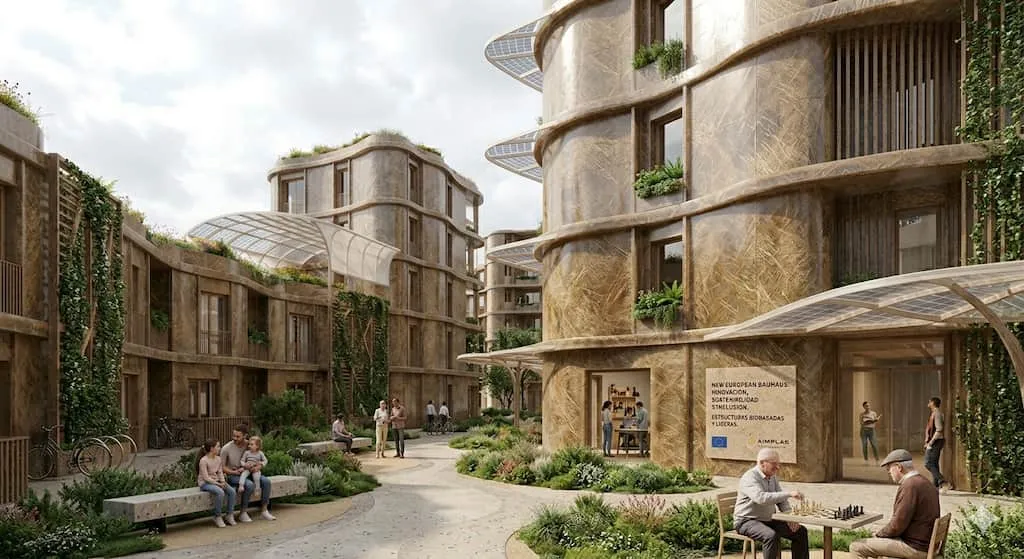
The New European Bauhaus (NEB) is reshaping the way architecture and the built environment are conceived. It no longer rewards isolated technical innovation alone, but rather solutions that combine design, sustainability and inclusion. For companies across the construction value chain, this means rethinking materials, standards, testing methodologies and product models. This article explores the role that biomaterials and lightweight composites can play in that transition and how AIMPLAS supports industry as a technology partner to accelerate it.
Why Does the New European Bauhaus Matter to the Construction Industry?
Driven by the European Union, the New European Bauhaus (NEB) bridges the European Green Deal with a cultural and social vision of the spaces we inhabit. Its underlying message is that climate success should not be measured solely by the tonnes of CO₂ avoided, but also by the quality of life that solutions provide. This is why the initiative is built around three core values: sustainability, beauty and inclusion [1]. In its most recent phase, the European Commission has given the initiative a more operational focus through the NEB Facility and an agenda centred on scalable solutions for neighbourhoods and cities [3].
For the construction sector, this framework has very practical implications. It is no longer enough to meet minimum energy requirements or incorporate a certain percentage of recycled material. The NEB calls for solutions that simultaneously deliver technical performance, a low environmental footprint, positive user experiences, circularity and social value. In other words, innovation in materials must go hand in hand with innovation in regulation, industrial design and project governance.
What Is Preventing the NEB from Reaching Real Projects?
The Strategic Synthesis Report produced by the NEB Junction Stakeholder Assembly provides valuable insights for the sector. Its conclusion is twofold: support for NEB principles is widespread, yet structural bottlenecks continue to hinder implementation on the ground [2]. The most frequently cited barriers are [2]:
- The difficulty of translating complex European policies into local decision-making.
- Administrative fragmentation.
- Funding mechanisms focused on launching projects rather than sustaining them over time.
- Limited legal recognition of concepts such as wellbeing, social cohesion and beauty.
For manufacturers, engineering firms, architecture practices and technology centres, this is particularly relevant because it signals a shift in how materials and construction systems will be evaluated. They will increasingly be assessed not only on cost or mechanical performance, but also on their contribution to understandable, scalable and long-lasting solutions. For industry, the NEB is fundamentally an exercise in translation: transforming inspiring ideas into specifications, testing protocols, prototypes, business models and certifiable products.
Why Are Bio-Based Materials and Lightweight Composites Gaining Momentum?
The reason these materials are gaining prominence within the NEB framework is straightforward: they allow simultaneous improvements in weight, performance and environmental impact. Polymer-matrix composites offer [11]:
- An excellent strength-to-weight ratio.
- Extensive geometric design freedom.
- Strong corrosion resistance.
- The ability to integrate multiple functions into a single component.
When bio-based resins, natural fibres, recycled content and eco-design principles are incorporated, they provide a realistic pathway towards reducing environmental impacts compared with traditional solutions heavily dependent on metals or virgin mineral resources [8].
However, sustainability should never be assumed. Technical literature consistently highlights that a composite does not become sustainable simply because it contains bio-based components. Sustainability must be demonstrated through life cycle assessments, durability data, credible processing and end-of-life scenarios, and a realistic evaluation of scalability barriers [8]. This approach avoids oversimplification while directing innovation towards commercially viable and verifiable solutions.
How Do We Move Beyond Simply Replacing Metal?
One of the most important debates in European industry concerns the extent to which metal components can be partially or fully replaced by lighter, lower-carbon composite alternatives, provided the substitution is technically justified.
The key point is that this is not merely a material substitution exercise. It requires rethinking geometries, joining methods, manufacturing processes and validation strategies. A well-designed composite solution can reduce weight, integrate functions, eliminate corrosion concerns and simplify assembly processes, but it also demands new approaches to design calculations, testing and certification [4][6].
The BASAJAUN project, published in Sustainability, illustrates this well. By replacing selected construction components with timber-based solutions and a newly developed biocomposite, researchers achieved significant reductions in embodied carbon emissions, particularly when aluminium profiles were replaced [7]. The lesson for industry is clear: decarbonising materials is not only about optimising existing processes but about redesigning products to remove high-carbon materials wherever technically robust alternatives exist.
This is also the philosophy behind BIOS MATER, a European project involving AIMPLAS that focuses on safe, circular and low-carbon construction [9]. Its relevance lies in connecting three dimensions that are often treated separately—materials, systems and validation. Developing a renewable-based material is not enough; it must also be compatible with manufacturing processes, perform reliably in service and deliver measurable environmental benefits, fully aligned with the principles of the NEB.
Is CEN/TS 19101 an Official Eurocode for Composites?
For composites to become mainstream in construction, high-performance materials alone are not enough. Shared design rules are equally essential.
This is where CEN/TS 19101:2022 represents a significant milestone. Developed within the Eurocodes framework, this technical specification provides guidance for the design of fibre-polymer composite structures used in buildings, bridges and other civil engineering works [4].
Its structure reflects a mature discipline, covering topics such as [4]:
- Design principles.
- Materials.
- Durability.
- Structural analysis.
- Ultimate and serviceability limit states.
- Connections.
- Sandwich panels.
- Hybrid structures.
- Fatigue.
- Testing-assisted design.
- Fire performance.
- Informative annexes and bridge-specific guidance.
It is important, however, to clarify its status. There is currently no fully established EN Eurocode dedicated to composites. CEN/TS 19101 is a Technical Specification with provisional status, intended to evolve as practical experience accumulates [4]. The Eurocodes/JRC ecosystem describes it as a supporting instrument for implementing the second generation of European structural design standards [5].
Although widely regarded as the foundation of a future composite structural Eurocode, it has not yet achieved full European Standard status. This makes it particularly important for manufacturers, structural engineers, laboratories and technology centres to become familiar with its principles and validation requirements now.
What Does CEN/TS 19101 Change for Manufacturers and Engineering Firms?
The introduction of a specification such as CEN/TS 19101 fundamentally changes the industrial conversation. It encourages composites to be treated not as bespoke, one-off solutions but as a recognised family of structural systems governed by explicit verification rules.
This affects:
- Raw material selection.
- Traceability requirements.
- Thermal and mechanical characterisation.
- Durability assessment.
- Adhesive and mechanical joining methods.
- Fatigue performance.
- Fire behaviour.
- The central role of testing within the design process [4].
For organisations seeking to replace metallic structures with lower-carbon composite alternatives, this presents both opportunities and challenges. The opportunity lies in adopting a design language that is increasingly familiar to specifiers and regulatory bodies. The challenge is generating sufficient experimental evidence and supporting decisions through calculation, simulation, prototyping and application-oriented testing.
This is where much of the sector’s future competitiveness will be determined.
How Does AIMPLAS Support the Industrialisation of Composites in Construction?
In this context, AIMPLAS’ alignment with NEB principles goes beyond sustainability narratives. It is rooted in the organisation’s ability to provide technological support to companies seeking to transform material concepts into validated industrial solutions.
AIMPLAS develops smart construction technologies based on advanced thermoplastic and thermoset materials, as well as high-performance composites that enable lighter and stronger structures. Bio-based and recycled materials are incorporated to enhance sustainability and circularity [10].
Its composites technology platform stands out for combining:
- High mechanical performance.
- Weight reduction.
- Design flexibility [11].
For companies evaluating the replacement of metal components, profiles, building envelopes or subsystems with composite alternatives, AIMPLAS can provide support throughout the entire development journey—from material selection and eco-design to prototyping, testing and experimental validation—helping to shorten the path from concept to industrial adoption.
Why Are Testing and Characterisation So Important?
Industrialising composites in construction is ultimately a matter of trust. In a regulated sector, trust is built on data.
AIMPLAS operates laboratories capable of characterising plastic materials, polymers and composites at every stage of development, from raw materials and semi-finished products to finished products and waste streams [12].
The organisation also highlights that its laboratory activities are accredited by ENAC in accordance with UNE-EN ISO/IEC 17025 and support a substantial volume of testing and analytical services each year [13].
This capability becomes especially important within the framework of CEN/TS 19101, where testing-assisted design and accurate material characterisation are central to the engineering process [4].
For companies, the conclusion is straightforward: transitioning from conventional metallic structures to lower-carbon composites cannot rely on assumptions or marketing claims. It requires rigorous testing programmes, expert interpretation of results, correlation with design calculations and a deep understanding of manufacturing processes.
Having access to this infrastructure and expertise reduces technological risk and accelerates market adoption.
How Does AIMPLAS Fit into the New European Bauhaus Agenda?
Taken as a whole, AIMPLAS’ contribution to the NEB agenda can be summarised through four key actions:
- Developing new bio-based and recycled material solutions.
- Validating performance through analysis, testing and demonstrators.
- Translating sustainability and regulatory requirements into practical engineering criteria.
- Implementing solutions alongside companies that wish to innovate without bearing the full technological risk alone.
The same philosophy can be seen in initiatives such as BIO4EEB, focused on bio-based insulation materials for greener construction [15], and in AIMPLAS’ support for corporate climate-neutrality and carbon-footprint reduction strategies [14].
This is not simply about creating “greener” materials. It is about adopting a systemic approach in which materials, processes, testing, regulation and sustainability advance together.
Conclusion: Rules, Data and Validation Are the Keys to Market Adoption
The New European Bauhaus is redefining what valuable innovation means in construction. Success is no longer measured solely by incremental technical improvements, but by the ability to deliver solutions that are beautiful, inclusive, circular and demonstrably climate-positive.
Within this framework, biomaterials and lightweight composite structures offer a compelling route towards reducing mass, replacing carbon-intensive materials and exploring entirely new product architectures.
Yet this opportunity will only become a commercial reality if it is supported by robust design rules, reliable data and rigorous validation. This is where initiatives such as BIOS MATER, scientific research on embodied carbon, the emergence of CEN/TS 19101 and the work of organisations such as AIMPLAS converge.
The transition proposed by the New European Bauhaus is not merely cultural. Above all, it is technological. Its success will depend on the industry’s ability to transform European principles into reliable, tested and scalable construction systems.
About the Authors
Arsenio Navarro is Lead Researcher for Construction and Renewable Energies at AIMPLAS, where he leads the development of advanced materials and composite solutions for sustainable construction and the energy transition.
Miguel Ángel Mafé is Lead Researcher at the AIMPLAS Characterisation Laboratory and is responsible for the thermal and mechanical characterisation of polymeric materials and composites within a laboratory accredited by ENAC in accordance with UNE-EN ISO/IEC 17025.
References
- European Comission / New European Bauhaus. About the initiative — New European Bauhaus. 2025/2026.
- NEB Junction Stakeholder Assembly. Strategic Synthesis Report. 2026.
- European Comission / New European Bauhaus. New European Bauhaus Facility. 2026.
- CEN. CEN/TS 19101:2022 — Design of fibre-polymer composite structures. 2022.
- Joint Research Centre — Eurocodes. CEN/TS 19101: Design of fibre-polymer composite structures. 2025.
- Ascione et al. Design of Fibre-Polymer Composite Structures: commentary to European Technical Specification CEN/TS 19101:2022. 2025.
- MDPI Sustainability. A1–A5 Embodied Carbon Assessment to Evaluate Bio-Based Alternatives in Basajaun FSMs. 2024.
- Hubbe. Sustainable Composites: A Review with Critical Questions to Guide Future Research. 2023.
Author
Arsenio Navarro, Miguel Ángel Mafé
Source
AIMPLAS, press release, 2026-06-22.
Supplier
AIMPLAS (Asociación de Investigación de Materiales Plásticos y Conexas)
European Commission
European Union
Share
Renewable Carbon News – Daily Newsletter
Subscribe to our daily email newsletter – the world's leading newsletter on renewable materials and chemicals