 Monthly News from the Renewable Carbon Initiative (RCI), January 2026
RCI started the year 2026 with a series of important publications – an extended LCA Case Studies Brochure and a new report on policy barriers for renewable carbon uptake. At the same time, RCI strengthened its role in the EU Commission’s Critical Chemicals Alliance. The newsletter also covers ongoing work in WG Sustainability and WG Policy, including engagement with SBTi, environmental footprinting, and quotas. Finally, we report on recent and upcoming RCI Roundtables, including BASF on competitiveness and green transformation and the forthcoming Molecule Group discussion on end-of-life treatment for sustainable chemicals and materials.
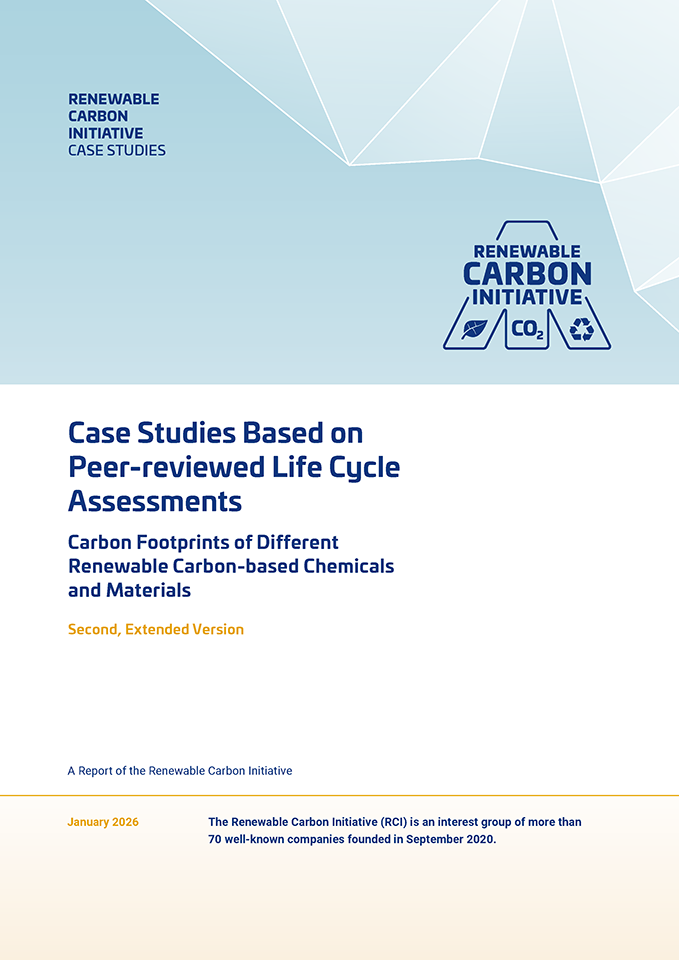
Publication of second, extended version of LCA Case Studies Brochure
On 22 January, the RCI published the second, extended version of the LCA case studies report. This report broadens the scope of the brochure “Case studies based on peer-reviewed Life Cycle Assessments – Carbon Footprints of Different Carbon-Based Chemicals and Materials”, published in November 2023. The initial brochure presented five peer-reviewed studies that drew strong interest from experts, policymakers, and industry leaders for their insights into the carbon footprints of various carbon-based chemicals and materials.
This second, extended version includes seven peer-reviewed LCAs from participating member companies: Braskem, Econic, Fibenol, LanzaTech, Lenzing (update), Peter Greven and Primient Covation. It summarises these existing, high-standard LCAs on the market that show renewable-carbon based chemicals and materials with reduced carbon footprints (compared to fossil alternatives). Its main intention is to provide a convincing document highlighting that use of renewable carbon is beneficial for the climate, already today.
These expanded contributions will deepen understanding of carbon footprints and further support RCI’s commitment to data-driven sustainability.
If you want to take a closer look at the publication, take a look at our press release or download the full report at https://renewable-carbon.eu/publications/product/case-studies-based-on-peer-reviewed-life-cycle-assessments-carbon-footprints-of-different-renewable-carbon-based-chemicals-and-materials-2nd-extended-version-rci-report-pdf/
Publication of Policy Barriers for Renewable Carbon Uptake
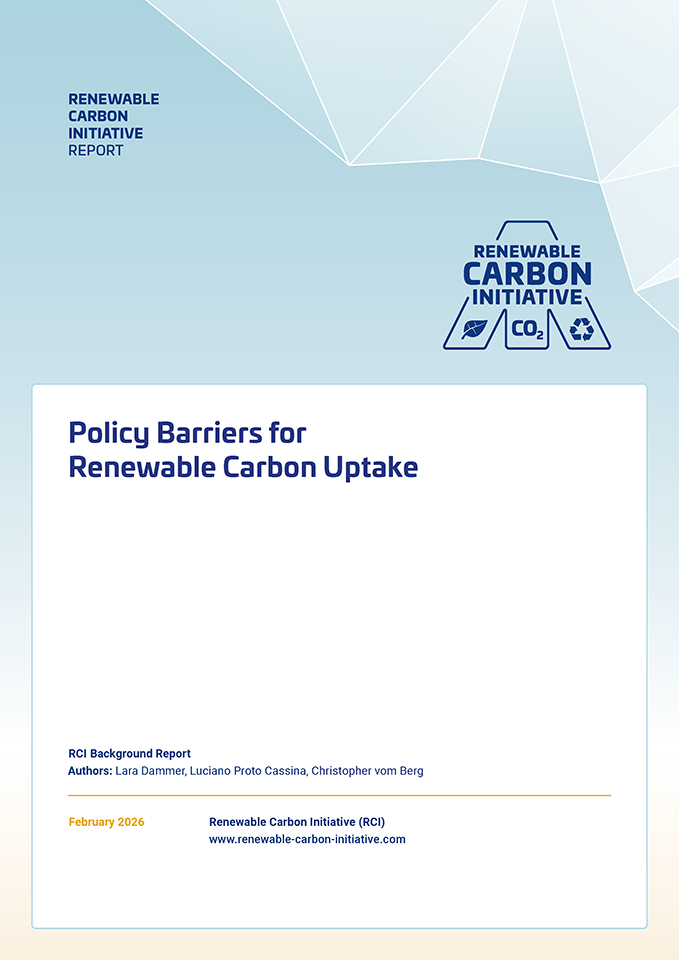
Just two weeks later, on 3 February, the RCI published another report with the title “Policy Barriers for Renewable Carbon Uptake”. Based on internal assessment of RCI member companies and joint analysis, this report reveals existing EU legislation which creates several roadblocks for the shift from fossil to renewable carbon. The report identifies ten concrete policy barriers across seven EU frameworks, including the ETS, REDIII, PPWR and SUPD.
Key findings show regulatory misalignment (creating non-level playing fields and regulatory uncertainty), outdated definitions and misleading classifications (excluding innovative, climate-friendly products from incentives and market access) and impractical administrative bureaucracy (often conflicting with industrial realities). The biggest barrier is not identified in a single regulation, but identified as the lack of coherent support for renewable carbon in the chemicals and derived materials economy.
The report provides practical suggestions to amend and fine-tune regulations in upcoming legislative revisions. It complements RCI’s Policy Proposals report published in 2025.
To support outreach of the report, we have released a press release (LINK). The full report can be downloaded here: https://renewable-carbon.eu/publications/product/policy-barriers-for-renewable-carbon-uptake-rci-report-pdf/
Critical Chemicals Alliance – Application to Working Groups
RCI is a member of the European Commission’s Critical Chemicals Alliance (CCA) since December 2025 and has successfully applied to support the work of two Working Groups. Going forward, RCI will be intensively involved in discussions of
- Working Group 3 – Modernisation of Chemical Productions in Europe MANDATE: to develop measures to support the modernisation and the long-term competitiveness of chemical production in Europe. The Group will particularly focus on critical productions in Europe, starting with a pilot project on steam crackers and ammonia production developed under the Competitiveness Coordination Tool (CCT).
- Working Group 4 – Lead markets MANDATE: to elaborate and assess the impacts of market pull measures for: a) low-carbon products, defined based on their product carbon footprint; b) and sustainable-carbon products, from non-virgin fossil sources, including biomass, recycled waste, and captured CO₂ or CO. These measures would include: minimum content requirements, fiscal incentives, earmarking of ETS revenues as well as EPR like systems to link end markets with chemical production.
WG Sustainability
Science Based Targets initiative (SBTi)
At the RCI General Assembly 2025, continued engagement with SBTi was ranked as a high priority. In December, RCI submitted feedback on SBTi’s Corporate Net-Zero Standard v2.0, providing concrete input how embedded renewable carbon could be better acknowledged and accounted for in the methodology of SBTi accounting. RCI intends continue to engage with SBTi in 2026, next steps will be discussed at the next WG Sustainability meeting on 18 February.
Call for SBTi Technical Council members
SBTi is seeking experts in climate mitigation and sustainability to join its Technical Council and contribute to the review and approval of SBTi standards. The application deadline is 26 February.
Carbon footprinting in recycling situations
In addition to SBTi-related work, the General Assembly 2025 also highly ranked a potential project focused on attributing carbon footprints in recycled products. The envisioned outcome would be a paper comparing different calculation approaches, highlighting the benefits of recycling, and developing recommendations. The precise scope of such an initiative will be discussed at the next WG Sustainability meeting on 18 February.
Environmental Footprint (EF) Technical Advisory Board (TAB)
RCI’s involvement in the EF TAB will continue throughout 2026. While timelines for feedback are often very short, the RCI Office will continue to share written summaries and relevant materials with members as promptly as possible.
The European Commission aims to finalise updated EF Recommendations within this year, with several additional meetings throughout the year, a targeted stakeholder consultation in March, a draft document in Q2 and publication of the updated recommendations before end of the year.
WG Policy
Key Activities & Priorities
A key focus of the WG Policy for 2026 will likely be on demand support mechanisms for renewable carbon, notably through policy instruments such as quotas and lead markets. In this context, the WG discussed developing a clear RCI position on renewable carbon quotas, building on emerging EU policy debates.
The WG intends to keep an eye on and engage in relevant EU documents and initiatives, including the Critical Chemicals Alliance, the implementation of the EU Bioeconomy Strategy, Biotech Act II, the ESPR via the Ecodesign Forum, Advanced Materials Act, Circular Economy Act, the revision of the EU ETS, EU Taxonomy, and Public Procurement frameworks.
Currently, WG Policy is preparing input to the SUPD evaluation Call for Evidence, addressing definitions of natural polymers, mass balance rules, and biodegradability standards.
RCI Roundtable
The RCI Roundtable is a member-driven, one-hour discussion format enabling structured, science-based dialogue on key renewable-carbon topics. RCI members may submit their interest to host a session, external stakeholders or partners can be invited to present, and each roundtable consists of a 15-minute topic presentation followed by 45 minutes of discussion.
BASF (DE) – Maintaining Competitiveness While Executing Green Transformation
The last roundtable was hosted by BASF on 26 January and brought together 78 participants. Dr. Ivana Krkljus clearly explained the preliminary design principles for a consumer-funded mechanism to accelerate the chemical sector’s green transition, providing a strong basis for an in-depth and constructive discussion. Participants actively engaged with the proposal, discussing its feasibility, underlying assumptions, and potential impacts.
The concept envisions modest product surcharges collected via obligated retailers and pooled into a third-party-managed fund to finance industry transformation projects. The model treats imports equally, includes safeguards to avoid social hardship, and considers surcharge levels that are small in percentage terms.
Molecule Group (US) – Barriers for Level Playing Field and Developing a Consensus on End-of-life Treatment for Sustainable Chemicals and Materials
The next roundtable will be hosted by RCI partner Molecule Group on 25 February. Tristan Brown (SCM Workstream Lead) will talk about the non-level playing field between sustainable chemicals and materials (SCM) and fuels. Unlike sustainable fuels, which have a uniform end-of-life (EOL) treatment through combustion, SCM products face uncertain EOL treatment due to multiple disposal mechanisms (e.g., landfilling, recycling, long-term use). This uncertainty is a significant barrier to SCM adoption and prevents these products from qualifying for existing sustainable fuel incentives, despite their role in defossilisation.
Tristan Brown will (1) highlight how EOL uncertainty constrains SCM adoption under current sustainability frameworks and (2) identify mechanisms to overcome EOL uncertainty with potential sector-wide consensus support.
Outreach and Advocacy
Impulse Talk at 42kaiserslautern
On 29 January, RCI, represented by Anke Schwarzenberger, was invited to deliver an impulse talk as part of a lecture series jointly organised by the Leibniz-Institut für Verbundwerkstoffe and the Chair of Sustainability Management at RPTU Kaiserslautern-Landau. Under the motto “Connect. Inspire. Change.”, the event brought together talks, interactive discussion formats, and speed-dating sessions that facilitated exchange between students, company representatives, and academia.
Supplier
BASF SE
European Commission
European Union
Leibniz-Institut für Verbundwerkstoffe (IVW)
Molecule Group
nova-Institut GmbH
Renewable Carbon Initiative (RCI)
Science Based Targets Initiative (SBTi)
University of Applied Sciences Kaiserslautern
Share
Renewable Carbon News – Daily Newsletter
Subscribe to our daily email newsletter – the world's leading newsletter on renewable materials and chemicals