 Monthly news from the Renewable Carbon Initiative (RCI), August 2025
This month, RCI has submitted feedback to the EC on the SUPD implementing decision, welcoming its adoption of Mass Balance Attribution (MBA) as a key tool for tracking recycled content and driving defossilisation. A minor update to RCI’s 2022 MBA Position Paper reflects these developments and provides clear recommendations for consistent EU-wide implementation. Meanwhile, the EC has launched consultations on the Circular Economy Act and the Biotech Act, and the Renewable Materials Conference is coming up with exciting workshops – including one with SBTi.
RCI input to the public consultation on the SUPD implementing decision on “Single-use plastic beverage bottles – EU rules for calculating, verifying and reporting on recycled plastic content”
On 19 August 2025, the RCI submitted feedback on the European Commission’s draft implementing decision under the Single-Use Plastics Directive (SUPD), establishing rules for calculating, verifying, and reporting recycled plastic content in single-use bottles. This is a critical step for chemical recycling and mass balance methodologies.
The RCI supports the draft decision, particularly its
- Implementation of Mass Balance Attribution (MBA) to quantify recycled content across complex value chains.
- Transparent attribution protocols, exclusion of fuel uses, and safeguards against over-attribution, helping to build trust in recycled content claims.
- Recognition of the draft as a foundational framework to operationalise MBA in the EU.
However, RCI also has recommendations/concerns:
- Increased administrative burden relative to existing certification schemes; harmonisation is required to minimise procedural complexity.
- Certain restrictions (e.g., exclusion of fuel use, limitations on recycled content calculations) may deter investment and reduce EU competitiveness.
- Definitions of “polymer,” “chemical building blocks,” and mass balance must be clearer to avoid misinterpretation and ensure technology neutrality
- Methodology must fully accommodate MBA across all technologies and sites, including legacy refineries.
Investment in chemical and physical recycling will accelerate defossilisation and sustainable carbon cycles. RCI advocates extending MBA rules to all polymers and sectors, incentivising recycling over incineration where it makes sense, and enabling all types of renewable carbon from biomass, carbon capture, and recycling.
Publication of minor update of position paper on Mass Balance Attribution (MBA)
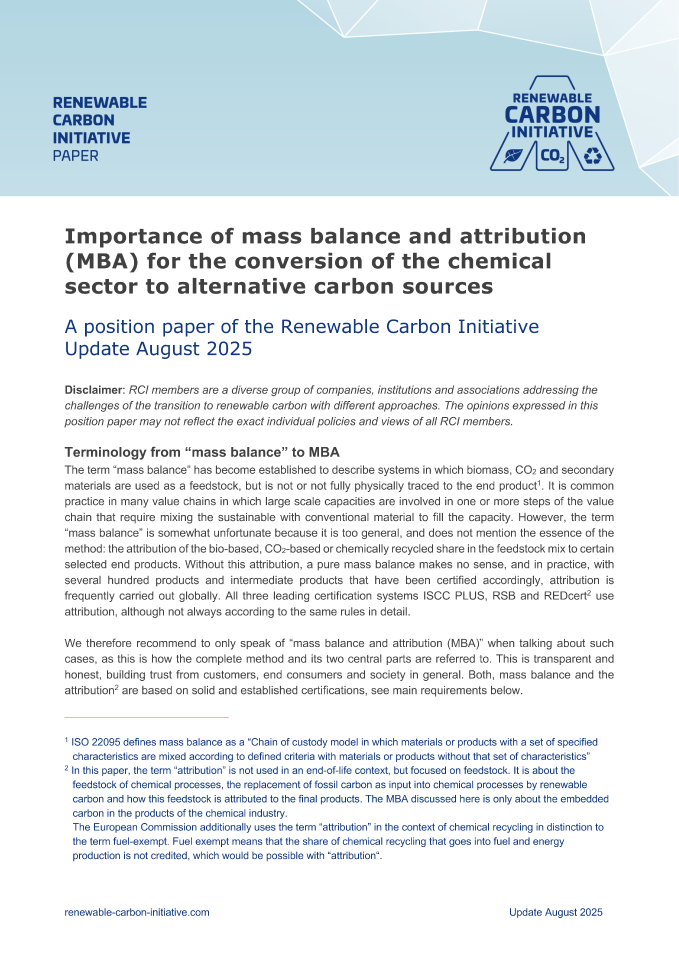
Calculation rules for Mass Balance Attribution (MBA) have now been published by the European Commission and were open for feedback under the SUPD implementing decision process. This development prompted the RCI to release a slightly updated version of the 2022 position paper on MBA, reflecting the new regulatory context and providing clear recommendations for ensuring robust and consistent implementation across the EU.
In August 2025, the RCI published the position paper “Importance of Mass Balance and Attribution (MBA) for the Conversion of the Chemical Sector to Alternative Carbon Sources”. It highlights the importance of MBA as one possible way to incentivise the transformation towards renewable carbon.
The updated position moves to the terminology “Mass Balance and Attribution” (MBA), aligning with emerging European regulatory standards. The term “free” attribution has been omitted, reinforcing a more harmonised and transparent accounting method. The regulatory environment for applying MBA is not yet fully defined, but is under active development. The MBA concept relies on rigorous rules for calculation, verification, and reporting. MBA focuses on site-specific attribution, excluding fuel-use, and tightening the criteria to prevent any double-counting along the value chain. Key regulatory changes include the reference to the Single Use Plastics Directive (SUPD), which sets precise methods for calculating attributed recycled content and serves as a blueprint also for biomass. The position paper names the most important quality criteria that all modern MBA certification schemes should fulfil, and would in best case be aligned with policy in the future.
Please find the new RCI position here: https://renewable-carbon.eu/publications/product/rcis-position-mass-balance-and-attribution-mba-update-2025/
2nd RCI roundtable hosted by RCI member Beckers, 16 September

TheRCI has launched a new member-driven roundtable format to encourage structured, science-based dialogue on critical renewable carbon topics.
The first session, hosted by Econic and dedicated to “The definition of renewable carbon to support the drive in chemicals”, marked a successful start and drew active contributions from RCI members.
The next roundtable will take place on 16 September, 14:00–15:00 CEST, hosted by Beckers, focusing on the ecoinvent database update from 3.10 to 3.11 and its impact on bio-materials carbon footprint calculation.
A further session is scheduled for 6 October, 14:00–15:00 CEST, hosted by IKEA. The specific topic is still under consideration and will be selected from several proposals of high interest.
Public EU consultations: EU steps up action on Circular Economy, Biotechnology, and competitiveness of the chemical sector
A lot is happening at EU level: the Commission has opened consultations on the Circular Economy Act (waste, e-waste, barriers to circularity, secondary raw materials – feedback period: 1 August to 6 November) and the Biotech Act (regulation, funding, clusters, workforce, data/AI – feedback period: 4 August to 10 November). RCI will coordinate inputs from its policy working group and use them to develop a joint position to submit to the consultations.
At the same time, the EC presented an Action Plan for the Chemicals Industry to strengthen the competitiveness and modernisation of the EU chemical sector. The Action Plan addresses key challenges, namely high energy costs, unfair global competition, and weak demand, while promoting investment in innovation and sustainability. As a particular highlight, the Action Plan clearly commits to the defossilisation of the chemical sector by facilitating a shift to bio-based, CCU-based and recycled carbon.
These initiatives underline the EU’s commitment to a circular, sustainable economy and a chemical industry less reliant on fossil resources.
Event: Renewable Materials Conference – SBTi and Policy Workshop on 23 and 24 September
The defossilisation of the chemical and materials industry is advancing. In the future, the sector will be based on renewable carbon sources – biomass, CO₂ utilisation, and recycling – replacing fossil feedstocks.
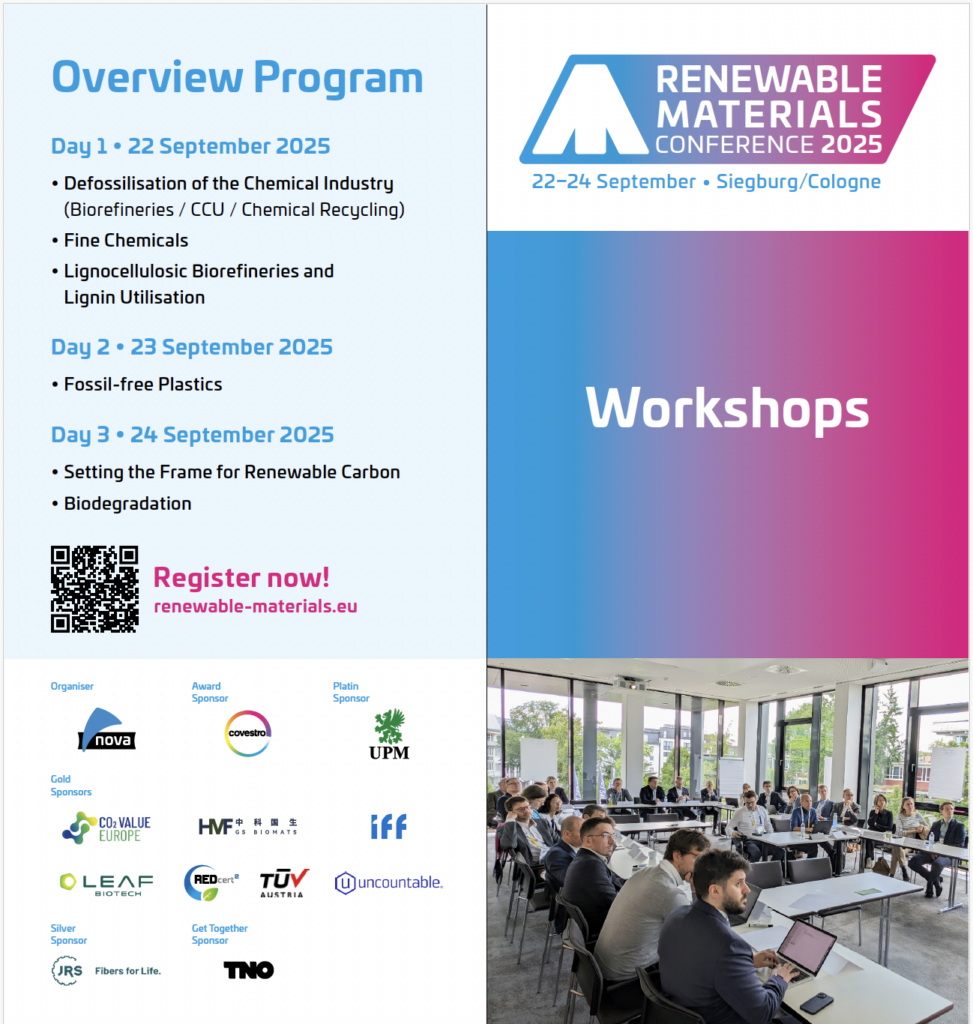
The leading platform to present and discuss these pathways is the Renewable Materials Conference 2025 (RMC), organised by the nova-Institute, taking place 22–24 September 2025 in Siegburg (Germany) and online. With 273 participants from 23 countries already registered and more than 500 expected, the conference has established itself as the central international meeting point for the renewable carbon economy.
The programme covers technological advances, industrial applications, and policy frameworks, providing a comprehensive overview of solutions for sustainable carbon cycles. A highlight will be the audience election of the “Renewable Material of the Year 2025”.
In addition, we would like to point out two workshops at the RMC:
- Kim Schoppink from the Science Based Targets initiative (SBTi) will host an on-site workshop on 23 September (14:10–15:40 CEST). Topic: Refining the Path to Net Zero with SBTi. Discussion of the Key Proposed Improvements of the Revised Corporate Net Zero Standard
- Christopher vom Berg from RCI/nova-Institute will host an on-site workshop on 24 September (11:20-12:50) with external experts Janine van Kampen, Dutch Ministry of Climate Policy and Green Growth (NL), Sebastian Kunz, Südzucker (DE), Luciano Proto Cassina, nova-Institute (DE). Topic: Facilitating Change – Policy for a Renewable Carbon Transition
Moreover, you can look forward to exciting panel discussions on the defossilisation of the chemical industry.
More information: renewable-materials.eu
RCI members benefit from a 20% discount on tickets.
Source
Renewable Carbon Initiative, original text, 2025-09-02.
Supplier
European Commission
Ministry of Climate Policy and Green Growth (NL)
nova-Institut GmbH
Renewable Carbon Initiative (RCI)
Science Based Targets Initiative (SBTi)
Südzucker AG
Share
Renewable Carbon News – Daily Newsletter
Subscribe to our daily email newsletter – the world's leading newsletter on renewable materials and chemicals