Introduction
Problem context
Lignocellulosic biomass represents a crucial renewable resource for sustainable energy systems, with considerable capacity to decrease dependence on fossil fuels and lower greenhouse gas emissions. Its thermochemical conversion enables advanced bioenergy and combustion technologies. Although lignocellulosic agricultural residues contain valuable compounds that could be recovered and reused, most of these by-products are still disposed of through landfilling, open-field burning, or uncontrolled incorporation into the soil. In the case of rice cultivation, the absence of efficient valorisation pathways and commercially attractive end uses has turned agricultural waste management into a significant environmental challenge.
The BIOVALSA project, discussed as a case study later in this report, focuses on the valorisation of rice straw generated in the Valencia region, particularly in the l’Albufera Natural Park. This agricultural activity generates approximately 75,000–90,000 tonnes of rice straw annually. Because rice harvesting is highly seasonal, most of this biomass is produced within a very short period between September and October, creating significant logistical and environmental challenges for its management. The large volume of biomass generated in a limited timeframe highlights the need for sustainable and economically viable valorisation strategies capable of transforming this underutilised residue into high-value products 1. Lignocellulose, a carbohydrate source, is an interesting raw material for biotechnological processes, owing to its renewable character, widespread distribution, abundance and low price 2.
This report gives an overview of the current status and future prospects of lignocellulosic biomass valorisation, with particular focus on mechanochemistry as a sustainable biomass activation strategy that facilitates fractionation and component recovery. It covers biomass availability and composition, processing technologies, key industrial stakeholders, market trends and sustainability benefits, with special attention to the conversion of agricultural and forestry residues into high-value bio-based products – illustrated through the ongoing BIOVALSA project in the Comunitat Valenciana, Spain.
Technology overview
Large quantities of rice residues are either burned or discarded, releasing greenhouse gases and air pollutants such as methane (CH₄), carbon monoxide (CO), nitrogen oxides (NOₓ) and polycyclic aromatic hydrocarbons (PAHs), which contribute to climate change and negatively affect environmental and human health 3. Global rice production exceeded 820 million tonnes in 2024, generating an estimated 800 – 1,000 million tonnes of rice straw annually worldwide. Despite its high content of cellulose, hemicellulose, lignin and silica, a substantial proportion of this biomass remains underutilised or is disposed of through open-field burning, with significant environmental consequences 4.
Lignocellulosic biomass more broadly – the cellulose-, hemicellulose- and lignin-rich fraction of plants found in agricultural residues, forestry residues and dedicated energy crops – one of the largest renewable sources of organic carbon on Earth and a cornerstone of the circular bioeconomy 5, 6. Unlike first-generation feedstocks such as corn or sugarcane, agricultural and forestry residues do not compete with food production, making them an attractive, low-opportunity-cost raw material for biorefineries 7.
Biomass Availability and Composition
Global production of lignocellulosic biomass is estimated at roughly 181.5 billion tonnes per year, of which only about 8.2 billion tonnes is currently recovered or valorised – around 7 billion tonnes from forestry, agriculture and grasses, and 1.2 billion tonnes from dedicated agricultural residues 8. Agricultural residues alone exceed an estimated 998 million tonnes annually worldwide, dominated by wheat straw (~350 million tonnes), sugarcane bagasse (~279–300 million tonnes), corn stover (~170 million tonnes) and rice husk (~102 million tonnes) 9.
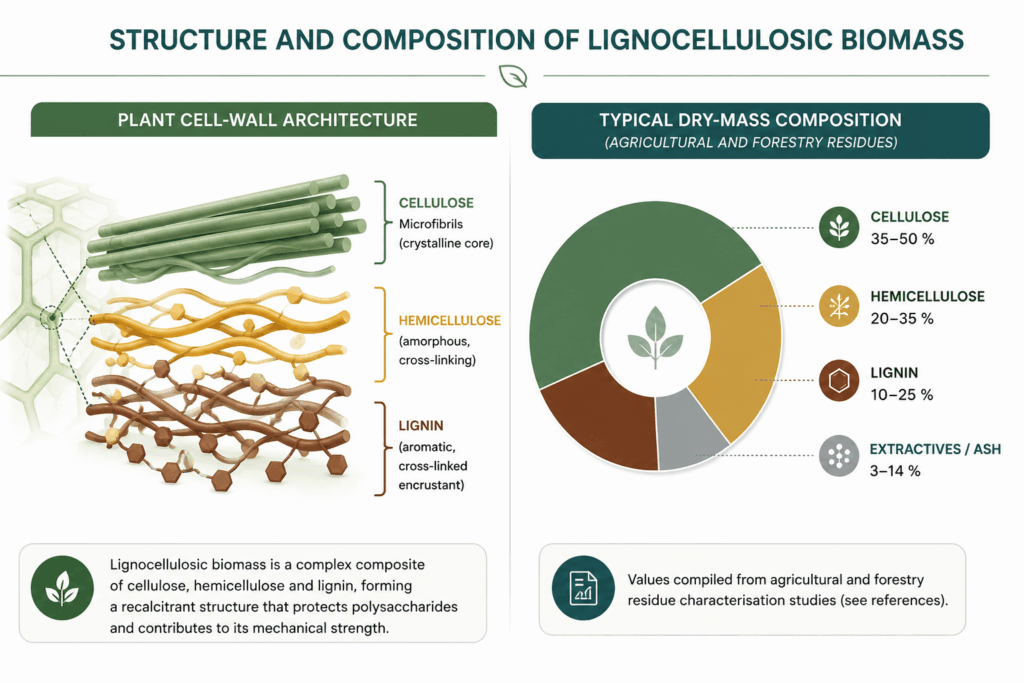
Chemically, lignocellulose is a natural composite of three interwoven biopolymers. Cellulose, highly ordered and hydrogen-bonded, typically makes up 35 – 52% of dry mass; hemicellulose, a branched and largely amorphous polysaccharide that cross-links cellulose microfibrils, accounts for 20 – 35%; and lignin, an irregular aromatic polymer bound to hemicellulose through lignin–carbohydrate complexes, contributes 10 – 25%, with the remainder made up of extractives and ash 9, 10, 11. This composite architecture gives lignocellulose its mechanical strength and its resistance to microbial and enzymatic attack, which is precisely what makes it difficult – and interesting – to valorise.
Processing Technologies
Because native lignocellulose resists direct conversion, essentially every valorisation route begins with a pretreatment, or activation, step intended to increase porosity and surface area, lower cellulose crystallinity, and loosen or separate the three biopolymer fractions 12 Established pretreatment families include thermal and physico-chemical methods such as steam explosion, which combines high-pressure steam hydrolysis with a mechanical decompression step and is regarded as one of the more industrially mature and environmentally favourable options 13; chemical methods such as dilute-acid, alkali, organosolv or ionic-liquid treatment, which solubilise hemicellulose or lignin but require reagent recovery and generate process effluents14; and biological pretreatments using lignin- or hemicellulose-degrading enzymes or micro-organisms, which are mild and specific but slower and harder to scale consistently 12.
Commercial enzymatic routes in particular can be costly: enzyme loadings alone can represent up to 40% of total process cost in some biomass-to-bioplastic value chains, a constraint that is driving interest in lower-cost fractionation alternatives, including mechanical and mechanochemical activation and engineered microbial systems that reduce dependence on commercial enzyme cocktails.
Mechanochemistry: A Sustainable Activation Strategy
Mechanochemistry applies mechanical energy – impact, shear, attrition or compression — to drive structural and chemical change with little or no solvent input. Applied to lignocellulose, recent reviews show that effective mechanochemical pretreatment operates principally through supramolecular modification: the generation of defects within cellulose crystallites and the creation of new reactive surface sites, rather than simple particle-size reduction alone.15 Impact–shear stress regimes have been found to be particularly effective for fibrous lignocellulosic materials 15.
Ball milling
Ball and vibratory milling are the most widely studied mechanochemical technologies for lignocellulose. Reviews consistently report reduced cellulose crystallinity index and degree of polymerisation with increasing milling energy input, together with improved enzymatic digestibility of the resulting substrate 16, 17. Ball milling has also been combined with mild chemical treatments – for example potassium-pyrosulfate-catalysed ‘mechanocatalytical’ milling of barley straw – to facilitate lignin removal while reducing reagent loadings relative to conventional chemical pretreatment 16.
Twin-screw extrusion
Twin-screw extrusion enables continuous and controllable application of shear, compression, and mixing forces as the biomass moves along the screw–barrel system. This provides a scalable pathway for continuous mechanochemical activation, with easier integration into established biorefinery processes compared with conventional batch milling approaches. In trials on sweetcorn by-products, triticale, corn stover and wheat straw, high-shear extrusion profiles increased the proportion of fine particles, solubilised water-soluble compounds, and reduced cellulose crystallinity by up to 8.6% for corn stover, improving downstream biomethane production 18. It has also been configured to simultaneously generate a biomolecule-rich filtrate and a solid extrudate suitable for direct conversion into bio-based materials, positioning it as an integrated fractionation step rather than pretreatment alone 19.
Mechanocatalysis and mechanoenzymatic synergy
Beyond pretreatment, mechanochemistry is being explored as a platform for solvent-free depolymerisation and catalytic transformations conducted directly under milling or extrusion conditions, extending mechanochemical organic-synthesis methods – such as ball-milling- and extrusion-based catalytic coupling chemistry – into the biomass domain 15, 20. A parallel line of research combines enzymatic hydrolysis with mechanical activation to reduce or eliminate bulk water use, although enzyme stability under mechanical and thermal stress during co-milling remains an open challenge 15.
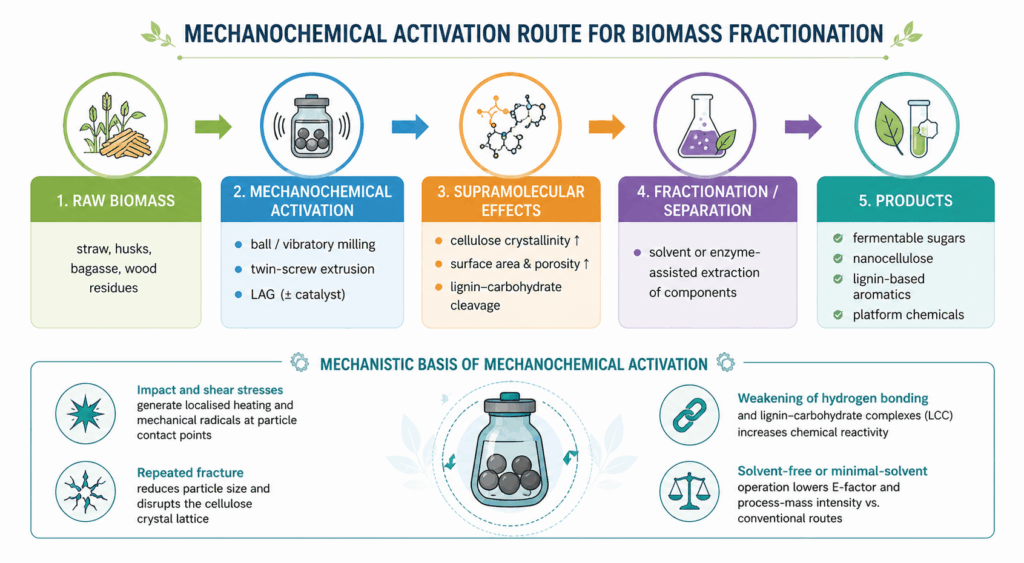
A recurring finding is that pretreatment effectiveness shows diminishing returns beyond a certain milling energy input, so process economics depend on finding an efficient operating window rather than maximising milling intensity 15. Industrial-scale considerations specific to mechanochemical activation include grinding-media wear, contamination risk, and the trade-off between batch and continuous operation; eccentric vibratory mills are already among the few mechanical pretreatment technologies operating at industrial-scale batch throughput 15.
Environmental Impact and Circular Bioeconomy
Life-cycle assessment of lignocellulosic biorefineries typically evaluates greenhouse-gas emissions, energy and water use, and land-use implications across the full biomass-to-product chain, increasingly paired with techno-economic analysis to jointly assess environmental and commercial viability 21. Comparative studies distinguishing first-, second- and third-generation biorefinery pathways generally find that lignocellulosic and later-generation routes offer substantially improved, and in some cases net-negative, emissions profiles relative to fossil-based baselines 22.
Mechanochemical activation minimizes or completely avoids the need for large quantities of bulk solvents, which leads to improved process mass intensity and lower E-factor values compared with conventional solvent-based pretreatment strategies. By reducing solvent consumption, this approach also mitigates the challenges related to solvent recovery and prevents the formation of inhibitory compounds commonly generated during acid, alkaline, or ionic-liquid-based treatments 15, 20. Its principal trade-off is electricity demand for milling or extrusion, so its net environmental benefit depends on the carbon intensity of the electricity supply and on optimising energy input against the diminishing structural returns described above 15.
Policy-wise, the EU’s circular bioeconomy is anchored in the 2012 Bioeconomy Strategy and its 2018 and 2022 reviews, updated in 2025 through a new Strategic Framework for a Competitive and Sustainable EU Bioeconomy that sets out a 2040 vision emphasising the cascaded, resource-efficient use of biomass across value chains, alongside stronger traceability and life-cycle sustainability data requirements for bio-based value chains 23, 24.
Economic Factors and Market Trends
Bio-based chemicals derived from lignocellulosic and other renewable feedstocks represent an expanding segment of the chemicals industry. Market analyses place the global bio-based chemicals market at roughly USD 93–102 billion in 2024–2025, forecast to grow at compound annual rates of around 10% through the early 2030s, reaching an estimated USD 170–200 billion by 2030–2033 25, 26, 27.
Within this category, the global lignin market – a direct co-product of lignocellulose fractionation – was valued at roughly USD 1 billion in 2025–2026, forecast to grow at a modest 3–4% CAGR through 2031–2032, driven mainly by lignosulfonate demand in concrete admixtures, dust suppression and animal feed, alongside emerging high-purity kraft-lignin applications in areas such as carbon-fibre precursors, battery materials and advanced specialty chemicals 28, 29, 30. The broader wood bio-products market is forecast to reach approximately USD 572 billion by 2033, with its bio-based chemicals sub-segment growing at roughly 8.3% CAGR 31.
Recent commercial milestones illustrate the transition of the sector toward higher-value and technically differentiated lignocellulosic products. UPM’s Leuna biorefinery in Germany has reached commercial-scale production of wood-based industrial sugars and lignin-derived functional materials, while Stora Enso has demonstrated the potential of lignin-derived hard carbon (Lignode ®) as an anode material for lithium-ion batteries, showing promising electrochemical performance in long-cycle testing 28.
Key Industrial Stakeholders
A growing set of forestry, pulp-and-paper and specialty-chemical companies have moved lignocellulosic biorefining into commercial or near-commercial operation. Borregaard (Norway) produces lignosulfonates, specialty lignin and bioethanol at its Sarpsborg biorefinery 32. Stora Enso operates a kraft-lignin line at Sunila and is developing lignin-derived hard carbon for batteries 28, 30. UPM Biochemicals’ Leuna plant in Germany produces wood-based industrial sugars and functional lignin fillers 28. Sappi, Ingevity, Domtar, Rayonier Advanced Materials and Nippon Paper Industries round out a group of established players supplying lignosulfonates, kraft lignin, dissolving pulp and cellulose specialties, while Metsä Group and process-technology supplier Valmet support integrated forestry biorefining 28, 30.
Alongside these established players, technology centres and SME-led consortia are developing next-generation fractionation routes tailored to regional agricultural residue streams – of which the BIOVALSA project, described below, is a current example.
Innovation Case Study: The BIOVALSA Project
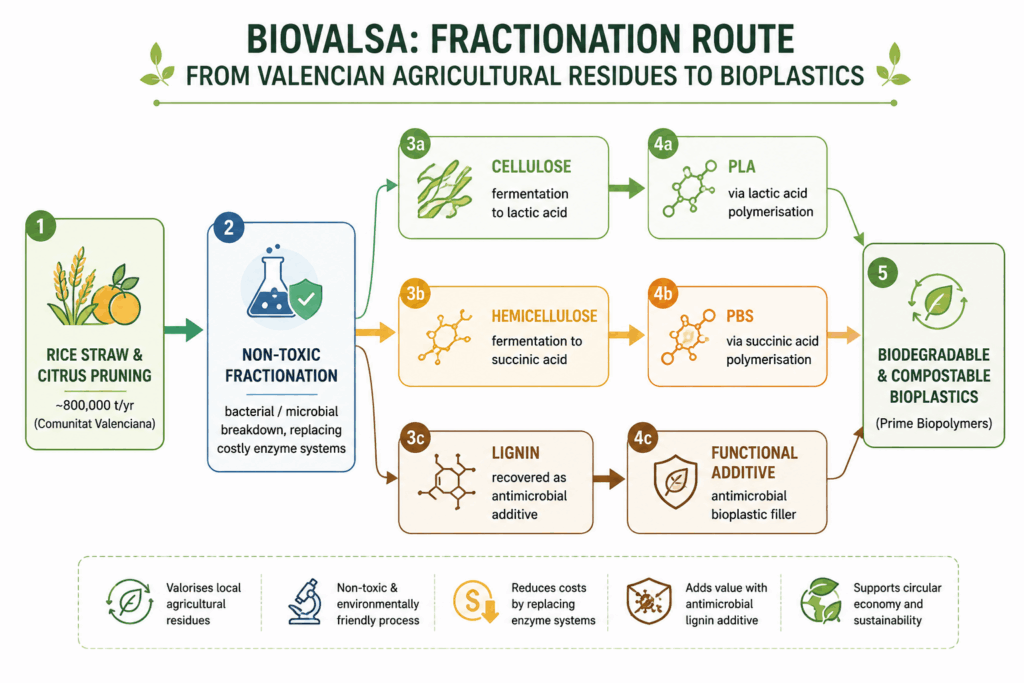
Every year, the Valencian agricultural sector generates around 800,000 tonnes of plant waste, such as rice straw and citrus pruning residues. Current biomass-recovery methods are costly, since commercial enzymes can represent up to 40% of total process cost, which limits industrial viability. To address this, AIMPLAS, the Plastics Technology Centre, is leading BIOVALSA, an initiative developing new processes for manufacturing sustainable bioplastics from agricultural and pruning residues. The project is funded by IVACE+i Innovación and receives financial support from the European Union through the ERDF Comunitat Valenciana programme 2021–2027.
BIOVALSA aims to develop alternative, non-toxic routes for recovering value from rice straw biomass, avoiding costly chemical compounds. The core idea is to replace conventional chemical–enzymatic treatments with processes that recover all three fractions of the lignocellulosic matrix – cellulose, hemicellulose and lignin – for use across the bioplastics industry. Cellulose is directed toward lactic acid, the key monomer for PLA, the most widely used bioplastic; hemicellulose is targeted for conversion into succinic acid, required for PBS, a more flexible and heat-resistant biopolymer; and lignin, owing to its antimicrobial properties, is recovered as a functional additive that limits microbial proliferation, increasing the market value and expanding the potential applications of the resulting biodegradable, compostable materials.
© AIMPLAS
Consortium
Coordinated by AIMPLAS, which contributes its expertise in both waste recovery and biopolymer manufacturing, BIOVALSA brings together specialists from the University Institute of Food Engineering at the Polytechnic University of Valencia (FoodUPV) and three companies based in the Comunitat Valenciana. Bioban contributes genomic analysis to identify the bacterial strains best suited to carrying out the treatments; Viromii is studying the economic viability of the new biocomposite-production processes; and Prime Biopolymers, as end customer, will produce the resulting biomaterials and assess their applicability.
Progress and outlook
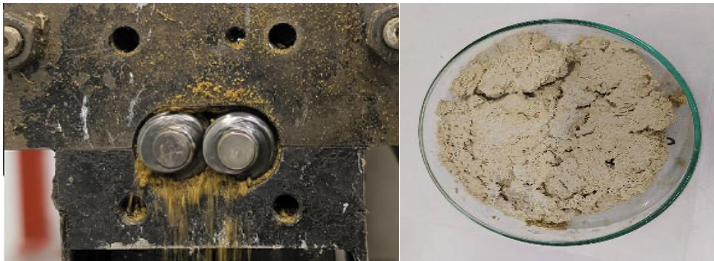
The project is currently in its third year of development. Significant progress has been achieved, including the successful separation and enrichment of rice straw fractions through alternative, non-toxic processing methods. Advanced Laser Spectroscopy (ALS) analysis confirmed a 20% increase in cellulose content compared with untreated rice straw processed directly in the extruder. In parallel, ongoing work focuses on the evaluation of bacterial and microbial strains capable of converting cellulose and hemicellulose fractions into lactic and succinic acids, key building blocks for bioplastic production.
BIOVALSA is aligned with the conclusions of the Strategic Specialised Innovation Committees (CEIE) on Circular Economy and Enabling Technologies, promoted by IVACE+i Innovación – responding, respectively, to the development of materials and technologies for high-added-value products from waste, and to the application of biotechnology to improve processes and products. The project also falls within the main axes of the Comunitat Valenciana’s Smart Specialisation Strategy (S3), coordinated by the Regional Ministry of Industry, Tourism, Innovation and Trade.
As a regionally rooted example of non-enzymatic, low-toxicity lignocellulose fractionation feeding directly into commercial bioplastic production, BIOVALSA illustrates how the broader mechanochemical and biological activation strategies discussed in this report are being translated into concrete industrial value chains for agricultural residues.33
Conclusion
Lignocellulosic biomass, and agricultural and forestry residues in particular, constitute an abundant, low-opportunity-cost renewable carbon resource whose valorisation is central to the circular bioeconomy 8, 9, 11. Effective conversion requires an activation step capable of overcoming the recalcitrant, cross-linked architecture of cellulose, hemicellulose and lignin, and mechanochemistry – through ball milling, twin-screw extrusion and related hybrid mechanocatalytic and mechanoenzymatic processes – offers a solvent-sparing, mechanistically well-characterised route to achieve this 15, 16, 17.
Industrial deployment is already under way among major forestry and specialty-chemical companies, and market analyses point to sustained growth in bio-based chemicals broadly and lignin-derived products specifically, with a clear trend toward higher-value, technically differentiated products 28, 25, 31. Regional initiatives such as BIOVALSA show how these same principles – replacing costly commercial enzymes and toxic chemistries with non-toxic, cost-effective fractionation – are being applied directly to local agricultural residue streams, turning a management burden into a feedstock for compostable bioplastics and reinforcing the feasibility of residue-based biorefineries within Europe’s growing circular economy.
References
1. Generar compost para reducir el problema de la quema de la paja de arroz en l’Albufera. iAgua. https://www.iagua.es/noticias/dam-aguas/generar-compost-reducir-problema-quema-paja-arroz-lalbufera
2. Singhvi, M., & Gokhale, D. (2013). Biomass to biodegradable polymer (PLA). RSC Advances, 3(33), 13558–13568.
3. Rai, R., Ranjan, R., Kant, C., & Dhar, P. (2024). Microplastic and adhesive free, multifunctional, circular economy approach-based biomass-derived drinking straws. iScience, 27(5), 109630. https://doi.org/10.1016/j.isci.2024.109630
4. Rice production, 2024. Our World in Data. https://ourworldindata.org/grapher/rice-production
5. Editorial: Emerging Feedstocks and Clean Technologies for Lignocellulosic Biofuel. Front. Energy Res. 2022. https://www.frontiersin.org/journals/energy-research/articles/10.3389/fenrg.2022.917081/full
6. Lignin Valorization from Lignocellulosic Biomass: Extraction, Depolymerization, and Applications in the Circular Bioeconomy. Sustainability 2025, 17(21), 9913. https://www.mdpi.com/2071-1050/17/21/9913
7. Lignocellulosic biomass from agricultural waste to the circular economy: a review with focus on biofuels, biocomposites and bioplastics. J. Clean. Prod., 2023. https://www.sciencedirect.com/science/article/pii/S0959652623009733
8. Editorial: Emerging Feedstocks and Clean Technologies for Lignocellulosic Biofuel (Ashokkumar et al., 2022, as cited). Front. Energy Res. 2022.
9. Lignocellulosic biomass as a renewable resource: Driving second-generation biofuel innovation from agricultural waste. ScienceDirect, 2025. https://www.sciencedirect.com/science/article/abs/pii/S0961953425005446
10. Recent Trends in the Pretreatment of Lignocellulosic Biomass for Value-Added Products. Front. Energy Res. 2018, 6, 141. https://www.frontiersin.org/journals/energy-research/articles/10.3389/fenrg.2018.00141/full
11. Lignocellulosics — an overview. ScienceDirect Topics. https://www.sciencedirect.com/topics/engineering/lignocellulosics
12. Physical–Chemical–Biological Pretreatment for Biomass Degradation and Industrial Applications: A Review. Biomass 2024, 2(4), 24. https://www.mdpi.com/2813-0391/2/4/24
13. Ziegler-Devin, I.; Chrusciel, L.; Brosse, N. Steam Explosion Pretreatment of Lignocellulosic Biomass. Front. Chem. 2021, 9, 705358. https://doi.org/10.3389/fchem.2021.705358
14. Recent Trends in the Pretreatment of Lignocellulosic Biomass for Value-Added Products. Front. Energy Res. 2018, 6, 141.
15. Mechanical Pretreatment of Plant Biomass: Mechanisms, Energy Efficiency, Technologies, and Life Cycle Assessment. Polysaccharides 2026, 7(2), 38. https://doi.org/10.3390/polysaccharides7020038
16. Ball milling as an important pretreatment technique in lignocellulose biorefineries: a review. Biomass Convers. Biorefinery, 2021. https://link.springer.com/article/10.1007/s13399-021-01800-7
17. Effect of ball-milling on crystallinity index, degree of polymerization and thermal stability of cellulose. Bioresour. Technol., 2018. https://www.sciencedirect.com/science/article/abs/pii/S0960852418312823
18. Twin-Screw Extrusion Mechanical Pretreatment for Enhancing Biomethane Production from Agro-Industrial, Agricultural and Catch Crop Biomasses. Biomass 2023, 1(2), 30. https://www.mdpi.com/2813-0391/1/2/30
19. Aqueous Pretreatment of Lignocellulosic Biomass for Binderless Material Production: Influence of Twin-Screw Extrusion Configuration and Liquid-to-Solid Ratio. 2024. https://www.ncbi.nlm.nih.gov/pmc/articles/PMC11243502/
20. Temperature-Controlled Mechanochemistry for the Nickel-Catalyzed Suzuki–Miyaura-Type Coupling of Aryl Sulfamates via Ball Milling and Twin-Screw Extrusion. 2023. https://www.ncbi.nlm.nih.gov/pmc/articles/PMC9828252/
21. Techno-Economic and Life Cycle Analysis of Biorefineries: Assessing Sustainability and Scalability in the Bioeconomy. Environ. Qual. Manage., 2025. https://onlinelibrary.wiley.com/doi/10.1002/tqem.70077
22. Life-cycle assessment of three biorefinery pathways across different generations. Sci. Rep. 2025, 15, 13135. https://www.nature.com/articles/s41598-025-96474-w
23. The European bioeconomy strategy revision: An opportunity to go against the tide and secure a sustainable future. ScienceDirect, 2026. https://www.sciencedirect.com/science/article/pii/S2772801326000011
24. The new EU Bioeconomy Strategy: a regulatory framework in transition. Crowell & Moring LLP, 2025. https://www.crowell.com/en/insights/client-alerts/the-new-eu-bioeconomy-strategy-a-regulatory-framework-in-transition
25. Bio-based Chemicals Market Size. SkyQuest, 2026. https://www.skyquestt.com/report/bio-based-chemicals-market
26. Bio-Based Chemicals Market Size, Share, Industry Trend and Forecast 2030. IndustryARC. https://www.industryarc.com/Report/17741/bio-based-chemicals-market.html
27. Bio-based Chemicals Market Size, Share, CAGR of 11.6%. Market.us, 2025. https://market.us/report/bio-based-chemicals-market/
28. Lignin Market to Reach USD 1263.6 Million by 2032 at 2.37% CAGR. Maximize Market Research, 2026. https://www.einpresswire.com/article/906889107
29. Lignin-based Biopolymers Market Size, Share and Growth Analysis Report, 2024–2034. Research and Markets. https://www.researchandmarkets.com/reports/6183777
30. Lignin Products Market Report. Mordor Intelligence, 2026. https://www.mordorintelligence.com/industry-reports/lignin-products-market
31. Wood Bio-Products Market Size, Growth Report, 2026–2033. Grand View Research. https://www.grandviewresearch.com/industry-analysis/wood-bio-products-market-report
32. Lignin Market Size, Share, Industry Report 2025–2032. Fortune Business Insights. https://www.fortunebusinessinsights.com/lignin-market-104547
33. BIOVALSA project overview. AIMPLAS, Plastics Technology Centre. https://www.aimplas.net/areas/circular-economy/
Author
Agnieszka Kobus (AIMPLAS)
Source
AIMPLAS, original text, 2026-07.
Supplier
AIMPLAS (Asociación de Investigación de Materiales Plásticos y Conexas)
Borregaard
Domtar Paper Company
European Regional Development Fund
European Union
Generalitat Valenciana
Ingevity
Metsä Group
Nippon Paper Industries Co., Ltd.
Rayonier Advanced Materials
Sappi Global
Stora Enso
Strategic Specialised Innovation Committees (CEIE)
UPM Biochemicals
Valencian Institute of Competitiveness and Innovation (IVACE+i)
Valmet
Share
Renewable Carbon News – Daily Newsletter
Subscribe to our daily email newsletter – the world's leading newsletter on renewable materials and chemicals