© Bio-KE
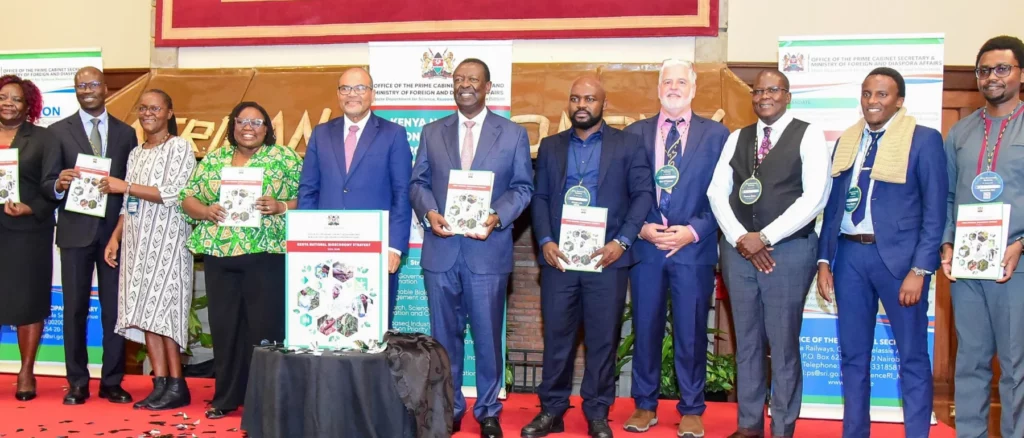
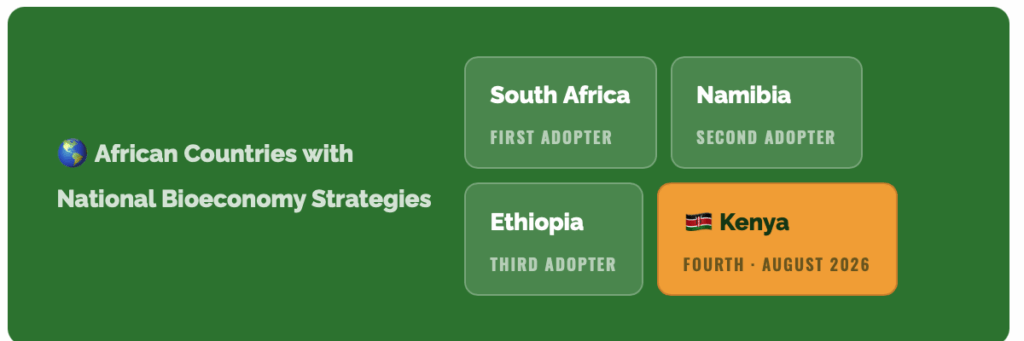
Kenya has just done something only three other African countries have ever done. On Tuesday, 25 August 2026, at the Windsor Hotel in Nairobi, the government — led by Prime Cabinet Secretary Musalia Mudavadi — launched the National Bioeconomy Strategy 2026–2036, a ten-year plan to turn the country’s biological wealth — its crops, livestock, forests, microbes, agricultural waste and scientific know-how — into industries, jobs and household incomes.
For most Kenyans going about their daily lives, “bioeconomy” can sound like a term reserved for scientists in laboratories. In truth, it is a strategy about the maize a farmer grows, the milk a pastoralist sells, the banana stems left to rot after harvest, and the ideas young innovators are nursing in university hubs across the country. It is about turning what Kenya already has in abundance into products, businesses and paychecks.
“The question is no longer whether we have the resources to build a bioeconomy, but whether we have the vision and determination to turn those resources into greater prosperity for our people.” – Prime Cabinet Secretary Musalia Mudavadi, at the Strategy Launch.
So What Changes for the Ordinary Kenyan?
The strategy’s central promise is value addition. For generations, Kenya has largely exported raw biological resources — tea leaves, raw hides, unprocessed fruit, raw fibre — while other countries turn them into higher-value goods. The new strategy pushes for that processing to happen at home.
- For Farmers Banana stems once discarded could become sanitary products. Agricultural waste could become biofertiliser, animal feed or energy — turning losses into income
- For Pastoralists Livestock byproducts could feed into biotech and manufacturing value chains rather than being lost after slaughter
- For Young Innovators A clear pathway from lab or farm idea to a viable enterprise, through stronger university–research–industry links
- For Entrepreneurs & SMEs A Bioeconomy Investment and Financing Roadmap to connect good ideas with financiers willing to back bio-based enterprises
- For Local Economies More factories and processing hubs closer to where raw materials are produced — creating jobs in rural and peri-urban areas
- For Households Stronger food systems, smarter use of fertiliser and water, and reduced post-harvest losses that quietly erode farmers’ incomes every season
Strategy Targets & Investment Ambitions
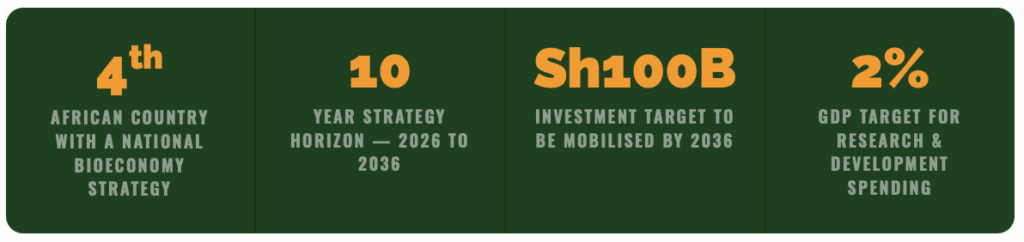
The government has set an ambition to mobilise Sh100 billion in bioeconomy investment by 2036, alongside a commitment to progressively raise research and development spending toward 2 percent of GDP. A proposed Bioeconomy Investment and Financing Roadmap is designed to connect entrepreneurs, farmers and researchers with financiers willing to back bio-based enterprises — addressing a long-standing gap where promising ideas stall for lack of capital.
SH100B INVESTMENT TARGET – 2% GDP FOR R&D – BIOECONOMY FINANCING ROADMAP – VALUE CHAIN DEVELOPMENT – GREEN JOB CREATION
“The success of this Strategy will ultimately be measured not by the quality of the document we launch today, but by the businesses established, the innovations commercialised, the investments mobilised, the value chains strengthened and, most importantly, the jobs and livelihoods created for Kenyans.” – Prime Cabinet Secretary Musalia Mudavadi.
Young People and Small Enterprises at the Centre
Young people and small enterprises sit at the heart of this vision.
Mudavadi spoke directly to the innovator working with little more than an idea and a dream: “We must ensure that the young Kenyan who has an idea in a laboratory, on a farm, in a university or in an innovation hub can see a pathway from that idea to a viable enterprise.”
That pathway is meant to run through stronger links between universities, research institutions and industry, so that promising research does not stay locked in laboratories but reaches markets, factories and farms.
Bio-KE at the Heart of This Milestone
Among those present at the launch was Prof. Thomas Rewe, Coordinator of the National Bioeconomy Education and Policy Framework (Bio-KE), who served on the Technical Working Group that helped draft the strategy — a direct recognition of Bio-KE’s contribution to shaping Kenya’s national bioeconomy vision.
“Kenya has made history today, joining only three other countries on the continent to launch a dedicated national bioeconomy strategy. This is more than a policy document — it is the blueprint for the next economic miracle, one built on the bio-based resources Kenyans already hold in their hands, farms and forests.” – Prof. Thomas Rewe, Coordinator, Bio-KE.
What Comes Next — Bio-KE’s Role in Translation
For Bio-KE, the task now shifts to translation — helping Kenyans everywhere understand what the strategy means for them, and helping connect farmers, students, researchers and entrepreneurs to the opportunities it is designed to unlock. The resources have always been here. What the strategy offers is a roadmap for turning them into lasting prosperity.
Bio-KE’s Role in Delivering the Strategy
- Curriculum integration: Embedding bioeconomy principles and skills into university programmes at Pwani University, Chuka University and beyond, producing graduates ready to drive strategy implementation
- Policy translation: Converting the strategy’s targets into practical frameworks, toolkits and resources that institutions, businesses and communities can act on immediately
- Stakeholder connection: Linking farmers, innovators, researchers and entrepreneurs to the financing pathways, research partnerships and enterprise support the strategy enables
- International knowledge bridge: Drawing on Bio-KE’s European and global partnerships to bring proven bioeconomy models — from Kalundborg, Denmark to CIFOR-ICRAF and beyond — into Kenya’s implementation journey
About Bio-KE
Bio-KE is building Kenya’s National Bioeconomy Education and Policy Framework — and helped draft the very strategy launched today. Join us as we turn Kenya’s biological wealth into lasting prosperity. www.bio-KE
Source
Bio-KE, press release, 2026-08-25.
Supplier
Bio-KE
Chuka University
Landscape Alliance
Pwani University
Share
Renewable Carbon News – Daily Newsletter
Subscribe to our daily email newsletter – the world's leading newsletter on renewable materials and chemicals