The German Federal Statistical Office expects a sharp expansion in grain legume area for the 2026 harvest. Production of dry peas, broad beans and soybeans has been expanded noticeably in Germany. The Union zur Förderung von Oel- und Proteinpflanzen e. V. (UFOP) fears that the European Commission’s plan to classify soybeans as a high-iLUC feedstock will result in massive collateral damage to soybean cultivation in the EU. UFOP has called on the German Minister of Agriculture Alois Rainer and members of the EU Parliament to stop the draft delegated regulation.
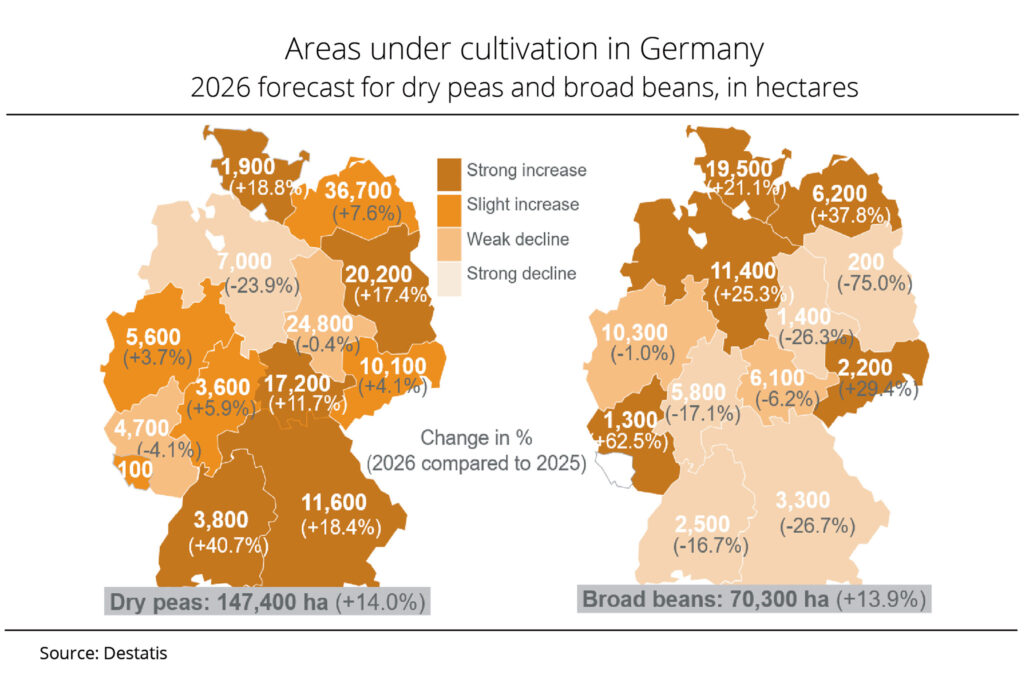
According to the German Federal Statistical Office’s latest forecast of grain legume cultivation area for the 2026 harvest, the dry pea area in Germany has expanded to approximately 147,400 hectares, representing a 14 per cent rise compared to the previous year. With the exception of Lower Saxony, Rhineland Palatinate and Saxony-Anhalt, all German states are recording increases in production area. Baden-Wuerttemberg is expected to record the biggest expansion in area with an increase of 40.7 per cent, reaching 3,800 hectares. Schleswig-Holstein and Bavaria are projected to see increases of 18.8 per cent and 18.4 per cent respectively. Mecklenburg-Western Pomerania, the most important German state in terms of area, is expected to record an increase of 7.6 per cent, bringing the pea area to 36,700 hectares.
The German Federal Statistical Office also anticipates a substantial expansion in broad bean area. The 2026 broad bean area is estimated at 70,300 hectares, representing an increase of 13.9 per cent compared with 2025. However, changes vary by region. Whereas expansions prevail in the north-west, some declines have been recorded in other regions.
Soybean cultivation is also expected to have grown significantly Germany in 2026. The soybean area is expected to reach around 51,000 hectares, representing an increase of 17.8 per cent year on year. Production remains mainly located in southern Germany, with Bavaria reporting an area of 24,100 hectares (+5.7 per cent) and Baden-Wuerttemberg 7,700 hectares (+4.1 per cent). The largest percentage increases are expected in eastern Germany, with Mecklenburg-Western Pomerania doubling its area to 1,600 hectares (+100 per cent), and Saxony-Anhalt and Saxony expanding the soybean area to 6,200 hectares (+87.9 per cent) and 2,600 hectares (+ 36.8 per cent) respectively. In general, all German states are expected to see expansions in area.
The Union zur Förderung von Oel- und Proteinpflanzen e. V. (UFOP) regards the trend in production area as confirmation that the agricultural sector is increasingly expanding the diversity of crops in crop rotation to include grain legumes as atmospheric nitrogen-fixing flowering plants, thereby unlocking new potential for added value in arable farming. However, according to UFOP, for the positive trend to continue, it is essential that growing these crops remains profitable for farmers. The association has therefore welcomed the protein strategies announced both by the EU Commission and the German Ministry of Agriculture which aim to support production through a wide range of business incentives and thus make a sustainable contribution to protein supply.
However, the plan by the European Commission’s Directorate-General for Energy to classify soybeans worldwide as a so-called high-iLUC feedstock has met with little understanding. This could seriously undermine the desired development of farming in Europe. UFOP has therefore called upon both Council and Parliament to stop the draft delegated regulation. From UFOP’s perspective, it is downright absurd that the fact that soybeans contain only 20 per cent oil should classify them as a high-iLUC feedstock when used for biofuel production. This would also deprive EU-grown soybeans of an option for creating added value. What is more, the regulation would also effectively hold European soybean cultivation responsible for a misguided international policy on rainforest protection. The UFOP has therefore called on Federal Minister Rainer to support Austria’s initiative at the Council of Agriculture Ministers in order to stop the draft. UFOP has also called on the European Parliament to put a stop to this regulatory nonsense and instead develop a polluter-pays approach to effectively tackle deforestation in South America.
Source
Union zur Förderung von Oel- und Proteinpflanzen e. V. (UFOP), press release, 2026-05-21.
Supplier
Bundesministerium für Landwirtschaft, Ernährung und Heimat (BMLEH) (formerly BMEL)
European Commission
European Union
Union zur Förderung von Oel- und Proteinpflanzen e.V. (UFOP)
Share
Renewable Carbon News – Daily Newsletter
Subscribe to our daily email newsletter – the world's leading newsletter on renewable materials and chemicals