 Horizon Europe Project PYSOLO: New Factsheet Highlights the Potential of Concentrated Solar Thermal (CST) for Industry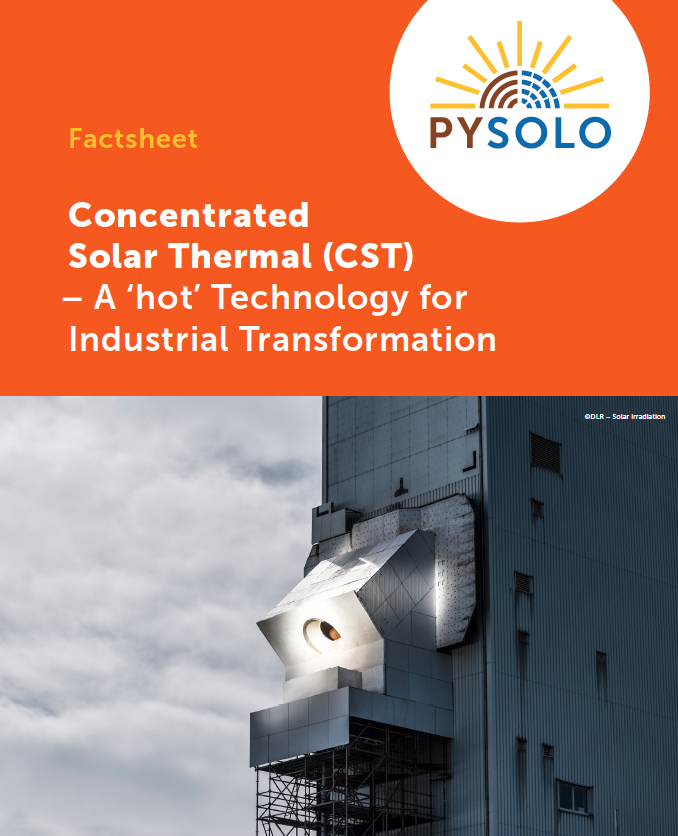
As part of the EU-funded PYSOLO project, a new factsheet on Concentrated Solar Thermal (CST) has been released. The document provides a concise yet comprehensive overview of this key technology for the industrial energy transition, outlining its applications, benefits, and current challenges.
High-temperature heat from solar energy
CST refers to the use of mirrors (heliostats) that concentrate solar radiation to generate very high temperatures. This heat can be directly used in industrial processes, such as chemical reactions, process heat supply, or electricity generation (in which case it is referred to as Concentrated Solar Power, CSP).
By providing renewable high-temperature heat, the technology can play a crucial role in both decarbonisation and defossilisation efforts.
Focus on industrial applications
A key part of the factsheet is the presentation of concrete use cases for CST:
- Biomass pyrolysis to produce bio-oil, biochar, and syngas
- Industrial process heat for sectors such as steel and mining
- Advanced plastics recycling
- Solar fuel production (e.g. hydrogen or syngas)
- Recovery of raw materials such as phosphorus and iron
- Electricity generation with integrated thermal storage
This wide range of applications highlights CST’s versatility across industries.
PYSOLO: solar-driven pyrolysis of biomass
The factsheet also showcases the role of the PYSOLO project, which focuses on harnessing CST for biomass pyrolysis. Compared to conventional processes that rely on fossil-based heat, the solar-driven approach enables:
- higher yields of valuable products
- reduced CO₂ emissions
- more efficient and sustainable operations
A major focus lies on the development of a solar-driven reactor and suitable particle heat carriers (PHC) capable of withstanding very high temperatures.
Opportunities and challenges
In addition to its advantages, the factsheet also addresses key challenges:
- high upfront investment costs
- need for locations with strong solar irradiation
- land requirements for mirror fields
- maintenance needs (e.g. cleaning and alignment of mirrors)
At the same time, supportive EU policy frameworks are helping to accelerate the deployment of these technologies.
The factsheet concludes that CST/CSP can become a cornerstone of a climate-neutral energy system. Especially when combined with storage solutions and other renewable technologies, CST offers the potential to deliver stable, continuous, and sustainable energy for industrial applications.
Access the full factsheet: https://pysolo.eu/publications/#Factsheets
With this new publication, the PYSOLO project contributes valuable insights into high-temperature solar thermal applications and demonstrates how innovative technologies can support the transformation of Europe’s industry toward sustainability.

Funded by the European Union. Views and opinions expressed are however those of the author(s) only and do not necessarily reflect those of the European Union or the European Climate, Infrastructure and Environment Executive Agency. Neither the European Union nor the granting authority can be held responsible for them.
Source
nova-Institute, original text, 2026-03-31.
Supplier
Centre de Ciència i Tecnologia Forestal de Catalunya
Deutsches Zentrum für Luft- und Raumfahrt e. V. (DLR)
EU-CORE Consulting
Horizon Europe
INERIS
nova-Institut GmbH
Politecnico di Milano (POLIMI)
Politecnico Di Torino
RE-CORD
Spanish National Research Council (CSIC)
Share
Renewable Carbon News – Daily Newsletter
Subscribe to our daily email newsletter – the world's leading newsletter on renewable materials and chemicals