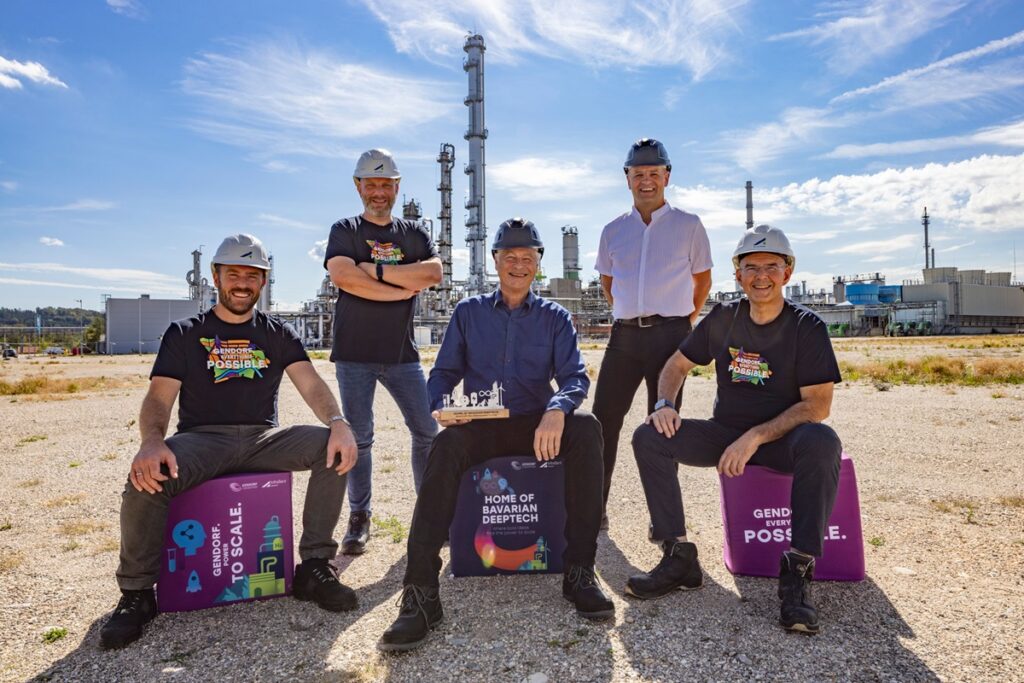
Deep-tech startup Furanova is planning to build a pilot plant for the production of bio-based plastics feedstocks at Gendorf Chemical Park in Burgkirchen, Germany. According to site operator InfraServ Gendorf, the company will gradually relocate its current activities from Raubling to the chemical park. Start-up of the pilot facility is scheduled for the first quarter of 2027.
At the heart of Furanova’s technology is the production of 2,5-furandicarboxylic acid (FDCA), a key building block for bio-based polymers such as polyethylene furanoate (PEF). PEF is regarded as a potential alternative to petrochemically derived PET in a range of applications.
Deep-tech startup Furanova is planning to build a pilot plant for the production of bio-based plastics feedstocks at Gendorf Chemical Park in Burgkirchen, Germany. According to site operator InfraServ Gendorf, the company will gradually relocate its current activities from Raubling to the chemical park. Start-up of the pilot facility is scheduled for the first quarter of 2027.
At the heart of Furanova’s technology is the production of 2,5-furandicarboxylic acid (FDCA), a key building block for bio-based polymers such as polyethylene furanoate (PEF). PEF is regarded as a potential alternative to petrochemically derived PET in a range of applications.
Furanova says its process uses sugar as a feedstock and renewable electricity as its energy source. In an electrochemical process, a furan intermediate is first produced and subsequently oxidized to FDCA. Green hydrogen is generated as a co-product, enabling the production of two industrially relevant products within a single process.
The company plans to move into office space at Gendorf Chemical Park in autumn 2026. The pilot plant is to be built on the approximately 3,500-square-metre “Base One” site, which InfraServ has developed specifically for pilot facilities operated by startups and scale-ups.
Further expansion is already envisaged. Furanova plans to add a demonstration plant and, at a later stage, a full-scale production facility at the site. According to InfraServ, the company expects to create between 60 and 80 jobs in Gendorf over the long term.
Furanova highlights PEF’s improved barrier properties against carbon dioxide, oxygen and water vapour compared with PET. In addition to packaging, the company sees potential applications in engineering plastics, fibres and polyurethanes.
The company’s long-term objective is to scale its FDCA technology to industrial production and subsequently commercialize or license the process.
Gendorf Chemical Park is currently expanding its infrastructure and support services for industrial deep-tech companies. Through its “Home of Bavarian Deeptech” programme and the “Base One” development site, the park aims to help young technology companies bridge the gap between pilot-scale development, demonstration projects and industrial production.
Source
Supplier
Share
Renewable Carbon News – Daily Newsletter
Subscribe to our daily email newsletter – the world's leading newsletter on renewable materials and chemicals