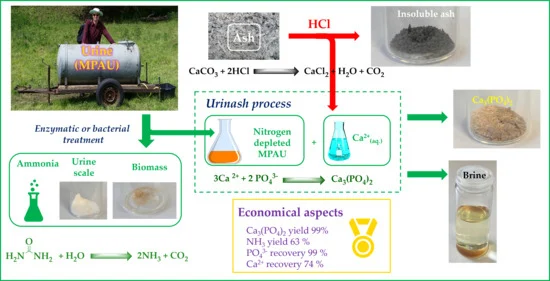
How can waste be put to good use instead of being disposed of? A research team at Saarland University developed an innovative approach that converts readily available waste materials – urine and ash – into valuable raw materials. The researchers aim to make good use of these two waste materials to provide nitrogen, phosphorus, calcium and magnesium – the basis of many fertilizers currently in high demand. The research findings were recently published in the renowned journal Bioengineering.
The following text has been machine translated from the German with no human editing.
Ash and urine are regarded as unwanted waste materials. They are produced in enormous quantities and also cause massive environmental problems. For instance, urine from intensive livestock farming contributes significantly to the contamination of soil and groundwater with nitrogen and phosphorus compounds, whilst wood ash must be disposed of in landfill sites. At the same time, both urine and ash contain valuable chemical components, including nitrogen, phosphorus, calcium and magnesium. These elements are among the most important raw materials for agriculture and industry.
Researchers led by Claus Jacob, Professor of Bioorganic Chemistry at Saarland University, have now developed the so-called ‘Urinash process’. It combines simple biological and chemical processes that can be used to convert the two waste products into valuable materials.
“The aim is to produce ‘green’ ammonia and calcium phosphate – both in-demand products with numerous potential applications,” explains Claus Jacob.
Green ammonia can, for example, serve as a climate-friendly energy source or as a raw material for fertilisers, whilst calcium phosphate is widely used in agriculture, medicine and materials science, amongst other fields.
In addition to recovering valuable raw materials, the research team is also investigating the practical implementation of the process. This includes issues relating to the collection, transport and processing of the raw materials, as well as the potential for scaling the process up to industrial levels.
“In the long term, the process could make an important contribution to the bioeconomy and a sustainable circular economy in our region too: it would make good use of regional waste streams, reduce the environmental impact previously caused by these substances and, at the same time, decrease the demand for energy-intensive ‘grey’ ammonia production, thereby curbing the environmentally damaging extraction of phosphate deposits,” says Professor Claus Jacob.
The project thus demonstrates how previously unused and unwanted waste materials can be transformed into valuable resources – an important step towards a more sustainable and resource-efficient regional circular economy.
Link to the original publication: https://doi.org/10.3390/bioengineering13070720
Contact
Prof. Dr Claus Jacob
Chair of Bioorganic Chemistry
Email: c.jacob@mx.uni-saarland.de
Tel.: 01573 0784388
Source
Saarland University, press release, 2026-07-07.
Supplier
Share
Renewable Carbon News – Daily Newsletter
Subscribe to our daily email newsletter – the world's leading newsletter on renewable materials and chemicals