Recycled and bioplastics are playing an increasingly important role in the transition to a sustainable economy. Their suitability for electromechanical assemblies – which are used, for example, in the automotive sector under harsh environmental conditions – has therefore been investigated.
The components must form a tight bond between the plastic and metal parts. This bond has been made possible by optimised plasma pre-treatments, which also enable applications beyond electromechanical assemblies that require good adhesion.
About electromechanical assemblies
To improve the sustainability of industrial production, greater use can be made of alternatives to conventional materials derived from crude oil. To contribute to this, INNOVENT, in a joint research project with febana Feinmechanische Bauelemente GmbH, investigated how electromechanical assemblies comprising plastic and metal components can also be manufactured using bio-based and recycled plastics. These electromechanical assemblies are used, for example, as connector or sensor housings – some of which have safety-critical applications in industrial settings – and contain additional components such as conductor tracks or printed circuit boards. They are used in demanding environments characterised by wide temperature ranges, high humidity and, in some cases, aggressive chemicals. The components moulded into the plastic housing must exhibit good adhesion to the housing and the encapsulants used, in order to prevent the ingress of liquids.
How do recycled and bioplastics compare?
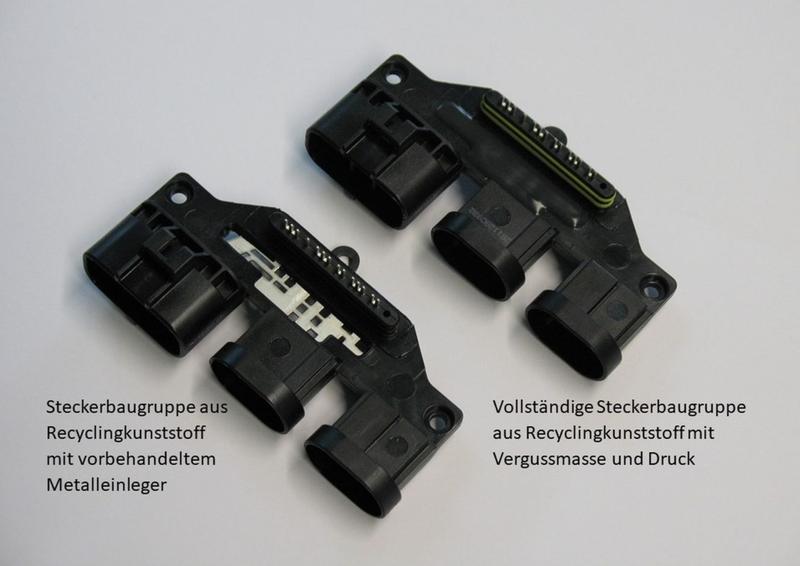
In order to investigate all these requirements, febana Feinmechanische Bauelemente GmbH developed a prototype assembly, which is shown in Figure 1 at various stages of production. This enabled the interaction between recycled and bioplastics and the metal components to be examined. Of particular relevance were the mechanical and thermal properties, as well as the chemical composition of the plastics. The recycled plastics examined all met the required specifications, whilst the bioplastics fell slightly short of the required strength, depending on the filler used.
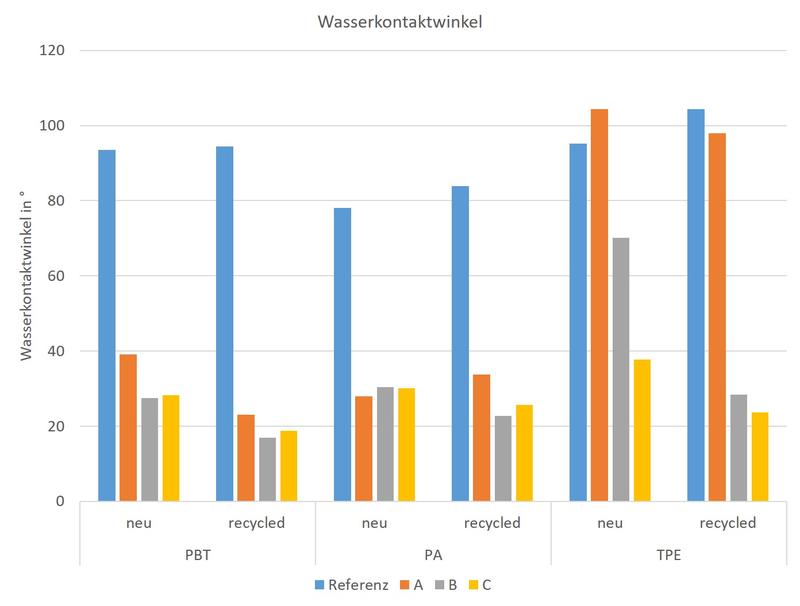
In order to further improve the adhesion between plastic and metal, pre-treatments were carried out using flame treatment and atmospheric pressure plasma. The different plastics required different plasma parameters to achieve an optimal bonding result. Figure 2 shows the improvements in wettability achieved by the plasma treatment. Flame treatment, on the other hand, proved to be an unsuitable method for the complex geometries of the assembly.
The composite materials successfully produced using plasma activation in the test assemblies were successfully tested for leak-tightness in real-world conditions.
And what can you do with it?
These studies show that recycled plastics do not have to spend their lives as ‘downcycled’ products such as window boxes or fence posts, or even end up in thermal recovery, but can instead be subject to economically viable ‘upcycling’, for example for applications in the automotive sector. The use of bioplastics in the toy industry is also a possibility.
The insights gained into the activation of recycled and bioplastics also open up new areas of application beyond composite materials in electromechanical assemblies. For example, plasma activation can also improve the printability of plastics using standard inks, which plays an important role in product marketing. By combining recycled or bioplastics with atmospheric pressure plasma, it is therefore possible to reduce the use of fossil-based raw materials, minimise waste and establish material cycles.
Contact
INNOVENT e.V.
Klaus Vogelsang
Scientific Stuff (Surface Technology)
E-Mail: k.vogelsang@innovent-jena.de
Source
INNOVENT, press release, 2026-06-26.
Supplier
febana Feinmechanische Baugruppen GmbH
INNOVENT
Share
Renewable Carbon News – Daily Newsletter
Subscribe to our daily email newsletter – the world's leading newsletter on renewable materials and chemicals