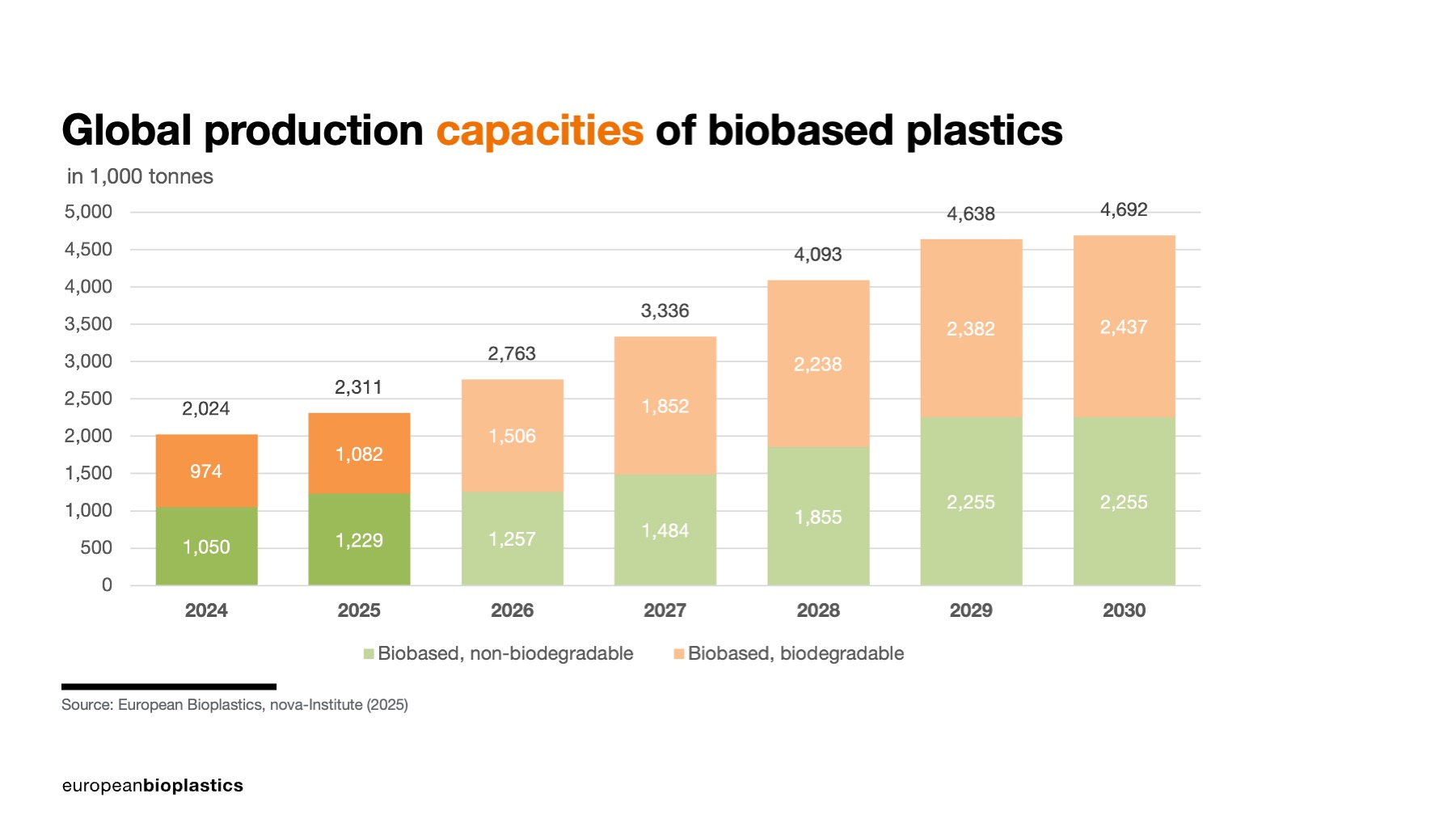
According to the report, global biobased plastics production capacity is projected to double from 2.31 million tonnes in 2025 to approximately 4.69 million tonnes by 2030. Biobased plastics currently represent around 0.5% of the 431 million tonnes of plastics produced worldwide each year. The increase reflects both rising market demand and ongoing innovation in material performance and applications.
“The steady rise in biobased plastics production highlights our industry’s role in supporting a more sustainable, circular economy,” said von Pogrell. “With increasing consumer and regulatory focus on low-impact materials, bioplastics are positioned to expand across diverse sectors and contribute to Europe’s evolving bioeconomy.”
Bioplastic alternatives are now available for nearly all conventional plastics and applications. The report shows that due to a strong global development of biobased and biodegradable polymers, such as polyhydroxyalkanoates (PHA) and polylactic acid (PLA), polypropylene (bioPP) as well as a steady growth of polyethylene (bioPE), the production capacities will continue to increase significantly within the next 5 years.
In Europe (EU27+3), growth is concentrated particularly in additional capacities for bioPP, bioPE, and PHA, underscoring the region’s strategic focus on scaling key technologies.
Bioplastics continue to diversify across industries, including packaging, textiles & fibres, consumer goods, automotive, and agriculture. In 2025, packaging remains the largest market segment, representing 41.3% (0.95 million tonnes) of global bioplastics production capacities – a slight decrease in share compared with 2024. The automotive & transport segment continues to grow and now reaches 0.24 million tonnes, accounting for 10.3% of applications.
The report also compares production capacity with actual production. In 2025, the global bioplastics industry operated at an average utilisation rate of 72%, producing 1.67 million tonnes out of a total production capacity of 2.31 million tonnes. Utilisation levels vary significantly by polymer, ranging from 28% to 100%, depending on technology maturity and market development. In Europe, the utilisation rate is slightly higher at 73%.
“The next phase of bioplastics market growth will depend on clear and stable policies that encourage innovation and investment.”said von Pogrell. “With Europe’s renewed bioeconomy agenda now explicitly recognising bioplastics, coherent regulation will be key to fully unlocking their potential across industries.”
The market data update 2025 has been compiled in cooperation with the market experts of the nova-Institute (Hürth, Germany).
Source
European Bioplastics e.V., press release, 2025-12-02.
Supplier
European Bioplastics e.V.
nova-Institut GmbH
Share
Renewable Carbon News – Daily Newsletter
Subscribe to our daily email newsletter – the world's leading newsletter on renewable materials and chemicals