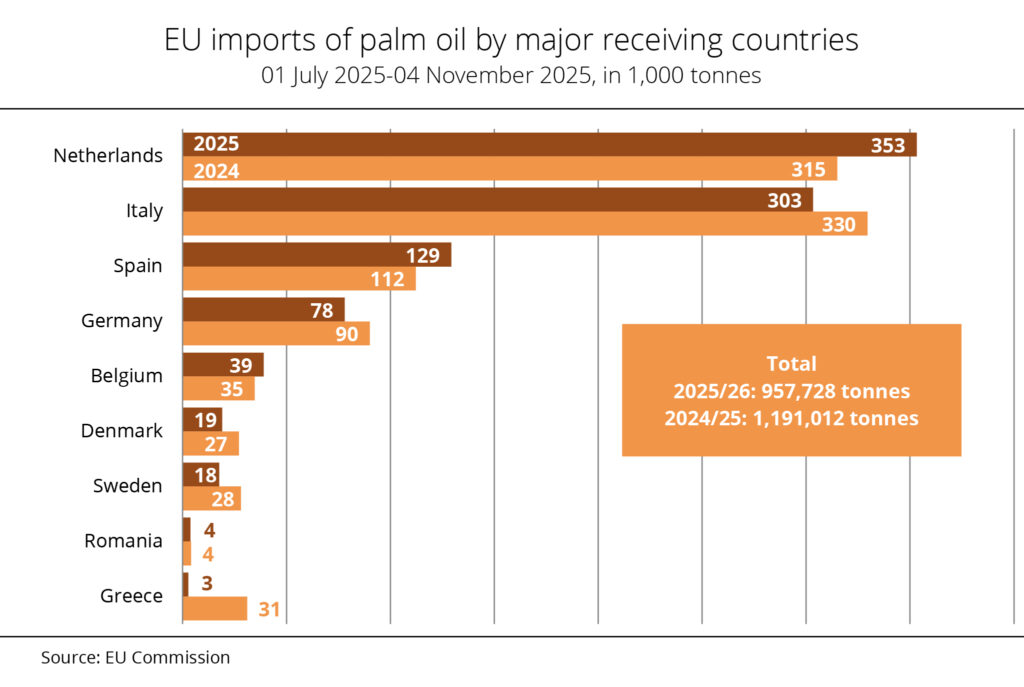
The downward trend in palm oil imports into the EU-27 continues, as is confirmed by the EU Commission’s import figures. The decline is due to the exclusion of biofuels derived from palm oil from being credited towards national quota obligations. At the same time, imports of waste oils and fats for use in transport fuel production are on the rise.
According to the EU Commission, the European Union imported nearly 958,000 tonnes of palm oil between 1 July and 2 November 2025 – a drop of roughly 20 per cent compared to the same period in the previous year. Malaysia remained the leading supplier, providing 272,000 tonnes and accounting for 28 per cent of total imports. This represents a slight increase in the country’s exports compared to the reference period. Indonesia ranked second with 261,000 tonnes, marking a sharp decline.
On the recipient side, the Netherlands remained the leading hub for European palm oil trading and a key location for biofuel production. At 353,000 tonnes, the country absorbed roughly 12 per cent more palm oil than in the same period the previous year. Italy took second place among importing countries, receiving 303,000 tonnes, which represents a decrease of 8 per cent. Greece recorded the sharpest decline (-91 per cent), followed by Sweden (-37 per cent) and Denmark (-30 per cent). Germany imported 78,000 tonnes, down 13 per cent year-on-year. In contrast, Belgium and Spain slightly increased their import volumes. According to research by Agrarmarkt Informations-Gesellschaft (AMI), these countries, along with the Netherlands, are among the few EU countries showing an upward import trend.
From the perspective of the Union zur Förderung von Oel- und Proteinpflanzen e.V. (UFOP), the continued decline in imports reflects the fundamentally critical public debate on palm oil. In several EU member states, this has already led to the exclusion of biofuels derived from palm oil from counting towards quota obligations. Such exclusions must be implemented across the entire EU by 2030. The figures also clearly show that there has been an increase in demand for imports of waste oils and fats used in biodiesel and HVO production to compensate for the decline in palm oil imports. Depending on waste category, these imports can be counted double towards national quota obligations. According to the UFOP, this double counting has created incentives to commit fraud and also generated virtual GHG reduction quotas that are not eligible for credit towards climate mitigation targets in the transport sector.
Emphasising that this “nonsense in climate policy” must be stopped as soon as possible, the association has welcomed the planned abolition of double counting provided for in the draft bill to amend the GHG quota act.
The UFOP strongly criticises the fact that the draft bill was not adopted at today’s Federal Cabinet meeting and that, as a result, the parliamentary legislative process has still not been initiated. The association expects the Federal Chancellery to finally take action – not least to avoid charging proceedings by the European Commission, which could damage Germany’s reputation.
Source
UFOP, Chart of the Week 46 (2025), press release, 2025-11-12.
Supplier
European Commission
European Union
Union zur Förderung von Oel- und Proteinpflanzen e.V. (UFOP)
Share
Renewable Carbon News – Daily Newsletter
Subscribe to our daily email newsletter – the world's leading newsletter on renewable materials and chemicals