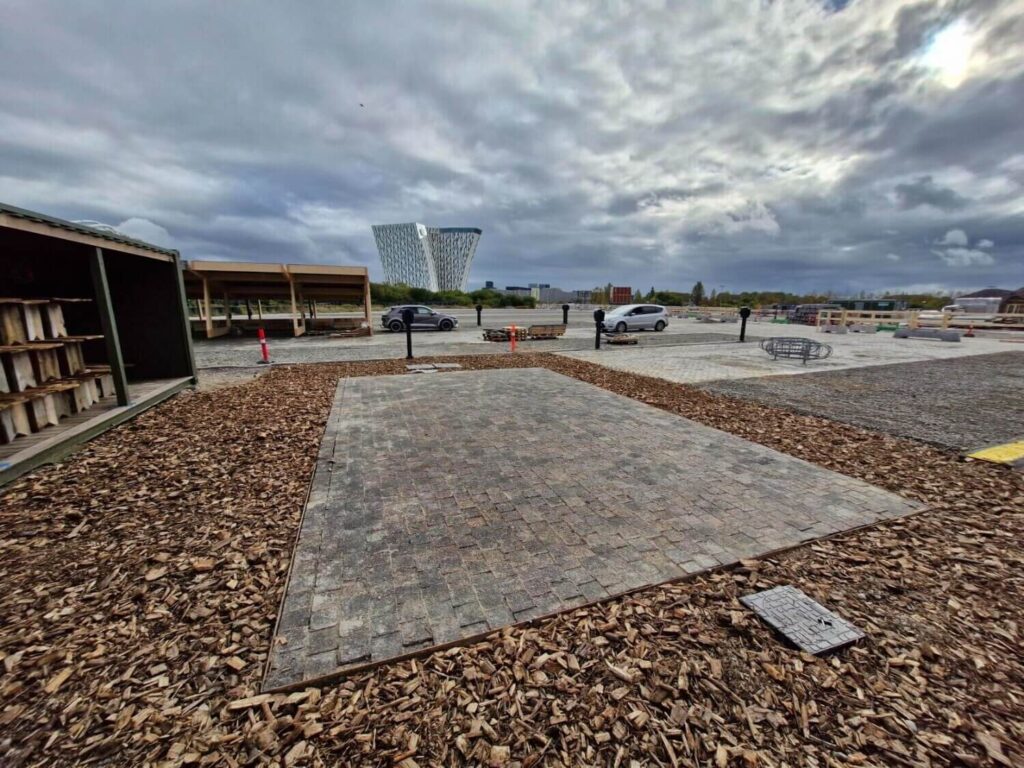
Cement is used to make concrete, which is among the most carbon-intensive building materials known today. Now, the traditional binder faces new competition. The Danish startup Visibuilt has developed a completely new type of paver bound together by the fungal root network – mycelium – which is a natural binder with great potential. These cultivated pavers are now being used for the first time at the Fælledby construction site in Copenhagen, following extensive testing.
Erling Thygesen, CEO of Fælledby, explains: “At Fælledby, we strive wherever possible to promote the green agenda. We want, both directly and indirectly, to help reduce the property sector’s significant climate footprint through testing and implementing new bio-based building materials.
In this context, experimenting with replacing cement or bitumen with a fungal root network as a binder fits perfectly with our ambitions to deliver the most climate-friendly district possible – both during construction and in later operations.”
The product, called visiPAVER, is the world’s first outdoor paver made with Visibuilt’s patent-pending binder, visiBINDER. Developed from the fungal root network mycelium, the binder makes it possible to produce pavers at low temperatures, without fossil resources or cement, and in a safe working environment.
“Today, infrastructure is produced in a highly carbon-intensive way. That’s why it makes a big difference to develop nature-based alternatives that can be manufactured locally,” says Line Kloster Pedersen, CEO and founder of Visibuilt.
“With visiPAVER, we demonstrate how our visiBINDER technology can replace conventional materials in construction projects – for example, concrete pavers. This is only the beginning: the potential goes far beyond pavers. Our technology is a platform that can strengthen supply security for future infrastructure projects.” adds Line Kloster Pedersen, CEO and founder of Visibuilt.
First installation at Fælledby
The new mycelium-based pavers are now being installed publicly for the first time at Fælledby – Copenhagen’s most ambitious district, aiming to use both recycled and bio-based building materials. Fælledby will comprise around 2,000 homes surrounded by nature on all sides. Here, visiPAVER will initially be used as a paving for a shared bicycle parking area.
A step toward natural infrastructure
With visiPAVER, Visibuilt takes an important step toward fossil-free infrastructure. The pavers show how new materials can perform well in practice while contributing to a more nature-integrated approach to urban development.
About Visibuilt
Visibuilt is a Danish startup founded in 2023 by CEO Line Kloster Pedersen. The company is developing the world’s first fungus-based binder for paving materials. The binder, visiBINDER, uses the root-like structure of fungi – mycelium – to create an alternative to fossil-based binders and cement currently used in infrastructure.
The invention has been widely recognized both in Denmark with a Danish Design Award and internationally with Norrsken Impact/100 list. The team consists of 17 employees and has established its headquarters, laboratories, and production facilities at the Danish Technological Institute and Alfa Laval Innovation House near Copenhagen.
Source
Visibuilt, press release, 2025-10-09.
Supplier
Share
Renewable Carbon News – Daily Newsletter
Subscribe to our daily email newsletter – the world's leading newsletter on renewable materials and chemicals