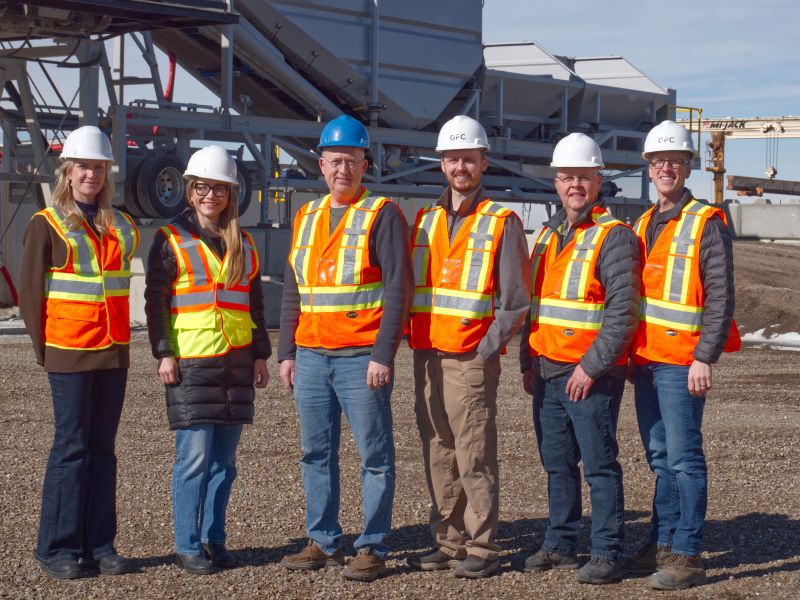
CURA Climate Inc. (CURA), a Canadian climate‑tech company developing electrochemical solutions to decarbonize cement production, today announced a strategic partnership with Grand Forks Concrete Ltd. (GFC), a leading precast concrete manufacturer in Western Canada. The partnership includes a formal agreement to jointly deploy both a pilot‑scale demonstration plant and a first‑of‑kind commercial facility to convert agricultural spent lime into low‑carbon cement and agricultural co‑products.
Under the Memorandum of Understanding (MoU), CURA and GFC will execute a three‑phase program–feasibility assessment, pilot demonstration, and commercial deployment–to demonstrate how spent lime from agricultural processing can be upgraded into low‑carbon cement and nutrient‑rich agricultural inputs. The partnership represents a major step toward closing material loops across construction, agriculture, and carbon management.
“Agricultural spent lime has long been treated as a liability,” said Erin Bobicki, CEO of CURA. “Together with Grand Forks Concrete, we’re building the first pilot and commercial facilities capable of producing low‑carbon ordinary Portland cement through electrochemistry – something that simply doesn’t exist anywhere today. It’s transformational for the circular economy and for the future of low‑carbon cement production.”
The collaboration aims to create the world’s first commercial platform capable of producing low-carbon cement and agricultural products from legacy industrial materials.
Turning Waste into Value
CURA’s patent-pending electrochemical process upgrades spent lime waste into low-carbon cement and agricultural products by selectively extracting high-value components and removing impurities. CURA’s technology uses electricity and water—rather than heat and fuel—to process materials. This approach not only partially electrifies the process of making cement, but enables an economically viable option to manage the CO2 emissions from cement manufacture.
The success of the pilot demonstration will unlock the path to the first commercial electrochemical cement plant—an industry‑defining facility capable of producing low‑carbon ordinary Portland cement at scale. The pilot will validate the technical, operational, and economic data required for commercial deployment, demonstrating that deep decarbonization of cement is both practical and cost‑competitive today. As demand for low‑carbon building materials accelerates across Canada, the commercial facility will provide the first broadly applicable, low‑carbon cement solution that integrates seamlessly into existing construction supply chains.
For Grand Forks Concrete, the partnership provides a pathway to locally sourced, low-carbon cement that integrates seamlessly into existing precast manufacturing operations, without requiring changes to downstream concrete production.
“This collaboration aligns perfectly with our commitment to innovation and sustainability,” said David Torrie, President of Grand Forks Concrete Ltd. “By working with CURA to build both a pilot plant and a commercial facility, we’re strengthening our supply chain and advancing a true circular economy—turning spent lime into high‑value cement and agricultural feedstocks that support a more resilient industrial system.”
Phased Pathway to Commercial Deployment
The partnership is structured across three phases:
- Phase 1 – Characterization and Feasibility: Laboratory and bench-scale testing to validate material performance, emissions reductions, and economic potential.
- Phase 2 – Pilot Demonstration and Product Qualification: A cost-shared pilot facility producing low-carbon cement and agricultural co-products for real-world testing and early revenue generation.
- Phase 3 – Commercial Deployment: Formation of a joint venture to design and operate a first-of-kind commercial facility converting spent lime into low-carbon construction materials and agricultural inputs at scale.
Building a Circular Future for Construction and Agriculture
Beyond emissions reductions, the CURA–GFC partnership demonstrates how climate technology can unlock new circular-economy pathways—connecting construction materials, agricultural productivity, and carbon management into a single integrated system.
“This is about more than cleaner cement,” added Bobicki. “It’s about redesigning industrial systems so yesterday’s waste becomes today’s feedstock—supporting farmers, builders, and communities at the same time.”
About Grand Forks Concrete Ltd.
Grand Forks Concrete Ltd. is a Western Canada–based precast concrete manufacturer serving infrastructure, commercial, and agricultural markets. GFC is recognized for its focus on innovation, quality, and sustainability in concrete manufacturing. Learn more at https://www.grandforksconcrete.com/
About CURA
CURA is a Canadian climatetech company developing electrochemical solutions to reduce CO2 emissions from cement production. Its CURALYTETM-powered electrolyzer cuts emissions by up to 85% while lowering energy use and cost. Designed as a retrofit-ready solution, CURA’s technology integrates with existing feedstocks, infrastructure, and operations. The company’s founders are seasoned climatetech leaders, with experience in scaling technologies to reduce the CO2 emissions of industrial operations. CURA works with partners globally to accelerate the decarbonization of the cement industry. Learn more at curaclimate.com.
Source
CURA, press release, 2026-03-10.
Supplier
Share
Renewable Carbon News – Daily Newsletter
Subscribe to our daily email newsletter – the world's leading newsletter on renewable materials and chemicals