 Consumer attitudes, the effectiveness of labels, and the potential of digital tools to support responsible consumption in the European bioeconomy
The EU-funded 3-CO project (Concise Consumer Communication through Robust Labels for Bio-based Systems) focuses on empowering consumers to make more sustainable choices by enhancing how bio-based products (BBPs) are labelled and certified. By developing actionable guidelines for label and certification scheme (LCS) owners, digital solutions to support consumer decision-making, and policy recommendations, 3-CO aims to improve the visibility, credibility, and uptake of sustainable products.
Recent reports, co-authored by Agnieszka Wiśniewska, explore consumer attitudes, the effectiveness of labels, and the potential of digital tools to support responsible consumption in the European bioeconomy.
In this interview, Agnieszka Wiśniewska from the University of Warsaw discusses the project’s latest research on consumer behaviour, the impact of labels and certifications in consumer behaviour, and the role of digital solutions in supporting responsible consumption.
1. Your publications “State-of-the-art report on consumer behaviour towards sustainable products” and “Report on the role of labels and smart solutions in supporting responsible consumption” show that many consumers find it difficult to recognise and trust labels on bio-based products. What are the main barriers, and how does the 3-CO project address these challenges?
First and foremost, our aim was to develop a robust understanding of the underlying causes of consumer difficulties in engaging with bio-based products, and how different consumer groups interpret information related to these products. To achieve this, the 3-CO project employed a three-phase methodology. Initially, we conducted a comprehensive literature review on sustainable consumption. This was followed by the design of a diagnostic tool for identifying consumer barriers, which was implemented in a quantitative survey across ten European Union countries, involving 3,000 respondents. Subsequently, we carried out in-depth focus group interviews in four countries and, finally, tested prototypes of digital decision-support tools with users. This approach allowed us to integrate statistical insights with an analysis of actual consumer behavior and perceptions.
The findings present a clear picture. Consumers generally lack awareness of what bio-based products are and report difficulty and time constraints in identifying such products on store shelves. Furthermore, part of them do not perceive any direct benefits associated with purchasing bio-based products. Regarding certification labels, not only is there a widespread lack of understanding of their meaning, but consumers also struggle to distinguish these labels from standard marketing claims. This is compounded by a significant issue: a pervasive lack of trust. Many consumers express concerns about so-called greenwashing, instances where environmental claims are not substantiated by actual company practices.
Additionally, a notable portion of respondents indicated that they do not experience any social or familial pressure to engage in sustainable consumption. And finally, even among those who wish to make more responsible choices, there is a clear absence of simple and effective tools to facilitate BBP purchasing.
The 3-CO project addresses these challenges on two fronts. First, we advocate for the simplification and standardization of labels to ensure clarity and comparability, particularly in the context of bio-based products. Second, we are developing digital tools, such as mobile applications, that enable users to scan a product and instantly receive a clear interpretation of its certification, tailored to their individual preferences. This cognitive and practical support is essential, as even the most environmentally conscious consumer requires a straightforward and trustworthy system to act in accordance with their values.
2.The report identifies three consumer segments: Passive Sceptics, Active Advocates, and Convenience Seekers. With regard to attitudes towards sustainability, how can label and certification schemes be tailored to better engage each of these groups and encourage more sustainable purchasing behaviour?
Segmentation was a critical component of the analysis. We identified three primary attitudinal profiles among consumers. Passive sceptics exhibit low trust in certification systems. They are typically poorly informed and reluctant to actively seek out information. In their case, communication strategies must rely on very simple, unambiguous labels, educational content based on clear and relatable examples, and tangible benefits. Active advocates, on the other hand, demonstrate high environmental awareness and are willing to engage with detailed information. For this group, it is essential to provide access to advanced data, such as carbon footprint, product life cycle assessments, or the social impact of production processes. The convenience-seekers segment prioritizes ease and speed in their decision-making. They require intuitive guidance, preferably in the form of mobile applications, visual recommendations, and ranking systems. Importantly, all three segments can be effectively engaged, provided that communication and tools are aligned with their respective decision-making styles.
3. The 3-CO project also explores the use of digital solutions, such as mobile apps, to support responsible consumption. What features or functionalities did consumers find most valuable in these digital tools, and how might they influence purchasing decisions in the bio-based sector?
Consumers responded very positively to the label-scanning feature. The ability to scan a QR code with a phone and instantly receive clear, concise information about a certification was perceived as both practical and trustworthy. They also appreciated the option to filter products based on sustainability criteria, personalize the results, and access ratings and reviews from other users. Simple, visually clear interfaces were especially valued, as well as educational features that help users understand the meaning of individual certifications. Social features also played an important role, such as the ability to share opinions, participate in product ratings, and engage with built-in gamification elements, which were particularly effective in increasing engagement among younger users.
4. Based on your findings, what practical recommendations would you give to bioeconomy stakeholders aiming to improve the visibility and credibility of bio-based products in the market?
The recommendations are wide-ranging: targeting businesses, public institutions, and civil society alike. We need to simplify eco-labels, reduce their number, and tailor messages to distinct consumer segments. Just as crucial are educational efforts on social media and campaigns that highlight the real, personal benefits of choosing bio-based products for health, for society, and for the environment. Civil society organizations should step up by offering practical educational tools, such as shopping guides or bite-sized e-learning formats, that work effectively in an environment of information overload and short attention spans, especially among younger audiences. It’s also vital to monitor label quality and prevent misuse. Transparent communication on this front is key to restoring trust and reducing fears around greenwashing. And finally – collaboration is essential. Public authorities, business, and civil society must work together to create a consistent, trustworthy, and user-friendly system for consumer information that truly empowers sustainable choices.
5. Looking ahead, how do you view the role of policy evolving in supporting better labelling and digital solutions for sustainable products? What policy measures and changes could make the biggest difference?
The role of public policy must evolve toward actively shaping the legal and operational framework for sustainable certification systems, as well as fostering the development of interoperable digital solutions. This is not a straightforward task under current conditions, as it requires harmonizing labelling standards across the European Union while accounting for the specificities of different product categories. There is no doubt that regulatory action is needed to eliminate vague or misleading labels and to promote transparent certification standards backed by public institutions. However, it is essential to ensure that certification does not become a financial burden for businesses that outweighs its benefits. The core idea behind certification is to validate and support responsible companies that engage in sustainable practices. For consumers, certifications should serve as trustworthy evidence and a practical tool for navigating the bio-based product landscape. For companies, they should act as a meaningful reward that recognizes real efforts aligned with the certified sustainability criteria.
6. Based on your experience co-creating digital solutions with consumers, what advice would you give to developers and designers working on apps or platforms for sustainable shopping?
When designing apps to support sustainable shopping, the guiding principles should be usability, clarity, and user segmentation. Such applications must be grounded in reliable, real-time data, and integrated with certification systems and public information sources to ensure transparency and trust. Gamification elements should play a supportive, not dominant role. Points systems, badges for eco-friendly purchases, educational quizzes, or rankings can be effective, but they must remain optional and non-intrusive, so as not to alienate more sceptical or conservative users. Importantly, gamification should be tied to tangible benefits, such as discounts or access to additional services.
Content and communication formats must be tailored to users’ lifestyles. Digitally active youth expect fast, essential information, microlearning formats work well here. In contrast, users less familiar with technology benefit from simplified interfaces with limited functionality. Meanwhile, sustainability-driven individuals seek depth and meaning, and appreciate features that allow them to actively contribute to sustainable development. Co-creation of content should not be overlooked. Building value through user engagement is key to success in a world of increasingly conscious consumers.
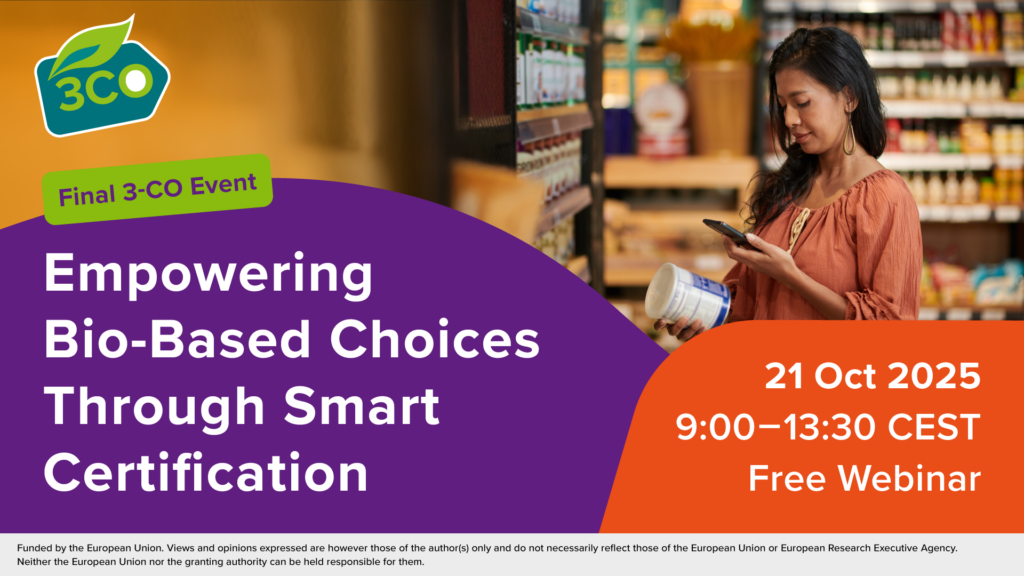
On 21 October 2025 from 9:00-13:00 CEST, the 3-CO project is hosting a final online-event present its achievements with plenty of international experts.
The event provides hot topic discussions on
- Labels and Certification
- Social Innovation
- Policy
- Consumer Perspectives

For more information on the EU-funded 3-CO project visit https://3co-project.eu.
Funded by the European Union. Views and opinions expressed are however those of the author(s) only and do not necessarily reflect those of the European Union or European Research Executive Agency. Neither the European Union nor the granting authority can be held responsible for them.
Source
3-CO, original text, 2025-08-13.
Supplier
nova-Institut GmbH
Uniwersytet Warszawski (PL)
Share
Renewable Carbon News – Daily Newsletter
Subscribe to our daily email newsletter – the world's leading newsletter on renewable materials and chemicals