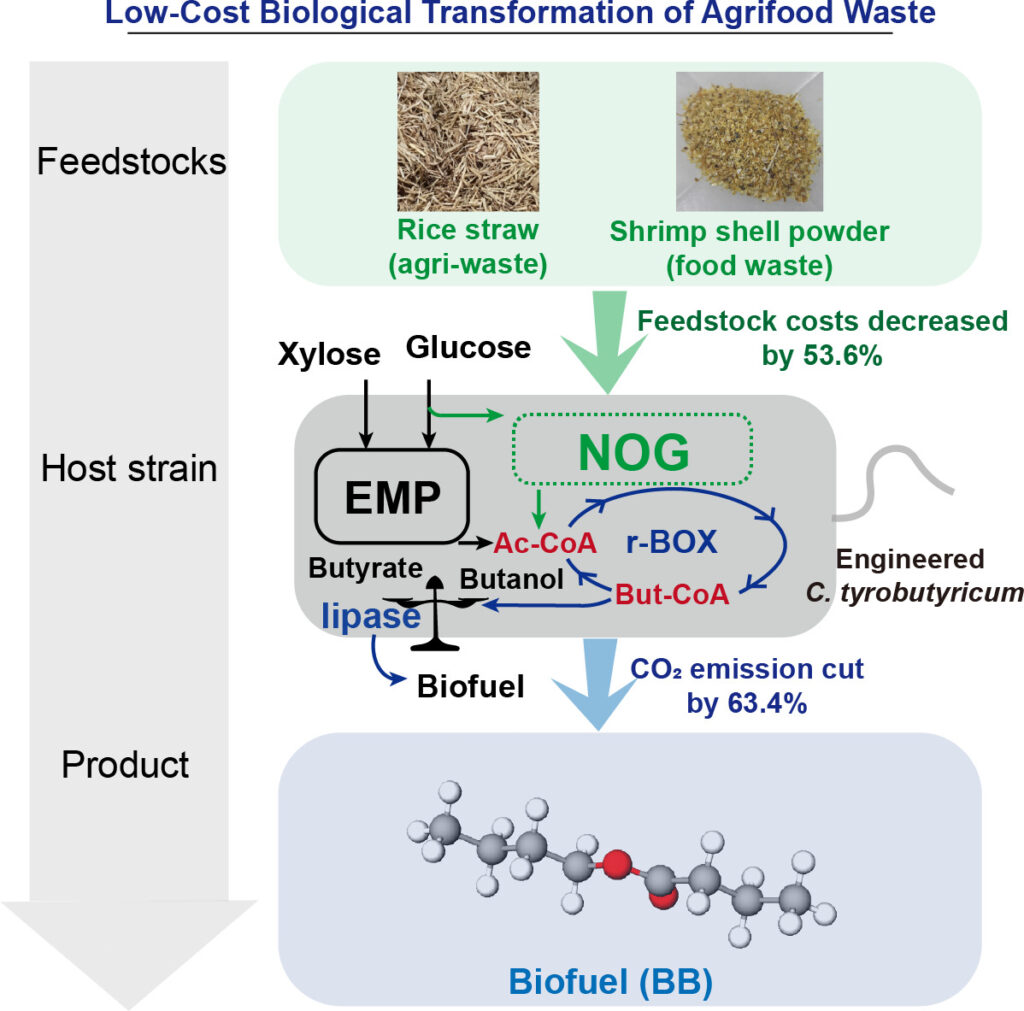
This study presents a carbon- and cost-efficient biosynthesis strategy for the biofuel butyl butyrate by engineering C. tyrobutyricum to utilize agrifood waste as the sole feedstock. Through iterative, multimodule strain engineering—including promoter engineering, multienzyme colocalization, nonoxidative glycolysis-driven carbon conservation, and cofactor engineering—high-titer butyl butyrate production with excellent selectivity was achieved in 5-l batch fermentations using only rice straw hydrolysate and shrimp shell waste, substantially reducing feedstock costs and life-cycle carbon emissions. The current Technology Readiness Level of this technology lies between 4 and 5. Several challenges remain before industrial implementation. The intracellular localization of lipase restricts access to extracellular precursors, necessitating the development of surface-displayed or secreted lipase systems to achieve complete esterification. Scaling up to industrial-scale fermenters requires optimization of process parameters such as pH control and extraction efficiency. Furthermore, upstream cellulase usage for rice straw hydrolysis accounts for the majority of greenhouse gas emissions, and developing low-cost, low-emission pretreatment technologies is essential. With advances in enzyme engineering and process intensification, this technology could progress toward Technology Readiness Level 6–7, enabling sustainable biomanufacturing of butyl butyrate from agrifood waste.
Highlights
An integrated multimodule engineering strategy was developed in C. tyrobutyricum for the high-efficiency de novobiosynthesis of the biofuel butyl butyrate.
A three-enzyme colocalization system, using self-assembling peptide tags and membrane-anchoring motifs, was designed to reduce precursor toxicity and enhance product efflux.
A nonoxidative glycolysis pathway, combined with deacylase overexpression, was introduced to conserve carbon by bypassing CO2-emitting steps.
A cost-effective fermentation medium, composed exclusively of rice straw hydrolysate and shrimp shell waste, was developed, substantially reducing feedstock costs and life-cycle carbon emissions.
Abstract
Microbial conversion of renewable feedstocks into biofuels is gaining interest due to its sustainability. In this research article, we develop a carbon- and cost-efficient fermentation route in Clostridium tyrobutyricum to produce the biofuel butyl butyrate (BB) from abundant, low-cost agrifood waste. Using iterative, multimodule strain engineering—promoter engineering, multienzyme colocalization, nonoxidative glycolysis-driven carbon conservation, and cofactor engineering—we achieved high-selectivity BB production from rice straw hydrolysate and shrimp shell waste. The best strain delivered a 49.5-fold improvement, reaching 31.16 g/l BB with 98.4% selectivity and a productivity of 0.325 g/l/h in 5-l batch fermentations. Techno-economic and carbon-footprint analyses indicate that, compared with conventional sugar biorefineries, agrifood-waste biorefineries cut feedstock costs by 53.6% and life-cycle carbon emissions by 63.4% per ton of BB produced. These results show that engineered C. tyrobutyricum enables carbon-efficient upcycling of agrifood waste into high-yield BB and provides a blueprint for the biosynthesis of other biofuels.
Author
Zhihan Yang (杨智晗), Zhenlei Liu (刘振磊), Chao Fang (方超), Yuxin Yang (杨雨欣), Chi Ren (任驰), Yingli Chen (陈盈利), Liying Zhu (朱丽英), Zhengming Zhu (朱政明), Ling Jiang (江凌), He Huang (黄和)
Source
Trends in Biotechnology, 2026-05-27.
Supplier
Share
Renewable Carbon News – Daily Newsletter
Subscribe to our daily email newsletter – the world's leading newsletter on renewable materials and chemicals