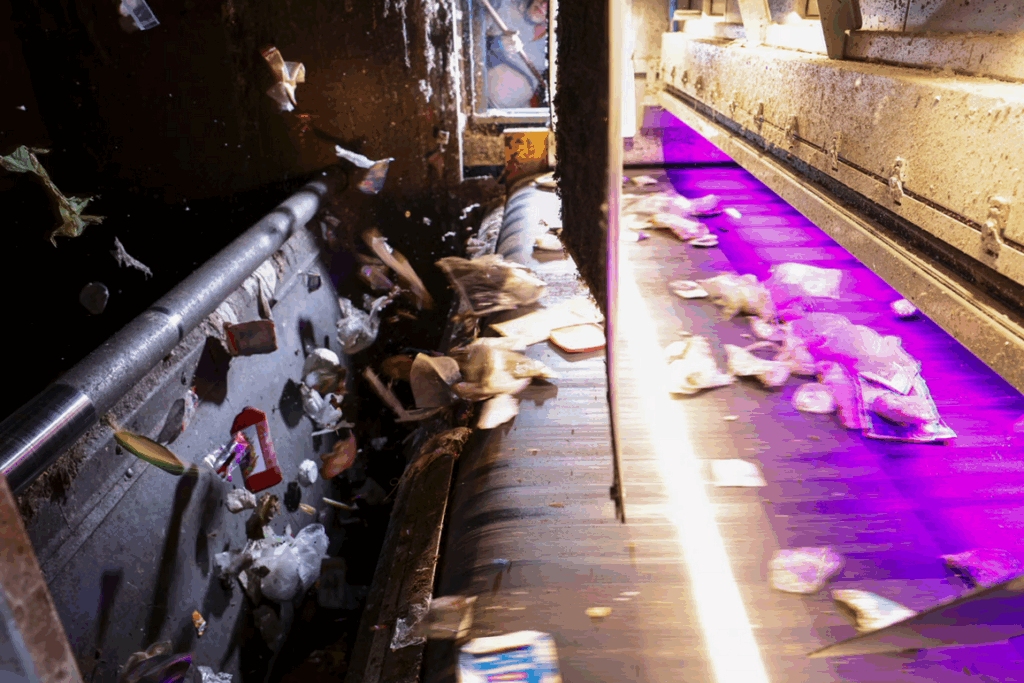
Belgium is the first country in Europe to launch a large-scale trial to recycle flexible food packaging – crisp bags, biscuit wrappers and plastic films – collected through the PMD bag (Belgium’s bag for plastic, metal and drink cartons) into new food packaging. For the project, food companies Mondelēz International, Ferrero, PepsiCo and pladis are working with Fost Plus, the organisation that coordinates the recycling and reuse of household packaging in Belgium. Thanks to imperceptible digital watermarks on the packaging, sorting machines can distinguish flexible food packaging — such as crisp bags or biscuit wrappers — apart from non-food packaging, such as the plastic film wrapped around a pack of diapers. This advanced sorting could bring the European target closer: from 2030, certain plastic food packaging wil need to contain at least 10 percent recycled plastic.
Belgian consumers won’t notice anything on the supermarket shelf, but the packaging of some of their favourite snacks now carries an invisible digital watermark. This smart piece of technology could make a significant difference to the way flexible food packaging is sorted and recycled.
Philippe Gendebien, Business Innovation Manager at Fost Plus: “It’s similar to a QR code, invisible to the naked eye, that carries information about what the packaging once held. When a package arrives at a sorting centre via the PMD bag, cameras on the sorting line can read that code and automatically send the package to the right waste stream. In other words: while we already sort packaging into 16 material streams today, this technology lets us add an extra step — also distinguishing between food and non-food packaging.”

Strict rules for food packaging
That distinction matters, because very strict rules govern the use of recycled plastic in food packaging in order to guarantee food safety. To date, only recycled PET — from drinks bottles or plastic trays, for example — may be used to make food packaging again, through conventional mechanical recycling.
Philippe Gendebien, Business Innovation Manager at Fost Plus: “The reason is that at least 95 percent of the PET packaging sorted from the PMD bag is originally food packaging too, which is why the recycled plastic made from it is also food-safe. For flexible packaging such as pouches and plastic films, this has been far more difficult until now, because today’s sorting-centre technology cannot separate flexible packaging that has held food from packaging used for non-food products. By adding this extra step with digital watermarks, we aim to help close the loop and turn crisp bags and biscuit wrappers back into food packaging too.”
.jpg)
New European targets

The technology is being tested as part of the European HolyGrail 2030 – Circular Packaging Consortium programme, a consortium of around 75 local, European, and global companies and organisations, facilitated by AIM (European Brands Association). Together they are exploring the potential of advanced sorting using digital watermarks, combined with new recycling technologies.
In Belgium, the sorting trials are led by Fost Plus. The sorted bales of film leave Belgium for the sorting centre of the German company Hündgen Entsorgung, which is fitted with special high-resolution cameras able to read the digital watermarks — thanks to technology developed by Digimarc and Pellenc ST. This is also the very first national trial in Europe involving flexible post-consumer packaging.
The initiative is part of the ambitions of the new European Packaging and Packaging Waste Regulation (PPWR), which requires plastic food packaging to contain at least 10 percent recycled material from 2030.
Philippe Gendebien, Business Innovation Manager at Fost Plus: “Belgium is already a frontrunner in packaging recycling, and with HolyGrail 2030 – Circular Packaging we are taking another step forward. We’re not testing the technology in a lab, but with packaging that consumers actually use and throw away. That’s the only way to find out whether it also works in the real world, where packaging can be creased, damaged or soiled. If the trial succeeds, it will open up new opportunities to help meet the European targets for recycled material in food packaging and to strengthen Belgium’s recycling chain even further.”
The recycling trials to produce food-safe recycled material will begin before the end of this year.
About Fost Plus
Since 1994, Fost Plus has been accelerating the transition to sustainable packaging management. The citizen is at the heart of an approach designed to prevent raw materials from becoming waste. To that end, Fost Plus sets up efficient structures to make correct sorting possible anytime and anywhere, works with some 5,000 members to improve packaging design with a view to better recycling, and rethinks the way we all handle (packaging) materials.
Fost Plus works closely with citizens, businesses, public authorities and experts to collect and recycle the household packaging placed on the market by its members. In doing so, the organisation fulfils its members’ Extended Producer Responsibility. 60 dedicated colleagues are committed to influencing behaviour so that the impact of the way we produce and consume on the environment stays as low as possible. By building sustainable material chains, Fost Plus contributes to a better society and a cleaner living environment for everyone.
Source
Fost Plus, press release, 2026-06-25.
Supplier
AIM - European Brands Association
Digimarc Corporation
Ferrero
Fost Plus
Hündgen Entsorgungs GmbH & Co
Mondelez International
Pellenc SA
PepsiCo
pladis
Share
Renewable Carbon News – Daily Newsletter
Subscribe to our daily email newsletter – the world's leading newsletter on renewable materials and chemicals