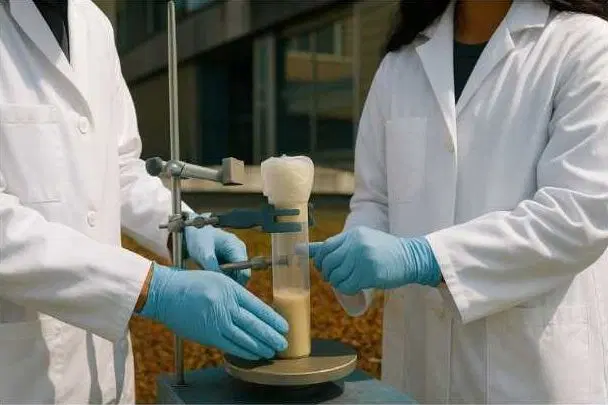
An international research team led by the University of Bayreuth has developed an innovative method for producing green hydrogen directly from seawater – without the use of additional reagents. The researchers report their groundbreaking findings in the prestigious Journal of the American Chemical Society.
Why it matters
As an emission-free energy carrier, green hydrogen is essential for decarbonising sectors such as transport, industry, and power generation – which is why demand is rising rapidly. Producing green hydrogen from seawater using sunlight and without the use of sacrificial reagents offers a particularly sustainable and environmentally friendly route to large-scale hydrogen production. This approach not only reduces operational costs and chemical waste, but also paves the way for a carbon-free hydrogen economy.
Unlike conventional hydrogen derived from fossil fuels, green hydrogen is produced without carbon dioxide emissions. The most common method is electrolysis, in which water is split into hydrogen and oxygen using clean electricity. However, electrolysis requires a significant amount of energy. A promising and resource-efficient alternative is offered by so-called photocatalytic processes, which use sunlight instead of electricity to split water. This involves light-active materials – photocatalysts – that absorb sunlight and provide the energy needed to drive the reaction. So far, methods for large-scale photocatalytic hydrogen production remain under development.
Recently, Professor Dr. Shoubhik Das, Chair of Organic Chemistry I at the University of Bayreuth, and his international team have succeeded in developing a photocatalyst capable of clean hydrogen production directly from seawater.
“Our research has produced the first nickel-based photocatalyst that can split seawater directly under sunlight – without any sacrificial reagent or co-catalyst. It achieves hydrogen production rates that surpass most single-component systems studied to date,” says Das.
In addition, the photocatalyst is resistant to corrosion by chloride – which is present in high concentrations in seawater – and is unaffected by other seawater constituents.
The development of this innovative photocatalyst marks a significant step towards a sustainable energy future. By enabling clean hydrogen production directly from seawater using sunlight, it contributes to the transition to sustainable, carbon-free energy systems and reduces dependence on fossil fuels.
Source
Seawater to Sustainable Fuel: Sunlight-Driven Green Hydrogen Generation with an Atomically Dispersed Photocatalyst. Satyadeep Waiba et al. Journal of the American Chemical Society (2025). DOI: https://doi.org/10.1021/jacs.5c11004
Contact

Prof. Dr. Shoubhik Das, Chair of Organic Chemistry I
Tel.: 0921 / 55-2671
E-Mail: shoubhik.das@uni-bayreuth.de
Source
University of Bayreuth, press release, 2025-11-14.
Supplier
Share
Renewable Carbon News – Daily Newsletter
Subscribe to our daily email newsletter – the world's leading newsletter on renewable materials and chemicals